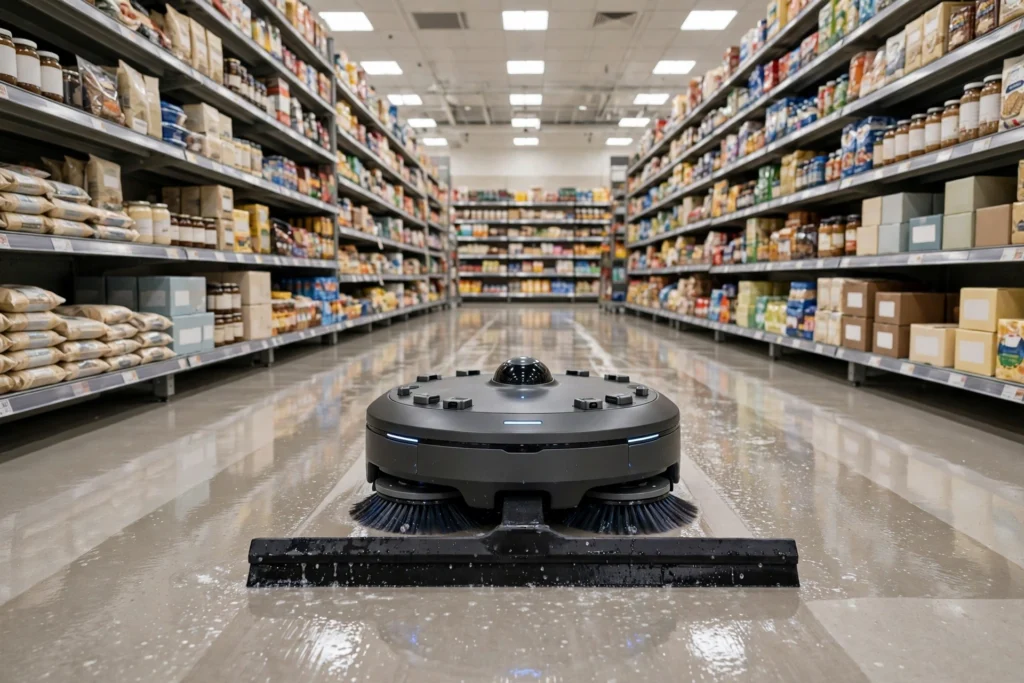
Floor scrubbing robots work by driving over a hard floor while spraying water, scrubbing with a spinning brush, and vacuuming the dirty water back up through a squeegee — all in one pass. Sensors and a stored map steer them around shelves and people, and they return to their dock to charge when the battery or water runs low.
Key Takeaways
- A floor scrubbing robot washes, scrubs, and dries a hard floor in a single pass.
- Two tanks keep clean and dirty water apart: one feeds the brush, the other collects what the squeegee picks up.
- Lidar, cameras, and bump sensors build a map and steer the robot around people and shelves.
- They suit large, flat floors in supermarkets, airports, warehouses, and hospitals — not carpets or cluttered rooms.
- Staff still handle setup, tank emptying, and the edges the robot cannot reach.
What is a floor scrubbing robot?
A floor scrubbing robot is a self-driving cleaning machine built for big hard floors: a small, slow vehicle with a water tank, a spinning brush, and a vacuum under its body. Supermarkets, airports, hospitals, and warehouses use them to keep thousands of square metres clean without someone pushing a machine all day.
They are bigger and heavier than the robot vacuums many people have at home. A home vacuum only picks up dust, while a floor scrubbing robot does a wet clean: it lays down water, scrubs the dirt loose, and sucks the dirty water away, leaving the floor nearly dry.
How does the cleaning cycle work?
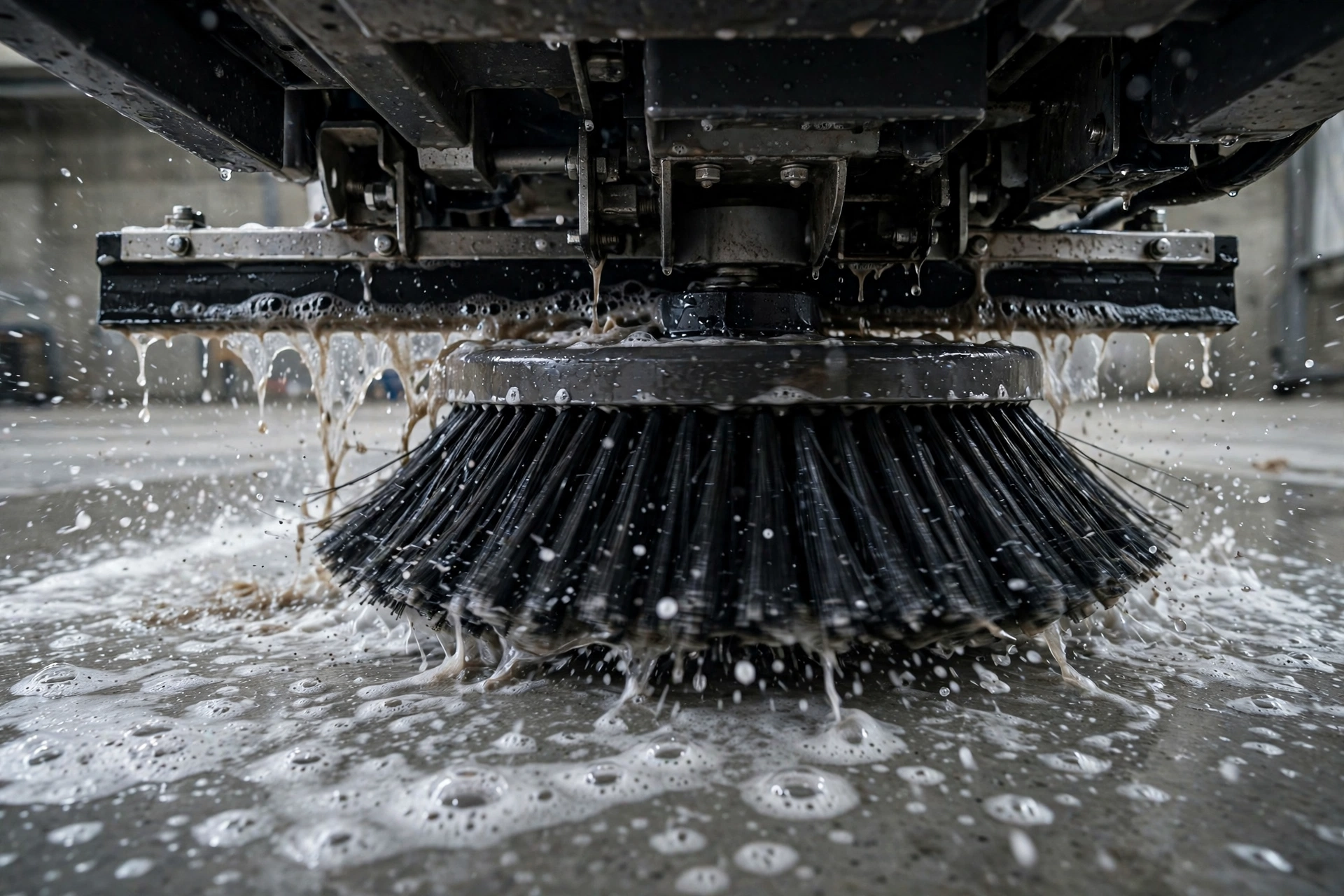
The cleaning cycle has four steps, and they all happen at once as the robot moves forward. First, a pump sprays water mixed with a little cleaning solution onto the floor, just ahead of the brush.
Next, the brush does the real work. Most robots use a round disk brush that spins fast, pressing a pad or bristles against the floor to lift grime and dried spills. Some use a cylindrical brush that rolls like a rolling pin and suits rougher floors.
Then comes the squeegee, a curved rubber blade at the back. It acts like a windscreen wiper, gathering the dirty water into a neat line, and a vacuum motor pulls that water into the recovery tank. Separate tanks mean the robot never scrubs with water it just picked up, and the floor behind it stays damp rather than wet.
How does it find its way around?
A floor scrubbing robot needs to know where it is, where it has cleaned, and what is in its path. Most do this with a mix of sensors. A spinning lidar unit on top fires laser beams around the room and measures how long they take to bounce back, building a map of walls, shelves, and doorways.
Before the first run, a worker drives the robot around once so it can learn the layout. The robot saves that map and plans neat, overlapping lanes across it. It tracks its position as it goes, so it does not clean the same strip twice or skip a corner.
When a person steps into its path, the robot slows down or stops, waits for the way to clear, and then carries on. If an aisle is blocked, many models can re-plan around the obstacle.
What happens when the water runs out?
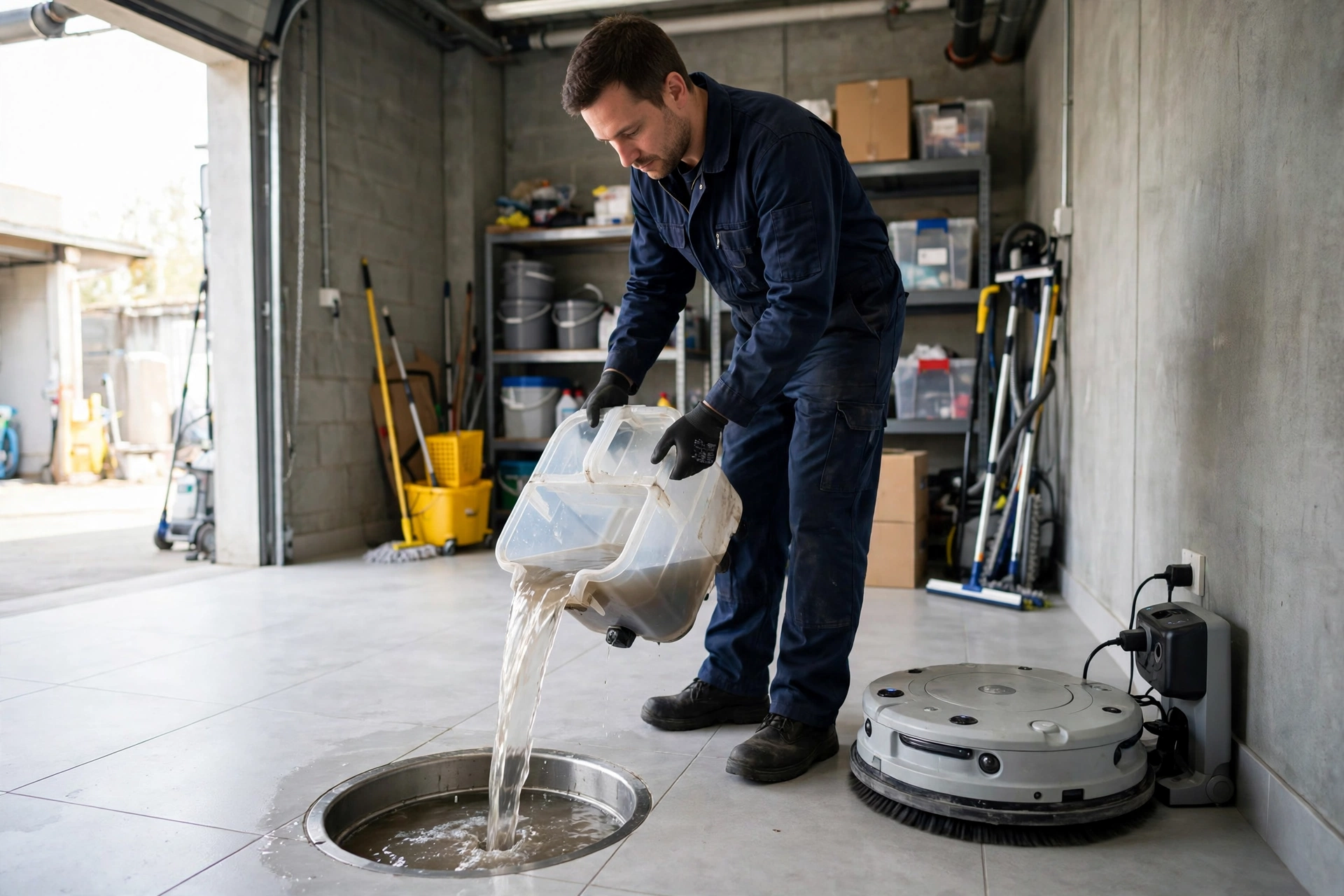
A floor scrubbing robot can only clean for as long as its tanks and battery allow. When the solution tank runs low, or the recovery tank fills up with dirty water, the robot stops cleaning and heads back to its dock.
At the dock, a worker empties the recovery tank down a drain, rinses it out, and refills the solution tank with fresh water and cleaning solution. The brushes and squeegee get a quick rinse too, and the robot charges its battery at the same time.
Where are floor scrubbing robots used?
Supermarkets were one of the first places to adopt them, because the floors are huge, flat, and cleaned every night. Airports use them in terminals, where a robot can work through the quiet hours and keep walkways safe. Hospitals value the steady, even clean they give to corridors and wards.
Warehouses and factories are another natural home. Their concrete floors collect dust, tyre marks, and packaging scraps, and a scrubbing robot can run after hours without getting in the way of forklifts — the same floors where warehouse robots move stock between shelves. Schools, shopping centres, and sports halls use them for the same reason. The airport robots that already help passengers show how comfortable public spaces have become with machines working nearby.
What are their limits?
Floor scrubbing robots are good at open floors, and honest about what they cannot do. They cannot climb stairs, clean carpets, or reach into tight corners and under low shelves — a worker with a mop still handles edges, doorways, and spills that need attention right away. They are also no use in water: a pool cleaning robot works underwater, which is a different job entirely.
They also struggle with clutter. A floor covered in boxes, cables, or loose stock forces the robot to stop and wait, or to skip whole sections. That is why they work best with a clear nightly routine: staff tidy the floor first, then the robot runs.
Cost is another limit. A commercial scrubbing robot costs far more than a mop and bucket, and it needs regular care — new brushes, new squeegees, and clean tanks. For a small shop with one room, that rarely makes sense; for a building with thousands of square metres of floor, the same machine can clean every night without getting tired.
Frequently Asked Questions
Are floor scrubbing robots safe around shoppers?
Yes. They move slowly, stop when someone steps in front of them, and leave the floor nearly dry. Most sites still run them at quiet times.
Do floor scrubbing robots replace cleaners?
No — they change the job rather than remove it. The robot handles the long, repetitive passes across open floor, while staff set it up, empty the tanks, and clean the edges it cannot reach.
How long does a floor scrubbing robot run on one charge?
It depends on the machine, but many commercial models run for a few hours — usually enough for a full night shift.
Can a floor scrubbing robot clean carpets?
No. Scrubbing robots are made for hard floors such as tile, concrete, and vinyl. Carpets need a vacuum or a carpet extractor, and a wet scrubber would only soak them.
Do they work on rough or damaged floors?
They cope with mildly rough concrete, especially with a cylindrical brush, but cracked or uneven floors can trip up the squeegee and leave water behind. A floor in poor repair should be fixed first.
Conclusion
Floor scrubbing robots combine four simple jobs — spraying, scrubbing, squeegeeing, and vacuuming — with sensors and a map that cover a big floor on their own. They are not a replacement for cleaners, but they take over the most repetitive part of the work.
If you manage a large building, the practical next step is to walk the floor and check three things: is it mostly open and flat, is it a hard surface, and can it be kept clear at cleaning time? If the answer is yes to all three, a floor scrubbing robot is worth a closer look. For background, the Britannica guide to robotics explains how robots sense and move, and the Wikipedia page on floor scrubbers covers the different brush and machine types in more detail.