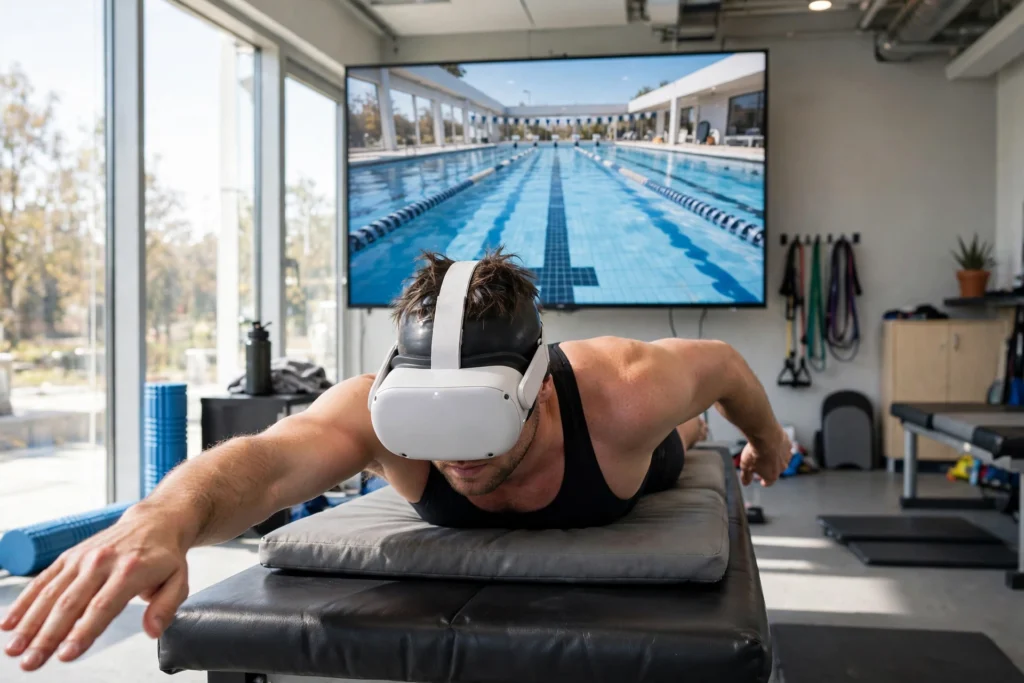
VR swimming training lets swimmers practise strokes, turns and breathing on dry land, inside a virtual pool. Wearing a headset, the swimmer sees a first-person view of the water while lying on a bench, and the system tracks arm and body movements to give instant feedback on technique.
Key Takeaways
- VR swimming training recreates the sights and movements of swimming without a pool, using a headset, motion tracking and a bench.
- It works best for learning stroke patterns, timing and breathing, and for building confidence before getting into real water.
- It cannot replace real swimming: there is no water resistance, buoyancy or breath control under water.
- Short, focused sessions with a coach work better than long, unguided ones.
How does VR swimming training actually work?
The swimmer puts on a VR headset and lies face down on a padded bench, sometimes called a swim bench. Some setups add hand controllers or small sensors on the wrists and ankles. The headset shows a virtual pool from the swimmer’s own point of view: lane ropes, the waterline, the wall ahead and, in some systems, a ghost image of the swimmer’s own arms moving through the stroke.
As the swimmer pulls through the air, motion sensors track the arms, head and body. The software compares that movement with a model of good technique and flags what needs fixing — a dropped elbow, a late breath, a kick that starts from the knee instead of the hip. Because the swimmer can see the stroke from inside it, the link between a mistake and its fix feels immediate.
Early research is promising. A 2025 study in BMC Sports Science, Medicine and Rehabilitation found that 55 novice swimmers who watched first-person 3D swim videos in a headset before pool lessons improved their distance per stroke and kick more than those with traditional lessons alone. It is early evidence, not proof that VR alone teaches swimming.
What does a VR swimming session look like?
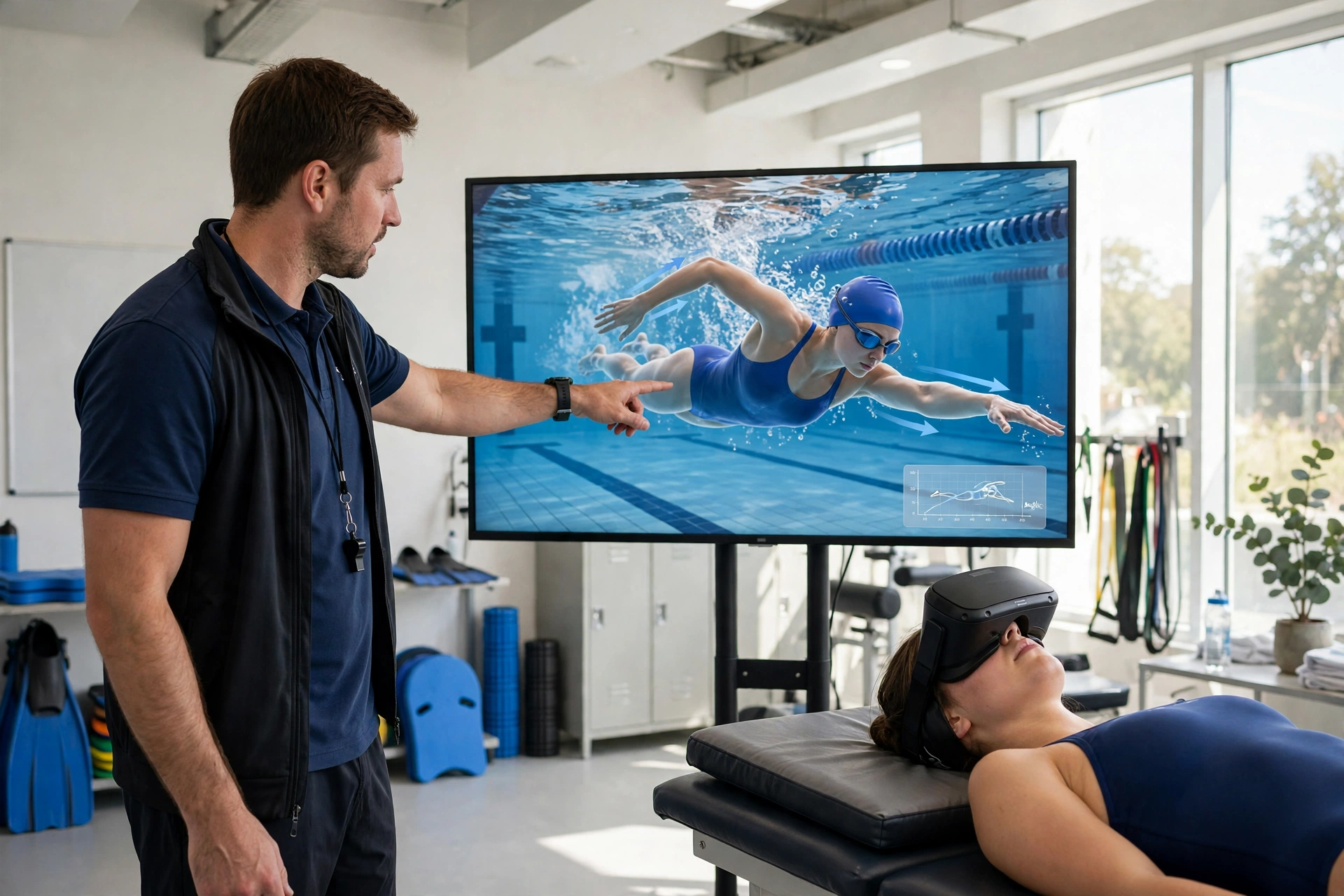
A typical session lasts 20 to 30 minutes: the swimmer first watches a slow-motion model of the stroke, then practises short sets of 10 to 20 strokes on the bench while the system gives live feedback on arm path, head position and breathing timing.
Coaches often pause to replay a stroke from a different angle, so the swimmer can see what their arms were actually doing. The headset stays dry throughout, which is the whole point: the swimmer is learning the shape of the movement, not fighting the water at the same time.
Can VR swimming training teach a complete beginner to swim?
Not on its own. VR can teach a beginner what the movements look and feel like, and it can help someone who is nervous about water to practise breathing and arm patterns in a safe, dry room. But swimming also needs balance in the water, floating, breath control while the face is submerged, and the feeling of water pushing back against the hands. None of that exists in a headset.
What VR does well for beginners is the step before the pool. A nervous learner can rehearse the freestyle arm cycle and practise turning the head to breathe until the setting feels familiar. Research on 360-degree VR videos for water safety found the same pattern with children: the virtual version builds understanding and lowers anxiety, while real water time builds the actual skill.
Which strokes and skills work best in VR?
Freestyle benefits most, because its arm cycle is long, repetitive and easy to track with sensors. Backstroke works well too, since the swimmer is face up and the headset stays clear of the bench. Breaststroke and butterfly are harder to simulate on a bench: breaststroke needs the legs to sweep wide, and butterfly needs a full-body wave that a flat bench cannot really support.
Turns are another good fit: a swimmer can rehearse a flip turn in slow motion, watching the wall approach in the headset. Breathing drills are one of the strongest uses, because the headset can show exactly when to turn the head and when to exhale.
What are the limits of VR swimming training?
The biggest limit is the missing water. On a bench, the arms move through air, so there is no resistance to pull against. A stroke that looks right in VR can still fall apart in a pool, because the timing of the catch — the moment the hand grips the water — can only be learned in water.
Motion sickness is a real problem for some users, especially when the virtual view moves faster than the body. Sessions are usually kept short for that reason, and anyone who feels dizzy should stop and take the headset off. Cost is another limit: a good setup needs a headset, sensors, a bench and software, which puts it out of reach for most home swimmers, though clubs and training centres are starting to share the equipment. Finally, VR cannot teach water safety. Knowing the strokes is not the same as knowing what to do if you get tired or pulled under, and that judgement only comes from supervised time in real water.
Who benefits most from VR swimming training?
Beginners and nervous swimmers get the most from it, because it lets them learn the movements and build confidence without the pressure of staying afloat. Competitive swimmers use it differently: to study their stroke in slow motion and practise race-day visualisation. Coaches use it to show a swimmer what a correction should feel like, instead of only describing it from the poolside.
It is also useful for swimmers coming back from injury. Someone with a shoulder problem can rehearse the arm pattern at low effort, with the system watching for compensations, before they are cleared to swim full sessions. For a broader look at how headsets support athletic practice, see our guide to VR sports training.
What equipment do you need, and what does it cost?
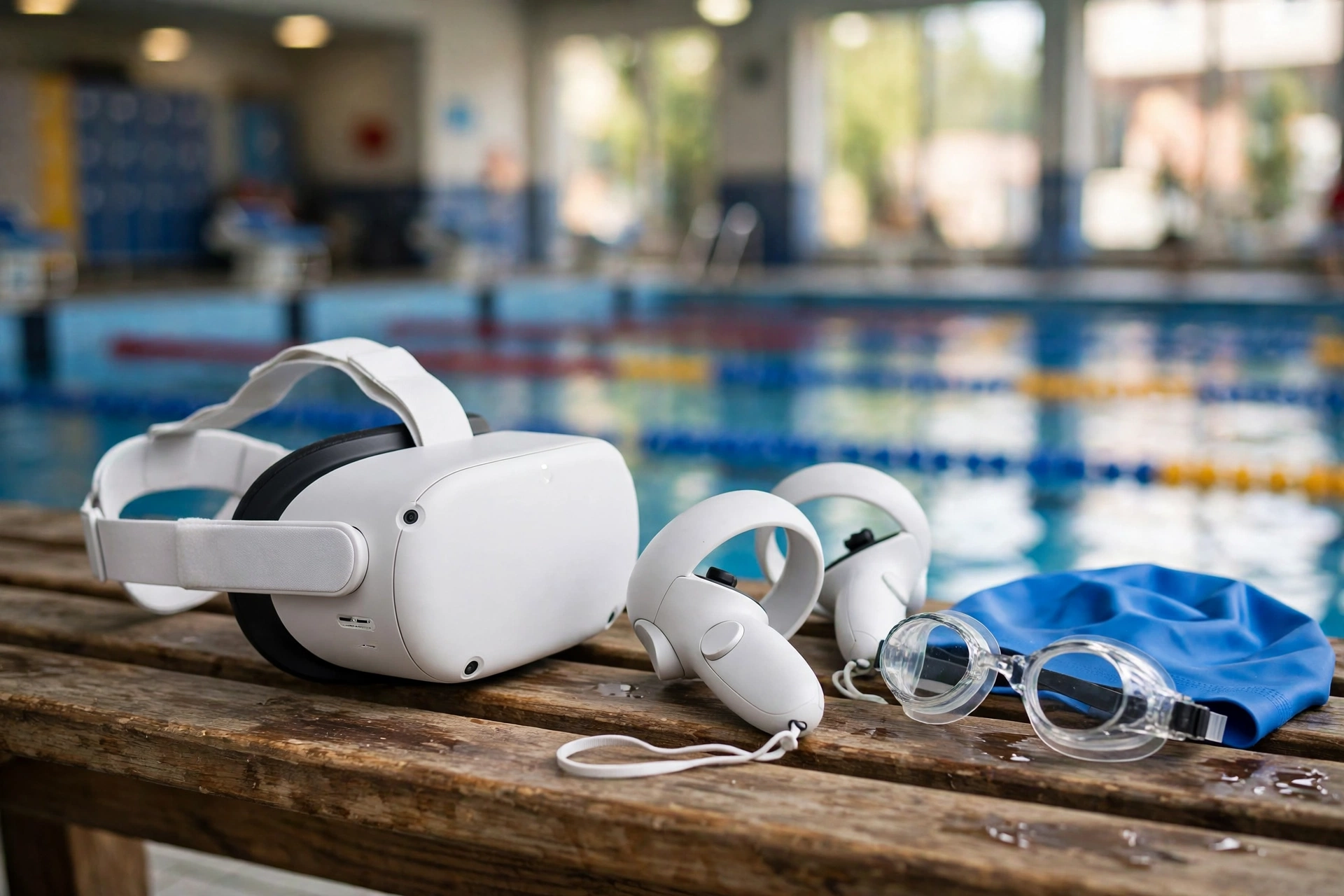
A basic setup has three parts: a VR headset, a tracking system and a bench — usually a padded, slightly tilted frame that supports the chest and hips while the arms swing free. Standalone headsets are the most common choice, because they need no separate computer and track the hands with built-in cameras.
The software varies most. Some apps simply show first-person swim footage in 360 degrees; others are full simulators with live feedback, stroke scoring and drill libraries. A standalone headset costs roughly what a mid-range phone does, while a dedicated system costs far more and is usually bought by clubs. For most swimmers, the sensible route is to try a session at a club before spending anything. Our guide to VR headsets explains the hardware, and VR fitness apps can help with conditioning between pool sessions.
Is VR swimming training safe?
For healthy adults, short sessions are generally safe, but a few precautions matter. Clear the floor around the bench before putting the headset on, because you cannot see the room while you are in it. Stop if you feel dizzy or nauseous. People with epilepsy or severe balance problems should check with a doctor first, and children should only use a headset under adult supervision.
Never use a VR headset in or near a real pool. Headsets are not waterproof, and a swimmer wearing one in water cannot see hazards or hear warnings. VR swimming training is a dry-land activity, and it should stay that way. Swimmers recovering from injury should follow their clinician’s advice on when to return to full training. For more on how VR is used in recovery work, see our guide to VR physical therapy.
FAQs
Can you learn to swim using only VR?
No. VR can teach movement patterns, timing and breathing, and build confidence, but it cannot teach balance, floating or breath control in water. Real pool time with a qualified instructor is essential.
How long should a VR swimming session last?
About 20 to 30 minutes is enough. Short, focused sessions with clear goals work better than long ones, and also reduce the chance of motion sickness and tired shoulders.
Does VR swimming training help competitive swimmers?
It can, mainly as a technique tool. Competitive swimmers use it to study their stroke in slow motion, practise race visualisation and rehearse turns. It is a supplement to pool training, not a replacement for it.
What is the best VR headset for swimming training?
There is no single best headset, and the software matters more than the hardware. A standalone headset with good hand tracking is a practical starting point, and the training app should offer live feedback and drill libraries rather than just video playback. Try a session at a club first if you can.
Can children use VR for swimming training?
Children can use VR swim apps under adult supervision and for short sessions. But children should always learn to swim with a qualified instructor in a real pool, and VR should never be presented as a substitute for that.
Conclusion
VR swimming training is a useful extra tool, not a shortcut. It lets swimmers see their stroke from the inside, practise on dry land and build confidence before they get wet, and early research suggests beginners who combine it with pool lessons can learn faster. Its limits are just as clear: no water resistance, no buoyancy and no substitute for real water time. If you are curious, book one session at a club or training centre, bring the stroke you most want to fix, and see whether the feedback matches what your coach already tells you. If it does, VR has earned a place in your training week — beside the pool, not instead of it.