
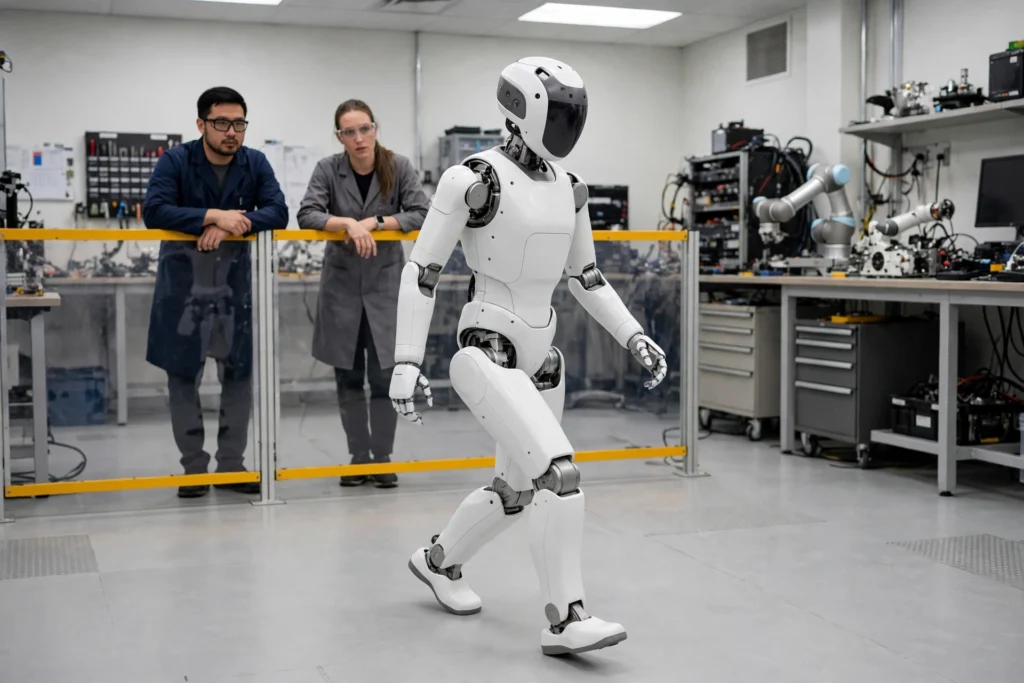
Robots learn to walk by combining balance sensors, joint motors, and step patterns called gaits, then practising those steps thousands of times in simulation before trying them on a real floor. No robot is born knowing how to walk; every step is planned, measured, and corrected in a fraction of a second.
Key Takeaways
- Walking robots sense tilt and pressure, then shift weight before tipping.
- A gait is the repeating step pattern a robot uses; the right one depends on leg count.
- Motors at the hips, knees, and ankles lift, swing, and place each foot.
- Most walking robots practise in simulation first, so mistakes happen safely on screen.
- Falling is part of the process: good robots fall safely and get back up.
What does it mean for a robot to walk?
Walking sounds simple until you try to build it: a robot must lift one foot without falling, move it forward, place it, then do the same with the next foot — all while its body keeps moving. People do this without thinking; a robot must calculate every part.
The core problem is balance. At any moment, some feet are grounded and some are in the air, and the robot’s weight must stay over the grounded feet, or it tips. Wheeled robots skip this problem, which is why warehouses are full of them — but legs can climb stairs and cross rough ground that stops a wheel.
How do robots keep their balance?
A walking robot senses where it is with a small set of sensors. An inertial measurement unit, or IMU, combines an accelerometer and a gyroscope to sense tilt and rotation, while force sensors in the feet report how hard each foot presses down. Together, they tell the robot whether it is leaning, slipping, or standing steady.
The controller reads those sensors many times per second and makes tiny corrections. Leaning left? It shifts its hips right or takes a wider step. A foot lands on a slope? The ankle adjusts so the sole stays flat.
What is a robot gait, and why does it matter?
A gait is the repeating pattern in which a robot moves its legs: which feet lift, in what order, and for how long each stays down. The right gait depends on leg count.
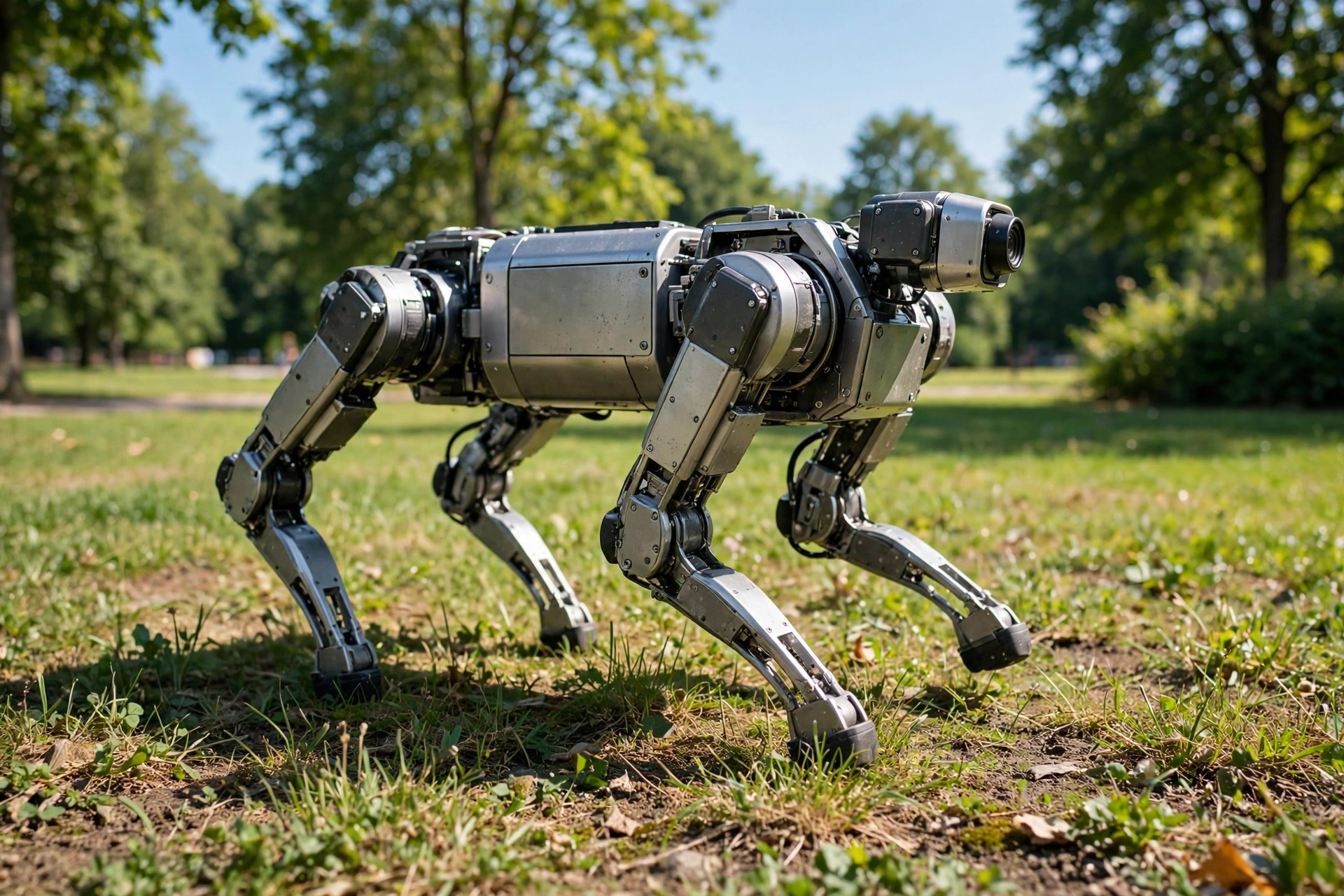
Two-legged robots use gaits that look familiar — one foot at a time, with a brief moment where both feet touch the ground. This is the hardest walking to control, with a moment balanced on a single foot. Four-legged robots have an easier time: at slow speeds they move one leg at a time on a stable tripod, and faster they switch to a trot, moving diagonal pairs together. Choosing a gait is a compromise between speed, stability, and energy use, and good robots switch gaits as conditions change.
How do motors and joints move a walking robot?
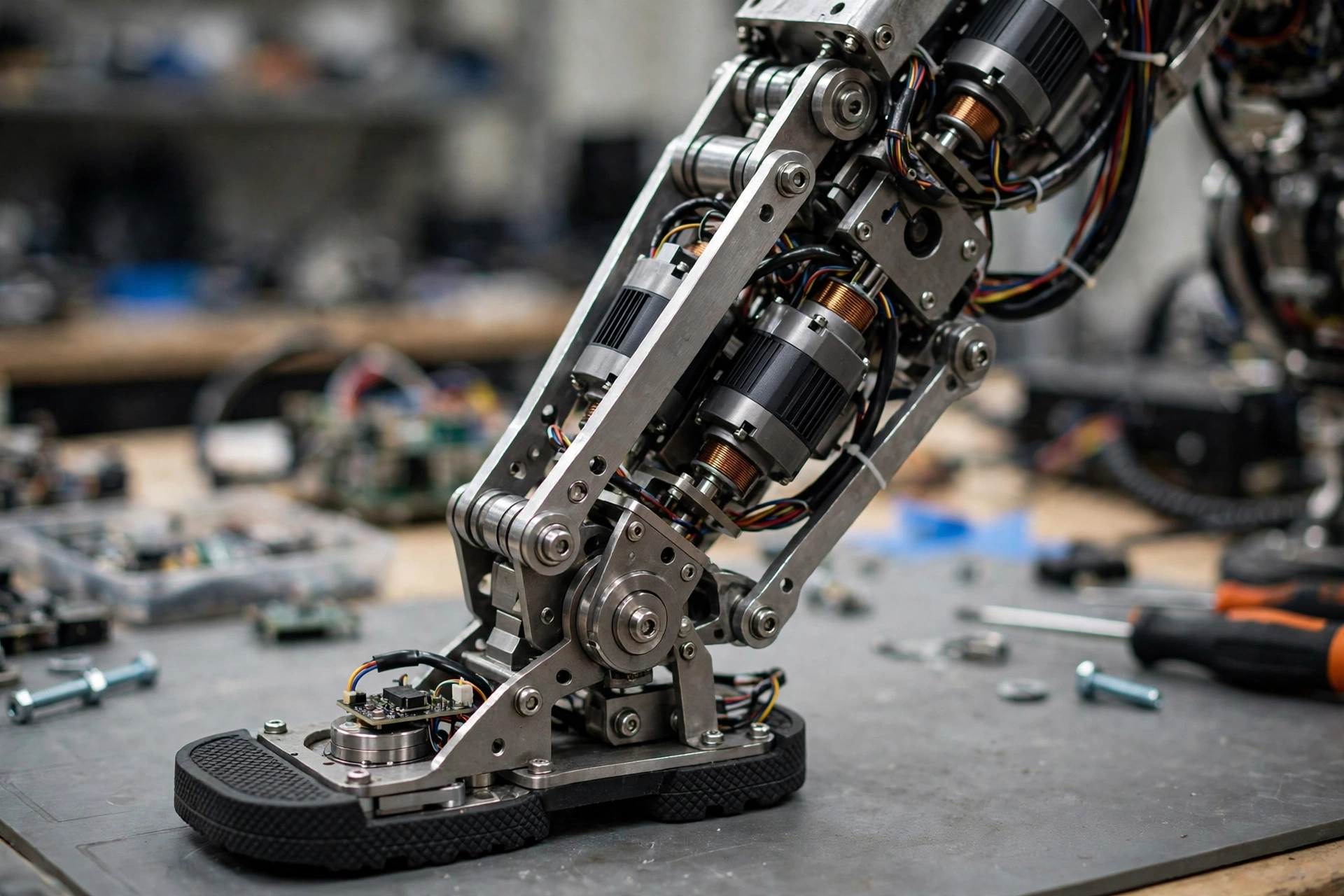
Each leg is a chain of joints — hip, knee, and ankle on a two-legged robot — and each joint has a motor, strong enough to lift the robot’s weight and precise enough to place a foot within millimetres of its target.
Most walking robots use electric motors with gearboxes, which trade speed for torque. The controller tells each motor how far to turn and how much force to apply, updating many times per second. When a foot strikes the ground, the motors absorb the impact and stiffen the leg to take the weight.
How do robots practise walking before they walk for real?
Almost no walking robot learns its first steps on a real floor. Instead, engineers build a physics simulation — a virtual copy of the robot and its environment — and let the robot practise there, where a fall costs nothing and thousands of step patterns can be tried in the time one real test would take.
Some practice uses reinforcement learning, where the robot is rewarded for staying upright and moving forward, and penalised for falling. Over many simulated attempts, the controller discovers which movements work. The result is then transferred to the real robot with careful tuning, because simulations never match reality exactly. Engineers often start a new robot on a treadmill or with a safety harness overhead, then make the terrain harder.
What happens when a walking robot falls?
Falling is not a failure of the whole idea; it is a normal part of walking on legs. What matters is what the robot does next. Well-designed robots detect a fall early — the sensors see the tilt growing faster than the motors can correct — and switch to a protective routine: tucking the limbs in, cutting power to the motors, and protecting the head and sensors. Some robots can roll back to their feet alone; others need a person to stand them up. The data from each fall feeds back into the next round of practice.
Where are walking robots used today?
Walking robots already work where wheels struggle. Four-legged robots inspect industrial sites, climb stairs in power plants, and patrol rough terrain. Humanoid robots are being tested in warehouses and labs, where stairs make legs useful, and rescue teams have trialled them for searching rubble, where broken ground stops wheels.
The most visible walking robots are the four-legged ones used for inspection and survey work, because their stability makes them reliable. Two-legged humanoid robots are catching up but are still mostly in testing. Costs are falling, so walking robots will likely appear in more everyday settings over time.
Frequently Asked Questions
Can robots walk as well as humans?
Not yet. People recover from trips without thinking and use very little energy. Robots are improving fast, but they still fall more often and use more power.
Why do most robots have wheels instead of legs?
Wheels are simpler, cheaper, and more energy-efficient on flat floors. Legs only win on rough, stepped, or cluttered ground — which is why warehouses use wheels and inspection robots in rough terrain use legs.
How long does it take a robot to learn to walk?
In simulation, a walking controller can be trained in hours or days. Transferring that skill to a real robot takes longer, as engineers must tune it for real motors, sensors, and floors.
Are walking robots safe around people?
They are designed to be, with speed and force limits and fall routines, but they are still tested away from people until they prove reliable — and should never be approached until operators say so.
Conclusion
Robots learn to walk the way a careful student learns anything difficult: by sensing what is happening, correcting mistakes quickly, and practising safely before performing for real. To see the pieces in action, look at how robot arms coordinate their joints, how humanoid robots put two-legged walking to work, and how warehouse robots move differently to solve the same problem. The wider field of robotics brings these ideas together, and the legged robot overview and general robotics reference explain the principles in more depth. The practical next step is simple: next time you see a video of a walking robot, watch its feet, not its head — the steps, the pauses, and the recoveries will show you exactly how it learned to walk.