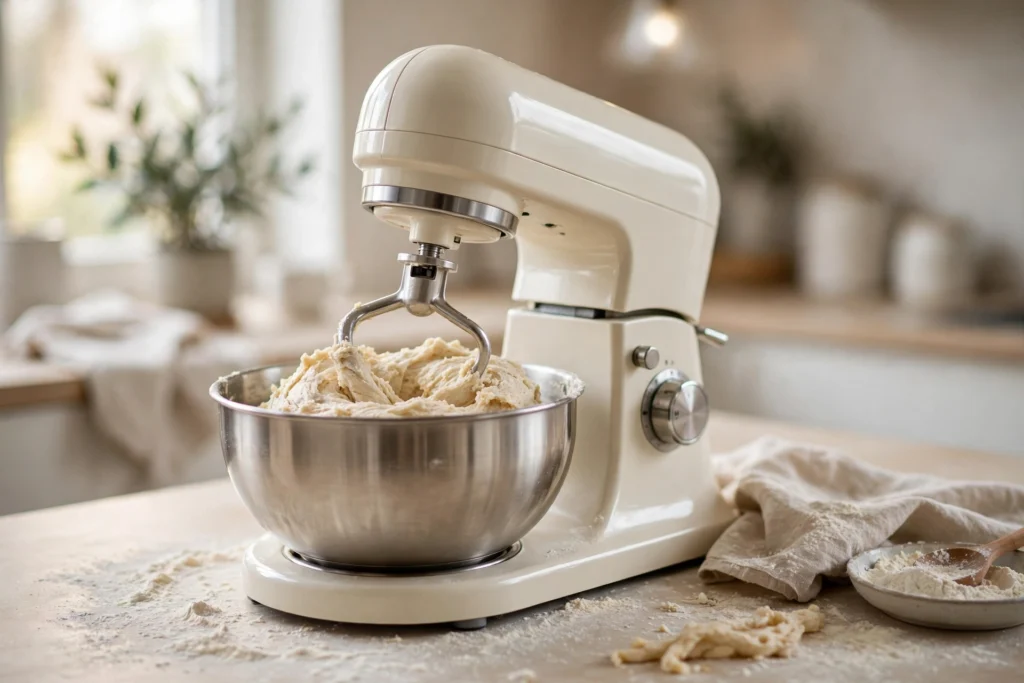
A stand mixer works by turning a motor’s fast spin into slow, strong, circular mixing. Gears inside the head cut the motor speed and boost its force, then drive one attachment — a beater, whisk, or dough hook — around a fixed bowl in a planetary path, so it reaches every part of the mixture without you holding anything.
Key Takeaways
- A motor, a gearbox, and a planetary drive do the work: the motor spins fast, the gears slow it down and add torque, and the drive sweeps the attachment around the bowl.
- The attachment spins on its own axis while orbiting the bowl, so it reaches the sides and middle without constant scraping.
- Low speeds fold and knead, middle speeds cream and mix, and high speeds whip air into cream and egg whites.
- Match the attachment to the job: flat beater for batters, whisk for whipping, dough hook for bread.
- A heavy base and a locked bowl keep the mixer steady; most problems come from the wrong speed, attachment, or an overloaded bowl.
What parts make a stand mixer work?
A stand mixer looks simple — a head, a bowl, and a base — but four parts do the work. The motor sits in the head and turns electricity into rotation. It spins far too fast, and with far too little force, to knead dough, so it never drives the attachment directly. Instead, a gearbox steps the speed down and multiplies the turning force, called torque. That trade is the point of the machine: less speed, far more push.
Below the gearbox sits the planetary drive, the gears that give the attachment its distinctive motion. The bowl locks into the base, and the base is heavy on purpose, so stiff dough doesn’t drag the machine across the counter.
What is planetary mixing action?
Planetary action is the mixer’s signature trick: the attachment spins on its own axis, like a planet rotating, while the shaft also travels in a circle around the centre of the bowl, like a planet orbiting the sun.
Because of this double motion, the beater’s tip traces a looping path that covers almost the whole bowl on every orbit. A hand mixer only mixes where you point it; a stand mixer does the moving, leaving your hands free to add ingredients.
Most home stand mixers are planetary mixers, with a fixed bowl and a moving attachment. Both designs are described in the overview of mixers on Wikipedia.
How do the speeds work?
The lowest speeds are for folding and stirring — adding flour to a batter or bringing dough together, where a fast start throws flour everywhere and tears soft dough. Low speed is also the setting for kneading, since the dough hook needs steady force rather than speed.
Middle speeds handle everyday jobs: creaming butter and sugar, mixing cake batter, blending cookie dough. High speeds are for whipping — egg whites, cream, and meringues need air beaten in quickly. Start slow, let the ingredients come together, then step the speed up. The same motor-and-gear idea sits behind a blender, which spins its blades fast to cut and mix — the stand mixer simply trades that speed for the force dough needs.
Which attachment should you use?
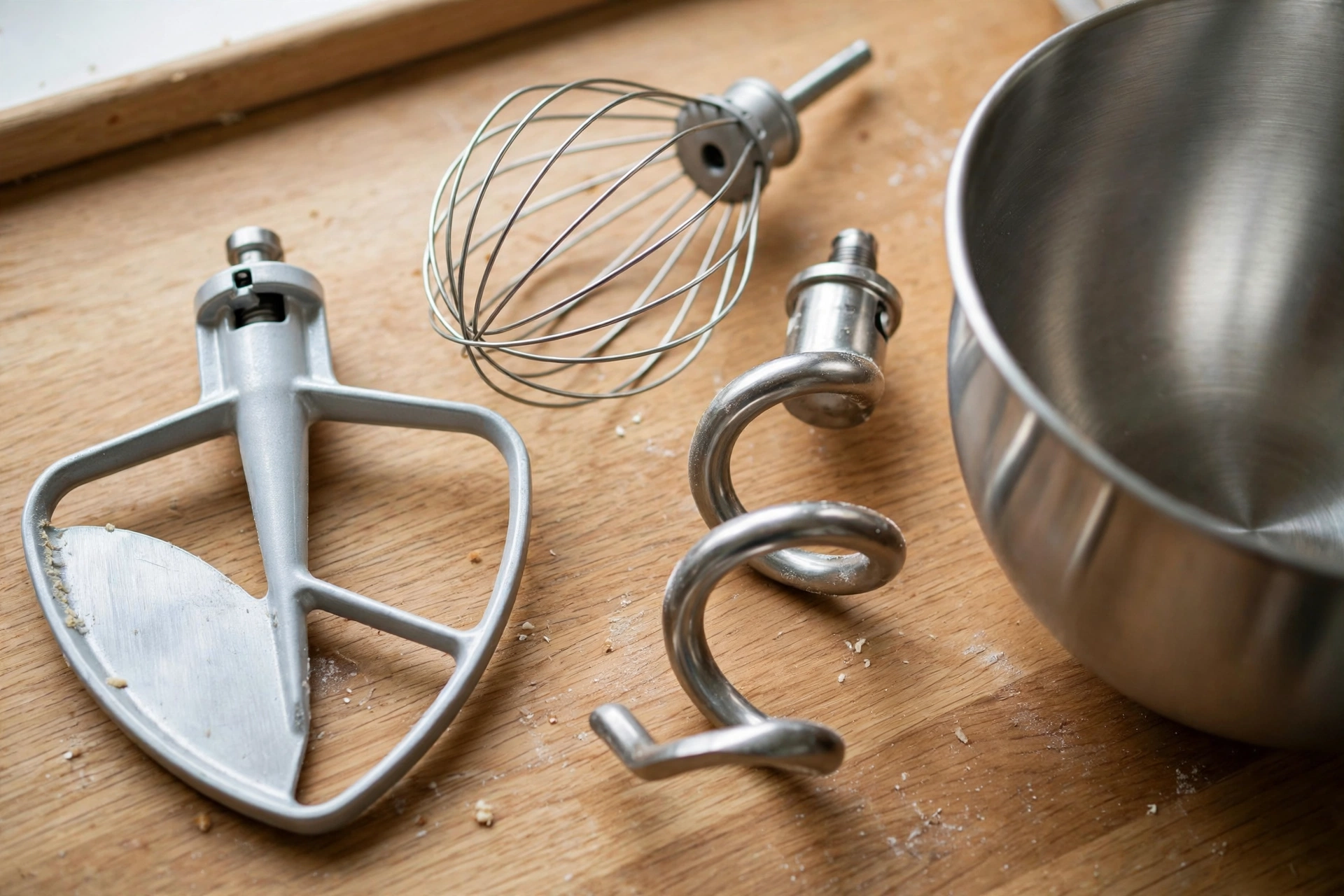
Almost every home stand mixer ships with the same three attachments. The flat beater is the all-rounder: it mixes cake and cookie batters, creams butter and sugar, and mashes soft ingredients without adding much air.
The wire whisk is for air: its thin wires trap air as they spin, so it suits whipped cream, meringues, and beaten egg whites — but it clogs in thick dough. The dough hook is the opposite. Its curved shape pushes and folds stiff dough, stretching the gluten that gives bread its structure. Use it for bread, pizza, and pasta dough.
Many mixers also have a hub on the head that lets the same motor drive extras such as pasta rollers — handy, but not essential, as the stand mixer guide from HowStuffWorks also notes.
Why does a stand mixer knead dough so well?
Kneading by hand works, but it is slow and tiring. A stand mixer does the same job with steady, even force: the dough hook folds the dough over itself again and again, stretching the gluten network that traps gas from the yeast and gives bread its rise and chew. The dough develops evenly in a few minutes.
Mind two details: the beater-to-bowl gap, roughly a coin’s thickness, and time — stop when the dough pulls cleanly away from the bowl and feels smooth and springy.
What can go wrong, and how do you fix it?
A mixer that walks across the counter is usually fighting a load it cannot handle — too much dough, too high a speed, or both. Cut the batch down or drop the speed, and check the bowl is locked in properly.
Is a stand mixer worth it for a small kitchen?
That depends on how often you bake. A stand mixer is heavy and takes up a permanent patch of counter. If you bake once a month, a hand mixer will do. If you bake most weekends or make bread regularly, it earns its place: it frees your hands and turns a twenty-minute knead into a few minutes of waiting.
Like other countertop helpers — a rice cooker that steams rice while you cook, a slow cooker that handles a stew all afternoon, or an electric kettle that boils water in minutes — it pays for itself in time saved. If you do buy one, choose by bowl size and motor strength for the baking you actually do, not by the number of speeds on the box.
FAQs
How does a stand mixer work?
A motor spins fast, a gearbox slows that spin and boosts its force, and a planetary drive moves the attachment in two directions at once — spinning on its own axis while circling the bowl.
What is the difference between a stand mixer and a hand mixer?
A stand mixer holds its own bowl, has a larger motor, and mixes hands-free. A hand mixer is lighter and cheaper, but you hold and move it yourself, and it struggles with stiff dough.
Can a stand mixer knead bread dough?
Yes. Use the dough hook on a low speed until the dough pulls away from the bowl and feels smooth, and keep the batch within the bowl’s capacity so the motor doesn’t strain.
Which stand mixer attachment is for cake batter?
The flat beater — it mixes batters and creams butter and sugar without whipping in too much air. Save the whisk for cream and egg whites, and the dough hook for bread.
Why does my stand mixer throw flour everywhere?
You probably started at too high a speed. Begin on the lowest setting until the flour is damp and combined, then step the speed up gradually.
Conclusion
A stand mixer is a simple idea executed well: a motor, a gearbox, and a planetary drive turn fast, weak spinning into slow, strong, even mixing. Pick the right attachment, start slow, and let the machine do the moving. If you bake regularly, try one next time you make bread or a cake batter and notice how much easier the mixing feels.