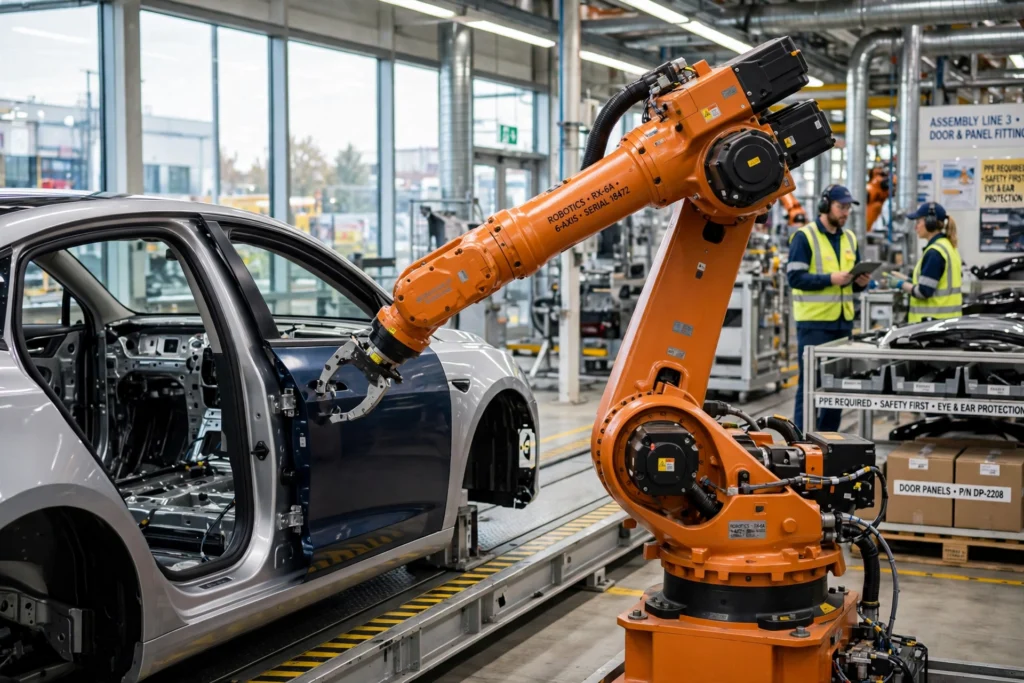
Assembly robots work by repeating a programmed sequence: pick up a part, carry it to the right spot, and join it to the next piece. Sensors and cameras check each step, correcting small errors and stopping if something is out of place. The result is the same product, built hundreds of times a day with far less variation than a tired human hand.
Key Takeaways
- An assembly robot follows a programmed routine of picking, placing, and fastening parts, checked by sensors at each step.
- Grippers, suction cups, and magnetic tools let one robot handle parts of many shapes and sizes.
- Cameras and force sensors correct small positioning errors, which is what makes the work so consistent.
- Safety comes from fences, light curtains, and slower collaborative robots that share space with people.
- Assembly robots suit high-volume, repetitive work best; small batches and unpredictable parts are still hard for them.
What is an assembly robot?
An assembly robot is a programmable machine built to put products together. Most look like a jointed arm bolted to the floor or a bench, though some are smaller tabletop models or move along a rail above the line. The arm is only half the story. At its end sits a tool — a gripper, a screwdriver, a glue nozzle, or a welding tip — chosen for one specific job.
The first assembly robots appeared on car production lines decades ago, doing one simple job over and over with no ability to adapt. Modern versions read sensors, adjust to parts that arrive slightly out of position, and can be reprogrammed for a new product in hours rather than weeks. If you want the broader picture first, our guide on what robotics is explains how these machines fit into the field as a whole.
How does an assembly robot pick up a part?
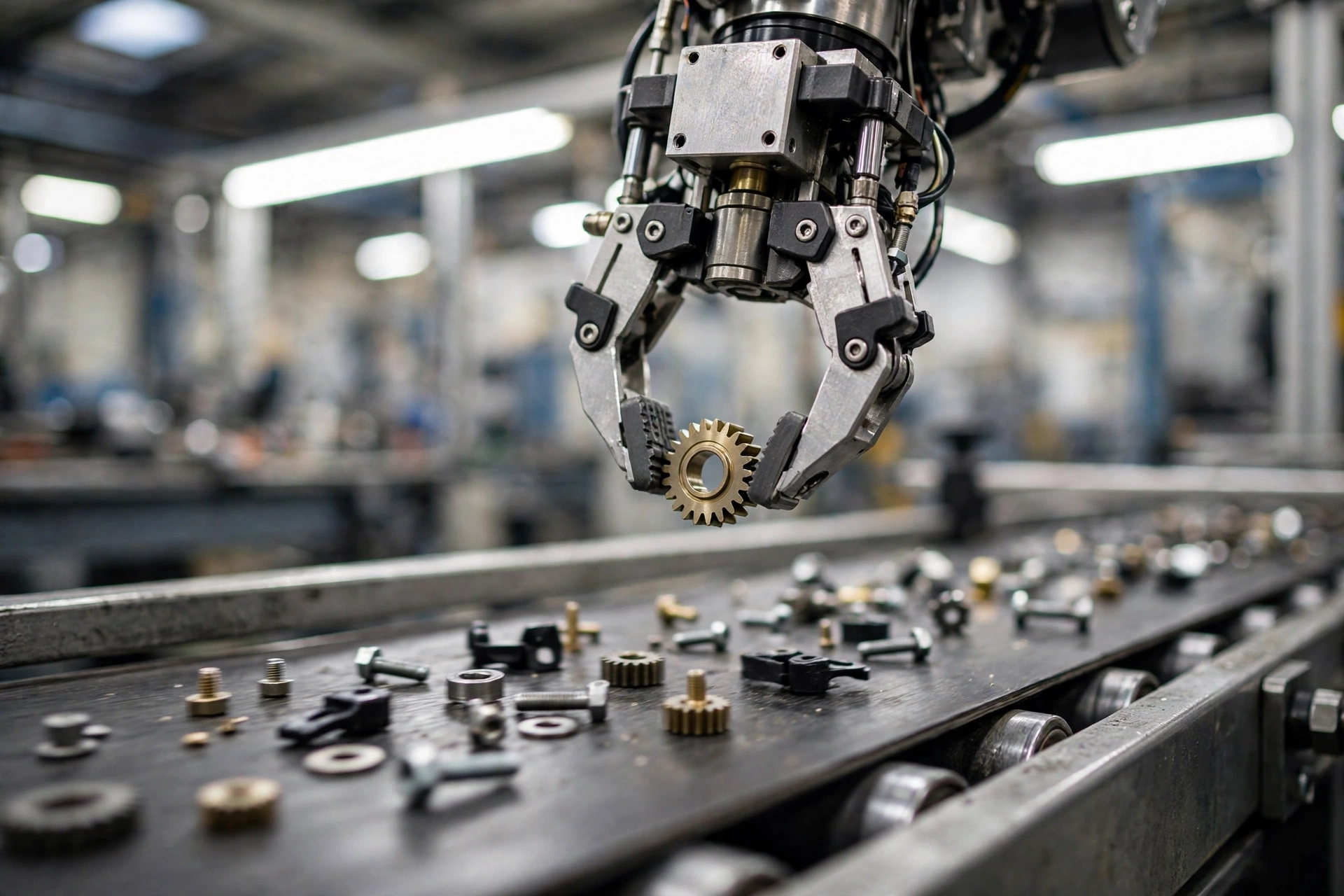
Everything starts with the gripper, the robot’s hand. Two-finger grippers squeeze a part between padded jaws, much like a pair of tongs. Vacuum grippers use suction cups to lift flat, smooth things such as glass panels or sheet metal, and magnetic grippers pick up steel parts without touching them at all. Some robots swap tools mid-job, dropping a gripper and picking up a screwdriver from a rack, the way a worker might reach for a different tool.
Before it grabs anything, the robot needs to know the part is there. A camera above the conveyor takes a picture, software finds the part’s edges, and the controller works out its exact position and angle. Force sensors in the wrist tell the robot how hard it is squeezing, so it holds a fragile circuit board gently and a steel bracket firmly.
How does it know exactly where each part goes?
The robot is taught, not guessed at. In the simplest setup, an engineer guides the arm through each position once using a handheld teach pendant, and the robot records every stop along the way. That list of positions becomes the program it replays all day.
More advanced lines add vision and measurement. A camera checks the part’s position as it arrives on the belt, and the robot shifts its target by a millimetre or two to match. Some systems read the product’s design file directly, so the robot knows where every screw hole should be before the first part arrives. The program gives the robot its plan, and the sensors correct the small differences between the plan and the real world.
What jobs do assembly robots do on a production line?
Pick and place is the most common. The robot lifts a part from a tray or conveyor and sets it into a housing, a socket, or a fixture. From there it moves on to fastening: driving screws, pressing clips home, or riveting panels together. Some robots apply glue or sealant in a neat, even bead, which is hard to do by hand at speed.
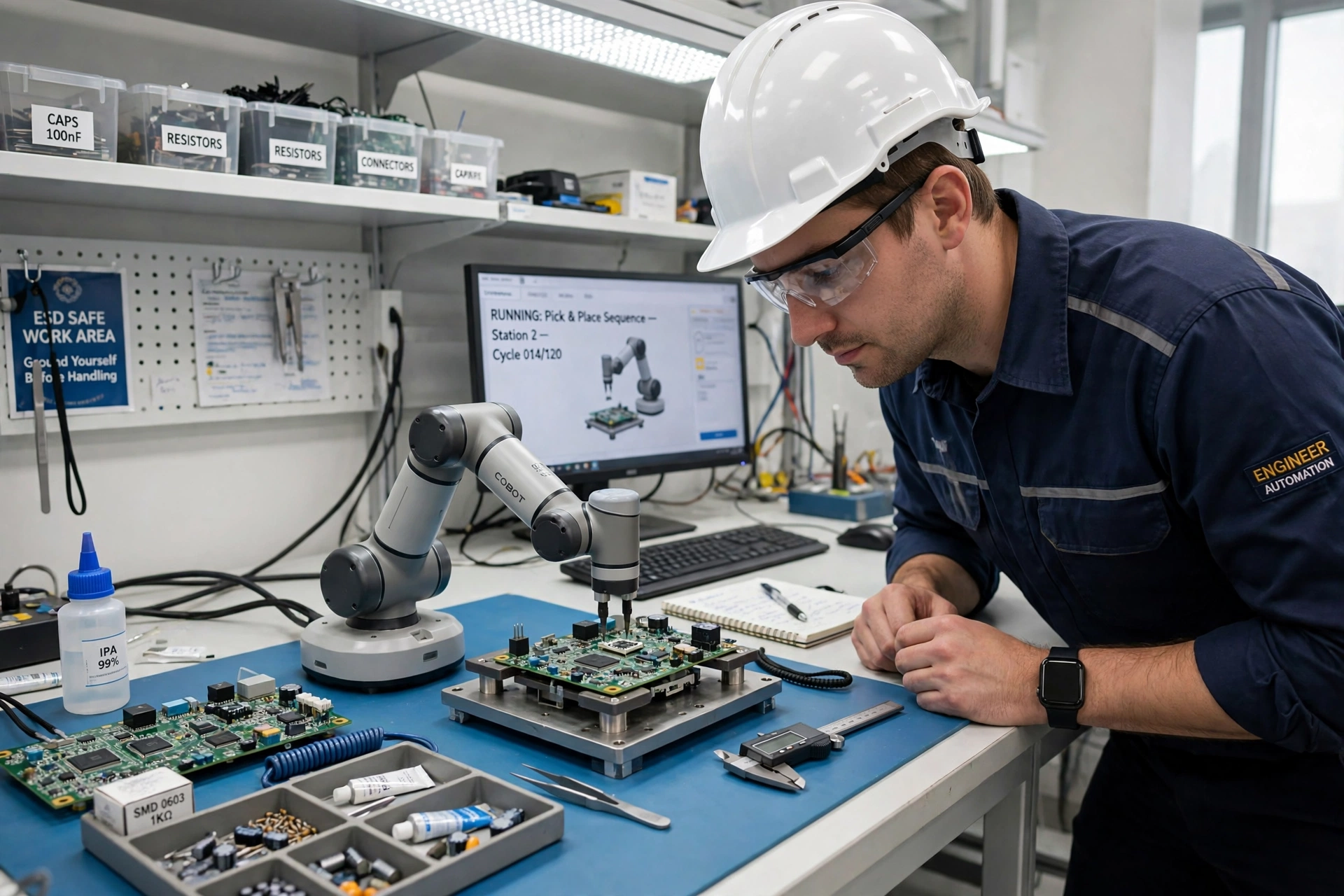
Electronics lines use smaller, gentler robots to place chips and connectors onto circuit boards, sometimes handling parts smaller than a grain of rice. Car plants use large arms to fit doors, windscreens, and dashboards. At the end of many lines, a robot runs a quick check — weighing the finished item or scanning a barcode — before the product moves on. Our guide to how robot arms work looks closer at the joints and motors behind all of this movement. Once a product leaves the line, warehouse robots often take over moving it to storage, so the two kinds of machine work side by side in the same building.
How do assembly robots stay so accurate?
Accuracy comes from stiff mechanics, good programming, and constant checking. The arm’s joints use servo motors with encoders that report their angle thousands of times a second, so the controller always knows where the arm is. The robot is also calibrated against fixed reference points on the bench.
Then the sensors close the loop. If a part arrives two millimetres to the left, the camera spots it and the robot adjusts. If a screw meets more resistance than expected, the torque sensor flags it and the line stops rather than forcing a bad joint. That is why a well-tuned assembly robot can repeat the same move to within a fraction of a millimetre, shift after shift.
How do factories keep people safe around assembly robots?
Traditional assembly robots are fast and strong, so they usually work behind fences with locked gates. If a gate opens, the robot stops. Light curtains work the same way: break the invisible beam, and the machine halts before anyone can reach it.
Collaborative robots, or cobots, take a different approach. They are smaller, slower, and built with force limits, so they can share a bench with a person. If a cobot bumps into someone, it stops at once. That makes them a good fit for smaller workshops and for jobs where a person and a robot hand parts back and forth. Our guide to how collaborative robots work explains the shared-workspace idea in more depth.
What are the limits of assembly robots?
Assembly robots are brilliant at repetition and poor at improvisation. A part that arrives bent, a screw that is missing, or a tray loaded the wrong way round can stop the line until a person steps in. Flexible materials cause trouble too: a robot can struggle with cables, fabric, and rubber seals that change shape as they are handled.
Cost is the other limit. The robot itself is only part of the price — grippers, fixtures, safety fencing, programming, and maintenance all add up. That is why small factories often start with one cobot on a single station rather than automating a whole line at once.
FAQs
Do assembly robots replace workers?
They replace specific repetitive tasks, not whole jobs. In most factories, people move into programming, quality checks, and maintenance, handling the exceptions the robot cannot. Headcount on a line often falls, while demand for skilled technicians rises.
How much does an assembly robot cost?
It varies widely. A small collaborative arm can cost about as much as a family car, while a large industrial cell with fencing, fixtures, and programming can cost several times more. Running costs such as electricity, maintenance, and spare parts add to the total over time.
How long does it take to set one up?
A simple pick-and-place station can be running in days. A full production line with several robots, custom fixtures, and safety systems can take weeks or months to design, install, and test before it runs at full speed.
Can small factories use assembly robots?
Yes, and collaborative robots have helped most here. A small cobot on a bench, doing one boring job well, is now within reach of many small businesses. Starting with a single station keeps the cost and the risk manageable.
What happens when a part is in the wrong place?
The robot’s sensors should catch it. A camera can see that a part is missing or misaligned, and a force sensor can feel that a screw is not seating properly. The robot then stops and alerts an operator, rather than forcing the part in and damaging the product.
Conclusion
Assembly robots work by combining a taught routine with live feedback: the program says what to do, and cameras and force sensors correct the details in real time. That mix of repetition and checking is what makes them so consistent, and it is also what sets their limits — they handle predictable parts beautifully and struggle with surprises.
If you are thinking about assembly robots for your own work, start small. Pick one repetitive job that is slow, tiring, or hard to do consistently, and look at what a single robot station would need: the gripper, the fixtures, the safety setup, and someone trained to look after it. A modest first step teaches you more than a grand plan. For background on the field these machines belong to, Britannica’s robotics overview and Wikipedia’s page on the industrial robot are both solid starting points.
Further reading:
- Britannica — Robotics: https://www.britannica.com/technology/robotics
- Wikipedia — Industrial robot: https://en.wikipedia.org/wiki/Industrial_robot