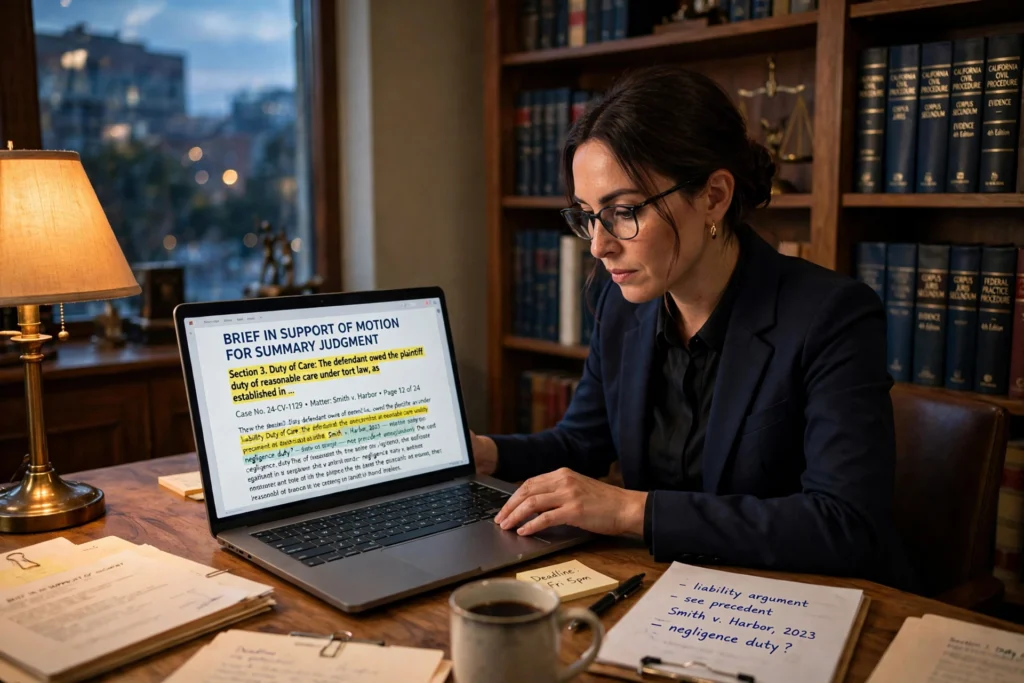
This article is general information about how AI tools work. It is not legal advice.
AI legal research tools read through case law, statutes, contracts and briefs far faster than a person can, then point a lawyer toward the passages most likely to matter. They shrink the pile of reading — but they do not replace legal judgement, and every citation they suggest still needs a human to check it against the original source.
Key Takeaways
- AI legal research tools search by meaning, not just keywords, so they find cases that use different words for the same idea.
- The time savings come from summarising long documents and narrowing a long list of cases to a short one.
- AI can invent cases and quotations that look real. Unverified citations have already led to lawyers being sanctioned.
- Client confidentiality is the biggest practical risk: never paste client details into a public AI tool.
- The lawyer remains responsible for everything filed, whatever tool produced the first draft.
How does AI legal research actually work?
Most legal research tools sit on top of a large database of published cases, statutes and secondary sources. When a lawyer types a question in plain English — “cases where a court refused to enforce a non-compete against a junior employee”, for instance — the system converts that question into a numerical representation of its meaning, then looks for passages with a similar meaning. This is the same idea behind natural language processing.
That meaning-based search is the real change. Traditional legal research relied on keywords, so a researcher had to guess the exact words a judge used. If the judge wrote “restrictive covenant” and you searched for “non-compete”, you could miss the case entirely. An AI system trained on legal text understands that the two phrases often refer to the same thing, so it returns both, ranked by relevance and recency. Many tools then add a generative model that reads the top results and writes a short answer, with links back to the cases it drew on.
What can AI do faster than a human researcher?
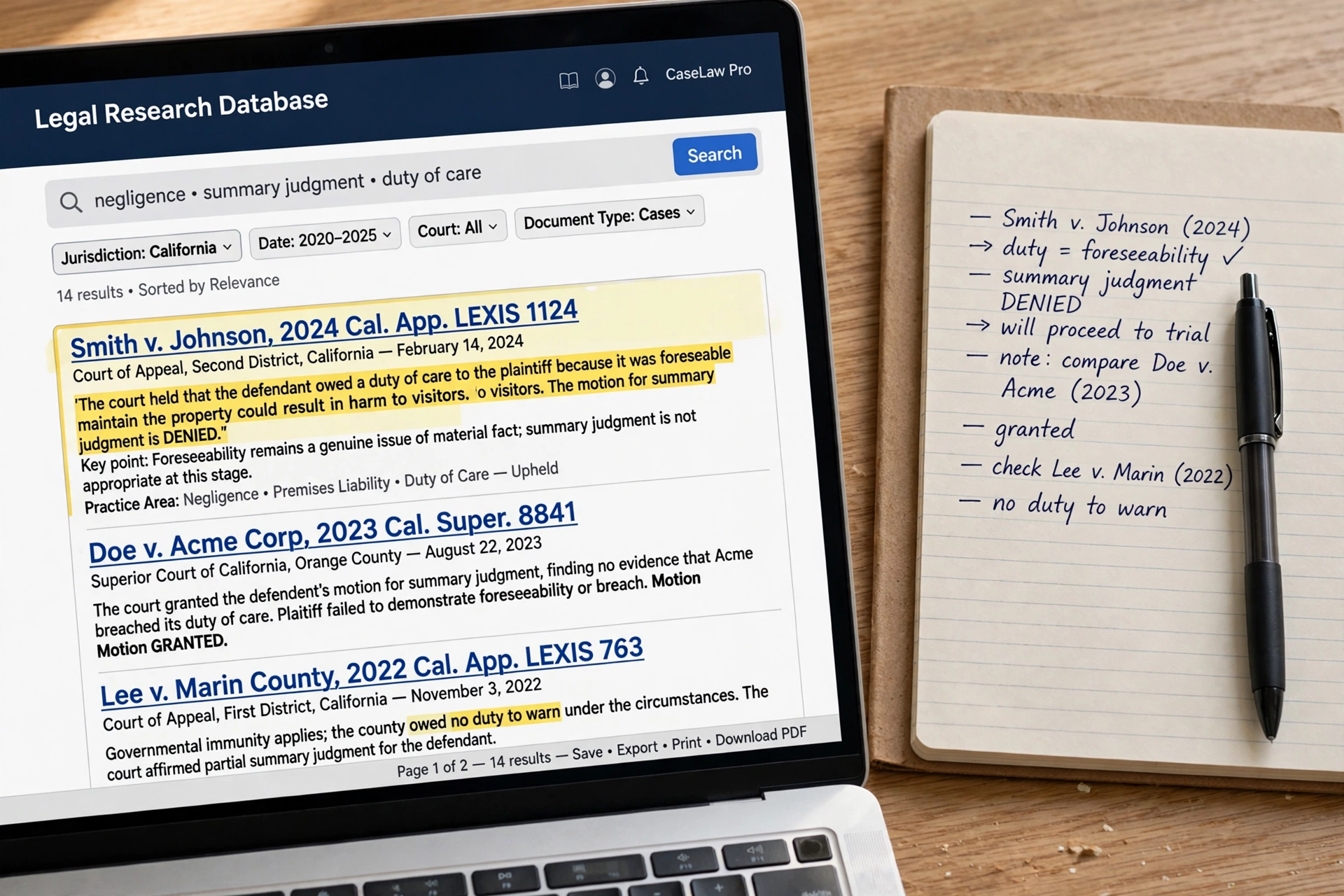
The clearest win is volume. A litigation team preparing for trial might need to review thousands of pages of discovery documents and contracts. An AI tool can read that pile in minutes, group similar documents together, and pull out the ones that mention a particular clause, date or party. What used to take a junior associate a week can take an afternoon — spent checking the shortlist instead of opening every file.
The same trick works for contracts: AI can compare a draft against a firm’s standard terms and flag every clause that differs.
Where does AI legal research go wrong?
The most serious problem is hallucination. A generative AI system can produce a case citation that looks perfect — correct format, plausible party names, a convincing quotation — for a case that does not exist. In 2023, two lawyers in New York were sanctioned after filing a brief that cited non-existent cases invented by ChatGPT. Since then, courts in several countries have fined lawyers who filed AI-generated citations without checking them. The pattern is always the same: the lawyer trusted the output and skipped the verification step.
The problem is worse than a simple error because the output sounds confident. A hallucinated citation does not arrive with a warning label, which is exactly why it slips past a busy lawyer. Legal-specific tools reduce the risk by answering only from a closed database of verified cases, but even those can misquote a passage.
Finally, there is what the tool does with the question itself. Pasting a client’s confidential facts into a free, public AI tool can breach the duty of confidentiality, because the input may be stored or used to train future versions of the model.
How should a lawyer check AI research before using it?
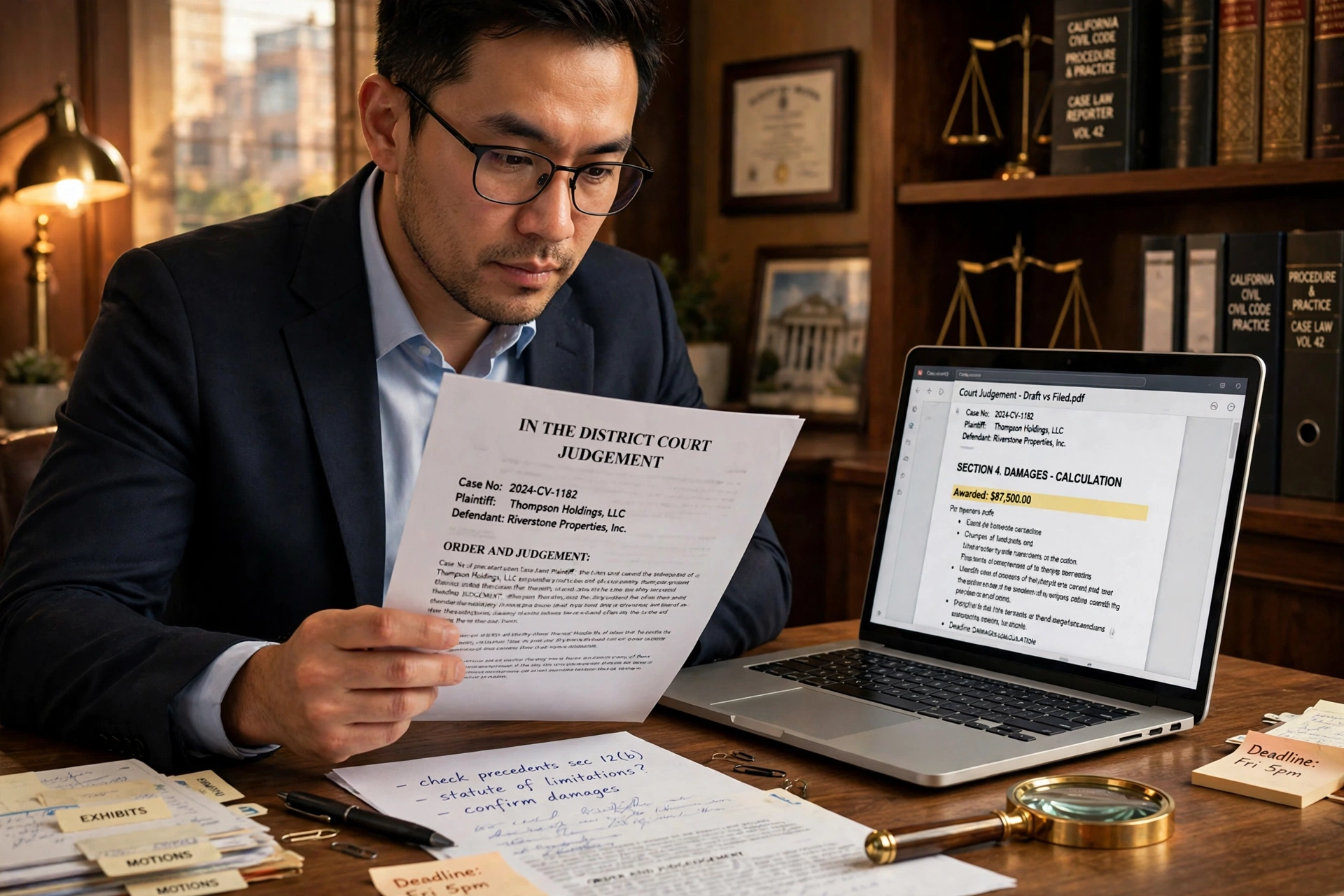
The rule is simple, and it is the same rule that applies to a junior colleague’s memo: trust nothing until you have read the source. Every case an AI tool suggests should be opened in a trusted legal database and read — at least the headnote and the passage the tool quoted. If you cannot find the quoted sentence in the original, do not cite it.
A practical checklist helps. First, confirm the case exists and is still good law — not overruled or distinguished in a way that changes the result. Second, check the jurisdiction and the date: a recent decision from another country may be interesting, but it does not bind a local court. Third, read the holding in context rather than relying on a one-line summary. Fourth, keep a record of what was checked.
Can AI replace lawyers?
Not in any serious sense, and not soon. Legal research is only one part of what a lawyer does. The rest — understanding a client’s actual problem, deciding which arguments are worth making, negotiating, persuading a judge, and taking responsibility for the outcome — depends on judgement, context and accountability. An AI tool has none of those. It cannot appear in court and it cannot be held responsible when something goes wrong.
What AI does change is the shape of the work. The hours spent on the first pass of research shrink, and the hours spent on checking and judgement grow. Junior lawyers will do less routine searching and more reviewing of AI output — a different skill, and one that law schools and firms are still learning to teach.
FAQs
Is it legal for lawyers to use AI for legal research?
Yes, in most jurisdictions, but with conditions. Bar associations have said lawyers may use AI tools as long as they verify the output, protect client confidentiality, and disclose AI use where the rules require it. The American Bar Association’s Formal Opinion 512, issued in 2024, sets out these duties in detail.
Can AI invent fake court cases?
Yes. Generative AI systems can produce realistic-looking citations for cases that do not exist, complete with plausible quotations. This has happened in real court filings, and lawyers have been fined and sanctioned for it. Legal-specific tools that answer only from verified databases are less prone to this, but no tool is immune — every citation should be checked against the original case.
Is my information safe when I use an AI legal research tool?
It depends on the tool. Enterprise and legal-specific platforms usually promise not to train on your inputs, but read the terms rather than assume it. Free public chatbots generally do not offer those protections, and lawyers should not paste client details into them.
What is the best way to start using AI for legal research?
Start with a low-risk task, such as summarising a long judgement you have already read, so you can judge the output against your own understanding. Ask the tool for linked sources with every answer, and check a sample of them in a trusted database. Agree a written policy for your team — which tools are approved, what data may be entered, and who checks the output — before using AI on client work.
Conclusion
AI legal research is already good at the parts of research that are slow and repetitive: searching by meaning and summarising long documents. It is not good at the parts that matter most — knowing which authority actually controls, and spotting when a quotation has been twisted. The lawyers who get the most from these tools treat them as a fast first draft of the research, then verify every citation by hand.
If you use AI for legal research, start small: pick one low-stakes task, insist on linked sources, and check every case in a trusted database before it goes anywhere near a client or a court.
Further reading
For the ideas in this post, see What Is Artificial Intelligence? The Complete Guide for the foundations, What Is Natural Language Processing? How Computers Understand Human Language for how machines read legal language, How Does AI Summarise Text? Shortening Articles, Meetings, and Documents Explained for the summarising behind these tools, and What Is AI Hallucination? Why AI Sometimes Makes Things Up for why invented citations happen. For authoritative guidance, see the American Bar Association’s guide to responsibly implementing AI in legal practice and the University of Chicago Library’s guide to AI and legal ethics.