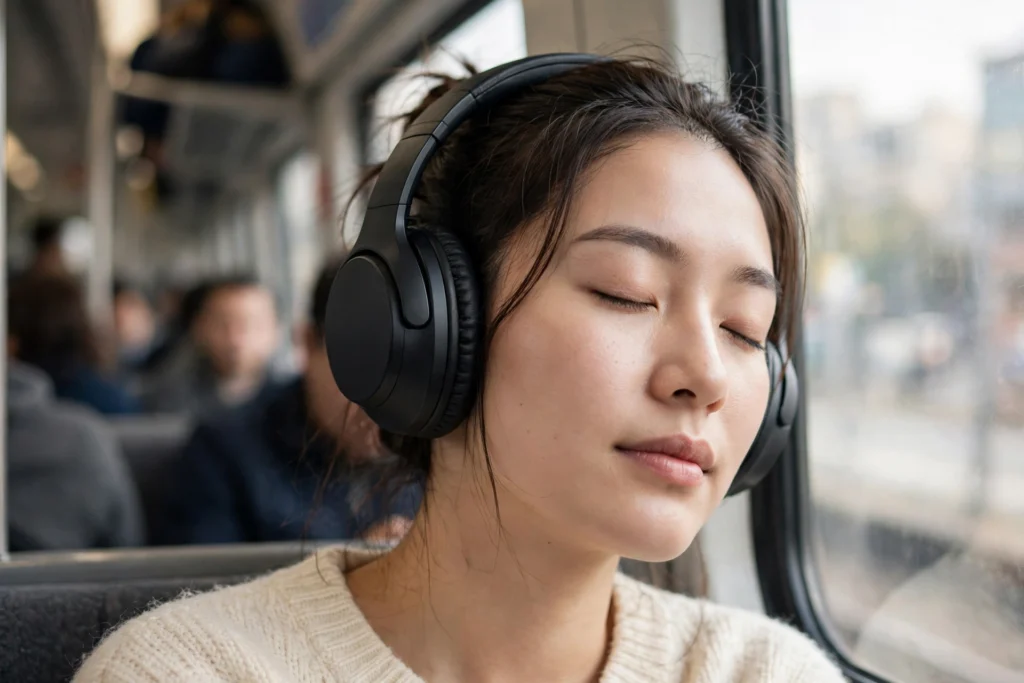
Noise cancelling work begins with a simple trick: your headphones listen to the noise around you, then play a mirror image of that sound so the two waves cancel each other out before they reach your ears. The result is not total silence, but a much quieter world, especially on trains, planes, and busy streets.
Key Takeaways
- Tiny microphones hear outside sound; a processor creates an opposite “anti-noise” wave.
- The two waves partly cancel out through destructive interference.
- The system works best on steady, low sounds such as engines, fans, and train rumble.
- Thick earcups block high sounds passively; the electronics handle the low ones.
- Transparency mode lets outside sound back in when you need to hear it.
What is active noise cancellation?
Active noise cancellation, usually shortened to ANC, is the electronic part of the system. A pair of ANC headphones or wireless earbuds carries small microphones, a processor, and a speaker driver in each earcup or bud. The microphones sample the sound around you, the processor works out its wave shape, and the speaker plays back an inverted copy, matched in loudness but flipped upside down.
Think of a sound wave as peaks and troughs in air pressure. When a peak of the anti-noise meets a trough of the real noise, the two add up to almost nothing. That is destructive interference, the same physics that lets two ripples on a pond flatten each other out. The whole cycle runs in a few thousandths of a second. Wikipedia’s overview of active noise control explains the same principle in more detail. ANC needs battery power, which is why a dead battery usually ends the quiet even if the music keeps playing.
How do the microphones and the anti-noise signal work?
Most modern headphones use two or three microphones per ear. The outside ones pick up noise before it reaches your ear, while an inside microphone, tucked close to the speaker, checks what is actually getting through. The processor compares the two and adjusts the anti-noise so the cancellation stays accurate even as you move your head. Using both layouts together is called hybrid ANC, and Explain That Stuff’s guide to how noise-cancelling headphones work walks through the different layouts with clear diagrams.
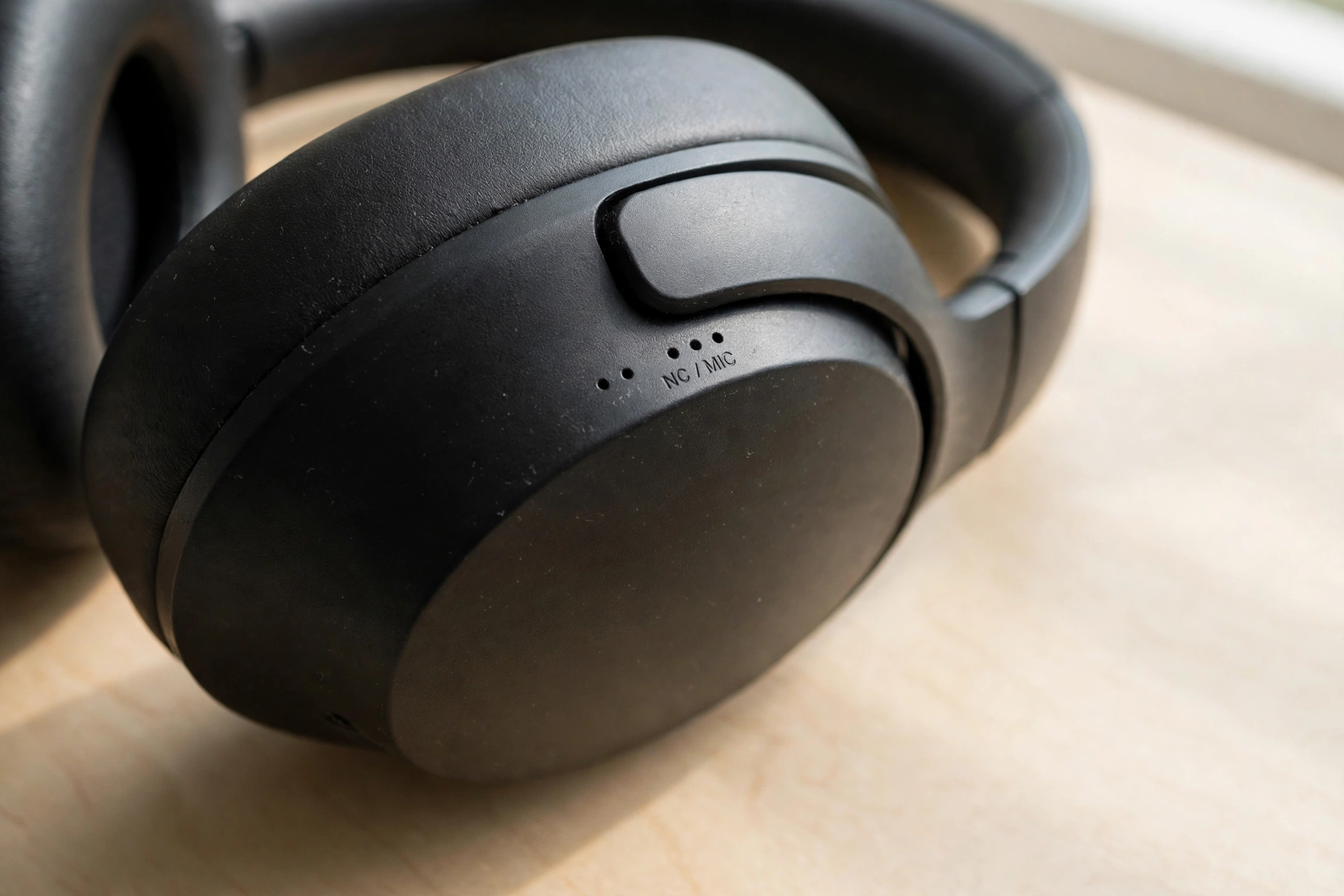
The signal is built by digital signal processing: the processor flips the microphone feed’s phase by 180 degrees and sends the result to the driver at exactly the right moment. Timing matters enormously. If the anti-noise arrives even slightly late, it stops cancelling and can start adding to the noise instead. Wind is the classic troublemaker, since a gust sounds like a huge burst of low noise. Many headphones now include a wind-reduction setting for exactly that.
What is the difference between active and passive noise cancelling?
Passive noise cancelling is the low-tech half of the job. Thick ear cushions, a tight seal, and dense materials physically block sound from reaching your ear. Foam ear tips on earbuds do the same thing in miniature. No battery, no processor, just a good seal.
The two halves also split the work by pitch. Passive isolation is strongest at high frequencies, where short sound waves are easily absorbed by padding. ANC is strongest at low frequencies, where the waves are long, steady, and predictable. Together they cover far more of the sound spectrum than either could alone, which is why a good fit matters: if your earbuds do not seal properly, high-frequency sound leaks straight past the passive layer.
Why does noise cancelling work best on engines and fans?
Steady, repeating sounds are the easiest to cancel. An aeroplane engine, a train’s rumble, or an air conditioner’s hum produces a waveform that repeats in a regular pattern, so the processor can predict what comes next and build the matching anti-noise with time to spare.
Sudden, irregular sounds are a different story. A conversation next to you, a door slamming, or a dog barking changes too fast for the system to track perfectly, so it softens them rather than erasing them. That is why you can still hear the person chatting beside you on a plane while the engine fades away, and why ANC feels less impressive in a quiet office, where there is simply less steady noise to remove.
What is transparency mode, and when should you use it?
Transparency mode, sometimes called ambient or passthrough mode, flips the system around. Instead of cancelling outside sound, the headphones pipe it in through the same microphones, mixed with your music. It exists because total isolation is not always safe or polite.
Use it when you need to hear the world: crossing a road, listening for a station announcement, or talking to a colleague without taking your headphones off. Many headphones switch automatically when they detect speech. One catch: transparency mode also picks up wind noise, and the outside world through a tiny microphone never sounds quite as natural as hearing it directly.

Does noise cancelling affect sound quality or hearing?
ANC changes what reaches your ear, so it can change how music sounds, but a well-tuned system accounts for that. The anti-noise is designed to cancel outside sound, not your music. Some people notice a faint hiss with ANC on in a silent room; that is the electronics themselves, and it usually disappears the moment any real sound is playing.
On hearing, the picture is mostly reassuring. ANC does not add dangerous levels of sound, and many people listen at lower volumes with ANC on because they no longer need to turn the music up to drown out the background. That pairs well with Bluetooth audio, which is how most ANC headphones connect to your phone. One caution is worth keeping: because ANC makes the world quieter, it is easy to miss things you need to hear, from traffic to a smoke alarm.
Frequently Asked Questions
Does noise cancelling block all sound?
No. It is very good at steady, low sounds such as engines and fans, and much less effective on sudden sounds such as voices or a door closing.
Do noise cancelling headphones work without music playing?
Yes. ANC works with no music at all, which is why many people wear them on flights just for the quiet. You still need battery power.
Why do my noise cancelling headphones sound worse in wind?
Wind hits the outside microphones hard and sounds like a huge burst of low-frequency noise, so the system can overcorrect and create a whooshing sound. A wind-reduction mode usually fixes it.
Is active noise cancellation the same as noise isolation?
No. Noise isolation is the physical blocking of sound by earcups and ear tips, while active noise cancellation is the electronic system that creates anti-noise. Most good headphones use both.
Can I use noise cancelling while walking near traffic?
You can, but transparency mode is safer. ANC can hide approaching vehicles and other warnings, so ambient mode near roads keeps you aware of your surroundings.
Conclusion
Noise cancelling work is a neat piece of everyday physics: microphones hear the noise, a processor builds its mirror image, and the two waves cancel each other out before they reach your ears. It works best on the steady drone of engines and fans, leans on a good physical seal for the high sounds, and pairs with transparency mode when you need to hear the world again.
If you are shopping for a pair, try them where you will actually use them, on a train or a busy street, not just in a quiet shop. Check the fit first, then the ANC strength, then the battery life with ANC on. At home, a strong Wi-Fi signal or a mesh Wi-Fi setup keeps your music streaming smoothly while the headphones do the quiet part.