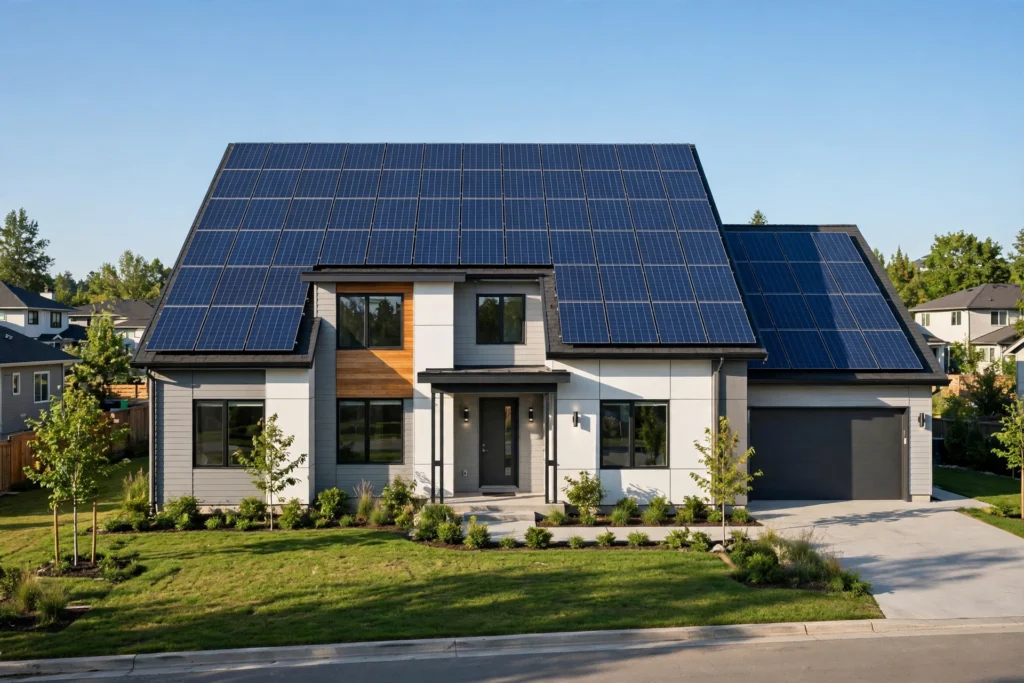
Solar panels work by turning sunlight into electricity. When light hits the silicon cells inside a panel, it knocks electrons loose, and that movement creates direct current. An inverter then changes it into the alternating current your home uses, so the power can run lights, appliances, and chargers.
Key Takeaways
- Solar panels turn sunlight into electricity through the photovoltaic effect in silicon cells.
- The cells produce direct current, and an inverter changes it into alternating current for your home.
- Output depends on sunlight, angle, shade, temperature, and panel cleanliness.
- Panels still work on cloudy days, with lower output, and stop at night without battery storage.
- Most panels last 25 years or more, with little maintenance beyond an occasional clean.
What is inside a solar panel?
A solar panel looks like a flat sheet of dark glass, but it is a sandwich of layers. The working heart is a set of solar cells, usually made from silicon, wired together in a grid. Toughened glass over them lets light through while protecting the cells from rain, hail, and knocks, and a metal frame gives the panel strength and lets it be bolted to a roof or ground mount. A small junction box on the back joins the wiring to the cables that carry power to the rest of the system.
Nothing inside moves: there are no fans or spinning parts, which is part of the appeal. The panel simply sits there, quietly converting light into electricity whenever the sun is up.
How does sunlight become electricity?
The key is the photovoltaic effect, and silicon is the material that makes it practical. A silicon cell is built from two thin layers with slightly different properties. When sunlight hits the cell, particles of light give energy to electrons in the silicon, knocking them loose. The cell’s structure then pushes those freed electrons in one direction, creating a flow of direct current — the same kind of current that comes from a battery. One cell alone makes only a small amount of power, so dozens are wired together inside a panel, and several panels are wired into an array, to build up enough voltage and current to be useful.
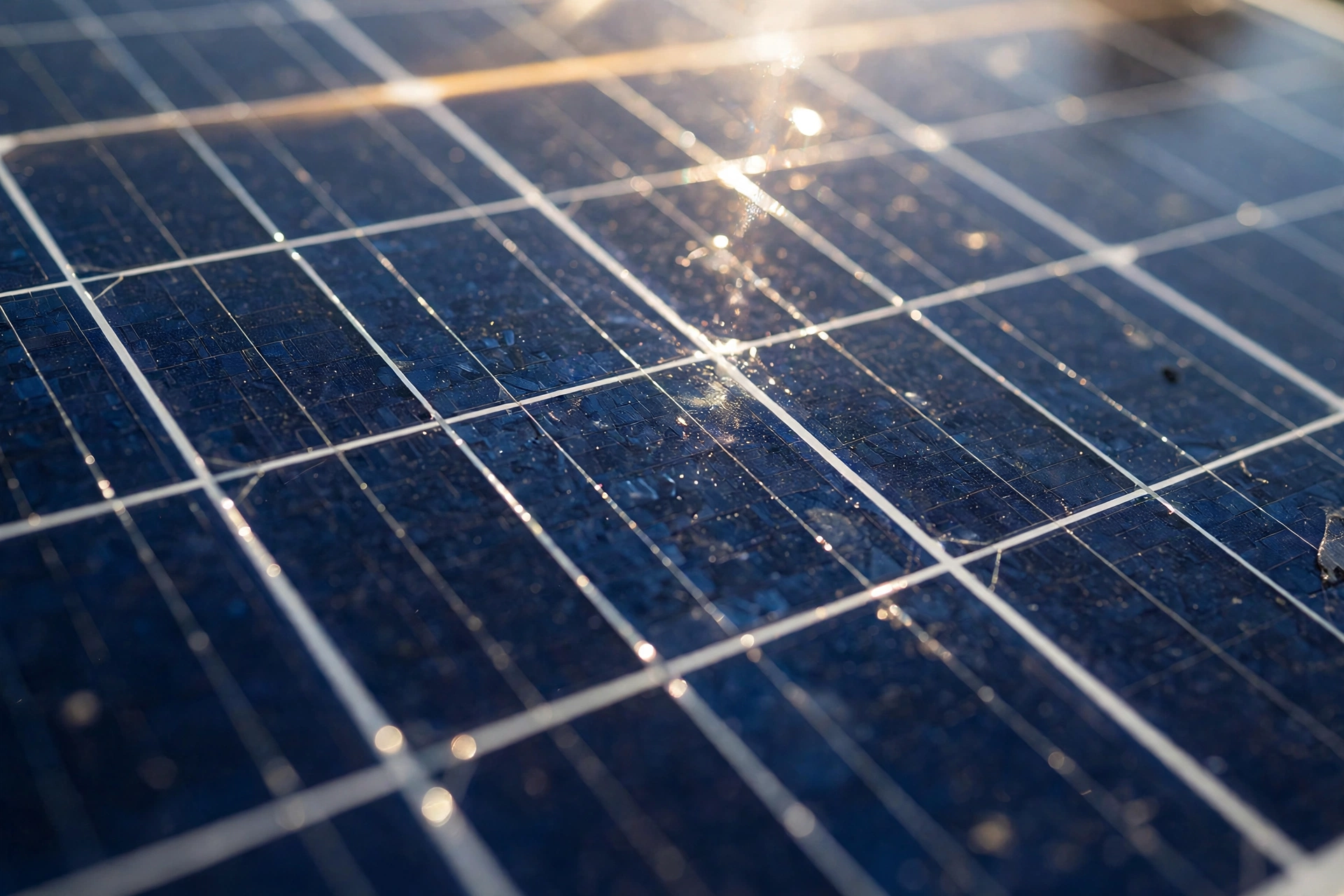
Panels respond to light, not heat. A bright, cold winter day can actually be a good day for solar panels, because the cells run more efficiently when they are cool. What matters most is how much light reaches the cells, and how directly it hits them.
What does the inverter do?
Your home runs on alternating current, or AC, so the DC from the panels must be converted before it can power anything. That is the inverter’s job. It sits between the panels and your home’s wiring, switching the current back and forth many times a second to produce the AC your sockets supply.
Most homes use one of two setups. A string inverter handles a whole row of panels at once, which is simple and cheaper — but the row performs at the level of its weakest panel, so shade on one panel pulls the others down. Microinverters, fitted behind each panel, let every panel work on its own, which helps with partial shade. They cost more, but make it easier to spot one underperforming panel. The inverter also watches for faults: if it detects a problem, or the grid goes down, it shuts the panels off to protect anyone working on the power lines.
Where does the power go?
Once converted, the electricity flows into your home and is used by whatever is running: lights, the fridge, the washing machine, phone chargers. On a sunny afternoon, the panels may make more than the house needs. In many places that extra power flows back into the grid, and you get a credit on your bill. The exact arrangement depends on where you live and your supplier, so check the local rules before counting on it.
If you add a home battery, extra daytime power is stored for the evening instead — the same idea as a power bank for your phone, on a much bigger scale. Home batteries usually use lithium-ion cells, similar in principle to the ones in a laptop battery, and they let you use your own solar power after dark. They add cost, so many households start with panels alone and add a battery later.
What affects how much power you get?
Sunlight is the biggest factor, and it changes through the day and the year. Panels facing the sun directly, tilted at a good angle for your location, do better than panels lying flat or facing away. In the northern hemisphere, a south-facing roof usually catches the most sun over the year, though east and west roofs can still work well. Shade is the next thing to watch: even a small shadow from a chimney or a tree branch can cut output more than you would expect, because the cells in a panel are wired in series. Temperature matters too — panels lose a little efficiency as they heat up, so airflow under the panels helps — and dirt blocks light before it reaches the cells, which is why clean panels perform better.
Do solar panels work on cloudy days and at night?
Yes, they work on cloudy days, just with less output. Clouds scatter sunlight, but plenty of light still gets through, so panels typically produce a fraction of their sunny-day output — often between a tenth and a quarter, depending on how thick the cloud is. At night, panels produce nothing, because there is no light to convert. That is the main limit of solar power, and it is why batteries or a grid connection matter: a grid-connected home draws from the grid after dark, while a home with a battery uses the power it stored during the day.
How long do panels last, and what care do they need?
Most solar panels come with a performance warranty of around 25 years, and many keep working well beyond that, just producing a little less power each year. The decline is slow — usually well under one percent a year — so a twenty-year-old panel is still a useful generator, not a dead one.
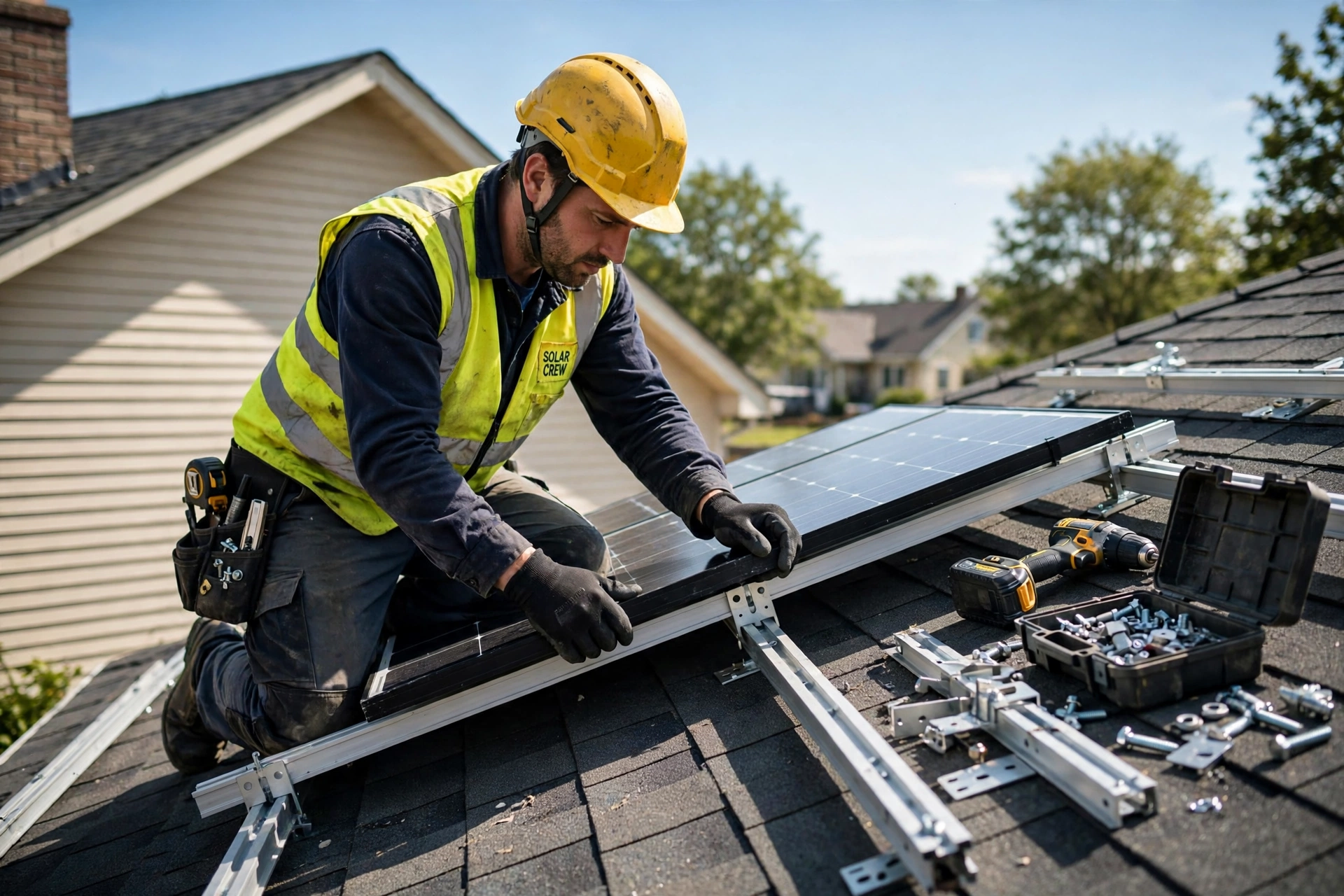
Care is light. Rain washes off much of the dust on its own, and in most places a visual check once or twice a year is enough. If you live somewhere dusty or dry, an occasional gentle clean with water and a soft brush helps, and for large arrays, solar panel cleaning robots can do the job without anyone climbing on the roof. The inverter usually has a shorter life than the panels and may need replacing once. Leave any electrical work to a qualified installer.
Frequently Asked Questions
Do solar panels work in winter?
Yes. Winter days are shorter and the sun sits lower, so output drops, but cold, bright days can be efficient. Snow usually slides off tilted panels, and a thin covering melts quickly once the sun comes out.
Can solar panels run my whole home?
It depends on roof size, location, and how much power you use. A well-sized system can cover a large share of a household’s annual use, and a battery helps cover evenings. Very few homes run entirely on solar alone without a grid connection or a large battery.
Do I need a battery with solar panels?
No, it is optional. Without one, you use solar power during the day and draw from the grid at night. A battery lets you store daytime surplus for the evening, which suits households that use most of their power after work.
How much roof space do solar panels need?
A typical home system of around a dozen panels needs roughly 20 to 25 square metres of suitable roof. The exact number depends on panel size and output, and on how much of the roof faces the sun without shade.
What happens to solar panels during a power cut?
For safety, a standard grid-connected system shuts down during a power cut, so it cannot feed electricity into lines that workers may be repairing. Some systems with a battery and a suitable inverter can keep essential circuits running — check this with your installer before you buy.
Conclusion
Solar panels are a simple idea done well: silicon cells catch sunlight, an inverter shapes the power for your home, and the whole system has no moving parts to wear out. Knowing how output changes with light, angle, shade, and temperature helps you set realistic expectations — and spot when something is underperforming.
As a practical next step, look at your own roof: which way does it face, is it shaded at any point in the day, and how much clear space does it have? Those three answers tell you more about whether solar suits your home than any specification sheet. For background reading, the Wikipedia solar panel article and the US Department of Energy’s guide to how solar energy works explain the technology in more detail, and our guide to wireless charging covers another way the power from your home reaches your devices.