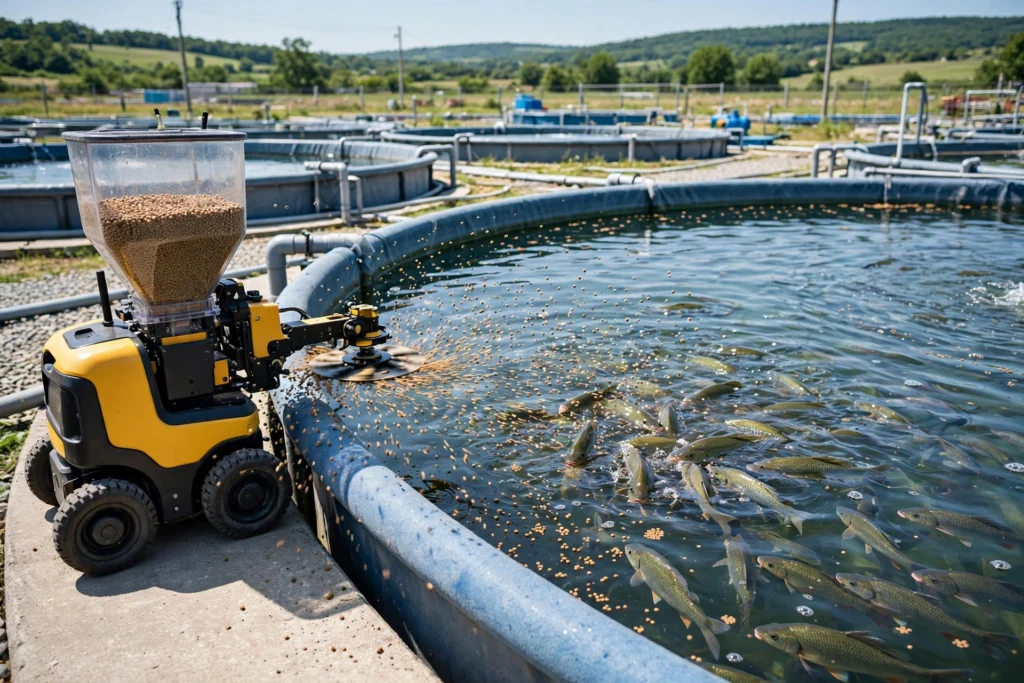
Fish feeding robots work by storing feed pellets in a hopper, releasing them on a timed schedule, and spreading them evenly across the water so every fish gets a share. Sensors watch how eagerly the fish eat, and the robot adjusts the next portion itself. The result is steadier feeding, less wasted feed, and healthier fish with less hand work.
Key Takeaways
- A fish feeding robot stores pellets in a hopper and drops them on a schedule, instead of hand feeding.
- A spinning spreader, blower, or moving arm throws pellets in a wide pattern so feed reaches the whole tank.
- Sensors for temperature, oxygen, and feeding activity help the robot decide how much to give and when to stop.
- Mobile feeders travel between tanks; fixed dispensers sit above a single tank or cage.
- The gains are steadier growth, less uneaten feed, and fewer feeding rounds for staff.
What exactly is a fish feeding robot?
A fish feeding robot takes over the daily job of feeding farmed fish. On a small farm it might be a single dispenser bolted above a tank. On a larger site it can be a wheeled robot that rolls along a row of tanks, or a floating unit that moves around a pond or a sea cage.
The job never changes: hold the feed, release the right amount, and spread it where the fish can reach it. What makes it a robot rather than a timer is the feedback — it measures, adjusts, and keeps a record a worker can check on a phone instead of standing at the water with a bucket.
How does the robot decide how much feed to give?
Feeding starts with a plan. The farmer enters the species, fish size, number in the tank, and water temperature. Young fish eat little and often; larger fish take bigger meals less often. Cold water slows fish down, so they need less; warm water usually means a bigger appetite.
A timer and a dosing unit follow the plan. A screw or vibrating plate meters pellets out in small amounts — important because uneaten pellets sink, rot, and use up oxygen, which stresses the fish. Some robots watch the surface with a camera and slow down when fish stop rising for food; others track oxygen and hold back a meal when levels are low.
How is the feed spread across the water?
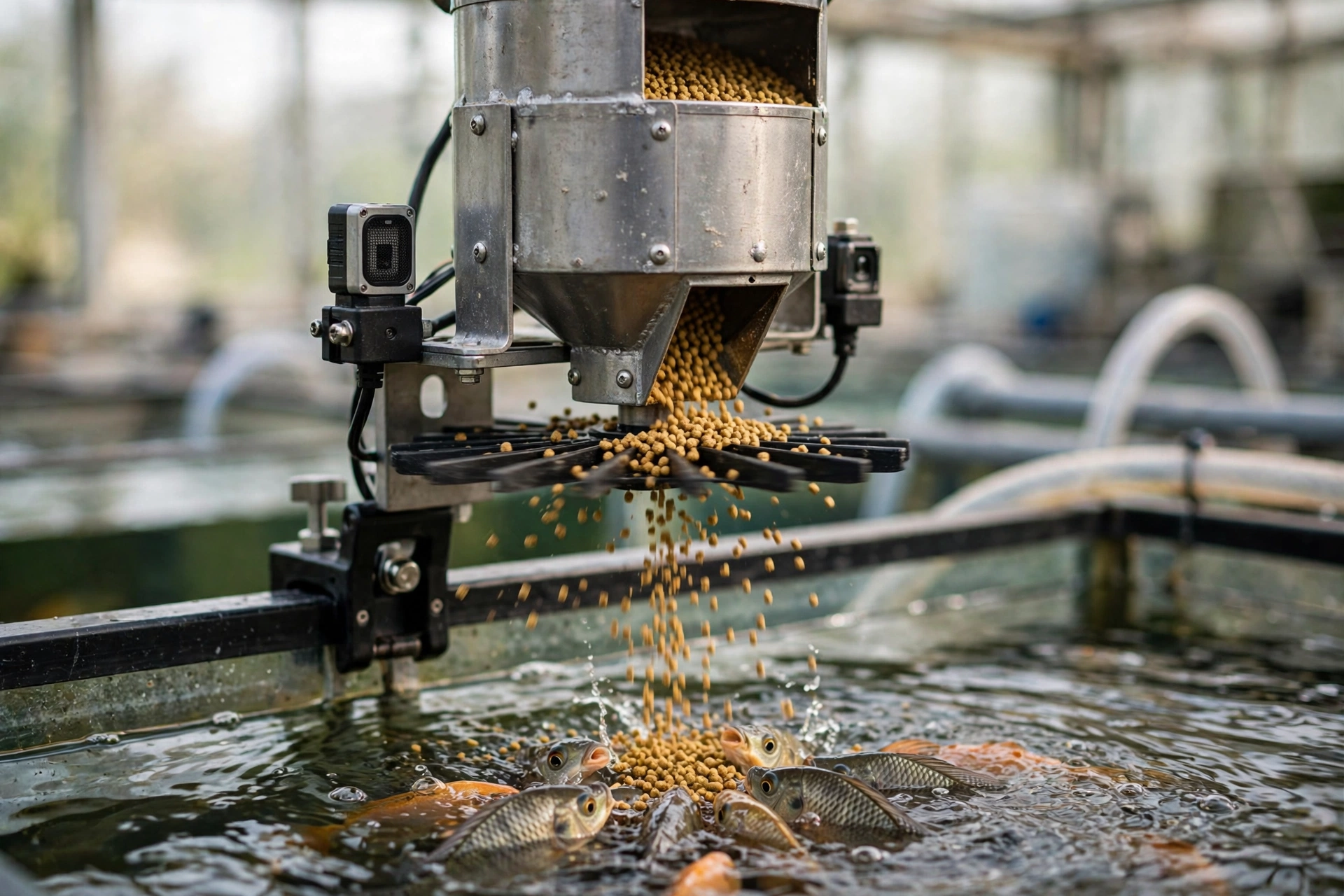
Dropping pellets in one spot leaves bold fish fed and shy ones hungry, so spreading matters. Most robots use a spinning disc that flings pellets in a wide circle, a blower that pushes them through a pipe across a pond or cage, or a moving arm that drops feed along the tank edge.
The best choice depends on the water’s shape. A round tank suits a disc in the middle. A long raceway suits a robot driving along the side. A sea cage suits a blower that can reach across a wide surface from one corner.
What kinds of fish feeding robots are there?
Fixed dispensers are the simplest type. They hang above one tank, hold a day or two of feed, and run on a schedule — ideal for hatcheries and small farms.
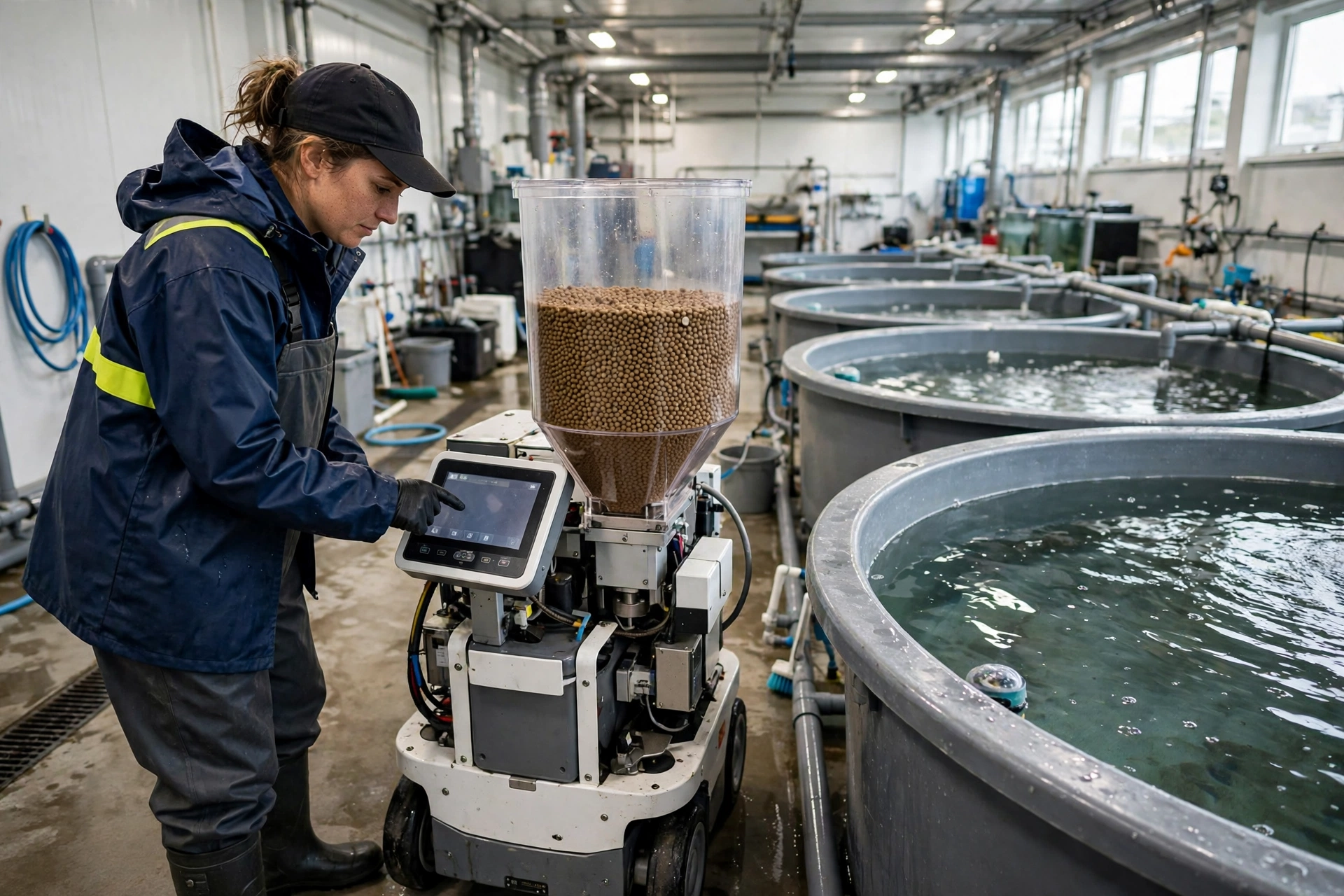
Mobile feeders move between tanks on wheels or rails, stopping at each to dispense a measured portion. Some carry their own hopper; others dock at a filling station. They suit indoor farms with rows of identical tanks.
Floating feeders work on ponds and sea cages: anchored barges with blowers, or small boats that steer themselves around a cage. They are built tougher and sealed against wind, waves, and salt water.
What sensors do fish feeding robots use?
Temperature and oxygen probes tell the robot whether the fish are likely hungry and whether the water can handle a meal. Cameras watch the surface and can spot pellets going uneaten. Load cells under the hopper weigh how much feed has gone out.
Some farms add acoustic sensors that listen for feeding sounds; when the splashing fades, the robot stops. Either way, the point is the same: feed only what the fish will eat, and know what happened afterwards.
What are the benefits for a fish farm?
Consistency comes first. Fish grow better on regular meals of the right size than on irregular handfuls, and a robot never forgets a feeding or arrives late.
Then there is less waste. Feed is one of a farm’s biggest costs, and pellets that sink uneaten are money on the tank floor. Measured portions cut that waste.
Time is the third gain. Feeding eats into every morning and evening; handing it to a machine frees staff for cleaning, health checks, and maintenance. The robot also logs what each tank got, so a farmer can spot a tank eating less than it should.
What are the limits and problems?
Pellets can bridge inside a damp hopper and block the flow until someone clears them. Salt water corrodes motors and electronics, so sea units need regular washing and part replacement. A power cut stops a fixed feeder just as surely as it stops a pump.
Sensors can misread, too: a camera can mistake ripples for feeding, and an oxygen probe drifts if it is not cleaned. Most farms still check the fish in person daily — the robot handles the routine, the farmer handles the judgement. Cost is the other limit: a mobile robot only pays off on a farm large enough to save real labour hours.
FAQs
Can a fish feeding robot feed different species?
Yes, if the pellet size and schedule suit each species. Most robots store a separate plan per tank, so one machine can serve trout and tilapia in different tanks.
Do fish feeding robots work at night?
Many do, and some species feed best in low light. A quiet dispenser can run night feeds without disturbing the fish — one reason farms buy them.
What happens if the robot breaks down?
Most units fail safe by stopping, so fish simply miss a meal. Farms keep a manual routine as backup and check the robot daily.
How much feed can a feeding robot hold?
A small dispenser may hold a day or two of feed; a large mobile unit can carry several days’ worth. Bigger hoppers mean fewer refills, but damp feed clumps more easily in them.
Is a fish feeding robot worth it for a small farm?
Often yes for a simple fixed dispenser, which pays for itself in saved time and less waste. A mobile robot only makes sense once hand feeding takes a large part of the working day.
Conclusion
Fish feeding robots work by combining a hopper, a measured dosing unit, a spreader, and a few sensors into one steady routine. They feed on time, in the right amount, and across the whole surface, keeping fish growing evenly and cutting the feed that sinks uneaten.
If you run a fish farm, start small: try one fixed dispenser on a single tank and compare its feed use and growth against a hand-fed tank over a few weeks. If the numbers look better, that tank is your case for expanding.
Further reading: Agricultural Robots | Fruit Picking Robots | Seeding Robots | Robot Arms | Aquaculture on Wikipedia | Aquaculture on Britannica