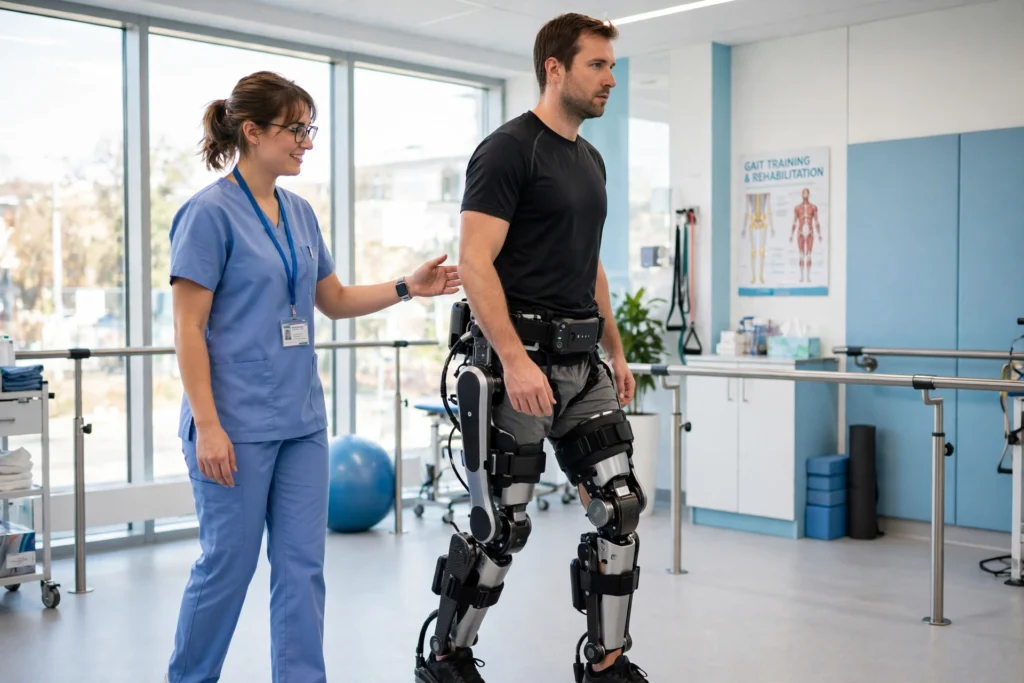
Rehabilitation robots work by guiding a patient’s limb through repeated, measured movements while sensors track force, position, and effort. A therapist sets the exercise, the robot provides as much help — or as much resistance — as needed, and the system records every repetition so progress can be seen clearly over time.
This article is general information about rehabilitation technology. It is not medical advice, and it does not replace guidance from a qualified clinician or therapist.
Key Takeaways
- Rehabilitation robots guide repeated therapeutic movements with adjustable help or resistance.
- Sensors measure position, force, and effort, giving therapists precise data instead of guesswork.
- The robots do not replace therapists; they extend what a therapist can do in a session.
- Recovery still depends on the patient’s own effort, consistency, and the underlying condition.
What Counts as a Rehabilitation Robot?
A rehabilitation robot is a machine built to help someone regain movement, strength, or coordination after an injury, a stroke, surgery, or a long illness. The best-known types are easy to picture: an exoskeleton that supports a leg while a patient practises walking, or a robotic arm that guides a hand through reaching exercises after a stroke.
The category is wider than that. Treadmill-based systems support a patient’s body weight while their legs move on a belt, tabletop devices rebuild shoulder control, and a robotic glove can gently open and close a patient’s fingers.
What ties them together is purpose. Unlike industrial robots, which are built for speed on a factory floor, rehabilitation robots are built for safe, close contact with people who are injured or weak — slow-moving, quick to stop, and adjustable to each person’s body and ability.
How Does a Rehabilitation Robot Guide a Movement?
A therapist decides what movement the patient needs to practise — say, lifting an arm to shoulder height — and the robot helps the patient do it, over and over again.
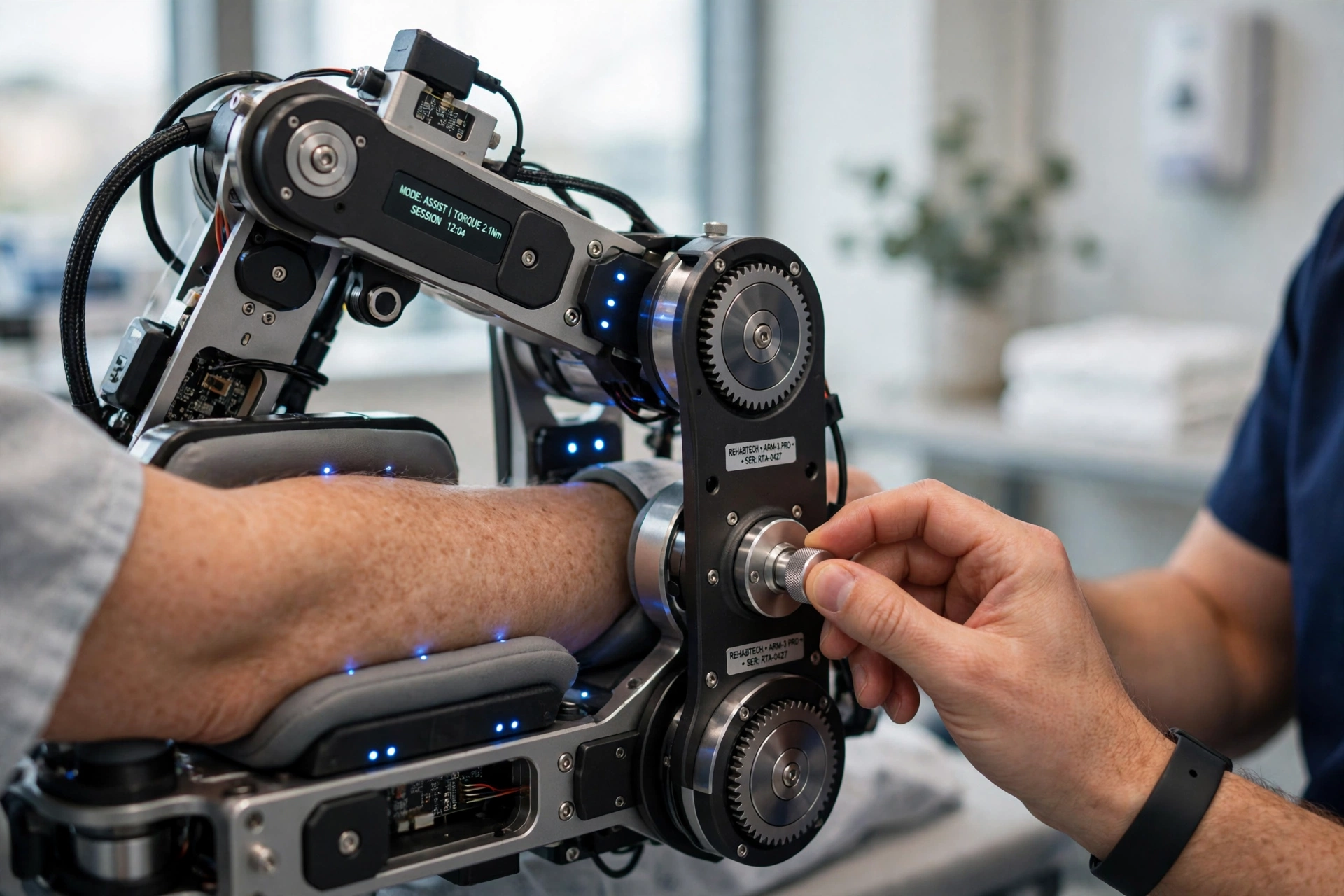
Most systems work in one of three modes. In passive mode, the robot does the moving and the patient’s limb goes along for the ride. This helps early on, when a patient cannot move the limb at all, because it keeps joints flexible and reminds the nervous system what the movement feels like.
In active-assist mode, the patient starts the movement and the robot fills in the missing effort. If the patient can lift their arm halfway, the robot supplies the rest. This is where the most useful work happens: the patient is genuinely trying, and the robot simply makes the attempt achievable.
In resistive mode, the robot pushes back. Once a patient has regained basic movement, the machine adds resistance to build strength, much like a weight machine at a gym — except the resistance can be tuned in tiny increments. A single session usually moves between these modes, and the robot remembers the settings, so the next session picks up where the last one ended.
What Do the Sensors Actually Measure?
The sensors turn a rehabilitation robot from an exercise machine into a clinical tool. A typical system tracks position, speed, force, and how smoothly the movement flows, all at once.
Position sensors tell the system exactly where the limb is in space. Force sensors measure how hard the patient is pushing — or how hard the robot needs to push to help. Together, they let the robot adjust in real time. If a patient tires halfway through a lift, the robot adds support within a fraction of a second. If the patient pushes too hard in the wrong direction, the robot eases off rather than fighting back.
This data also gives therapists something they never had before: numbers. Instead of judging progress by eye, a therapist can see that a patient’s reach improved by a few centimetres over a fortnight, or that their movement became measurably smoother. Many systems show the patient a simple display — a target to reach, a score, a game-like task — which turns a dull repetition into something worth trying for.
Underneath, the technology is closely related to factory robot arms and their control systems, but judged on safety and gentleness rather than speed.
Where Are Rehabilitation Robots Used?
You will find these machines mainly in hospitals and specialist rehabilitation clinics, where they sit alongside physiotherapy gyms and occupational therapy rooms. Stroke recovery is the biggest use: after a stroke, many patients need to relearn basic movements, and the high number of repetitions a robot can deliver is genuinely hard for a human therapist to match alone.
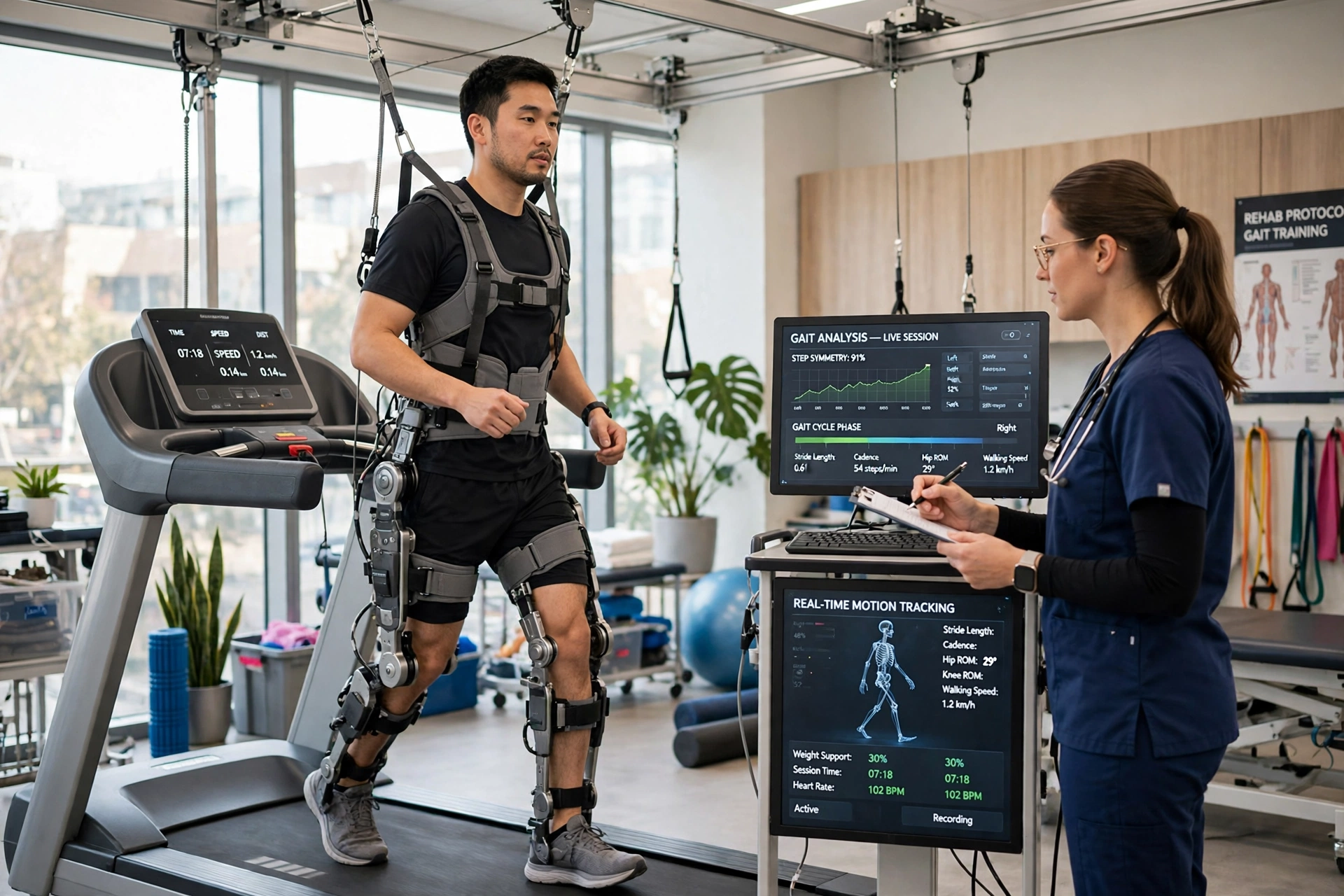
They are also used after spinal cord injuries, surgery, and sports injuries, and for children with cerebral palsy, where game-like exercises keep young patients engaged. Larger systems help patients practise walking with partial body-weight support; smaller ones focus on a single joint, such as the wrist.
Home use is growing, but slowly. A few simpler devices are designed for home use under a therapist’s remote supervision. The clinic remains the main setting for now, partly because the machines are expensive and partly because a therapist’s judgement is still central to using them well. New developments, including clinical trials and new devices, are tracked by outlets such as IEEE Spectrum’s robotics section.
What Are the Limits of Rehabilitation Robots?
For all their promise, these robots have real limits. First, they are not a shortcut. Recovery after a serious injury is slow, and no machine can replace the thousands of repetitions and sheer persistence that regaining movement requires. A robot can make those repetitions easier to deliver, but it cannot do the learning for the patient.
Second, cost and access are genuine problems. A full system is expensive to buy and maintain, so it is mostly found in larger hospitals and private clinics. Many patients still rely on traditional hands-on therapy, which remains effective and widely available.
Third, the evidence is still catching up. Studies show robot-assisted therapy can match conventional therapy for some patients and movements, but it is not clearly better across the board. What the robots offer is consistency, measurement, and far more repetitions per session.
Finally, a robot cannot read a patient the way a good therapist can — it cannot tell that someone is in pain, frustrated, or afraid. That is why the best programmes treat the robot as a tool the therapist uses, not as a replacement for the therapist.
Frequently Asked Questions
Do rehabilitation robots replace physiotherapists?
No. They are tools that therapists use. The therapist assesses the patient, sets the goals, chooses the exercises, and interprets the data the robot collects. The robot delivers the repetitions and the measurements; the clinical judgement stays human.
How long does a session with a rehabilitation robot take?
A typical session lasts 30 to 60 minutes, much like a conventional physiotherapy session. Sessions are usually scheduled several times a week over weeks or months.
Are rehabilitation robots safe?
They are designed with safety as a priority: they move slowly, limit the force they can apply, and stop if they detect unexpected resistance. Sessions run under professional supervision, and suitability depends on the individual patient.
Can rehabilitation robots help after a stroke?
They are widely used in stroke rehabilitation, particularly for relearning arm and hand movement, because repeated practice is one of the main drivers of recovery. Results vary, and a therapist decides whether robot-assisted therapy is appropriate.
How much do rehabilitation robots cost?
Clinic systems are expensive, which is why most patients use them through a hospital or clinic. Simpler home devices cost much less but offer fewer features, and coverage varies by country and insurer.
Conclusion
Rehabilitation robots work by combining guided movement, precise sensors, and careful supervision into a therapy tool that can deliver far more practice than hands-on treatment alone. They are not a replacement for a therapist, and they are not a shortcut to recovery — but for patients rebuilding movement after injury or illness, they offer consistency, measurement, and encouragement that can make a long process a little easier.
If you or someone you care for is considering robot-assisted therapy, the practical next step is to ask your doctor or physiotherapist whether it is available locally and whether it suits your situation. For a broader look at the field, see What Is Robotics? and the overview of rehabilitation robotics on Wikipedia.