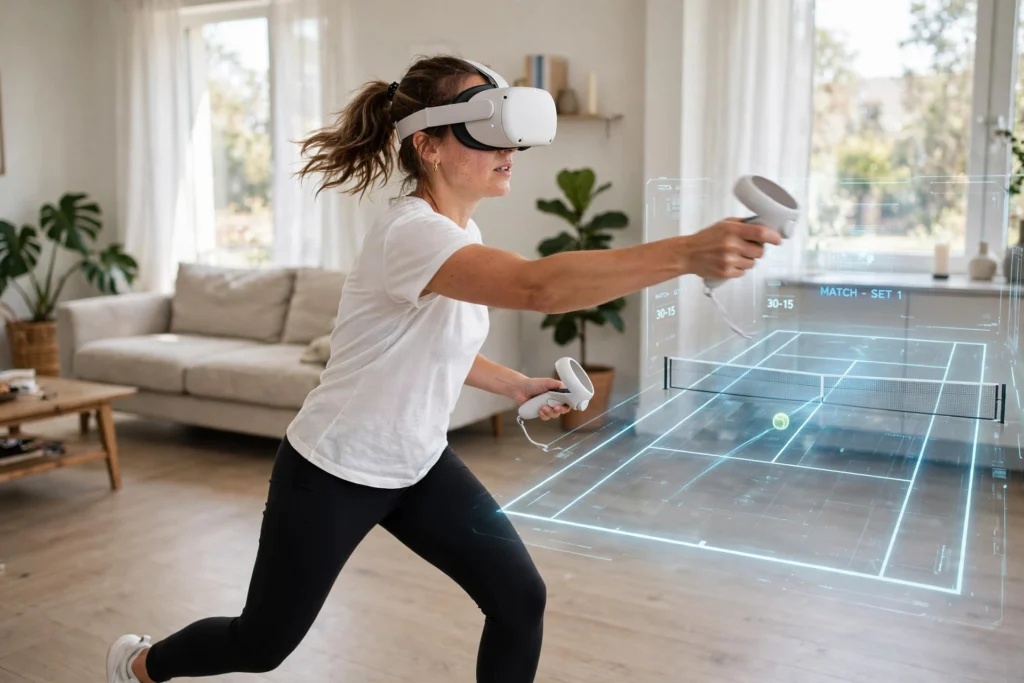
VR tennis puts a full tennis court inside your headset, so you can rally, serve, and play points without leaving your living room. Your headset tracks where you look and move, your controllers stand in for a racket, and the game turns each swing into a shot on a virtual court.
Key Takeaways
- VR tennis tracks your controllers and headset to turn real swings into shots on a virtual court.
- Timing and placement matter more than raw power, since most games use simplified physics.
- Play solo rallies, practice drills, or online matches against other players.
- Start with about two metres square of clear space, wrist straps on, and short sessions.
- It can sharpen timing and footwork, but it will not replace time on a real court.
How does VR tennis track your swing?
The core trick is the same one behind most virtual reality: the headset follows your head, and the controllers follow your hands. Cameras on the headset watch the controllers, while motion sensors inside each one measure speed and direction. Together, they tell the game where your “racket” is and how fast it is moving at contact.
That is why the swing itself matters more than pressing a button. A short, well-timed forehand usually beats a wild arm-flail, because the game reads the angle and speed of the controller at contact. Most games add a little help — a generous contact zone, or a touch of aim assist — so slightly mistimed shots still feel fair.
What does a VR tennis match actually feel like?
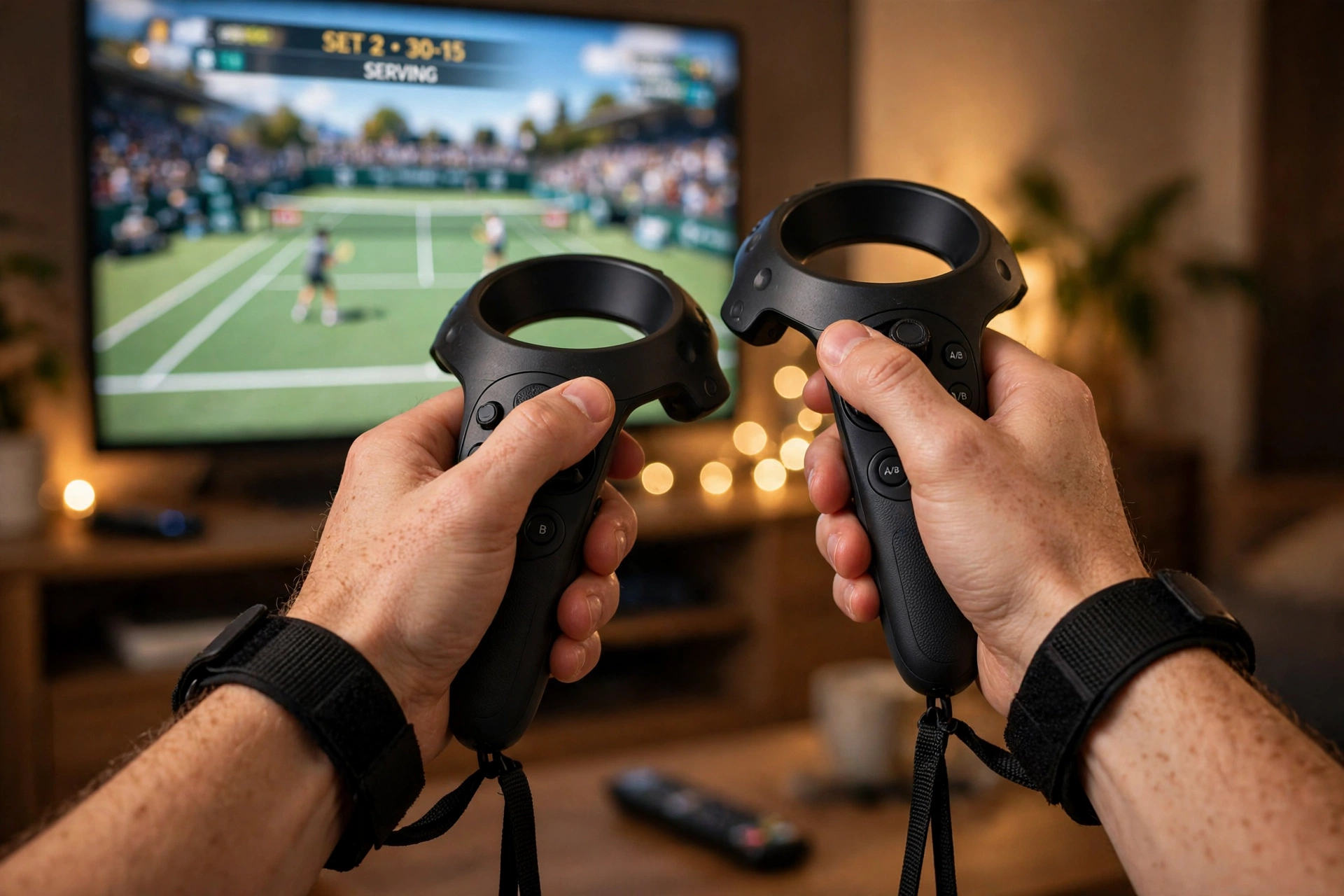
You stand on a virtual baseline, the court stretches out in front of you, and the ball comes over the net with a soft thud you can almost feel. There is no weight in your hand beyond the controller, so the first few rallies feel odd — your brain expects a racket and gets a small plastic grip instead. Most players adjust within a few minutes, and the rally takes over.
Movement feels most different. You cannot run across a real court in your living room, so games move you for you — small steps, a teleport to the ball, or an automatic slide along the baseline. You play mostly with your upper body and timing, not your legs, which keeps the game playable in a small room. Our guide to VR headsets explains the screens, lenses, and tracking behind it.
How do scoring, rallies, and opponents work?
Scoring follows the same rhythm as real tennis: 15, 30, 40, game, set, match, with tie-breaks in most games. Serves are a simple toss-and-swing motion, and the game calls balls in or out for you. Some titles let you tweak the rules — shorter sets, no-ad scoring, or rally-only practice — handy when you only have twenty minutes.
Opponents come in three flavours. Practice modes feed you balls so you can repeat one shot until it clicks. AI opponents range from gentle rally partners to fast players who punish lazy footwork. Online matches put you against real people, usually near your level after a few matches — which is where it gets properly competitive, because a human opponent will spot a weak backhand far quicker than any AI will.
Can VR tennis improve your real game?
It can help, with limits. The timing of a split step, reading where a ball is going, and keeping your eye on contact all transfer reasonably well. Players who practise in VR often say their reaction time and shot selection feel sharper back on a real court. Footwork drills and target practice are genuinely useful, because repetition builds those habits.
What it cannot do is teach you the feel of a real racket. There is no string bed, no weight, and no vibration on contact, so your grip and the fine touch of a drop shot do not carry over. It is a training aid, not a replacement. The pattern is familiar: VR boxing builds fitness and timing without teaching you to take a punch, and our guide to VR sports training looks at how this kind of practice fits into a wider routine.
What space and gear do you need?
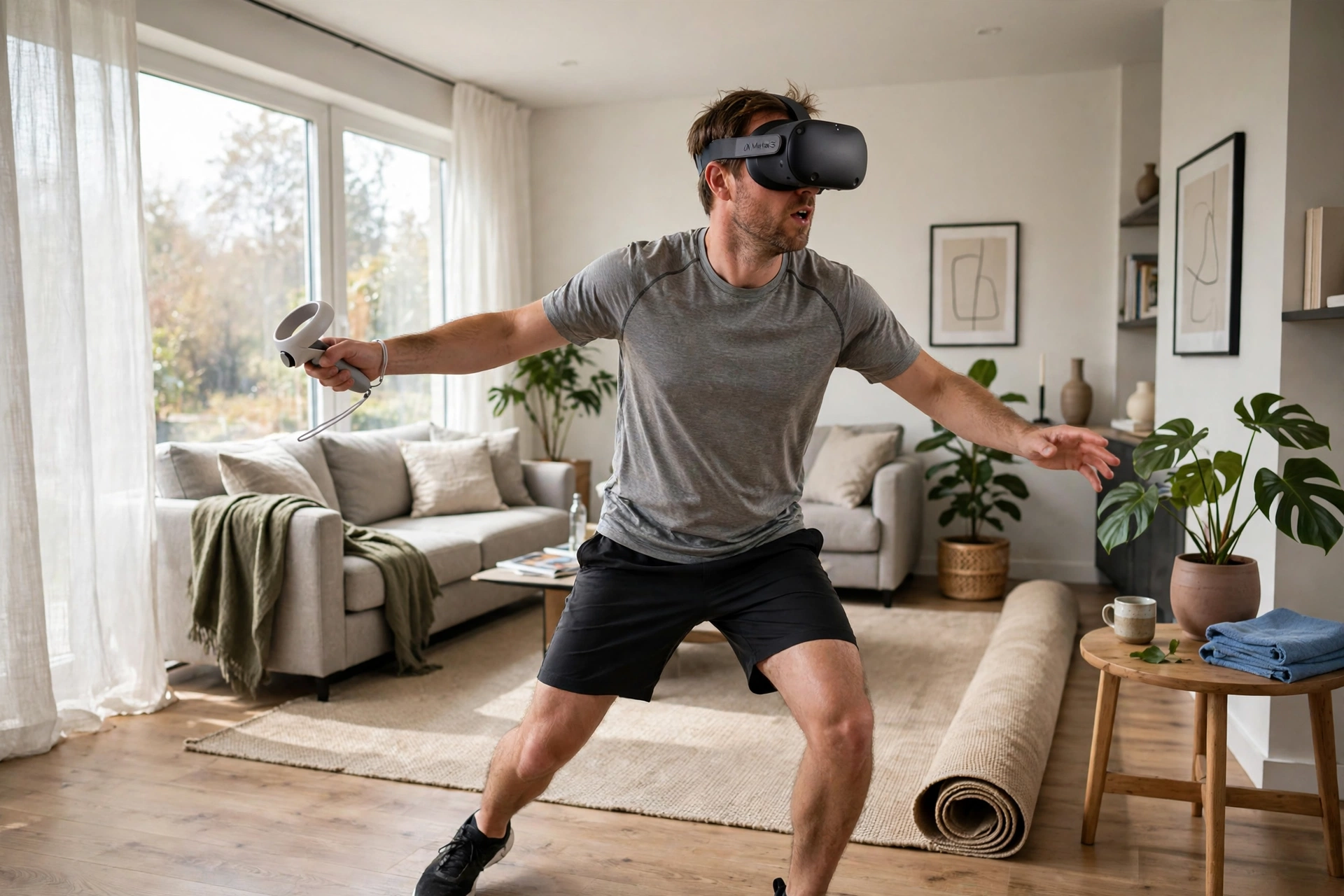
You need a standalone headset and its two controllers — the kind sold as a complete kit, such as the Meta Quest range, works well. No extra sensors are needed for most tennis games, since the headset’s built-in cameras handle the tracking. A clear patch of floor about two metres square is enough; push furniture, rugs, and anything breakable out of reach first.
Set your play boundary carefully and keep it switched on. It is the invisible fence that warns you when you are near a wall or a table, and the most useful safety feature in the headset. Wear the wrist straps, tighten them properly, and take the headset off between sets if you feel warm or tired. Good lighting helps tracking too — a dim room can make the controllers lose their place mid-rally.
What should you watch out for?
The two things to respect are your room and your body. A full tennis swing covers more space than you think, especially on a backhand, so check what is behind you as well as in front of you. Ceiling fans, lamps, and low shelves are the usual casualties. If you share the room, let others know you are playing — a headset blocks your view of them completely.
The second is motion and fatigue. Some players feel slightly queasy during fast rallies, especially when the game moves their viewpoint for them. Short sessions help, and stopping at the first sign of discomfort beats pushing through. Treat it like any workout: warm up, drink water, and rest your shoulders. Our guide to VR fitness covers building up session length without overdoing it.
Frequently Asked Questions
Do I need a real tennis racket to play VR tennis?
No. The controllers act as your racket, and most games are designed around them. Some players add a controller attachment shaped like a racket handle for a more familiar grip, but it is optional.
Is VR tennis a good workout?
It can be. A lively match keeps your arms moving and your heart rate up, and longer rallies add small steps and lunges. It is lighter than a real match, though, since you cover far less ground.
Will VR tennis work in a small room?
Usually, yes, with roughly two metres square of clear floor. The game moves your player for you, so you do not need a full court’s worth of space — but you do need enough room to swing safely.
Does VR tennis help beginners learn the game?
It is a friendly way to start. The rules, scoring, and court layout are all shown for you, and practice modes let you repeat shots without feeling rushed. It works best alongside real coaching, though, since a coach can correct your grip and stance in ways a game cannot.
Conclusion
VR tennis is at its best when you treat it as a fun, practical way to play more tennis — not a perfect replica of the real thing. Set up a clear space, put your wrist straps on, and start with a short practice session or a gentle AI match. If the rallies click, try an online match or a longer set. And when you next get onto a real court, you may find your eyes are quicker and your decisions sharper — which is exactly what a good training game should do.