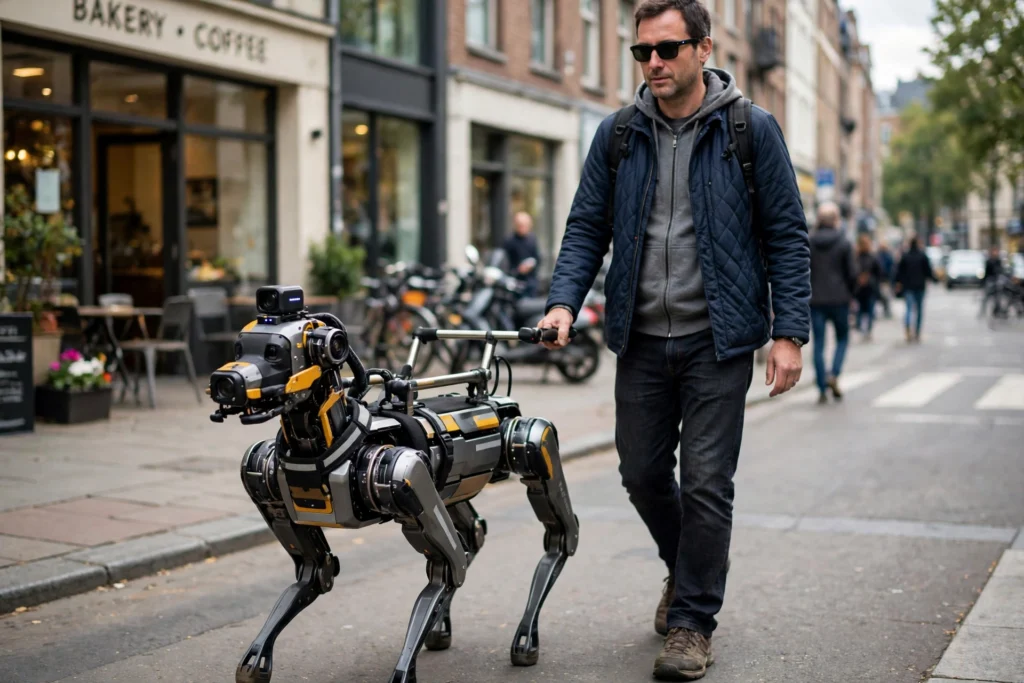
Robot guide dogs are four- or six-legged machines that guide blind people the way a trained guide dog does. They scan the path with cameras and LiDAR, steer around obstacles, and pass directions through a rigid handle and spoken prompts. They are still research projects, not products you can buy, but field tests in China and Scotland show real promise.
Key Takeaways
- Robot guide dogs map the path with cameras, LiDAR, and depth sensors, then steer around obstacles.
- The user holds a rigid handle, so the robot can tug, slow down, or stop to signal what is happening.
- They can read traffic lights and follow planned routes — two things a real guide dog cannot do.
- They are still in testing: stairs, rough ground, bad weather, and short battery life all limit them.
- A trained guide dog remains the gold standard, and robot guides aim to add choice, not replace dogs.
Why Are Researchers Building Robot Guide Dogs?
A trained guide dog changes its owner’s life, but supply is the problem. Training one dog takes around two years, and the wait for a match can stretch for months. In China, researchers at Shanghai Jiao Tong University have pointed out that there are just over 400 guide dogs for almost 20 million blind people. That gap is the reason robot guide dogs exist.
A machine needs no feeding or rest, and it can be copied once the design works — which is why universities keep funding the research.
How Does a Robot Guide Dog Actually Work?
Most robot guide dogs are built on a quadruped platform — the same kind of four-legged walking robot used in warehouses and on construction sites. A few designs, including the one from Shanghai Jiao Tong University, use six legs for extra stability. The legs matter because the robot must step over kerbs and keep its balance on uneven ground while a person leans on its handle.
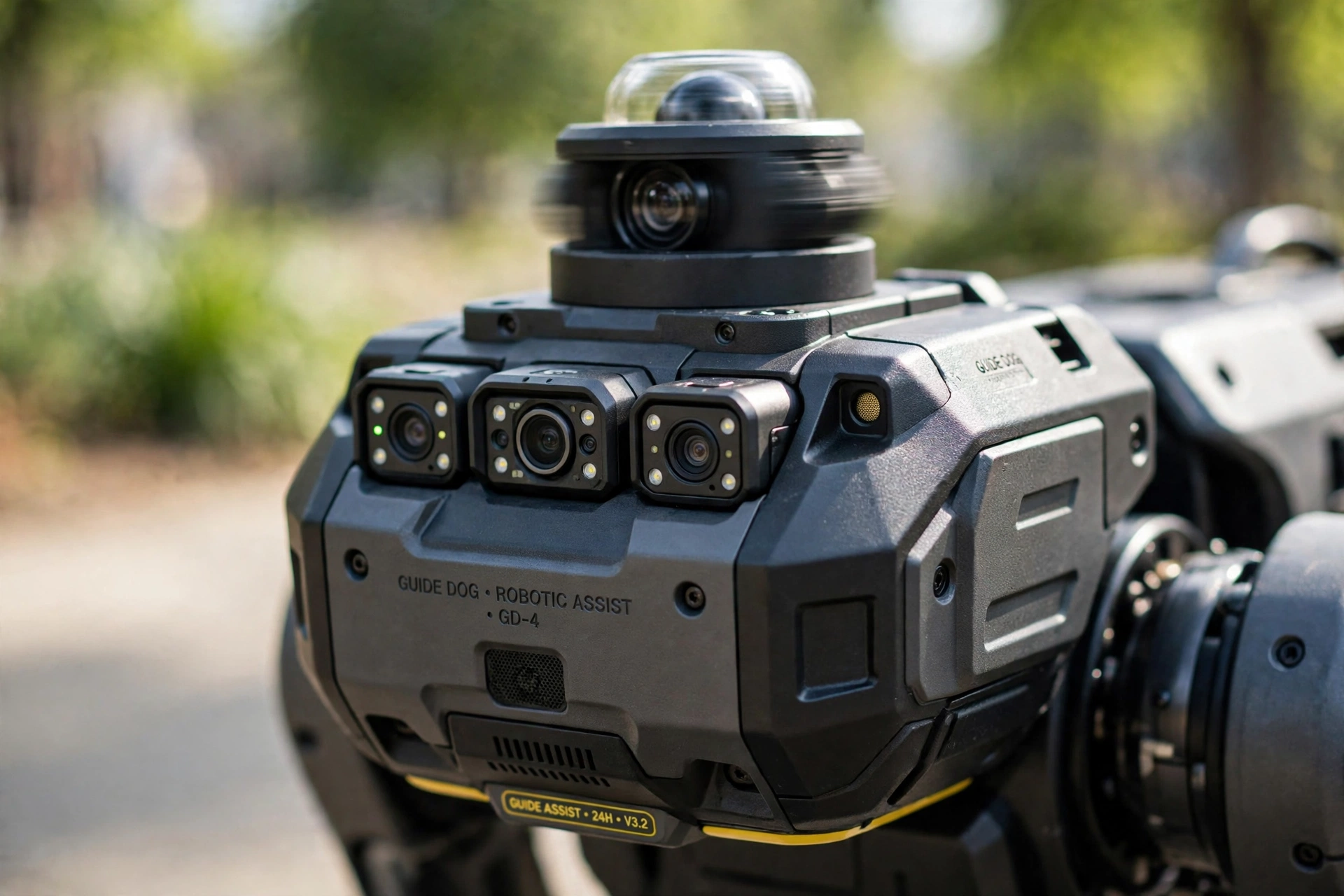
The sensing stack does the real work. Cameras watch the path, LiDAR measures distances, and depth sensors fill in the gaps close to the ground. Together they build a live map of walls, people, parked bikes, and low branches, and the robot plans a route around them at a pace its user can follow.
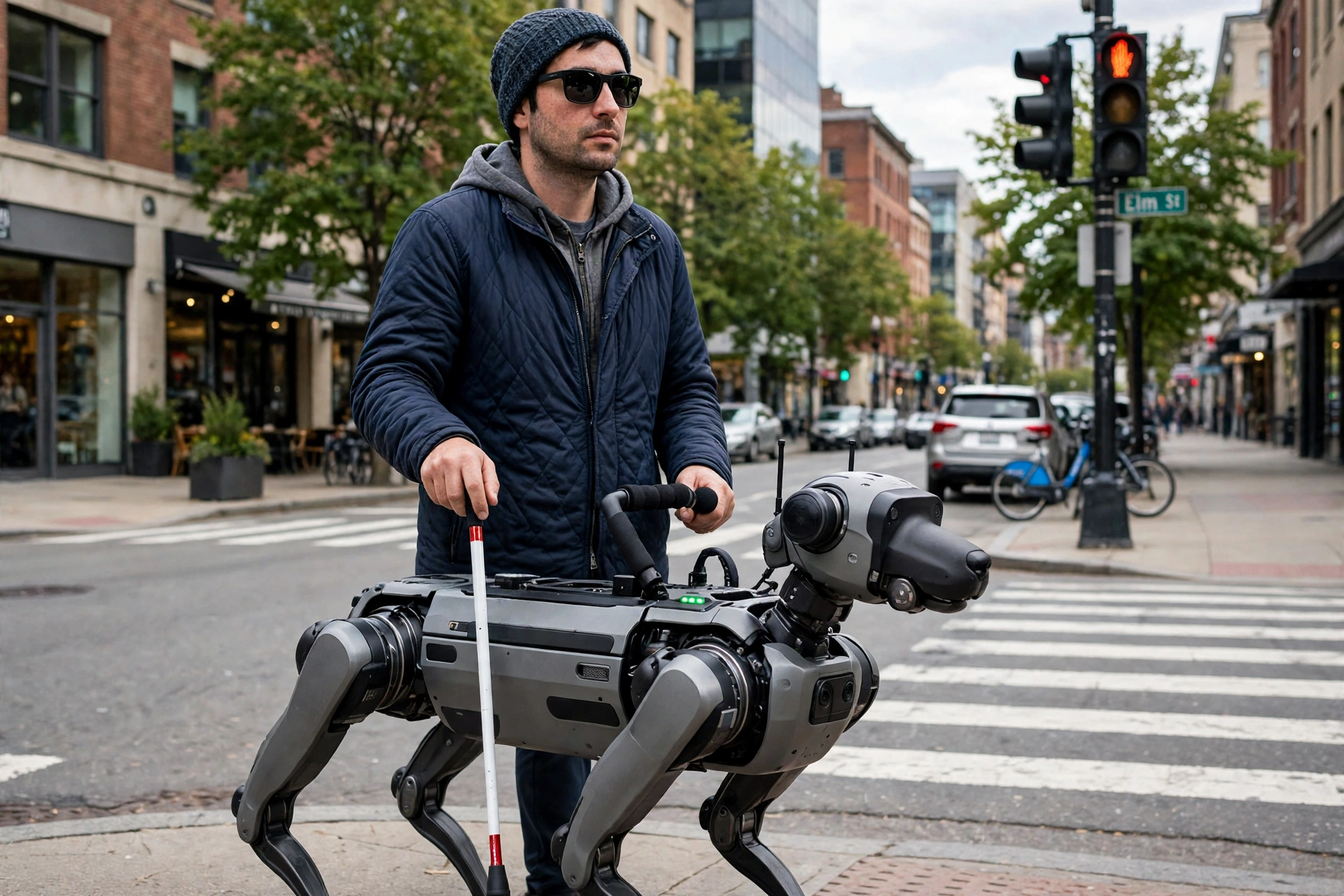
Communication runs both ways through the handle and through voice. The rigid handle is the main channel: a gentle pull left, a slow-down before a kerb, a full stop when something blocks the way. Many prototypes also listen to spoken commands, such as “take me to the bus stop”, and answer with updates like “steps ahead”.
What Can a Robot Guide Dog Do That a Real Dog Cannot?
The clearest advantage is traffic lights. A real guide dog cannot tell whether a light is red or green; it waits for its owner to judge the traffic and give the command to cross. A robot guide dog can read the light itself, and that removes one of the riskiest moments in a blind pedestrian’s day. The second advantage is consistency: a robot guide dog does not tire, lose focus, or have an off day, and for someone who walks the same route to work every morning, that predictability is worth a lot.
Robot Guide Dog vs Trained Guide Dog vs White Cane
| Feature | Robot guide dog | Trained guide dog | White cane |
|---|---|---|---|
| Reads traffic lights | Yes, with cameras | No | No |
| Learns new routes | From maps and GPS | From repeated walks | User memorises the route |
| Works in rain and snow | Limited, sensors struggle | Yes, with a coat | Yes |
| Needs power or food | Battery, a few hours | Food, rest, vet care | Nothing |
| Available today | Trials only | Yes, after a long wait | Yes, widely available |
| Cost to the user | Not yet priced | Usually free via charities | Low |
The trade-off is plain: the cane is cheap but gives the least help, the trained dog gives the most help but is scarce, and the robot sits in the middle.
Where Are Robot Guide Dogs Being Tested?
At Shanghai Jiao Tong University, Professor Gao Feng’s team has built a six-legged guide robot roughly the size of an English Bulldog, and blind volunteers have tested it on real streets since 2024. It walks at up to three metres per second and recognises traffic light signals and voice commands, replying in under a second.
In Glasgow, the RoboGuide project at the University of Glasgow has run trials with volunteers from the Royal National Institute of Blind People Scotland, guiding people through the Hunterian Museum. The focus is indoor navigation, where GPS does not work and a robot that can learn a building’s layout is genuinely useful. Researchers in South Korea add one more idea: software that watches for hazards at human height, like overhanging branches, which a low-mounted sensor would otherwise miss.
What Still Limits Robot Guide Dogs?
Stairs are the biggest everyday problem. A four-legged robot can climb a kerb, but a full flight of stairs is slow and risky, and an escalator is harder still. Rough ground, mud, and deep snow confuse the sensors and the balance system, so most prototypes stick to pavements and indoor floors.
Battery life is the second limit. A few hours of walking is fine for a trip to the shops, but a full day out needs a recharge or a spare battery, and a guide dog that stops mid-journey is worse than no guide at all. Then there is trust: handing your safety to a machine takes time, and early testers say the handle’s tugs take a while to learn. Cost is unresolved too — none of these robots has a retail price yet.
Frequently Asked Questions
Can I buy a robot guide dog today?
No. Every robot guide dog here is a research project or a field trial, with no shop selling one yet and no price announced. If you need help walking now, a white cane or a trained guide dog through a charity is the realistic option.
Are robot guide dogs meant to replace real guide dogs?
No. The aim is to give people who cannot get a trained dog another option. Real dogs bring judgement, warmth, and companionship that no machine matches.
How fast can a robot guide dog walk?
The Shanghai Jiao Tong University prototype walks at up to three metres per second. In practice the robot matches its user’s pace.
Do robot guide dogs work indoors?
Yes, and indoors is where some of them work best. The Glasgow RoboGuide project is built for museums, hospitals, and shopping centres, where it learns routes between rooms without needing GPS.
What happens if the robot’s battery runs out?
Current prototypes warn the user well before the battery is low, and the user can fall back on a white cane. A future version would need a battery that lasts a full day, or a quick-swap pack.
The Bottom Line
Robot guide dogs are not ready to replace trained dogs, and they may never fully do so. But the idea behind them is sound: combine a walking robot’s legs with cameras, LiDAR, and a handle, and you get a guide that never tires, reads traffic lights, and can be copied for everyone who needs one. The field tests in Shanghai and Glasgow show the pieces working — now the job is stairs, batteries, weather, and trust.
If this technology interests you, follow the university projects rather than waiting for a product launch. The Shanghai Jiao Tong University team and the University of Glasgow’s RoboGuide project both publish updates as their trials progress.
Further reading: Shanghai Jiao Tong University robot guide dog (https://global.sjtu.edu.cn/hmt/news/view/1775) and Co-Ego navigation research for guide dog robots (https://arxiv.org/html/2603.20121)