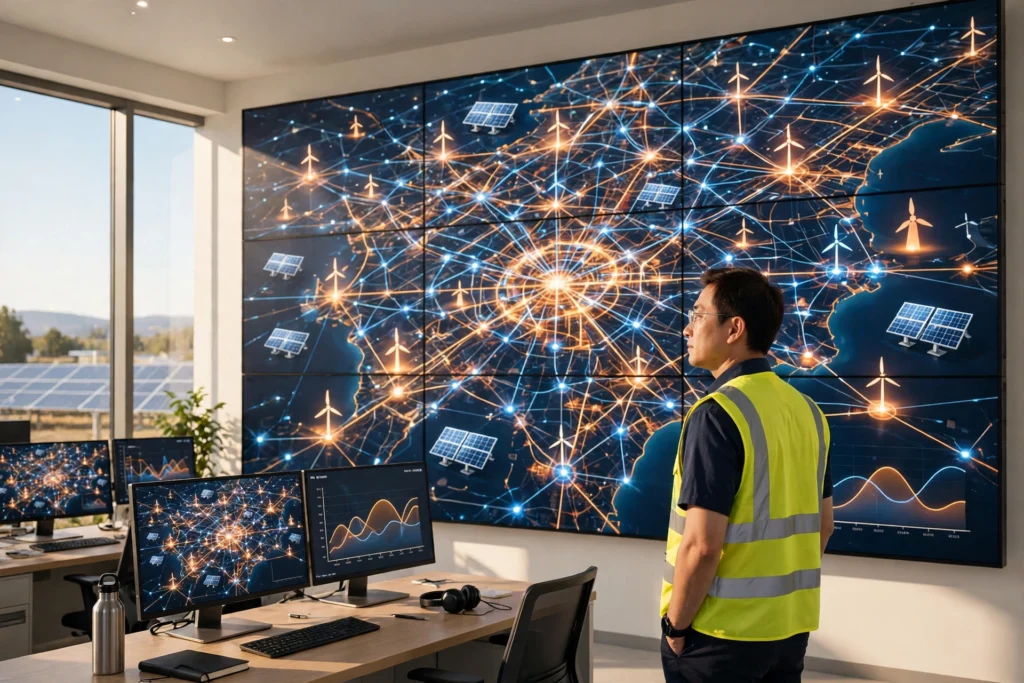
AI in energy means using artificial intelligence to help produce, move, and use electricity more sensibly. It forecasts demand, steadies grids fed by changeable wind and solar power, spots failing equipment early, and trims waste in homes and workplaces.
Key Takeaways
- AI in energy is mostly about prediction: how much power people will need, and how much wind and solar farms will produce.
- Grids use it to balance supply and demand minute by minute, which matters more as renewables grow.
- It helps engineers find faults before blackouts, and helps households use less power without thinking about it.
- It has real limits: it needs good data, it cannot fix old wires, and running AI itself uses electricity.
What does AI in energy actually mean?
Energy has always run on forecasts: operators guess how much electricity a city will need at 7pm, and plan around it. What changed is the amount of data involved, and how fast it arrives.
A modern grid juggles thousands of sources at once — power stations, wind farms, rooftop solar, batteries, electric cars — and keeping all of that in balance by hand is getting harder. That is where machine learning comes in: models trained on years of records spot patterns a person would miss, then suggest what to do next. People still make the calls. The AI does the counting.
How does AI help keep the lights on?
The first job of any grid is balance: electricity must be generated at almost exactly the rate it is used. Traditionally, operators kept spare capacity idling just in case. That works, but it wastes fuel and money.
AI helps in two ways. First, it predicts demand more precisely, so less spare capacity needs to sit running: a model that has seen years of evenings — cold snaps, big match nights, heatwaves — can estimate tonight’s peak within a narrow range. Second, it reacts faster than a person can, switching on batteries or asking flexible users to pause for a few minutes when demand jumps.
This matters most where renewables make up a large share of supply: a gas plant can be turned up on request, but a wind farm cannot be asked to make more wind. So the grid has to plan around the weather, and AI weather forecasting makes that planning possible.
What can AI do with wind and solar?
Wind and sunshine are free, but unreliable. AI helps in three practical ways.
It forecasts output. Combining weather models with data from each turbine or panel — blade angle, cloud cover, panel temperature — it predicts how much power a site will produce over the next hours and days.
It squeezes more from each site: turbines angled slightly differently, panels cleaned when dust is costing output, batteries charged when power is cheap and plentiful.
And it helps decide where to build next: planners can test thousands of possible wind farm layouts against years of wind data. The International Energy Agency’s Energy and AI report looks at how these uses are developing.
How does AI spot faults before they cause blackouts?
Much of the grid is old, and transformers and cables usually fail at the worst moment — during a storm or a heatwave. Replacing everything at once is not realistic, so operators need to know which parts are most likely to fail first.
That suits AI well. Sensors on a transformer record temperature, vibration, and the chemical makeup of its cooling oil, and a model trained on similar units can notice a slow drift — a temperature creeping up over weeks — and flag it for inspection before it becomes an emergency.
Drones help too: computer vision models can scan photos of power lines and spot cracked insulators, rust, or branches growing too close. Intel describes how energy companies use this kind of inspection and analytics in its guide to AI in the energy industry. Getting the right crew and spare part to the right substation on time is a logistics problem too, and one of the quieter ways AI in logistics overlaps with energy work.
What does AI in energy mean at home?
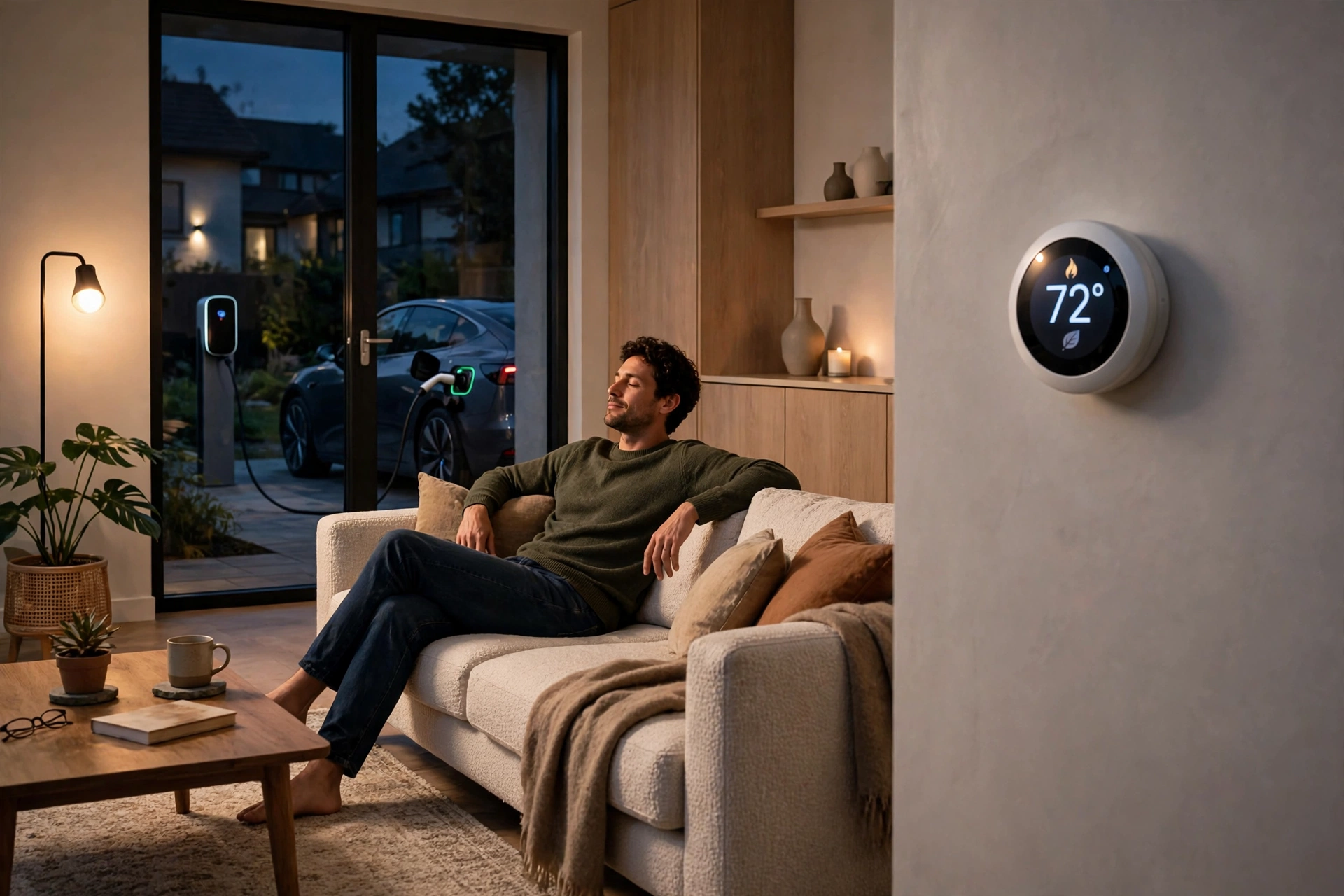
Most of us will never see a substation, but AI in energy shows up in ordinary homes too. A smart thermostat learns when you are usually out and eases off the heating instead of warming an empty house. Some tariffs charge your electric car overnight, when demand is low, and pause charging during the evening peak.
The savings for one household are modest. Across a whole city, they are not.
Energy tasks, with and without AI
| Task | Without AI | With AI |
|---|---|---|
| Predicting demand | Rough estimates from past averages | Hour-by-hour forecasts from weather and usage data |
| Balancing wind and solar | Large spare capacity kept running | Batteries and flexible demand fill the gaps |
| Finding faults | Fixed schedules, or waiting for a failure | Sensors flag risky equipment weeks ahead |
| Planning new wind farms | A few layouts tested by hand | Thousands of layouts tested on years of wind data |
| Home energy use | Heating and charging on fixed timers | Learns your routine and shifts use to cheaper, cleaner times |
What are the limits of AI in energy?
AI in energy is useful, but it is not magic. First, it is only as good as its data. Much grid equipment was installed before sensors were cheap, so the data is patchy.
Second, it cannot rebuild the grid. Software can squeeze more from existing wires, but at some point a town needs a bigger cable, and no model can dig that trench.
Third, AI itself uses electricity. Training large models and running data centres takes real power. It is one of the ironies of the field: the tool that helps save energy also consumes it.
Finally, there is security: a grid managed by software can be attacked through software, so energy companies treat their AI systems as critical infrastructure, with strict access controls and human oversight.
Frequently asked questions
Will AI make my electricity bill cheaper?
It can help, mainly by cutting waste — better forecasting means less spare capacity sitting idle, and smart tariffs let you use power when it is cheapest. But bills also depend on fuel prices and network costs, so AI alone will not slash them.
Is AI in energy only about renewable power?
No, though renewables are where it helps most. It is also used in gas and oil operations, nuclear plant maintenance, and the everyday work of running grids, whatever the source of the power.
Can AI predict a blackout?
Not exactly. It can estimate which equipment is most likely to fail and when demand might outrun supply, giving operators time to act. But storms and sudden failures can still catch any system out.
What should I do if I want to use less energy at home?
Start with the easy wins: a smart thermostat, charging an electric car overnight on a cheap tariff, and shifting laundry and dishwashing out of the evening peak.
The bottom line
AI in energy is not about replacing engineers with machines. It is about giving them a better view of a system that has grown too big and too fast-moving to manage by feel alone — and judging the technology by what it actually saves, not what it promises.
If you want to try it at home, check whether your supplier offers a smart tariff, and shift one regular job — charging, laundry, or heating water — to off-peak hours.
Further reading: IEA, Energy and AI (https://www.iea.org/reports/energy-and-ai); Intel, Artificial Intelligence (AI) in the Energy Industry (https://www.intel.com/content/www/us/en/learn/ai-in-energy.html).