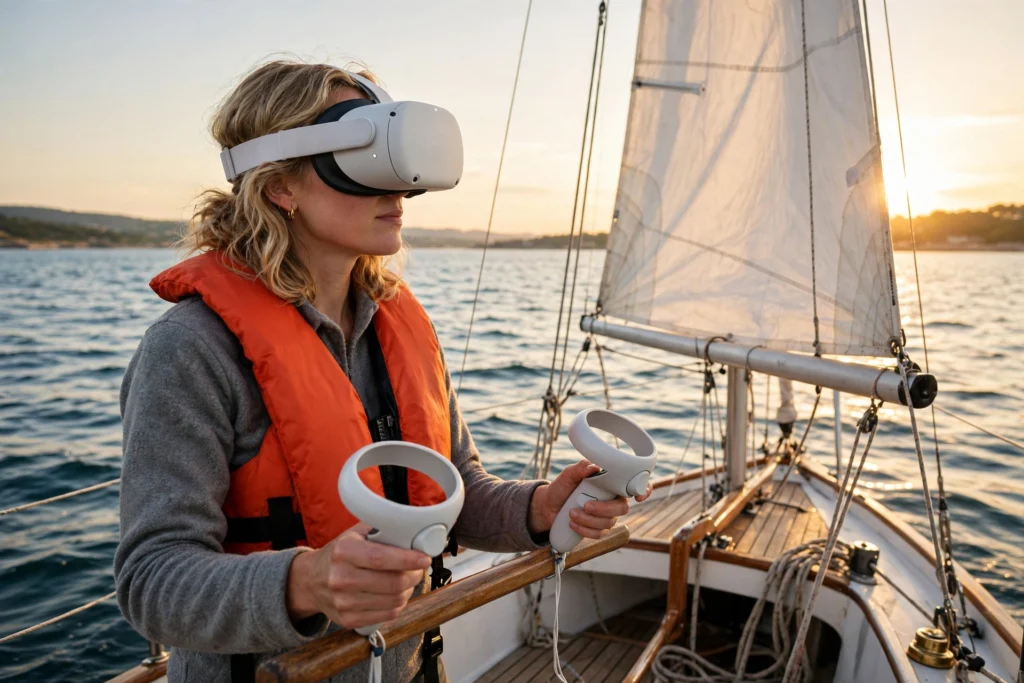
VR sailing puts you at the helm of a boat that isn’t there. You pull on a headset, pick up the controllers, and you’re standing on a deck, trimming a sail and steering for a mark on the horizon. It feels surprisingly close to the real thing — and for a complete beginner, that’s the point.
Key Takeaways
- VR sailing teaches the core ideas — steering, sail trim, tacking, and reading the wind — in a safe, repeatable space.
- The leading app is MarineVerse Sailing Club on Meta Quest, with structured lessons from sailing school NauticEd.
- You still need real water time to call yourself a sailor; VR builds confidence, not sea sense.
- A standalone headset and the app cost far less than a single weekend sailing course.
- Start with short sessions and a clear play space, with a chair nearby if you feel wobbly.
What does VR sailing actually feel like?
The moment the headset goes on, the living room disappears. You’re on a small yacht, the mainsail is up, and a ribbon on the sail is fluttering. Your left hand holds the tiller, your right hand works the sheet — the rope that controls the sail. Pull it in and the boat leans into the wind and speeds up; ease it out and the sail flutters and the boat slows.
That’s the trick VR pulls off: it turns an abstract idea into something your hands can feel. Reading about “points of sail” is dull; feeling the boat slow when you sail too close to the wind, then surge forward as you bear away, teaches the same lesson in ten seconds.
Most sessions run on a standalone headset such as a Meta Quest 3 — no cable, no gaming PC. The headset tracks your gaze and hands while the app builds the boat, sea, and wind around you. New to headsets? How Do VR Headsets Work? explains the screens, lenses, and tracking behind the illusion.
What can you learn in VR sailing?
More than you’d expect, and less than you’d hope.
The basics come first. MarineVerse Sailing Club walks you through boat parts, steering, and sail trim in short lessons built with NauticEd, a real sailing education provider. You learn to tack — turn the bow through the wind — and to gybe, the downwind turn that catches beginners out. You practise holding a course, reading the wind, and docking in tight spaces where a mistake costs nothing but pride.
Racing is where it gets addictive. MarineVerse Cup turns those lessons into races against other players, with starts, marks, and right-of-way rules. Losing because you mistimed a tack stings just enough to make you practise it again until it clicks — the part that transfers best to real water.
Here’s what VR can’t teach you: the weight of a real tiller in a gust, the way a boat heels until your stomach drops, reading a real sky for weather, or tying a knot under pressure. Treat it as a flight simulator for sailors — brilliant for procedures and confidence, no substitute for the real thing.
VR sailing vs real lessons vs sailing games
| VR sailing | Real sailing lessons | Flat-screen sailing games | |
|---|---|---|---|
| Cost to start | Headset plus app | A weekend course costs several times more | A game and a console or PC |
| Risk of mistakes | None — reset and try again | Real, though an instructor is beside you | None, but the controls feel abstract |
| What your hands learn | Steering, trimming, timing | Everything, including balance and ropes | Button presses, mostly |
| Weather and seasons | Any day, any weather | Cancelled in bad weather | Any day, any weather |
| Best for | Beginners building confidence | Anyone who wants to sail for real | Relaxing fun with a sailing theme |
Do you need a big room or fancy gear?
No, and that’s part of the appeal. A standalone headset is enough, and you can play standing or sitting — sitting is sensible at first, because your body expects the boat to move and it doesn’t. That mismatch is also why some people feel queasy; How Does VR Motion Sickness Happen? covers the cause and the fixes, like shorter sessions and a fan on your face.
You do need a clear patch of floor. How Does VR Room Mapping Work? explains the safe boundary your headset sets up — and you’ll be reaching for imaginary ropes and turning to check the sail behind you, so clear the coffee table and give yourself a couple of metres.
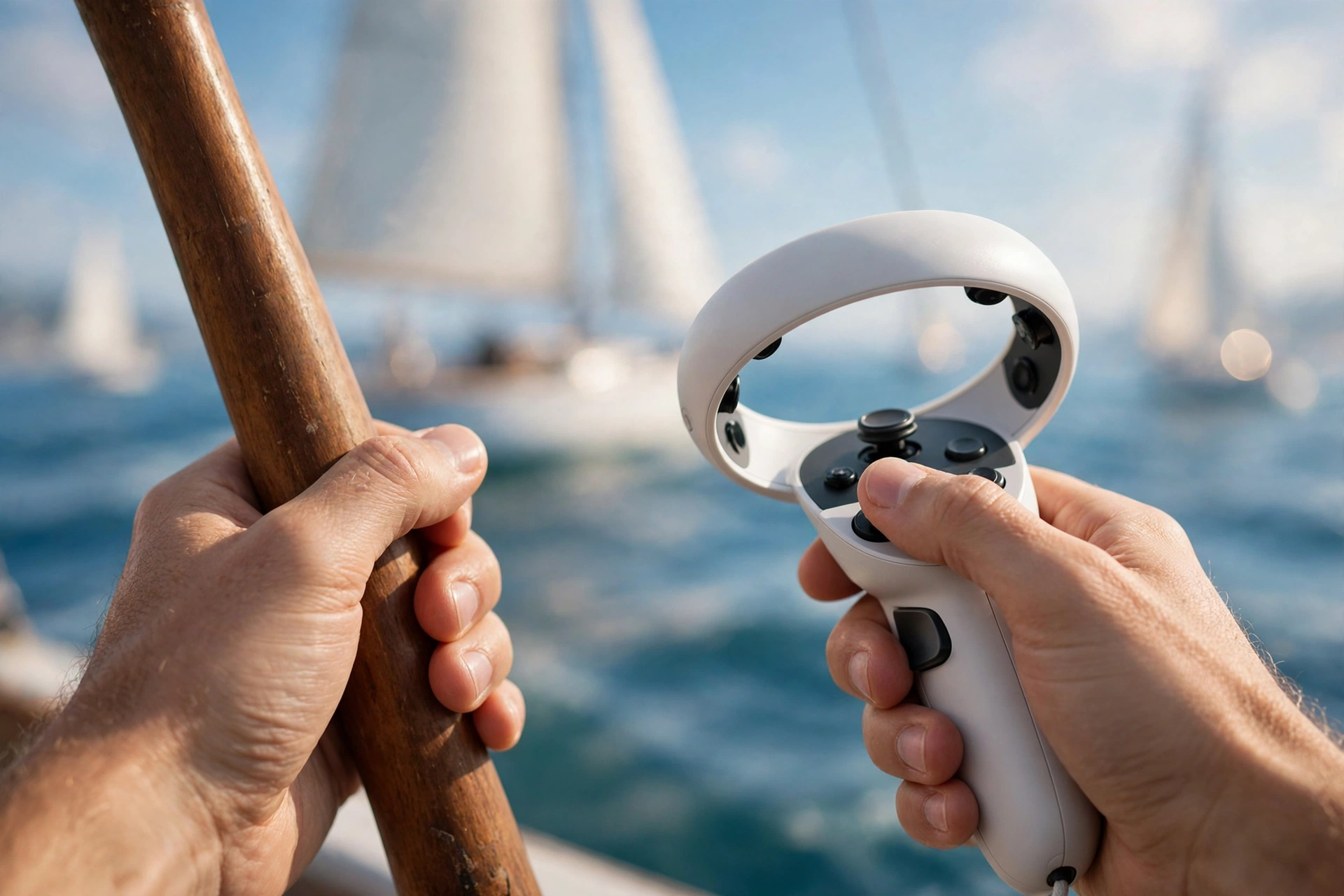
The controllers do the work of your hands: one steers, the other trims the sail, and the buttons handle the compass or resetting your view. If they feel strange at first, How Do VR Controllers Work? explains the buttons, tracking, and haptics — the small vibrations that tell you when you’ve grabbed something.
A first sail: what a beginner session looks like
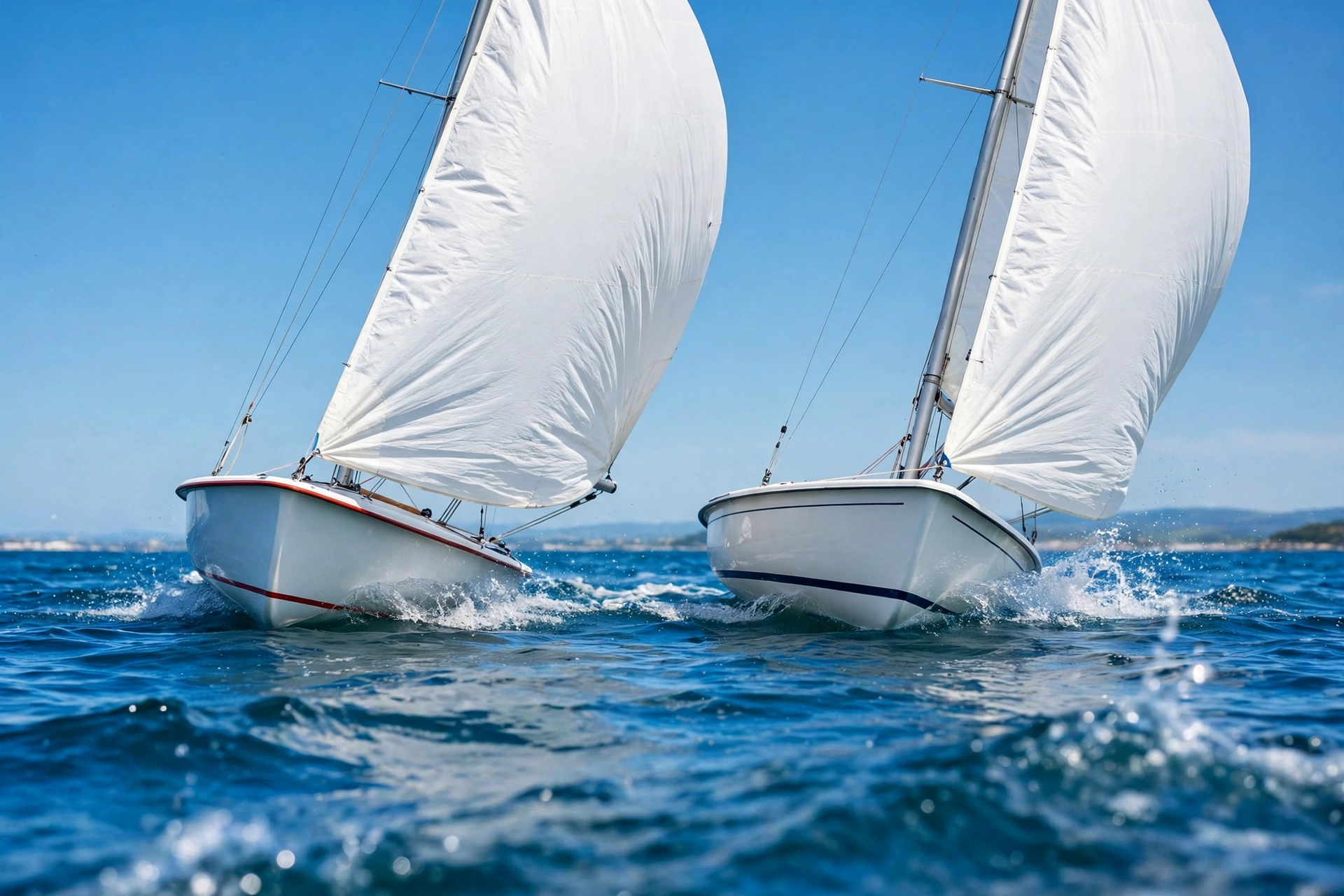
Picture a Saturday morning. The app drops you into a calm bay, and the first lesson is just steering: push the tiller one way, watch the bow swing the other way, and keep the boat on a distant buoy. Five minutes, and it already feels like an achievement.
Next comes sail trim. The app shows a ribbon on the sail: pull the sheet until it flies straight back. Too tight and the sail stalls; too loose and it flaps. You get it wrong a few times — then suddenly the sail fills, the boat heels, and you feel the lift of speed that hooks sailors for life. In a real lesson that moment might take an hour; in VR, ten minutes.
Then a race. You mistime the start, you’re last at the first mark, and you spend the rest of the race clawing back places one good tack at a time. You finish third, or fifth, or last — and immediately want another go. That’s the loop that makes VR sailing work: the game makes you repeat the skill until it’s yours.
Is VR sailing worth it if you never plan to sail for real?
Honestly, yes — if you like the feeling of it. Plenty of people play VR sailing the way others play VR golf or VR fishing: a relaxing, absorbing half hour. There’s something genuinely calming about a quiet virtual sea, a steady breeze, and a boat that goes where you tell it to.
And if you do catch the bug, you’re ahead of someone starting cold. You’ll know the vocabulary, the order of a tack, and what a trimmed sail looks like. A real instructor will still have plenty to teach you, but you won’t start from zero — and your first real lesson will be far more fun for it.
FAQs
Do I need sailing experience to try VR sailing? No. The main apps are built for complete beginners, with tutorials that start from zero.
Which headset works best for VR sailing? A standalone Meta Quest 3 or 3S is the usual pick, because MarineVerse Sailing Club runs on it without a PC. Older Quest 2 headsets work too.
Can VR sailing replace real sailing lessons? No. It teaches procedures, timing, and confidence — not balance, weather reading, rope work, or safety at sea.
Will I get seasick in VR sailing? Some people feel queasy when the virtual boat heels or turns quickly. Short sessions, sitting down, and a fan usually help, and most people adjust within a few sessions.
How much does it cost to start VR sailing? Roughly a standalone headset plus the app — far less than a weekend sailing course. Some training modules are free with registration.
The practical next step
If you’re curious, the cheapest way to find out is to borrow a headset. Ask a friend with a Quest to lend it for half an hour and run through MarineVerse Sailing Club’s first lessons. If the moment the sail fills makes you grin, you’ve got your answer — then book a real taster session at a local sailing school and see how much already feels familiar.
Further reading: MarineVerse — learn to sail in VR · US Sailing