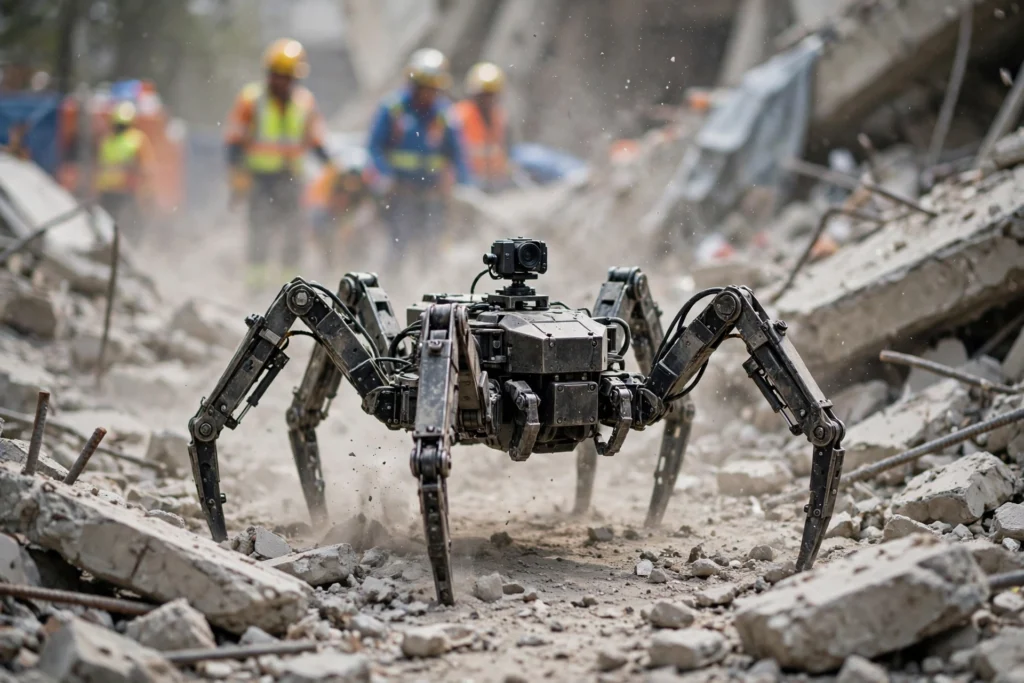
Spider robots are walking machines built like their namesake: a compact body, six or eight jointed legs, and a camera or sensor pack on top. Instead of rolling on wheels, they step over rubble and squeeze into gaps where a wheeled robot would get stuck. Most are research machines, but the idea is simple — legs go where wheels cannot.
Key Takeaways
- Spider robots walk on six legs (hexapods) or eight legs, copying how real spiders and insects move.
- They keep several feet on the ground at all times, which makes them hard to tip over on rough ground.
- Their main jobs are search and rescue, industrial inspection, and exploring hazardous places.
- Cameras, lidar, and foot sensors tell them where to place each step.
- They are slower and more expensive than wheeled robots, so they are used where wheels fail.
What exactly is a spider robot?
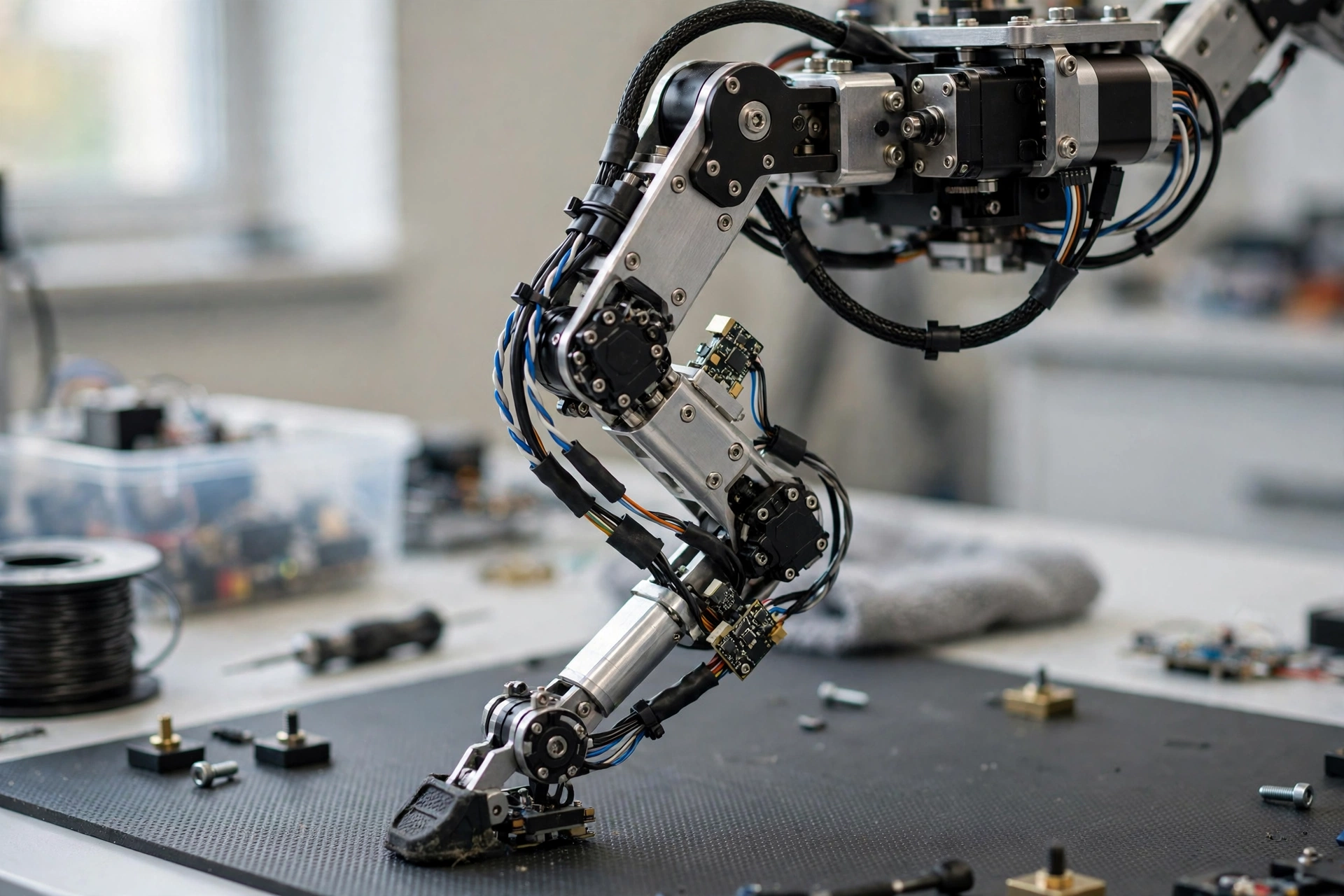
A spider robot is a legged robot whose body is modelled on a spider. Most designs have six legs, which engineers call hexapods, while a smaller number have eight. Each leg usually has three joints, driven by small servo motors, so the robot can lift a foot, swing it forward, and set it down again without disturbing the others. The body carries the battery, the control board, and whatever the job needs — usually a camera, and sometimes lidar, a thermal camera, or a gas sensor.
Real spiders inspired the design for a good reason. A spider spreads its weight across many legs, so losing its footing on one leg rarely means a fall. Engineers copy that trick, and a legged machine can also step over an obstacle instead of pushing through it — handy in a collapsed building or a cluttered factory floor.
How do spider robots walk without falling over?
They cheat, in a clever way: they never lift all their legs at once. Six-legged spider robots typically use a tripod gait, where three legs stay planted while the other three swing forward, then the two groups swap. At any moment the robot stands on a triangle of feet, which is a stable base. Eight-legged designs work the same way, often keeping four feet down while the other four move, just as Fraunhofer IPA’s research spider does.
Each step is planned, not guessed. Foot sensors feel when a leg touches solid ground, and an inertial sensor tracks how the body tilts. If a foot lands on loose rubble, the controller shifts the weight to the other legs before the next step. Cameras and lidar map the ground ahead, so the robot can pick footholds instead of stumbling into holes. That is also why spider robots move slowly: every step is a small calculation.
Some designs bend the rules entirely. Festo’s BionicWheelBot, inspired by the flic-flac spider, walks on six of its eight legs and folds the other two away. When it needs speed, it bends three legs on each side into a wheel shape and rolls, which is much faster than walking over flat ground.
What are spider robots used for?
Three jobs come up again and again: rescue, inspection, and hazardous environments. After an earthquake, a spider robot can pick its way through broken concrete and send back video of what is inside, without putting a rescue worker at risk. In a factory, the same machine can crawl along a pipe rack or inside a large duct to photograph cracks and corrosion. And where the air itself is dangerous — a chemical spill, for instance — a robot can go in first and report back.
The Fraunhofer IPA spider shows how that works in practice. Its legs are about 20 centimetres long, driven by elastic bellows that copy the way real spiders extend their legs with fluid pressure. It carries a camera and measuring equipment, and its job is to explore ground that people cannot enter after a chemical accident, sending images and readings back to emergency responders.
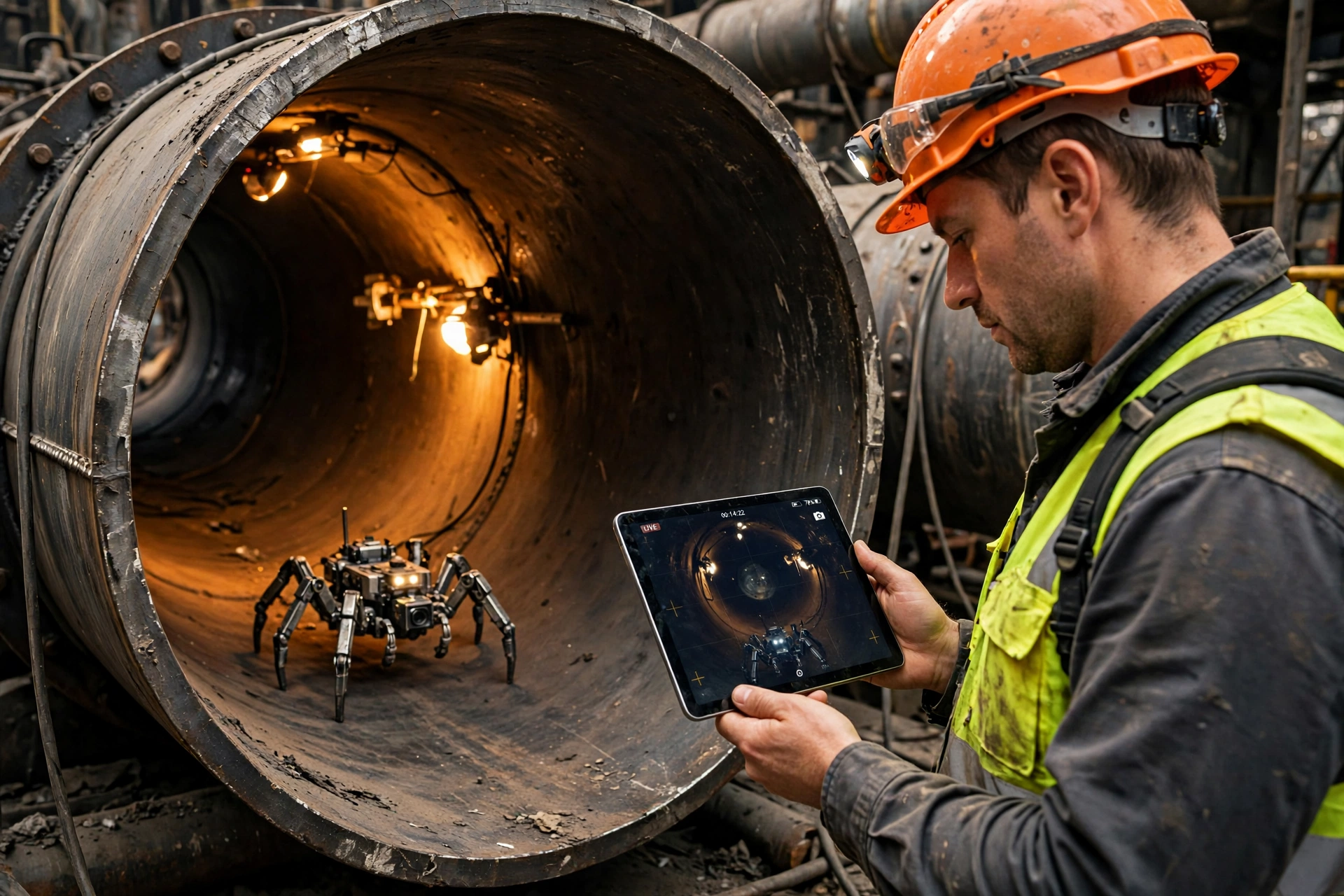
Inspection is the most practical use today. A spider robot can walk the inside of a large pipe, climb over weld seams, and stop to photograph a suspect joint, while an engineer watches the live feed from outside. Wheels struggle on curved pipe walls and loose debris; legs do not.
How do spider robots compare with other robots?
Legs are a trade-off, and the table shows where spider robots win and where they lose.
| Spider robot | Rough ground, tight gaps, staying upright | Slow, complex, costly |
| Robot dog | Fast walking, carrying loads, open ground | Needs more space to turn |
| Snake robot | Very tight spaces, pipes, narrow gaps | Slow, hard to carry heavy sensors |
| Wheeled rover | Speed and battery life on flat ground | Stuck by steps, rubble, and gaps |
Robot dogs are the closest cousins: both are legged, both carry cameras, and both work outdoors. The difference is the job. A robot dog is built for speed and payload, so it suits patrols and deliveries across open ground. A spider robot is built for stability and squeezing through awkward spaces, so it suits rubble and pipework. Snake robots go further into tight spaces but carry little, and wheeled rovers win on flat floors, which is why warehouses still run on wheels.
What are the limits of spider robots?
Speed is the first. A walking robot that plans every step will never keep up with a wheeled one on a smooth floor, and the motors in six or eight legs drain a battery faster than a pair of wheel motors. Cost is the second: each leg needs its own motors, sensors, and wiring, so a spider robot has far more moving parts to build and maintain than a simple rover. Control is the third. Walking on uneven ground is hard to program, and most spider robots still need a human operator nearby or a lot of computing power to move on their own.
There is also the question of what they carry. A small spider robot can manage a camera and a few sensors, but a heavy tool adds weight that the legs must support with every step. That is why many designs stay small and light. Soft robots, built from flexible materials instead of rigid metal, are one answer: gentler and lighter, though they carry even less.
Could you buy a spider robot?
You can, in a sense. Hobby kits and research platforms are sold online, and machines like the Robugtix T8 — a tarantula-style robot — are aimed at makers and educators rather than factories. These are closer to advanced teaching tools than to working rescue machines, but they use the same ideas: servo-driven legs, a tripod gait, and a phone or tablet as the controller.
A working inspection or rescue spider robot is a different purchase. Those are built to order by research labs and specialist firms, with the sensors and software for a specific job. If you are a student or a hobbyist, a kit is a good way to learn how legged walking works. If you run a facility that needs pipes inspected, hire a robotics inspection service rather than buying the machine yourself.
Frequently asked questions
How many legs does a spider robot have? Most have six legs and are called hexapods, though some research designs have eight, like a real spider. Six is the common choice because it gives a stable tripod gait with fewer motors to control.
Are spider robots faster than wheeled robots? No. On flat ground a wheeled robot is much faster and uses less battery. Spider robots win only on rough, broken, or cluttered ground where wheels get stuck.
Can spider robots climb walls? Most cannot. A few research prototypes can climb gentle slopes and low obstacles, and some use grippers or suction for vertical surfaces, but wall-climbing is not a standard ability.
Do spider robots work on their own? Some can follow a planned route and pick their own footholds, but most still need a human operator watching the camera feed and steering.
Are spider robots dangerous? Not in normal use. They move slowly, weigh little, and are usually operated at a distance. Their main safety role is the opposite: keeping people out of dangerous places by going in first.
Conclusion
Spider robots are a specialist answer to a simple problem: wheels fail where the ground is broken. By copying a spider’s many-legged walk, they stay upright on rubble, step into pipes, and explore places too dangerous for people. They will not replace wheeled robots, but for rescue teams and inspectors, a machine that can walk where nothing else can is worth the trade-off. If the idea appeals to you, start with a small hexapod kit: building one teaches the gait, the sensors, and the balance that make the real machines work.
Further reading: Wikipedia’s hexapod robotics overview and a recent spider-robot vibration-sensing study.