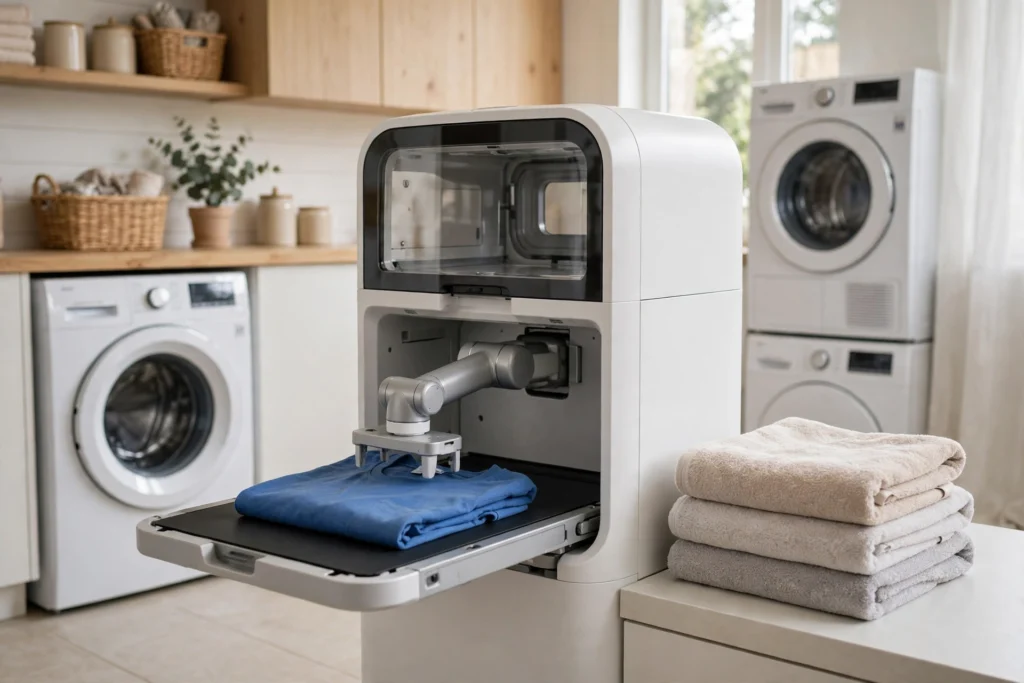
Yes — partly. Laundry robots can already fold simple items like T-shirts and towels, and commercial laundry lines fold hotel linen all day. But a home robot that takes a mixed pile from the dryer and puts it away is still a work in progress, because soft, floppy fabric is one of the hardest things for a machine to handle.
Key Takeaways
- Laundry robots fold clothes with cameras, grippers and folding arms, but they work best on flat, simple items.
- Home folding machines need you to feed each item in; they do not take a mixed pile yet.
- Commercial laundry lines already fold towels and sheets at scale for hotels and hospitals.
- Soft fabric is the hard part: it bends, folds over itself and hides its own edges.
- The best-known home prototypes were slow and expensive, so check real availability and price before buying.
What exactly is a laundry robot?
A laundry robot handles the dry end of laundry: folding, sorting and stacking clean clothes. It does not usually wash or dry anything — that job still belongs to the washing machine. Clothes come out of the dryer, and the robot turns a loose pile into neat, stackable folds.
There are two kinds in use today: the home folding machine, a freestanding appliance about the size of a small fridge, and the commercial laundry line, a row of connected machines in a laundry plant that feeds, folds and stacks towels, sheets and uniforms without stopping.
How does a home folding machine work?
A home folding machine works in a short sequence, and each step has to go right or the fold comes out wrong.
First, you feed the item in. On the best-known design, FoldiMate, you clip each garment onto a tray, and the machine pulls it inside. This is the part people find most surprising: the robot does not pick clothes out of a pile. You hand it one item at a time, already roughly flat.
Next, cameras and sensors look at the garment. They measure its size and shape and work out where the sleeves or waistband are. Some designs use AI image recognition to tell a T-shirt from a pair of trousers, then pick a folding pattern to match.
Then the folding happens: arms, rollers or moving flaps fold the sides in, fold the item in half, and press it flat, sometimes with a short burst of steam to smooth wrinkles. The folded item slides out onto a tray, ready to be put away.
Why is folding clothes so hard for a robot?
Folding a shirt looks easy because your hands do a lot of quiet work you never notice. A robot has to do all of it on purpose, and fabric fights back at every step.
The first problem is that cloth is soft. A metal part holds its shape, so a robot arm always knows where its edges are. A T-shirt does not: it flops, stretches and folds over itself, so the machine must keep re-checking where the edges are. Engineers call this handling a deformable object, and it is one of the trickiest jobs in robotics — sewing robots face the same struggle with limp fabric.
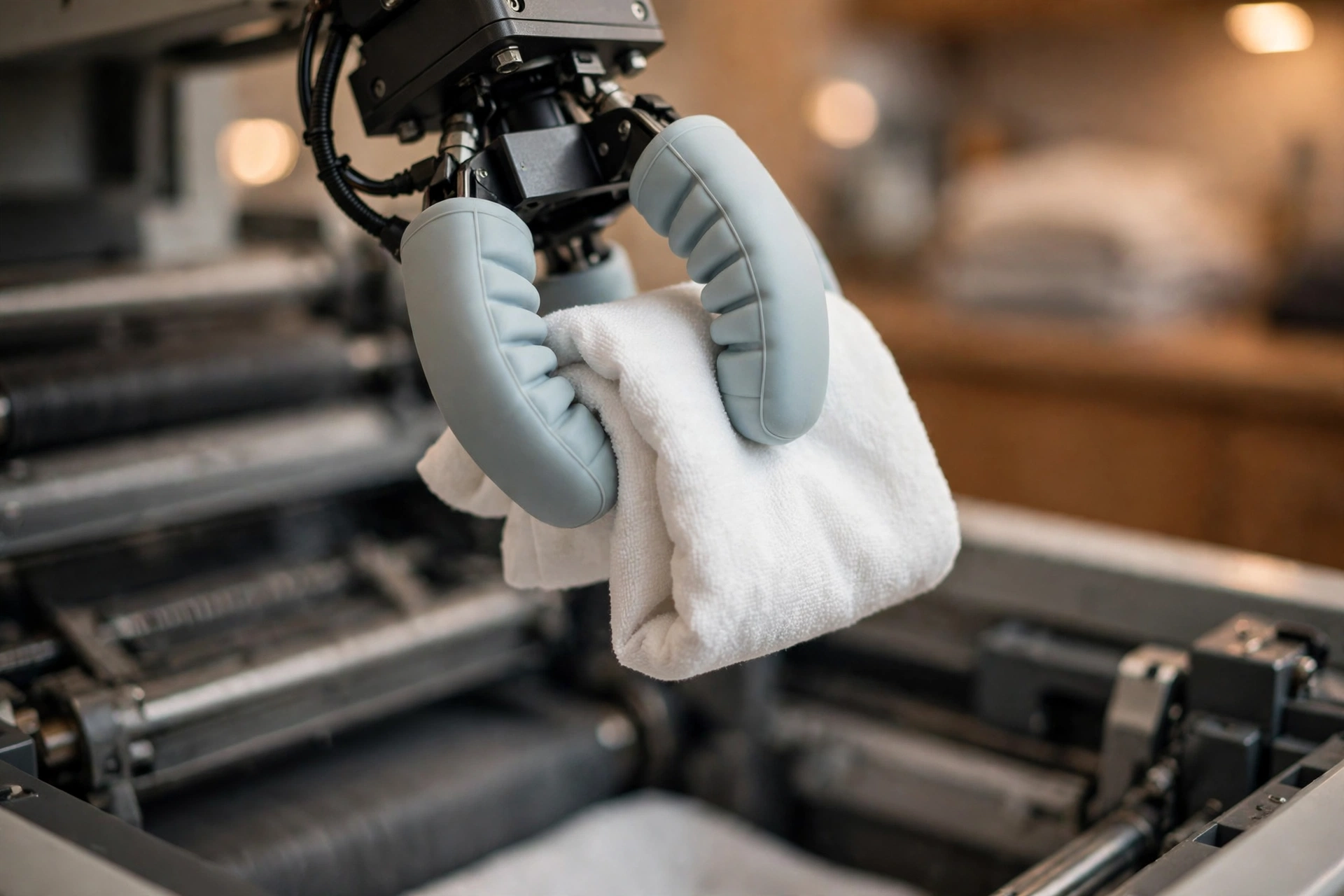
The second problem is finding a grip. Human fingers pinch a corner or a hem without thinking. A robot gripper needs a flat edge to hold, and a crumpled shirt may not offer one. That is why many laundry robots use soft, padded grippers instead of hard metal claws: they can squeeze fabric gently without tearing it. The arms work on the same principles as factory robot arms, just with a much gentler touch — see our guide to how robot arms work.
The third problem is variety. A load mixes thick towels, thin T-shirts, long trousers and small socks, each needing a different fold and grip. Sorting that mix is a job in itself, and warehouse robots that sort and stack rigid boxes had an easier start, because boxes hold their shape.
Where laundry robots already work today
If home folding machines are still finding their feet, commercial laundry robots are already on the job. Hotels, hospitals and uniform services send thousands of towels and sheets through laundry plants every day, and much of that folding is now automated.
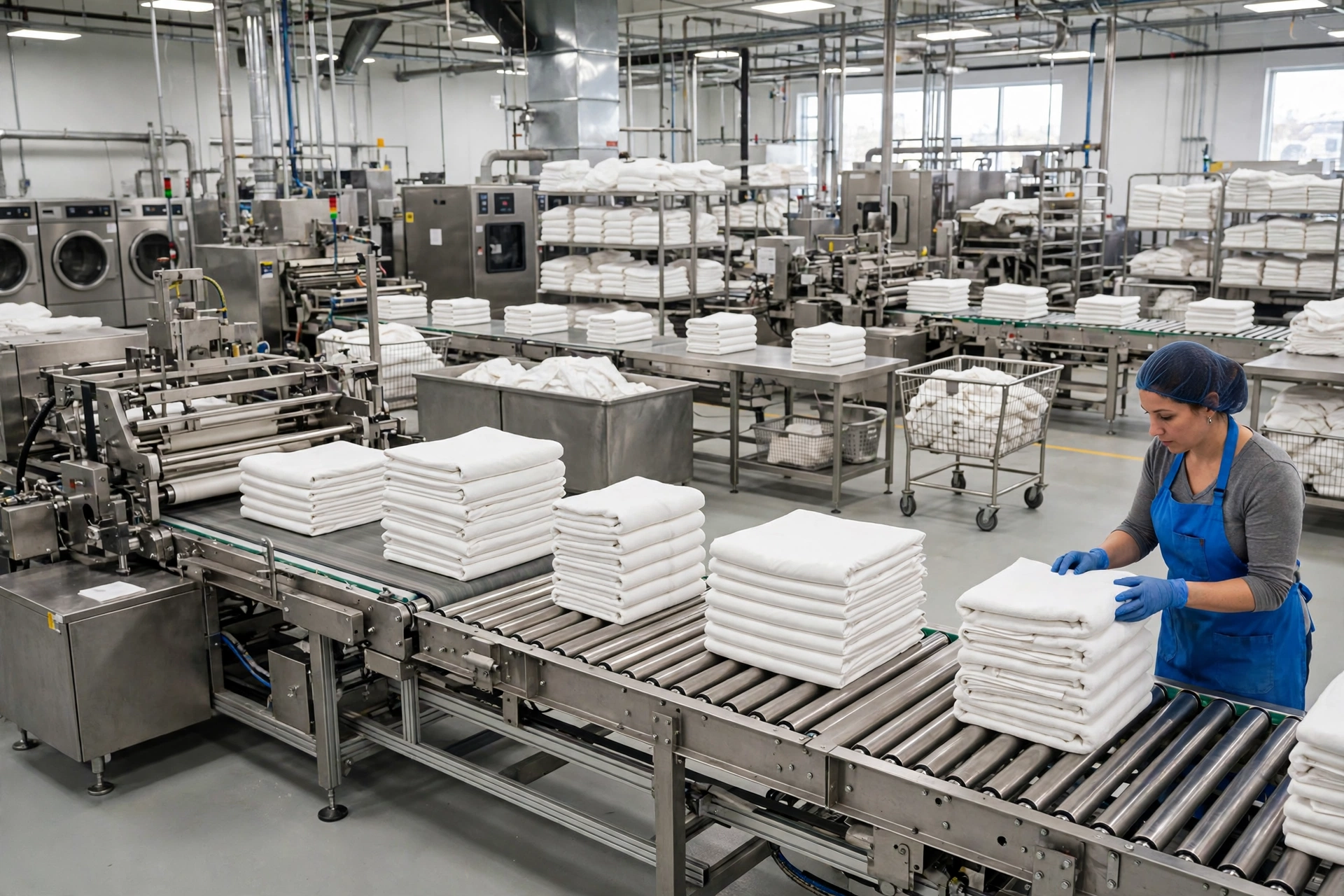
A typical commercial line works like this. Washed and dried towels arrive on a conveyor. A feeding robot uses cameras to spot each towel, separates it from the pile with a servo-driven gripper, and lays it flat. A folding machine folds it to a set size and stacks it, and the stacks move on a belt to a pick-up station for checking and delivery.
One maker, Kannegiesser, builds a line called Robofeed that does exactly this for mixed hotel and hospital towels. The key difference from a home machine is the workload: the same items, in the same sizes, hour after hour. That repetition is what makes automation pay.
Home folding machine vs commercial laundry line
| Home folding machine | Commercial laundry line | Folding by hand | |
|---|---|---|---|
| Best for: | T-shirts, trousers, towels | Towels, sheets, uniforms in bulk | Anything, any shape. |
| How items arrive: | You feed each one in | Conveyor feeds them automatically | You pick each one up. |
| Handles mixed piles?: | No, one item at a time | Only similar items in a run | Yes. |
| Main limit: | Cost, size and item variety | Needs huge, steady volume | Your time and patience. |
What can laundry robots not do yet?
Honesty matters here, because the demos look more finished than the products are. FoldiMate, shown at trade fairs, asked users to clip each item on by hand and handled only medium-sized garments. Laundroid, another much-discussed prototype, used AI to recognise clothes but was reported to take several minutes per item, and its reported price was around $16,000. Neither became a common household product.
So laundry robots still cannot sort a mixed pile from the dryer on their own. They struggle with small items like socks and baby clothes, and with stretchy or slippery fabrics. They do not hang clothes or match pairs. And they take up floor space roughly the size of another appliance. The folding itself is largely solved; the hard part is handling a mixed pile without help.
Frequently Asked Questions
Can a laundry robot wash and dry clothes too?
Not as a rule. Most only fold, sort and stack; washing and drying still happen in a washer and dryer first.
How long does it take a laundry robot to fold a load?
A home folder takes seconds per garment once fed in, so a full load still takes several minutes. A commercial line folds continuously and is far faster.
Are laundry robots worth the money?
For a hotel or hospital laundry, usually yes: the volume is huge and the items are uniform. For a home, it depends on the price and how much laundry you do. At prototype prices, most households would be better off waiting.
Will a laundry robot damage my clothes?
A well-designed one should not: soft grippers, smooth rollers and steam are gentler than a tumble dryer. But delicate fabrics, zips and buttons can still catch, so check the maker’s guidance first.
When will home laundry robots be common?
Nobody can promise a date. When a home machine can take a heap from the dryer and sort it unaided, at a price near a good washer, that is when they will spread.
Conclusion
Laundry robots are real, useful machines — just not quite the ones in the adverts yet. Commercial lines already fold hotel towels and hospital sheets all day, because steady, repeated items suit automation. Home folders can fold a T-shirt well, but they still need you to feed each item in. If you run a laundry, the technology is worth a serious look now. If you fold at home, check whether any machine is genuinely for sale at a price you would pay — and if not, enjoy the wait.
Further reading: Kannegiesser on automated laundry robotics, and BeezBot’s overview of laundry folding robots.