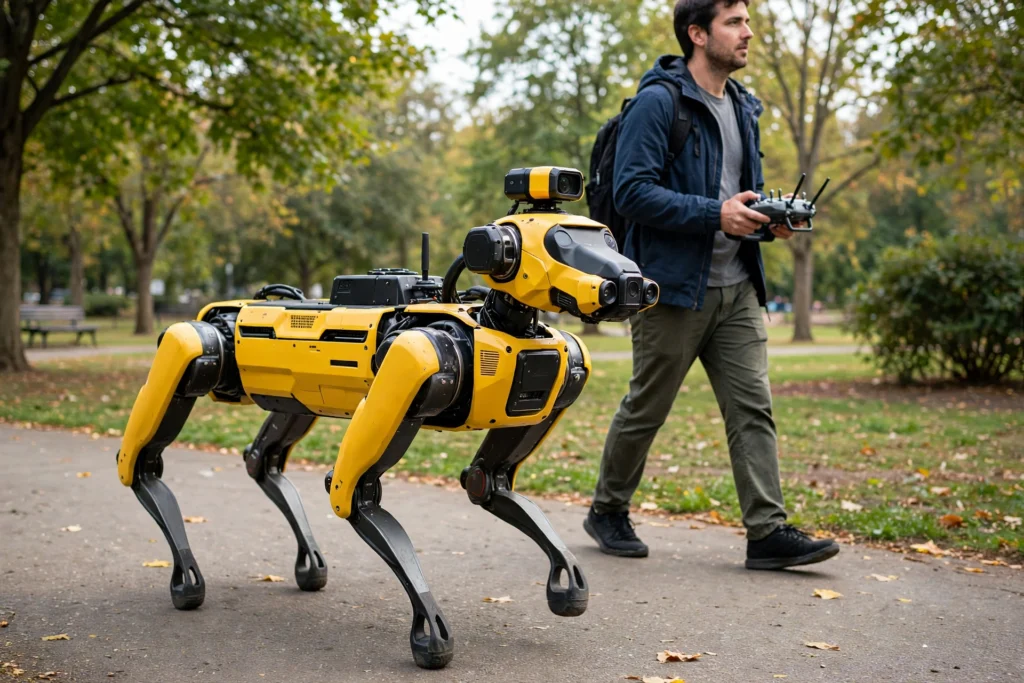
A robot dog is a four-legged machine that walks, balances, and carries sensors or tools where wheels would struggle. It uses motors in its legs, cameras and laser scanners to see the ground ahead, and a control system that adjusts each step many times a second. An operator usually tells it where to go, while the robot itself handles staying upright.
Key Takeaways
- Robot dogs walk on four articulated legs, each driven by motors that bend, lift, and place the foot in a planned pattern.
- Balance comes from constant feedback: sensors report tilt, foot contact, and slip, and the controller corrects the next step.
- Cameras, lidar, and depth sensors build a map of stairs, rocks, and obstacles so the robot can plan a route.
- Many robot dogs carry a camera, a sensor, or a small arm, so the same platform can inspect, patrol, or help in a search.
- They are strongest on rough or stepped ground. They are slower, pricier, and shorter on battery than a wheeled robot on flat ground.
Why four legs instead of wheels?
Wheels are brilliant on a smooth floor, and hopeless on a staircase. Legs solve that trade-off. A leg can lift over a kerb, a rock, or a pipe, place its foot on a narrow step, and keep the body level while the ground underneath changes. That is why robot dogs show up in places like construction sites, factories, and outdoor inspection routes, where the path is rarely flat and tidy.
There is a cost, though. Legs need many more motors and joints than wheels, and every step is a small balancing act. A wheeled robot can roll along with little thought; a legged robot has to decide, step by step, where to put each foot and how much weight to put on it. Engineers accept that complexity because the payoff is access: a robot dog can go up stairs, over rubble, and across a muddy yard that would stop a wheeled machine cold.
How does a robot dog walk without falling over?
Walking starts with a gait, a repeating pattern of footfalls. At a slow walk, three feet stay on the ground while one moves, which keeps the robot stable. At a trot, diagonal pairs move together, which is faster but needs quicker corrections. The controller picks a gait for the speed and terrain, then adjusts it on the fly.
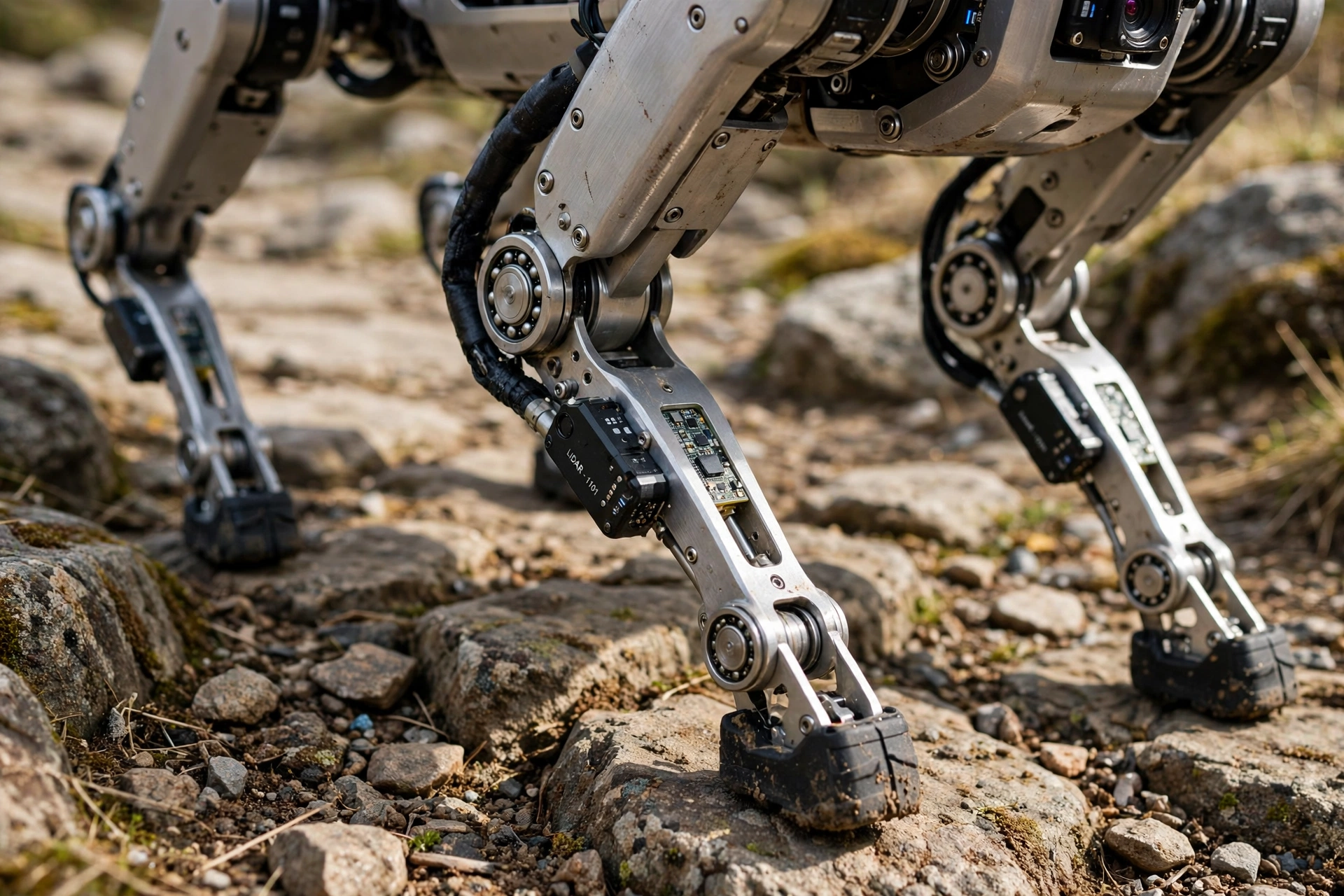
Each leg has joints much like a hip, knee, and ankle, driven by electric motors. Force sensors in the feet tell the controller when a foot has landed, and motion sensors in the body report tilt and acceleration. If a foot slips on wet concrete, or a leg lands on a loose stone, the controller shifts weight, shortens the next step, or plants a foot wider to recover. That loop runs many times a second, which is why a good robot dog can be nudged and still stay standing — it is not rigid, it is constantly catching itself.
How does it see where it is going?
A robot dog rarely relies on one sensor. Cameras give colour and detail, depth cameras judge distance, and lidar sweeps a laser around to build a three-dimensional map of walls, stairs, and obstacles. Together, those readings let the robot plan a path, avoid a drop, and remember where it has already been.
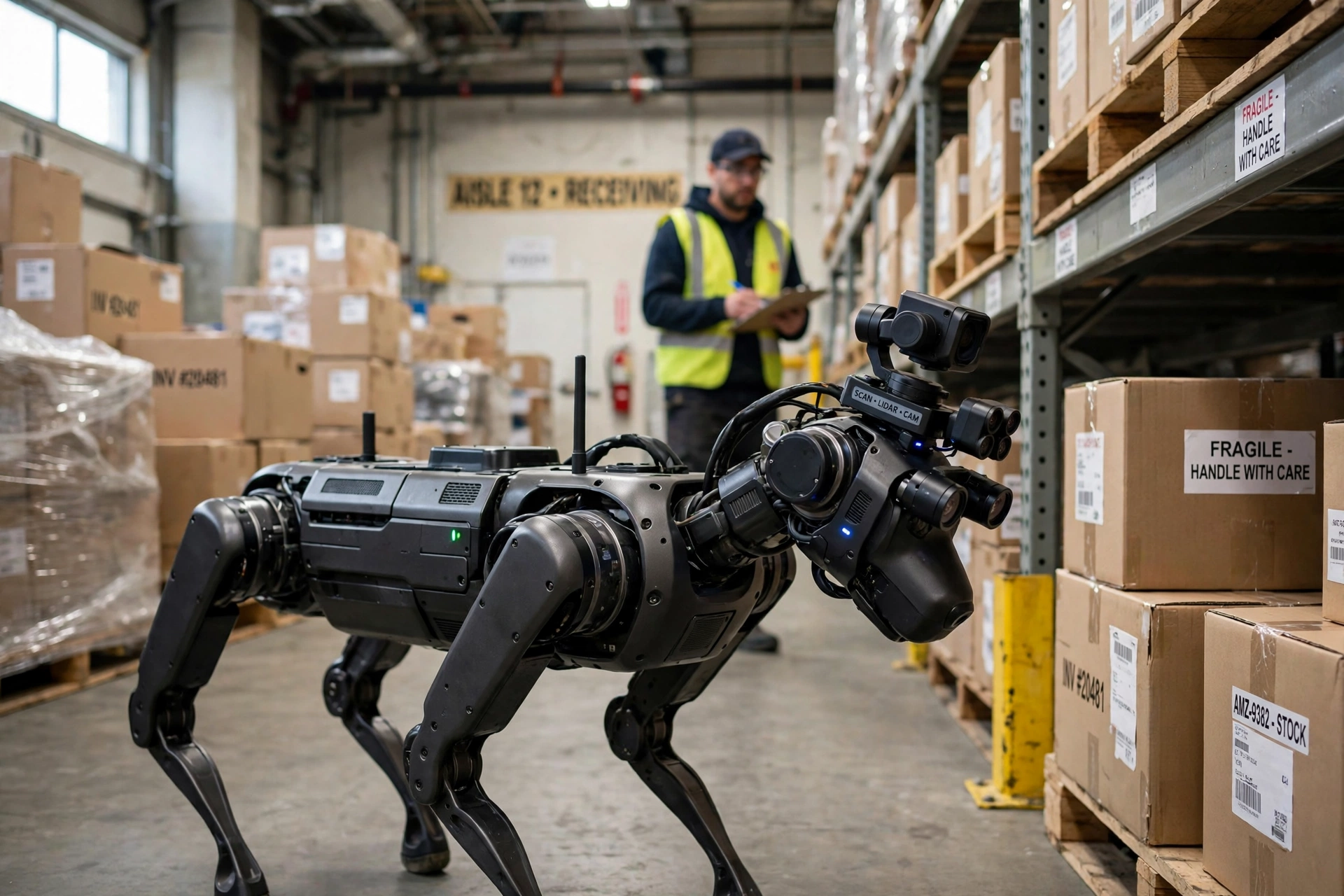
That map is also what makes the robot useful. On an inspection round, the same cameras that guide its feet can photograph a gauge, a valve, or a crack in a wall, and tag each photo with its location. A person can then review the round from a desk, instead of walking the whole site. Much like a rescue robot, which must navigate rubble and tight spaces, a robot dog’s value often lies in going somewhere awkward and bringing back a clear record.
What can a robot dog actually do?
Most robot dogs are platforms, not single-purpose machines. Change what is mounted on top, and you change the job. A camera and thermal sensor suit inspection and patrol work. A small arm can open a door, pick up a sample, or place a sensor. A radio or speaker lets an operator talk to someone at the far end of a site.
In practice, common jobs include routine inspection of industrial sites, patrolling a perimeter, carrying a small load across rough ground, and helping search teams look into places that are unsafe for people. Some are also used in research and teaching, where students can test walking, mapping, and control ideas on a real machine. Toy and companion versions exist too, but they are a different class: lighter, simpler, and built for play rather than work, so they should not be confused with the industrial machines described here.
How is a robot dog controlled?
Control is usually shared. An operator may steer it with a controller, tap a point on a map, or give it a route to follow on its own, while the robot handles balance, obstacle avoidance, and safety stops by itself. If the radio link drops, a well-designed robot should stop in place or return along its route, rather than wandering off.
That shared control is a safety feature as much as a convenience. The operator decides the mission and watches the camera feed, while the robot makes the split-second balance decisions no human could make fast enough. It also means the operator needs training: knowing when to let the robot handle a step, and when to take over or stop it, matters more than fancy driving.
What are the limits?
Battery life is the most practical limit. Four legs, many motors, and a full sensor set use a lot of power, so most working robot dogs run for an hour or two before needing a charge or a battery swap. Cost is another: precision joints, sensors, and software put these machines well above a wheeled robot of similar size.
Terrain still sets boundaries. Deep mud, loose sand, very steep slopes, and slippery ice can defeat even a good legged robot, and it will not climb a ladder or open every door. Like robot arms, which work best when the task and reach are well defined, robot dogs work best on a planned route with known obstacles. And like warehouse robots, they shine when the job repeats: the same inspection round, the same patrol, the same rough path, day after day.
FAQs
Is a robot dog the same as a pet robot?
Not usually. A pet or toy robot dog is built for companionship and play, with simple movement and behaviour. An industrial robot dog is a working machine: stronger, heavier, packed with sensors, and designed to inspect, patrol, or carry equipment in difficult places.
Can a robot dog climb stairs?
Yes, most working models can climb ordinary stairs, placing one foot at a time and keeping its body level. Steep, narrow, or damaged stairs are harder, and an operator should check the specific model’s limits before sending it up.
How long does a robot dog’s battery last?
It varies by model and workload, but a typical working run is around one to two hours of active walking and sensing. Carrying a heavy load, climbing, or running many sensors shortens that time, so spare batteries are common on longer jobs.
Are robot dogs autonomous?
Partly. They usually handle balance, foot placement, and obstacle avoidance on their own, while a person sets the route, monitors the camera feed, and takes over when needed. Fully unsupervised operation is possible on a well-mapped route, but most work still keeps a person in the loop.
What happens if a robot dog falls over?
Many can right themselves, or at least sit safely until an operator helps. A fall can still damage a sensor or an arm, so operators are trained to avoid risky ground, keep the robot within its limits, and inspect it after any tumble.
Conclusion
A robot dog works by turning walking into a control problem: four motorised legs, fast balance feedback, and a sensor map of the ground ahead, all guided by an operator who sets the mission. It will not replace a wheeled robot on a flat floor, or a person on a complex job, but on stairs, rubble, and rough site routes it goes where wheels cannot. If you want to understand one better, a practical next step is to watch a video of a real inspection round, then note the moments the robot pauses, re-plans a step, or waits for its operator — those pauses are the machine thinking with its feet.
For background on robotics in general, see Britannica’s overview of robotics and Wikipedia’s guide to legged robots.