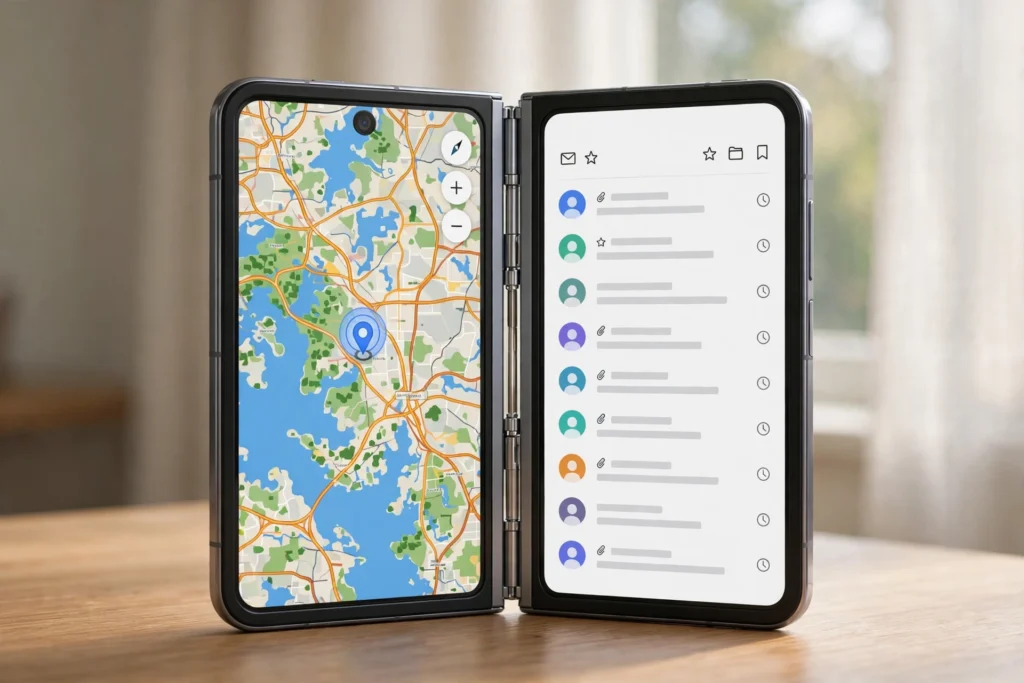
A foldable phone is a smartphone with a flexible screen and a hinge, so it folds in half and opens again. Book-style models unfold into a small tablet, while flip-style models fold a full-size phone down to a pocket square. Inside it is an ordinary phone, but the screen, hinge and software all have to cope with the bend.
Key Takeaways
- A foldable phone uses a flexible OLED panel on a plastic base instead of rigid glass.
- The hinge guides the fold, protects the screen when shut, and holds the phone part-open.
- Book-style folds open into a small tablet; flip-style folds shrink a normal phone to pocket size.
- The screen is softer than ordinary phone glass, so it scratches more easily.
- Prices stay high — book-style models often cost around $1,800 or more — so check the warranty first.
What makes the screen bend instead of break?
A normal phone screen is built on rigid glass, which does not bend. A foldable swaps that base for a thin plastic film, usually polyimide, with OLED pixels printed on top. Each pixel makes its own light, so there is no stiff backlight to fight the fold. Above the pixels sit ultra-thin glass, micrometres thick, and a soft film that takes the daily wear, glued with flexible adhesive so the stack curves as one.
That is also why you can usually see and feel a faint crease down the middle: the screen curves around a gentle radius rather than folding flat like paper, and the crease is where that curve lives. Newer models hide it better, and the crease is normal, not damage. For the screen technology in plain English, see our guide to What Is OLED?
What does the hinge actually do?
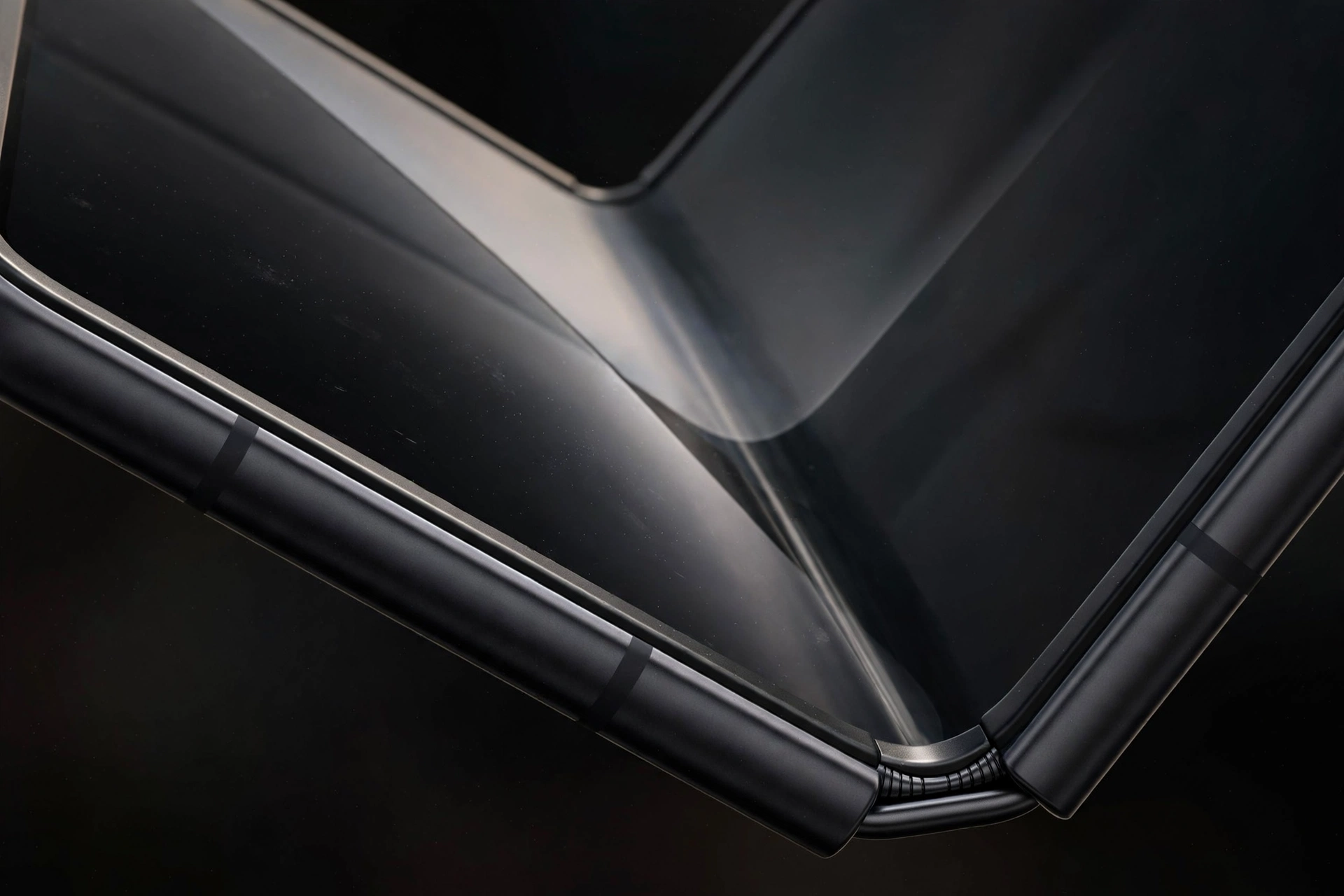
The hinge does more than swing: it links the two rigid halves, guides the screen through the same curve every time, and leaves a small teardrop-shaped gap when the phone shuts, so the layers are never squeezed flat. That gap also gives dust somewhere to go.
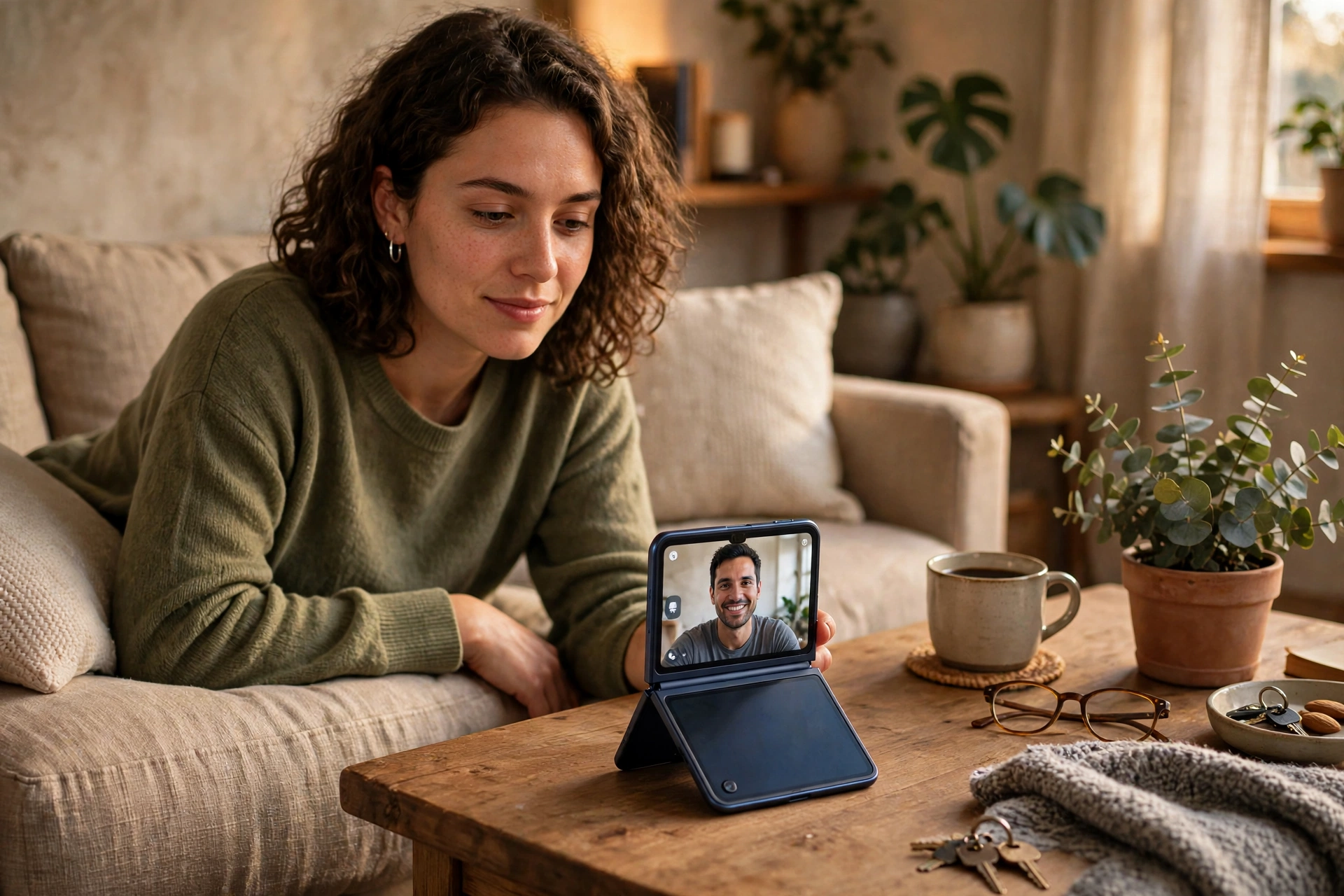
On many models the hinge holds its position part-way open. Samsung calls this Flex Mode: prop the phone on a table for a video call or set it down for a hands-free photo, and it stays put. Power and data cables run through the hinge too, and makers rate hinges for hundreds of thousands of folds. But a hinge that grinds, sticks or wobbles is a fault, not a quirk — test it first in the shop.
Book-style or flip-style: which fold suits you?
Two shapes are on sale today, solving opposite problems. A book-style foldable, such as the Samsung Galaxy Z Fold7 or the Google Pixel 10 Pro Fold, opens sideways into a tablet-sized screen of about seven or eight inches. A flip-style foldable, such as the Galaxy Z Flip7 or the Motorola Razr, is a normal-size phone that folds in half to a small square for a jacket pocket.
| Book-style fold | Flip-style fold | Regular phone | |
|---|---|---|---|
| Open | Small tablet, about 7–8 inches | Normal phone, about 6.7 inches | One fixed screen |
| Folded | A thick, narrow phone | A pocket-size square | Stays the same |
| Best for | Reading, documents, two apps at once | Portability, quick calls, selfies | Simplicity and price |
| Price | Highest, often around $1,800 or more | Mid-range to high | Cheapest for the same power |
Book style for documents and editing; flip for a normal phone in less pocket space. Otherwise a regular phone gives more performance for the money.
A day with a foldable: what changes in practice?
Picture a Tuesday with a book-style foldable. On the train you check messages on the cover screen without unfolding anything. At lunch a long report arrives, so you open the phone flat: document on one side, email beside it, no app-switching. That split view is the trick a slab phone cannot copy.
In the evening a friend video-calls, so you fold the phone to a right angle and stand it on the table, talking hands-free while you make tea. The software follows the shape, moving apps to the big screen when you unfold. Inside, the chips and cameras match a flagship’s, as our guide to how a smartphone works explains.
What should you check before buying one?
Start with the crease: open the phone, tilt it under the lights and run a finger down the middle. A faint line is normal; a deep groove is not. Then work the hinge: open and close it slowly, stop halfway, and check it holds its angle — a good hinge moves smoothly and clicks into place.
Next, try the cover screen: on a flip phone it is the screen you will use most, so it must be bright enough for daylight. Check the water and dust rating too: many foldables carry IPX8 water resistance, but dust protection lags behind. Finally, ask what the warranty covers — a screen repair on a foldable can cost several times more than on a regular phone.
What are the downsides?
Price is the obvious one: a book-style foldable still costs roughly twice what a good ordinary phone does. They are also thicker and heavier when folded, and the inner screen needs more care. Its surface is softer than toughened glass, so a fingernail or a grain of sand can mark it — never peel off the factory film. The touchscreen guide covers how that top layer handles taps and swipes.
Cases are harder to find, some apps still do not use the big screen well, and repairs cost more. None of that makes a foldable a bad phone — but buy one for a reason, because you want the bigger screen or the smaller pocket, not because the fold looks fun.
Frequently Asked Questions
Do foldable phones break easily?
No more than a normal phone in ordinary use, but the inner screen scratches more easily and the hinge can wear. Keep it cased and grit away from the hinge, and it should last for years.
Can you see the crease?
Yes, usually — a faint line down the middle, often felt with a fingertip. It shows most on a white screen at an angle. Compare models side by side.
Can you put a screen protector on a foldable phone?
Only the one made for it. Foldables ship with a thin film fitted; peeling it off or adding stiff glass can damage the screen. If it bubbles, have it replaced.
Are foldable phones waterproof?
Many are water-resistant, not waterproof. Several carry an IPX8 rating — a short dunk in fresh water — but that excludes dust and salt water. Check the exact rating first.
Will my apps work on a foldable phone?
Almost all of them. Foldables run ordinary Android with extra software for the changing screen size, though a few apps do not stretch across the big display. Try your favourites on the display model first.
Conclusion
A foldable phone is an ordinary smartphone wrapped around an extraordinary screen. The flexible OLED panel, the hinge and the software all solve one problem: a bigger display without a bigger pocket. The trade-offs — higher price, a visible crease, a softer screen, costlier repairs — are easy to judge once you hold one.
The next step is a hands-on test, not a spec sheet. In a shop, open and close both styles a few dozen times, check the crease, try your apps, and ask what a screen repair costs. If it still feels right after ten minutes, you have your reason to buy one.
Further reading: How Foldable Phones Work — ScienceABC and Foldable Phones Explained — The Droid Guy.