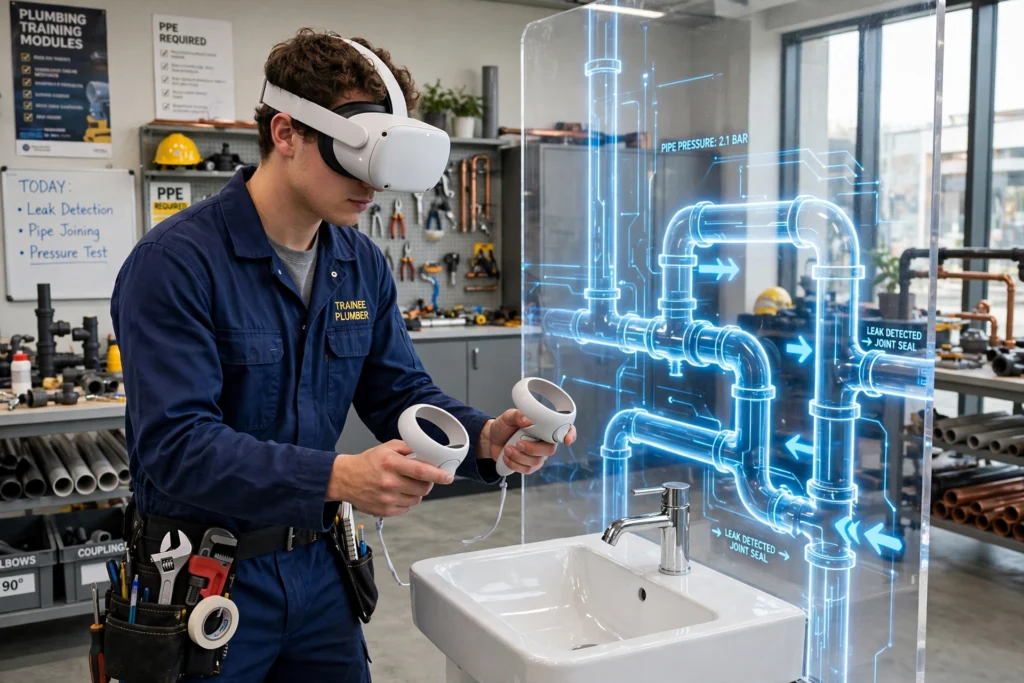
Yes — VR plumbing training can teach you the core moves of plumbing before you ever touch a real pipe. In a headset you stand in a virtual kitchen or bathroom, pick up virtual tools, and practise fitting pipes, finding leaks, and shutting off water. You will still need real hands-on hours before anyone hires you to fix their home.
Key Takeaways
- VR plumbing training puts you inside a virtual home to fit pipes, fix leaks, and run shutoff drills without flooding anything.
- Trainees repeat the same job as often as they like, and the simulation scores each attempt, so mistakes become lessons.
- It teaches sequence, tool choice, and safety habits well, but it cannot fully teach the feel of a tight joint or a heavy wrench.
- VR works best as the first step, followed by workshop practice and a real apprenticeship.
What does a VR plumbing lesson actually look like?
You start in a virtual room — a kitchen, a bathroom, or a plant room — with a tool belt and a job card. The job might be fitting a new trap under a sink or tracing a damp patch to a cracked joint. You reach for a pipe, cut it to length, and join it to the next section. If the joint is wrong, the simulation shows water escaping, marks the fault, and lets you try again.
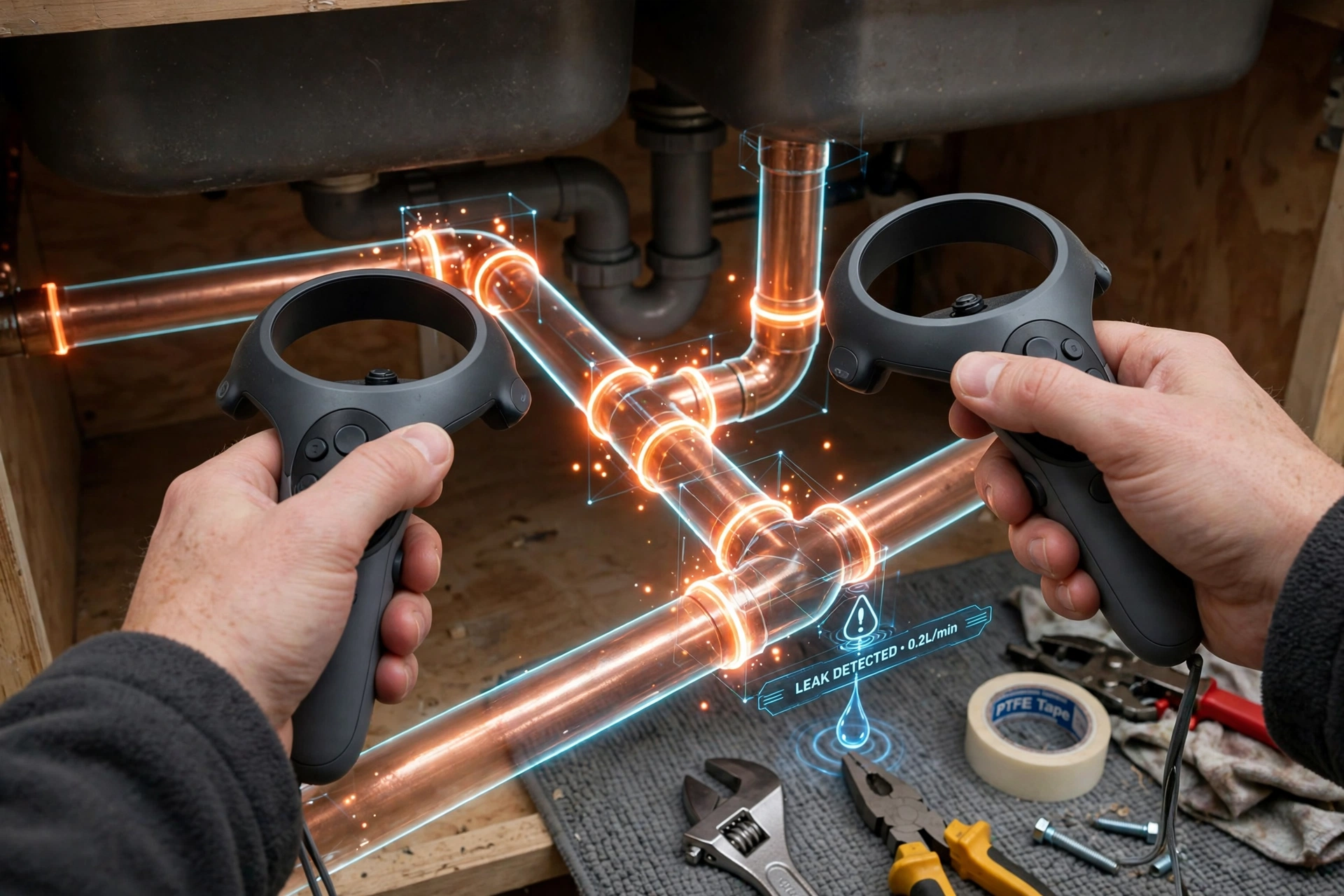
Good training software adds pressure: a timer counts down while the leak gets worse. The headset also shows things a real wall hides: pipes glow through plaster, water flow is drawn as moving arrows, and a pressure reading floats beside each joint. The same see-through trick makes VR welding training useful too, since trainees can watch a joint form instead of guessing what happened inside it.
Which plumbing skills transfer best to VR?
Some skills suit the headset far better. Pipe fitting is the obvious one — measuring, cutting, and joining in the right order. Leak detection is another: the simulation hides a fault and asks you to find it with pressure gauges and joint checks. Shutoff drills are a third: a burst pipe in VR is dramatic and harmless, and you learn to find the stopcock fast without soaking a real floor — the kind of calm-under-pressure habit VR safety training drills into workers across the trades.
Tool handling is the weak spot: a virtual wrench has no weight, and a virtual copper pipe does not resist when you bend it. Instructors treat VR as a rehearsal, not a full replacement: you learn the order of the job in the headset, then build the muscle memory with real tools in a workshop. It is the same trade-off as VR electrician training: the headset teaches safe sequence, the bench teaches feel.
A worked example: the leaking trap under a kitchen sink
Picture a trainee called Maya on her third VR session, given a job card: a kitchen sink draining slowly and smelling faintly of drains. She opens the cupboard, and the simulation shows the trap — the U-shaped pipe that holds water to block smells — with a slow drip at one joint.
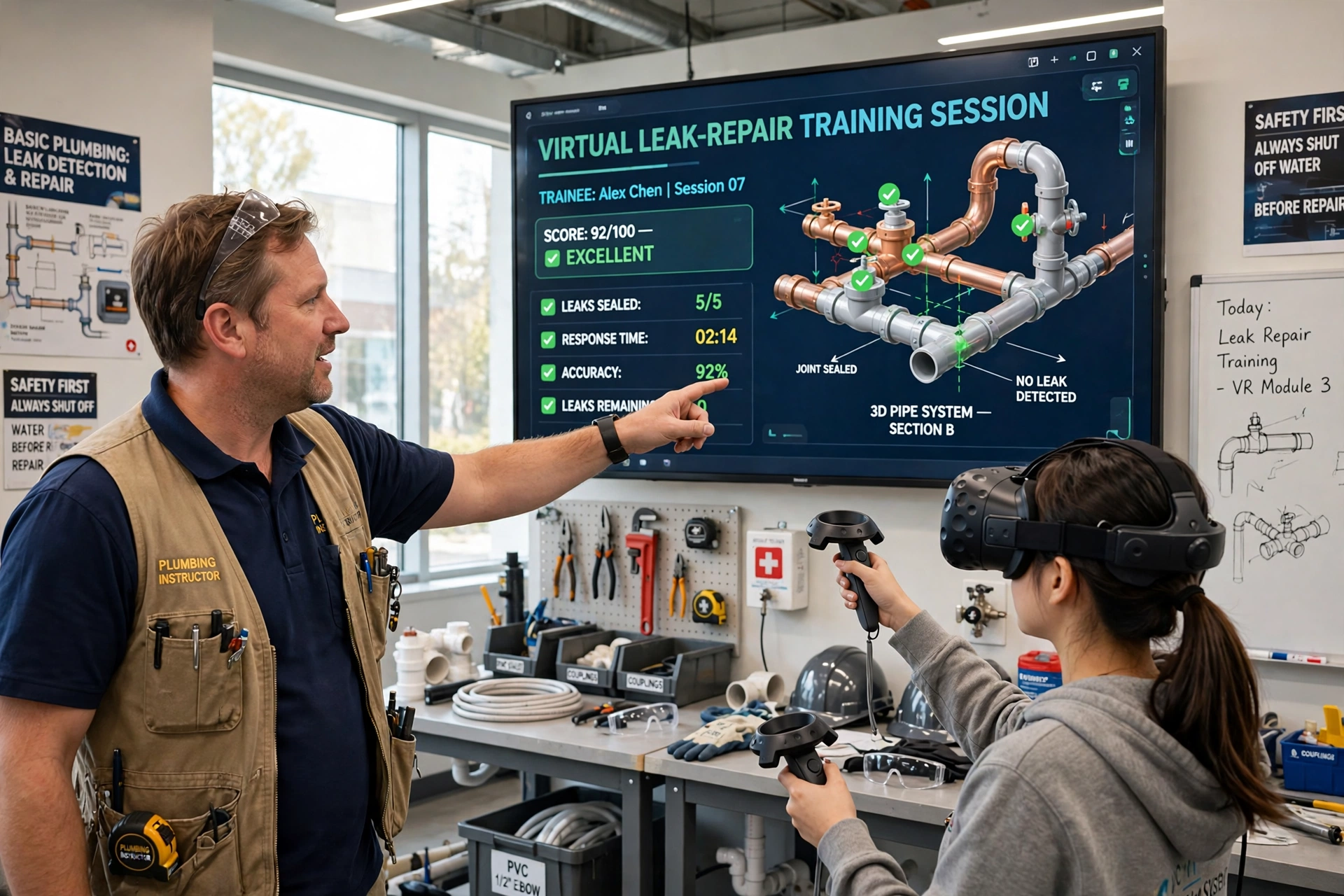
First she shuts off the water and puts a bucket under the trap, then loosens the slip nuts and removes it to find grease build-up and a worn washer. She swaps the washer, refits the trap, and runs the tap: the drip is gone and the drain flows freely. Her score: 92 out of 100, a point lost for forgetting the second joint. In a real kitchen, that lesson would have cost a wet floor; in VR, ten minutes and a retry.
How does VR training compare with classroom and on-the-job learning?
| VR training | Repeating jobs safely, seeing hidden pipes | No real weight or resistance in tools |
| Classroom and workshop | Real tools and materials, instructor beside you | Limited time per student, materials cost money |
| On-the-job apprenticeship | Real customers, real pressure, real pay | Mistakes cost time and money |
The trainees who progress fastest mix all three: VR for repetition, the workshop for feel, and the apprenticeship for judgement.
What should you check before signing up for a VR plumbing course?
Start with the headset: some courses post you one, others expect your own or a training centre’s kit. Then ask what the course covers — pipe fitting, drainage, fixtures, water heaters, and safety should all appear in the syllabus. Ask whether the certificate counts toward anything: in many places it does not make you a licensed plumber on its own, but it is a step toward an apprenticeship and the logged hours licensing requires.
Also check who marks your work: the best programmes pair automatic scoring with a human instructor who watches your replays and spots habits the software misses — a wrong grip, a skipped pressure test, a rushed joint. That feedback turns a high VR score into a reliable plumber, and it is the same reason VR construction training works best with an instructor watching.
Can VR plumbing training really get you a job?
It can get you started: training providers pair the simulations with apprenticeship placements, and employers like trainees who arrive already knowing the sequence of a job. What VR cannot do is skip the rest: you will still need supervised real-world hours and, in most regions, to meet local licensing rules before working unsupervised.
Think of it like a flight simulator: nobody earns their wings in the simulator alone, but nobody sensible climbs into a real cockpit without simulator hours first.
Frequently Asked Questions
Do I need experience before trying VR plumbing training?
No. Most programmes are built for beginners and start with naming the parts of a system before asking you to fit anything.
How long does a VR plumbing course take?
It varies a lot. Some short courses run a few weeks part-time; full technician programmes run around 20 weeks and include safety certification.
Is VR plumbing training expensive?
Prices differ widely, and some include the headset in the fee. Before you pay, compare what is included: headset, software access, instructor time, and any exam or safety certificate.
Can VR teach me to solder a copper joint?
It can teach you the steps — clean, flux, heat, feed the solder — but not the feel of the right temperature or the weight of the torch. That still needs a real workshop.
Will a VR certificate make me a licensed plumber?
On its own, no. Licensing rules vary by place and usually require supervised real-world hours and an exam. A VR certificate shows an employer you have practised the basics; it is a starting point, not a licence.
The bottom line
VR plumbing training is a practical way into a hands-on trade: practise pipe fitting, leak repair, and shutoff drills in a virtual home where mistakes cost nothing, and see the hidden side of plumbing that real walls keep secret. It cannot replace real tools or a real apprenticeship, but as a first step it is hard to beat — try a trial session at a training centre first.
Further reading: ImmerseLearn’s VR plumbing programme and Interplay Learning’s plumbing training.