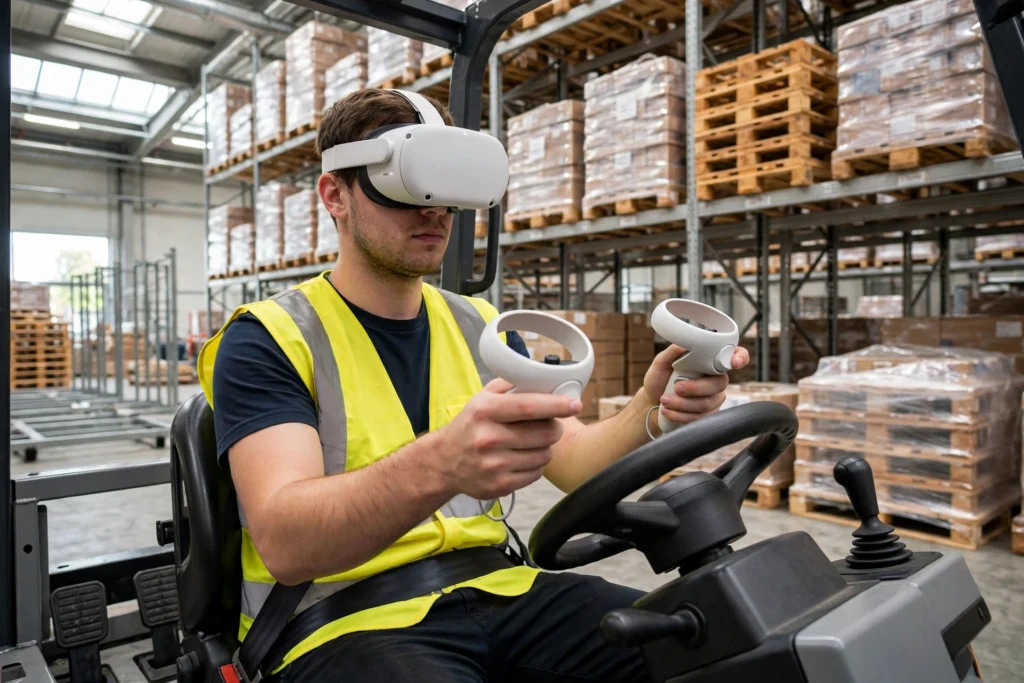
Yes — you can learn the basics of driving a forklift in virtual reality. VR forklift training puts a trainee in a warehouse with a headset and controllers, so they can practise inspections, steering, and stacking before touching a real truck. It is a strong start, but a qualified evaluator still has to watch the operator drive a real forklift first.
Key Takeaways
- It teaches the controls, the pre-use inspection, and the habits that keep pedestrians safe — with no risk to people, stock, or racking.
- A session runs through inspection, driving, load handling, and hazard scenarios, then ends with a score for the trainer.
- VR cannot replace the final evaluation on a real truck: US OSHA rules require formal instruction, practical training, and a workplace evaluation.
- It suits new starters, refresher training, and operators switching truck types, but not the feel of a heavy load.
What does a VR forklift training session look like?
Picture a new starter on their first morning: instead of the keys to a three-tonne truck, a headset, and a virtual warehouse aisle. Prompts walk them through the inspection: tyres, forks, mast chains, overhead guard, seatbelt. Miss a step and the simulation flags it.
Then the driving starts. The trainee steers through aisles, sounds the horn at blind corners, and learns the odd truth about forklifts — they steer from the rear wheels, so the back end swings wide in a way a car never does.
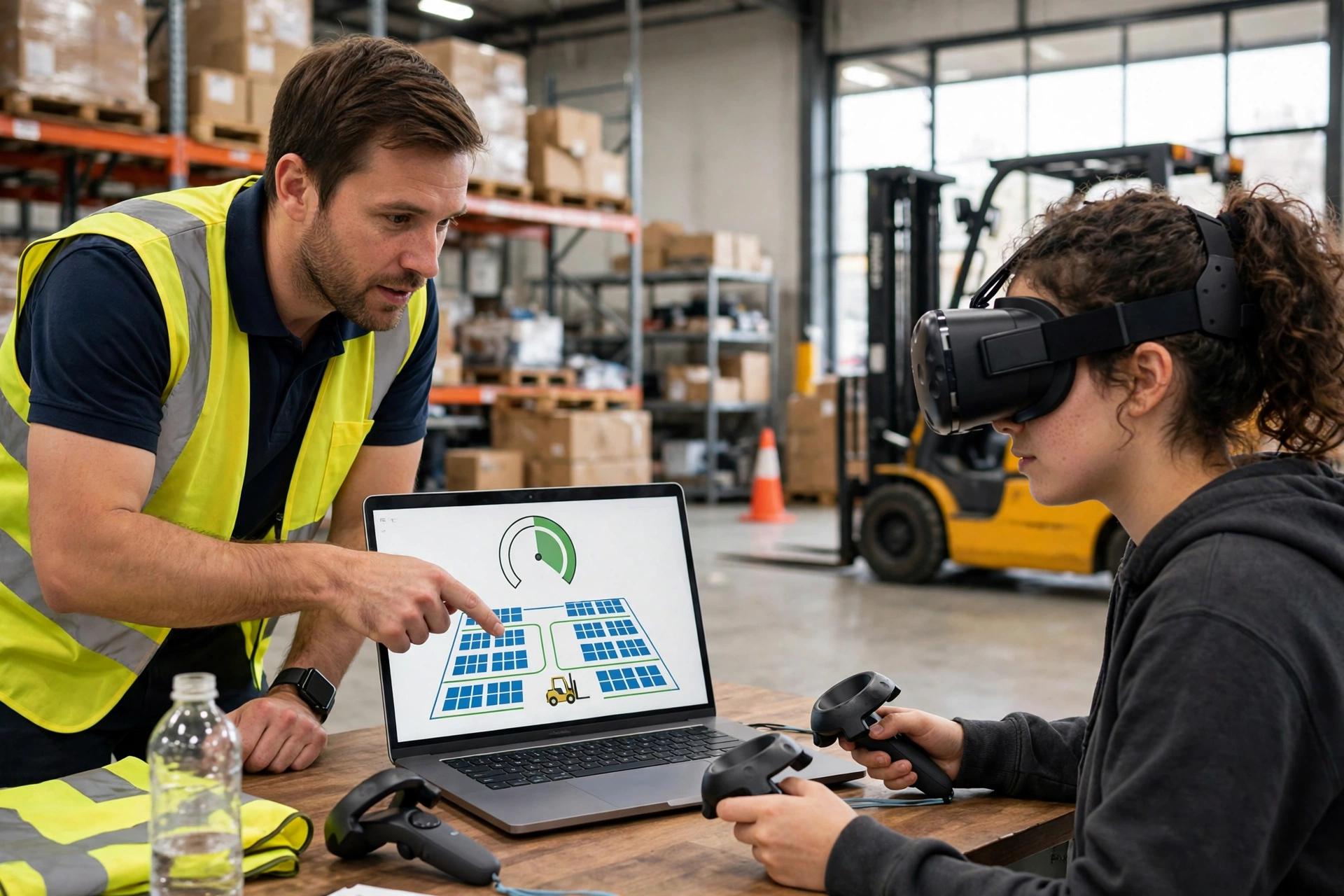
Then load handling: pick up a pallet, keep the forks level, stack it at height. The simulation tracks fork tilt and approach speed, and lets the trainee tip a virtual pallet — a mistake that costs nothing in VR. Then the hazards arrive: a pedestrian steps out, a load shifts, another forklift crosses from a blind aisle. Afterwards, the trainer gets a report of what to practise again.
What can VR teach that a classroom cannot?
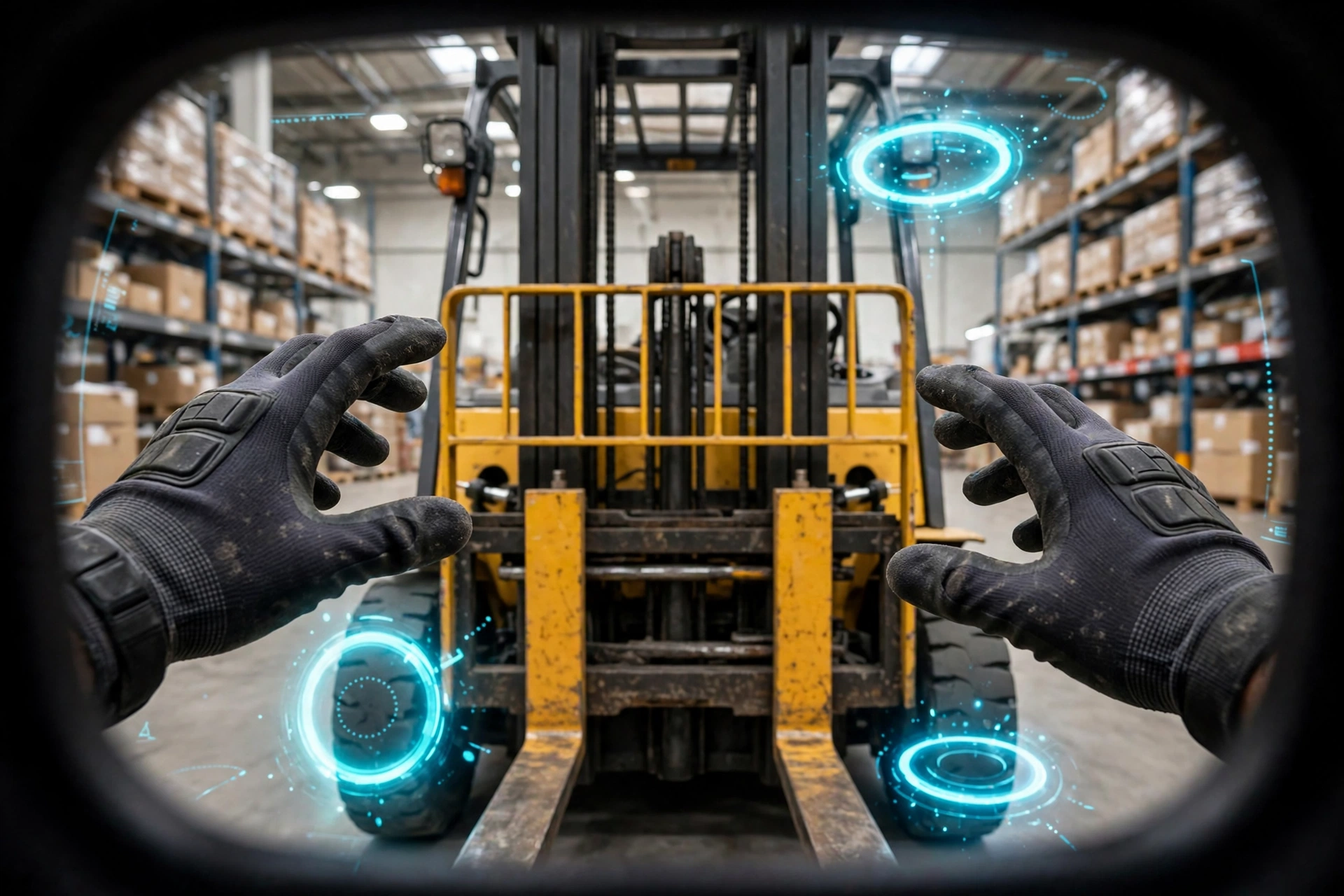
A classroom can explain the stability triangle: a forklift stays upright only while its centre of gravity sits inside the triangle formed by the wheels. VR lets a trainee find out what happens when it does not: raise a load too high, turn too fast, and the virtual truck tips. The lesson lands in a way a diagram never manages.
Blind spots work the same way: the mast blocks much of the view, and a pedestrian behind a rack is invisible until the last second. In VR, trainees learn to stop, sound the horn, and look — because they have already had the near-miss, virtually. It also drills the small habits: seatbelt on, forks lowered when parked, mirrors checked.
Where does VR fall short?
The biggest gap is physical feel. A real forklift vibrates, lurches, and fights back when a load is uneven. Most VR rigs cannot reproduce that weight, so a trainee who is smooth in VR can still be clumsy on their first real shift. Motion seats and real controls help, but it is still a simulation. Variety is the other gap: a virtual warehouse is one warehouse, while a real one has wet floors, broken pallets, and dim corners. No simulation covers every quirk of a real site, which is why the final evaluation happens on site.
VR forklift training vs classroom vs real truck
| VR training | Classroom | Real truck | |
|---|---|---|---|
| Cost of a mistake | None | None | Real — injury or damage |
| Teaches the controls | Yes, hands-on | Diagrams only | Yes, for real |
| Teaches load feel | Partly | No | Yes, fully |
| Repeats a drill | As often as you like | Talk it through | Slow, ties up a truck |
| Counts toward certification | Practice | Instruction | Final evaluation |
The three belong together: the classroom explains the rules, VR builds the habits, and the real truck proves the operator can do it for real.
A typical first week: Monday, theory and a first VR session; Tuesday, load handling; Wednesday, hazard scenarios; Thursday, a real truck in a quiet yard, trainer beside her; Friday, the evaluator watches a full task. The pass happens on a real truck, with the VR hours behind it.
Who is VR forklift training best for?
New starters get the most from it, because they can make their first mistakes safely. Experienced operators use it for refresher training — rules change, and habits drift — and for switching truck types, since a stand-up rider drives nothing like a sit-down counterbalance truck. High-turnover warehouses like it because a trainee can start the same day, without waiting for a free truck and trainer. Training centres like it too: one headset serves a whole class in rotation. That is why VR has spread through other trades, from VR electrician training to VR welding training and VR construction training.
Does VR forklift training count toward a licence?
The answer depends on where you are. In the US, OSHA’s powered industrial truck standard requires formal instruction, practical training, and an evaluation of the operator in the workplace. VR can cover the first two, but the evaluation must be observed on real equipment. Providers such as VictoryXR agree: their simulator prepares operators for certification, and the employer still completes the workplace evaluation. Other countries have their own rules, so check local requirements first.
What kit do you need?
Most programmes run on a standard standalone headset with controllers; some add a wheel, pedals, and levers. Costs vary — per-trainee or site licences — so the price list is only part of the picture. What matters more is whether the training matches your trucks: a course built around a sit-down truck teaches little about a reach truck. Ask which truck types it covers, whether it includes the inspection and hazard scenarios, and whether it produces a report the trainer can review. If it only lets you drive around a warehouse, it is a game, not training.
FAQs
Can VR forklift training replace hands-on training?
No. It replaces the early, risky part of hands-on training, but a qualified evaluator must still watch the operator on a real forklift first.
How long does a VR forklift session take?
Sessions run around 20 to 40 minutes per module, per one provider’s guide. Short, repeated sessions usually work better than one long one.
Do you need a special headset?
Most run on a standard standalone headset, such as a Meta Quest or a PICO headset, with controllers. Some add a wheel, pedals, and levers.
What about motion sickness?
Most trainees are fine, but a few feel queasy during sharp turns. Good programmes keep early sessions short, and anyone who feels ill should stop and try again another day.
What should I look for in a VR forklift course?
Check which truck types it covers, whether it includes the inspection and hazard scenarios, and whether it produces a report the trainer can review.
Conclusion
VR forklift training is a sensible way to start a job where early mistakes are expensive. It teaches the controls, the inspection routine, and the safety habits where nothing can be damaged and nobody can be hurt. Its limits are honest: no real load weight, and no sign-off on its own. If you run a warehouse or a training centre, try a demo session with one of your own trainers, on the truck type your team drives, and compare the VR report with the trainee’s first real-truck session. If the habits transfer, VR has earned its place in your training plan.
Further reading: VictoryXR enterprise VR training and HTC VIVE — XR Training Makes Forklift Operators Safer. Related on Techserps: VR safety training.