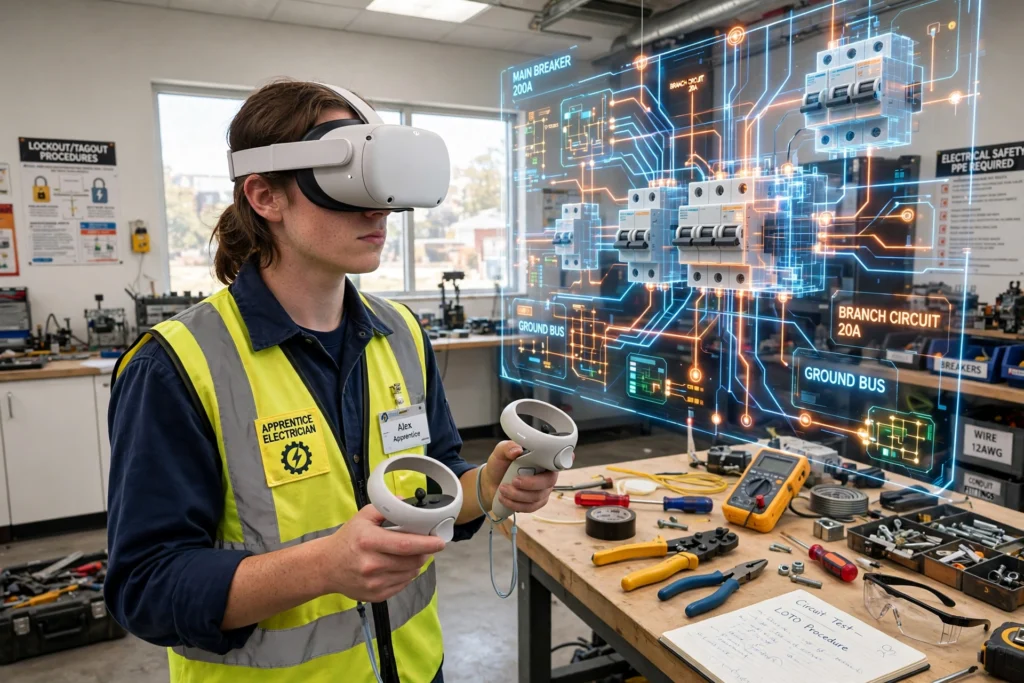
VR electrician training lets apprentices wire circuits, test panels, and practise fault-finding inside a headset, with no live current anywhere near them. The panels, wires, and meters are virtual, but the steps are the real ones: isolate the circuit, lock it out, prove it dead, do the work, then restore it.
Key Takeaways
- VR electrician training recreates panels, switches, and wiring jobs in a headset, so apprentices can practise without live current.
- The core skill it drills is the safety sequence: plan the job, isolate and lock out, test before you touch, then restore.
- Mistakes in VR carry virtual consequences, such as a simulated arc flash, so the lesson lands without anyone getting hurt.
- A learner can repeat the same job as often as they like.
- It does not replace real bench time or supervised live work.
What does an electrician actually practise in VR?
A typical lesson starts in front of a virtual panel or a room that needs wiring. The learner picks up virtual tools, strips a virtual cable, and connects it to the right terminal. Early lessons are simple — a light switch, a socket, a labelled consumer unit — and later ones add three-way switching, fault-tracing, and panels that must be isolated first.
Markers and voice prompts guide each step at first, then fade away, so the final run is done from memory.
Our guide to How Do VR Headsets Work? explains the screens, lenses, and tracking that make these virtual panels feel solid enough to work on.
How does a VR electrician lesson run?
Most lessons follow the same five steps as real electrical work, because the whole point is to make the sequence automatic. First, plan: read the panel schedule and pick the right protective equipment. Then isolate: switch the circuit off, lock the breaker, and tag it so nobody else can switch it back on. This is lockout-tagout, and it is the habit VR training drills hardest.
Third is the step instructors care about most: test before you touch. The learner checks the meter on a known live source, tests the circuit they are about to work on, then checks the meter again. This live-dead-live check is easy to rush in real life and easy to practise properly in VR, where skipping it produces an immediate warning rather than a shock.
Then comes the work itself, and finally removing the locks, re-energising, and testing. Every step is recorded, so the instructor can see where someone hesitated or skipped ahead.
Why is practising in VR safer than practising on a bench?
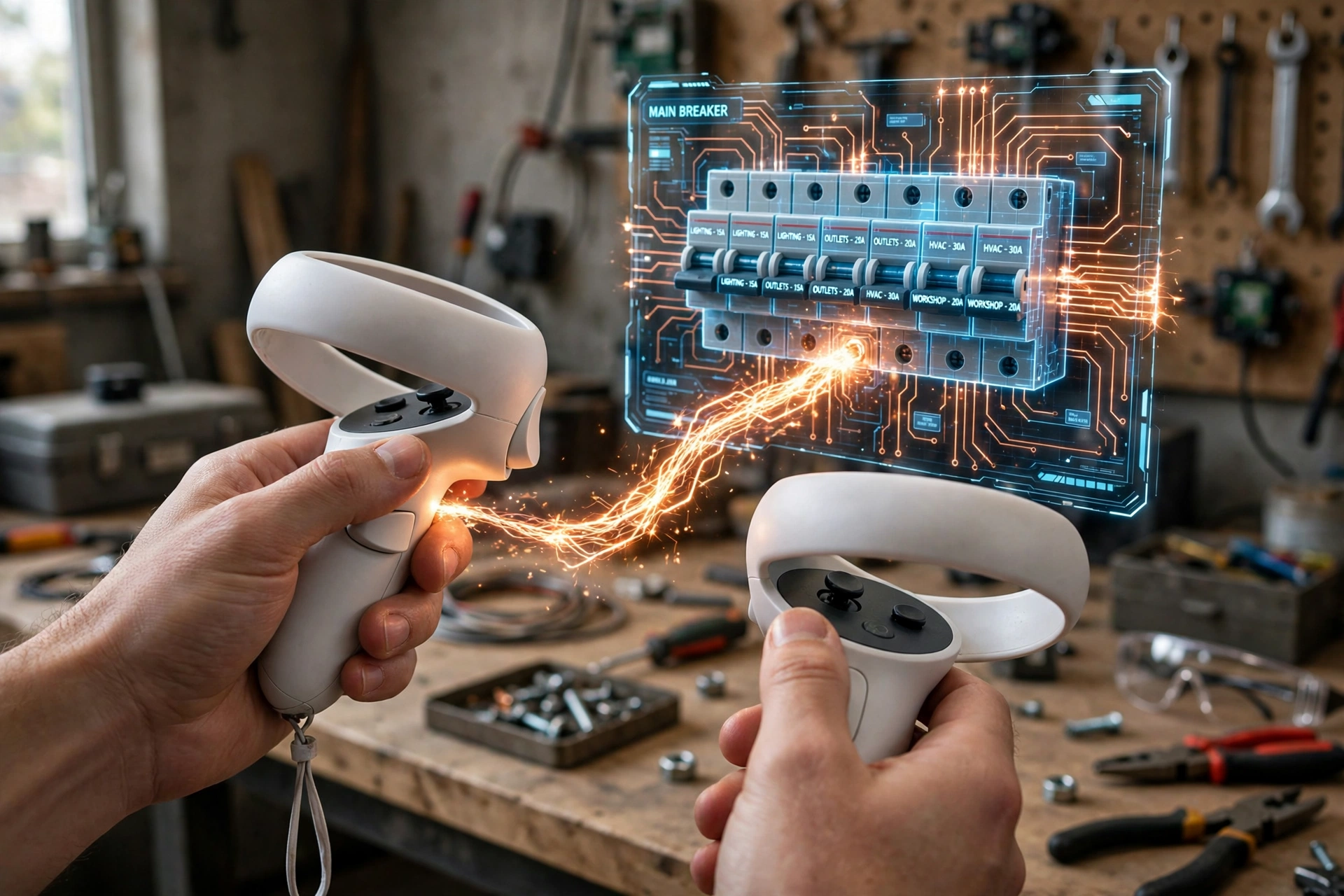
A bench is safe too, when it is set up properly. VR adds something different: it lets learners meet dangerous situations without the danger. Touch a conductor you thought was dead and the simulation shows an arc flash, with light, sound, and a failed score. Nobody is hurt, but the mistake is hard to forget. Instructors would rather a learner makes that error in a headset than on their first week on site.
VR also removes the bottleneck of real materials: with one training board and thirty students, each learner gets few turns, while in VR everyone gets their own panel and can repeat a lesson until the steps stick. Programmes built for electrical apprentices, such as the Virtual Electrical Training platform developed with IDEAL Industries, are now used in hundreds of schools.
One limit to keep in mind: a virtual screwdriver has no weight, and a virtual cable never fights back when you bend it, so the best courses pair VR sessions with real bench work.
How is VR electrician training different from classroom learning?
A classroom teaches the theory; VR teaches the doing. The difference shows up in the first week on site, when an apprentice who has only read about lockout-tagout meets a real panel for the first time. The one who has run the sequence twenty times in VR usually moves more slowly and more carefully, because the steps are already in their hands.
| Classroom or video | VR training | Live bench work | |
|---|---|---|---|
| What you learn | Theory, regulations, diagrams | The full job sequence, step by step | Real materials, tools, and feel |
| Mistakes | Found in a test, days later | Shown the moment they happen | Costly, and sometimes dangerous |
| Repetition | Read the chapter again | Repeat the job as often as you like | Limited by boards, cable, and time |
| Safety practice | Described on slides | Practised: isolate, lock, test, restore | Real, under close supervision |
VR sits in the middle: more hands-on than a lecture, safer and more repeatable than a live panel. It works best as the bridge between the two, not as a substitute for either.
How do schools use the scores?
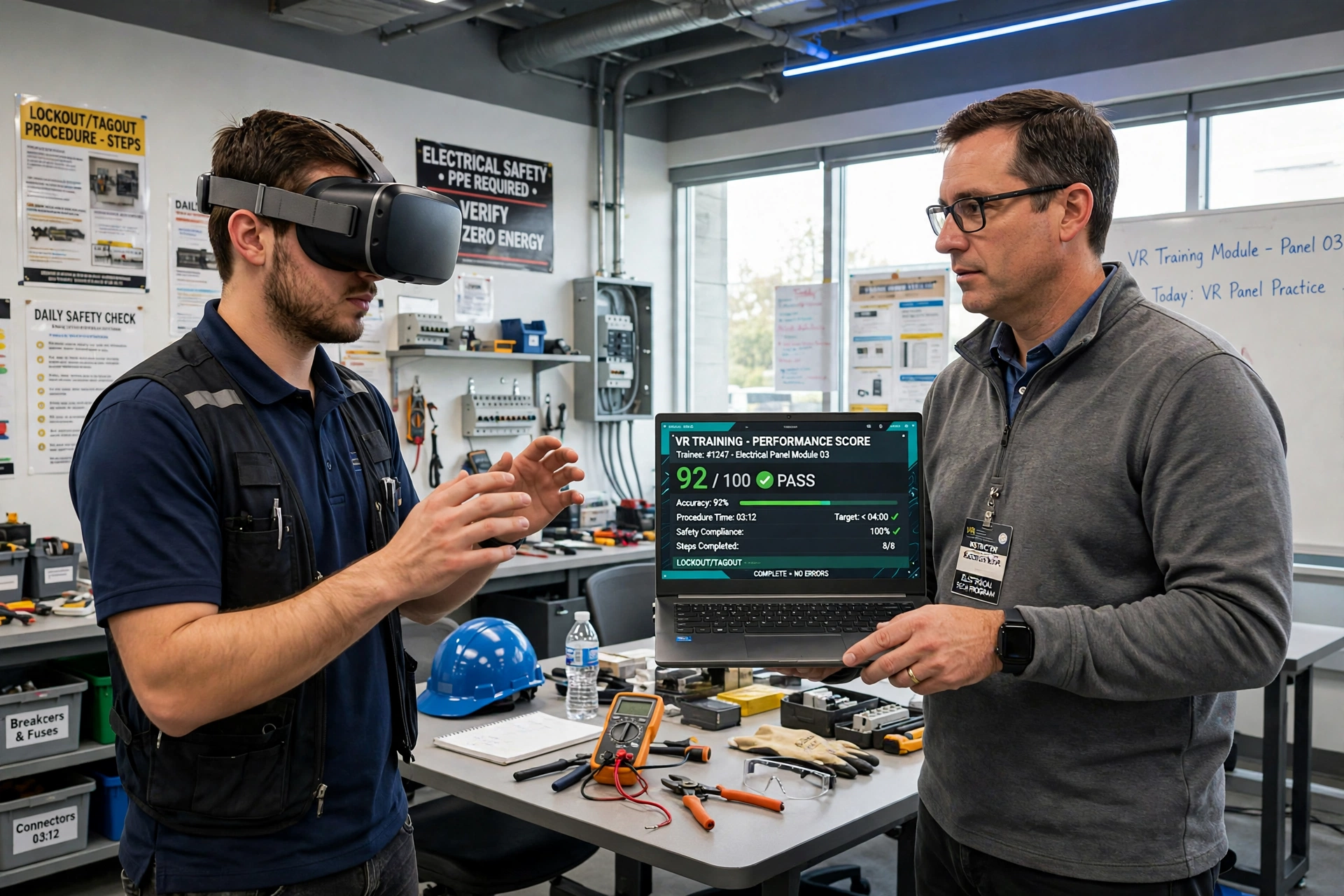
Every lesson records the attempt: which steps were done, in what order, how long each took, and what was missed. The instructor watches the learner’s view live on a laptop, then reviews the record. For the learner, a clear pass mark and a list of missed steps turns a vague “do better” into something concrete.
Other trade training in VR works the same way. Our guides to How Does VR Work for Welding Training? and How Does VR Work for Construction Training? show how welders and site workers practise risky jobs the same way, and How Does VR Work for Safety Training? covers the wider safety drills behind all of them.
What kit do you need?
Most programmes run on standalone headsets, the kind that needs no PC and no cables. The college or employer usually owns the headsets, and the learner books a slot. The software is usually licensed to a school or company rather than sold to one person. If you are choosing a course, ask whether VR sessions are included, how many hours you get, and whether the practice is assessed or just a demo.
FAQs
Do I still need real electrical work after VR training?
Yes. VR builds the sequence and the safety habits, but qualification still needs supervised work on real installations.
Can VR really teach lockout-tagout properly?
It teaches the sequence well: isolate, lock, tag, test, and restore in the right order. It cannot teach the feel of a stiff breaker. That part comes from the bench.
What headset do I need for electrician training?
Most programmes use a standalone headset with hand controllers and no PC. Check the provider’s supported devices list before buying anything yourself.
Does VR training count toward an electrician’s licence?
That depends on the country and the awarding body. The licence still requires assessed real-world work and exams, so ask the provider exactly what counts before you enrol.
Is VR training useful for experienced electricians too?
Yes, for refreshers. A qualified electrician can rehearse a procedure they rarely do, such as switchgear maintenance.
Conclusion
VR electrician training works by putting apprentices in front of virtual panels and making them run the real safety sequence: plan, isolate, lock out, test, then work. It is safer than learning on live equipment and more hands-on than a textbook. Its limits are honest ones: it cannot teach the feel of real cable and tools, and it cannot replace supervised real work.
Your next step is simple. If you are choosing a course, ask how many VR practice hours it includes and whether your lockout-tagout sequence is scored. If you are already training, ask your instructor for one extra run of the isolation and testing lesson, because that is the sequence that keeps electricians safe on every job after.
Further reading: Roundtable Learning’s guide to VR and AR in the electrical industry and Bubbler Reality Labs’ electrical safety VR training module.