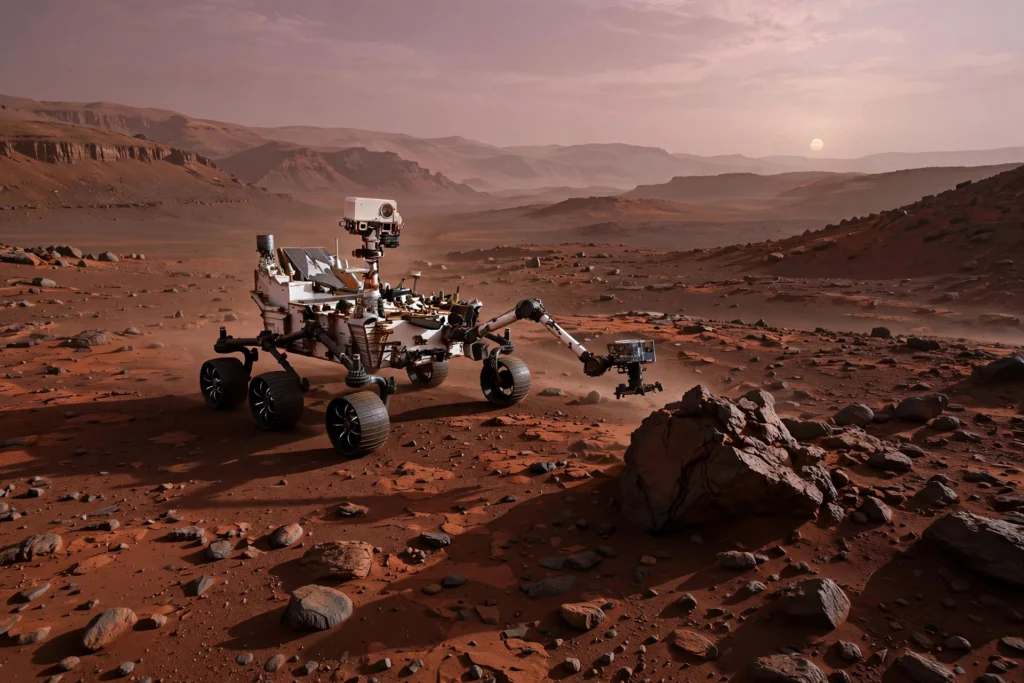
AI in space is software that lets spacecraft make decisions on their own. It drives Mars rovers around rocks, sifts through telescope data to spot new planets, and helps satellites dodge debris — all while radio signals take minutes or hours to travel back to Earth. In short, it does the thinking where humans cannot be in the room.
Key Takeaways
- Mars rovers use AI to pick their own routes, because a radio signal can take more than 20 minutes to travel one way.
- In 2017, a neural network found an eighth planet around Kepler-90 in data astronomers had already checked.
- AI sorts the flood of telescope data, flagging rare signals worth a closer look.
- Satellites use AI to watch for collisions and spot faults before they turn serious.
- People still make the big calls. AI handles the routine work, not the mission itself.
Why does space need AI at all?
Two things make space different from Earth: distance and data. A radio signal still takes three to 22 minutes to reach Mars, and hours to reach a probe near Jupiter. You cannot steer a rover with a joystick when every command arrives minutes late.
Modern telescopes collect far more data than any team could read by hand — the Square Kilometre Array, still being built, is expected to generate around 700 petabytes a year. That is the job artificial intelligence now does in space: it decides locally, on the spacecraft, instead of waiting for instructions from Earth.
How does AI drive a rover on Mars?
NASA’s Perseverance rover is the clearest example. Its AutoNav system uses stereo cameras to build a 3D map of the ground ahead, spots hazards such as large rocks and steep slopes, and plots its own route around them. Perseverance covers ground on its own while its team sleeps.
Picture a typical day, or sol. The team sends a short list of goals — drive to that ridge, photograph those rocks, drill a sample here — and the rover works through it alone, zapping interesting rocks with a laser to learn what they are made of. At day’s end it sends home a shortlist of the best results, not every byte it collected.
It runs on machine learning and computer vision, trained on rocky Martian ground rather than faces. It is not perfect — the rover still drives slowly — but without it, a rover would spend most of its life parked, waiting for instructions. For the hardware side, see our guide to space robots.
How does AI find new planets?
Most planets outside our solar system are found by watching their stars. When a planet passes in front of its star, the star’s light dips very slightly — a tiny, regular flicker in a graph called a light curve. Spotting that dip by eye in millions of light curves would take forever, so astronomers train neural networks to do it instead.
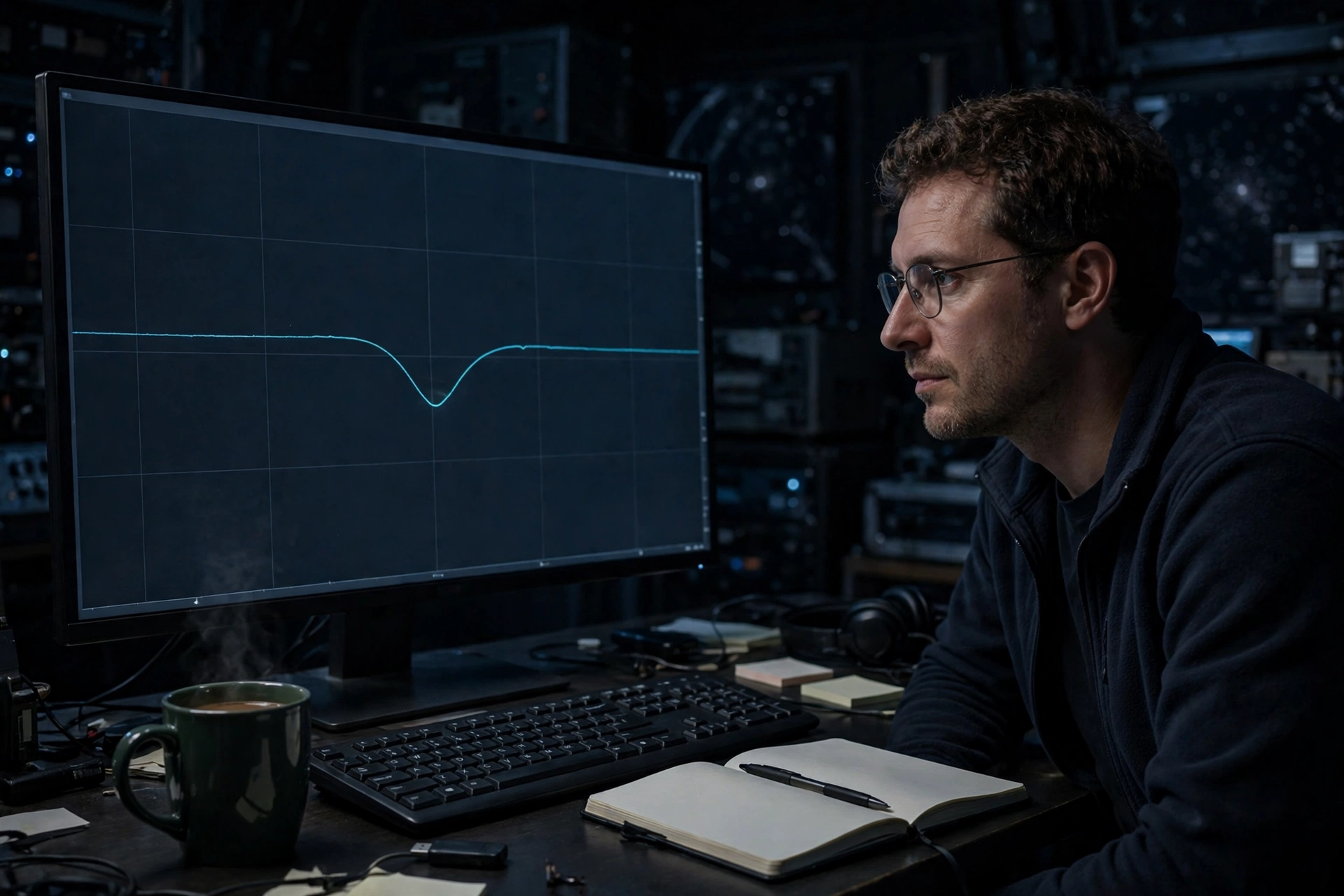
The most famous catch came in 2017, when a neural network built by researchers at Google found an eighth planet orbiting the star Kepler-90 — in data from NASA’s Kepler telescope that astronomers had already searched. Kepler-90 became the first known star system with as many planets as our own, and the same approach is now used on data from the TESS telescope.
Galaxy Zoo once relied on volunteers to classify galaxies; today AI does most of that sorting, leaving the strange cases for human eyes. The pattern is always the same: the telescope gathers too much for people to read, and the AI points them at the few things worth their time.
What does AI do for satellites?
Closer to home, AI keeps the machines above our heads working. Thousands of active satellites share orbit with far more pieces of debris, and close passes keep growing. AI tracks orbits, flags the risky encounters, and helps operators decide when a satellite should move.
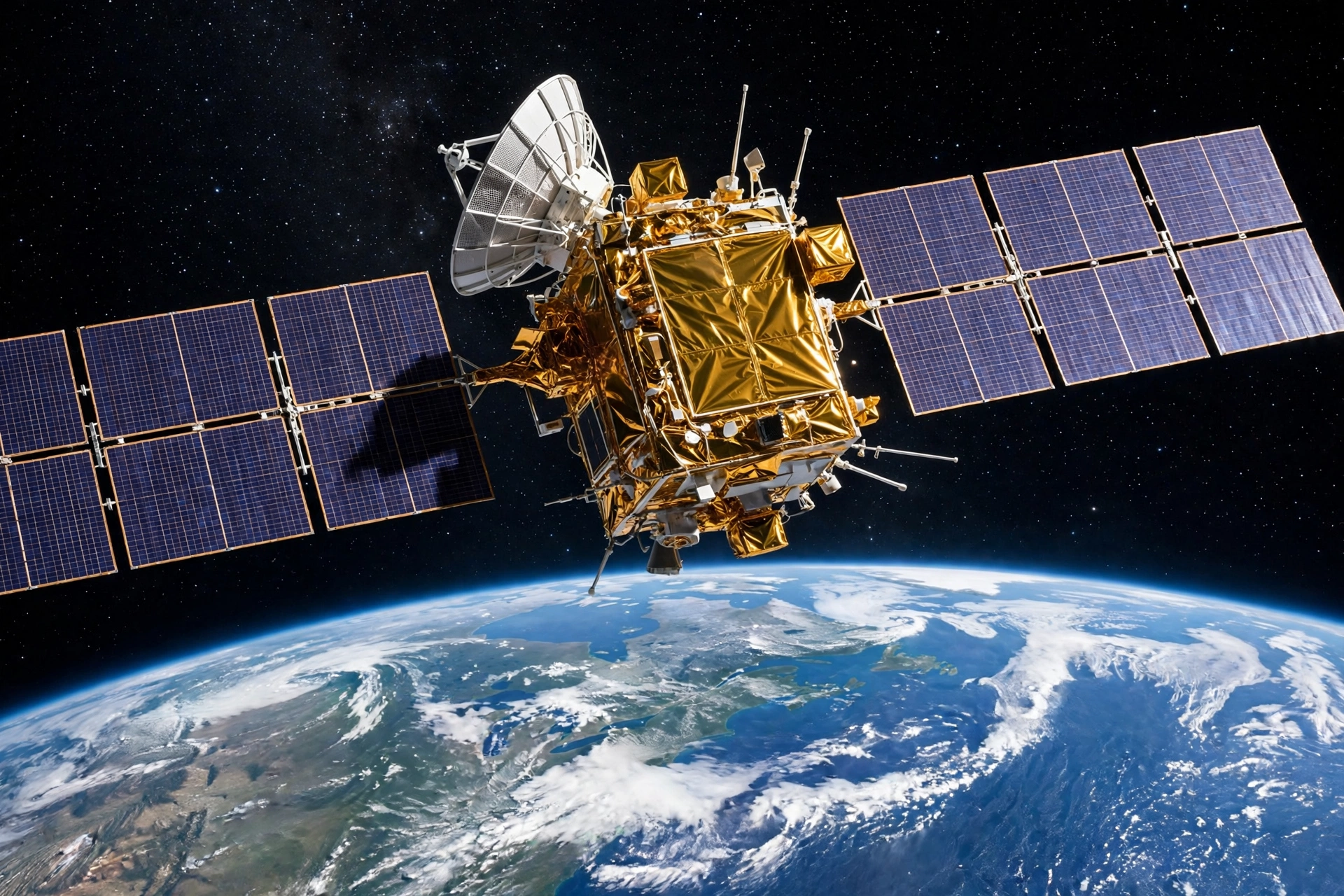
AI also watches the satellites themselves. A satellite cannot be taken to a workshop, so its software monitors temperatures, battery levels, and sensor readings for the small, odd patterns that come before a failure. Catching a problem early can mean the difference between a satellite that keeps working for years and one that goes silent.
The same idea applies to Earth observation: satellites photograph the whole planet daily, and AI sorts those images, spotting wildfires, floods, and crop stress far faster than any team of analysts.
AI in space vs AI on Earth
The ideas are familiar, but space changes the rules. Here is how the two compare:
| AI in space | AI on Earth | |
|---|---|---|
| Waiting for instructions | Minutes to hours; the craft decides alone | Milliseconds; a data centre is in reach |
| How much data | Too much to send home; most is sorted on board | Usually uploaded and processed in the cloud |
| Computing power | Weak radiation-hardened chips, years behind phones | The latest processors, no real power limit |
| Fixing a mistake | Often impossible; a bad move can end a mission | Usually fixed with a software update |
| Who decides | AI handles routine choices; people approve the rest | People can step in at any moment |
Where are the limits?
For all its successes, AI in space is narrow. A model trained to spot planets in Kepler data may miss something completely new, because it only knows what it has seen before. A rover’s navigation AI can be confused by unfamiliar terrain. Engineers keep the AI’s job small and specific, and the spacecraft stops to wait for help when unsure.
The hardware is a limit too. Chips that survive radiation in space are deliberately simple and slow, years behind the processors in a phone, so space AI has to be lean. And the biggest decisions stay with people: AI proposes, sorts, and drives, but humans choose where the rover goes next.
Frequently Asked Questions
Has AI actually discovered a planet?
Yes. In 2017, a neural network found Kepler-90i, an eighth planet around the star Kepler-90, in Kepler data that had already been searched by hand.
Can AI run a whole space mission by itself?
No. AI handles routine work — driving, sorting data, watching for faults — but mission planning and anything risky still go through people on Earth.
Does AI steer satellites around space junk?
It helps. AI tracks orbits and flags dangerous close passes, and operators usually approve the move. Fully automatic dodging is still being tested.
Will AI replace astronauts?
No. AI takes on work that is dull, distant, or dangerous, while astronauts do the judgement and repair that need a person on the spot.
How can I follow AI space discoveries for myself?
NASA publishes Perseverance’s raw images as they arrive, and its exoplanet archive lists every confirmed planet. Galaxy Zoo also lets volunteers classify galaxies alongside the AI.
Conclusion
AI in space is not about robots taking over the universe. It is about giving spacecraft enough sense to cope while help is minutes or hours away: driving themselves across Mars, picking new planets out of a flood of starlight, and keeping satellites out of trouble. The telescopes and rovers are the eyes and hands; AI decides what is worth looking at next. People are still in charge — setting the goals and checking the results.
Your next step is a small one: pick a mission to follow. NASA’s Perseverance raw image feed shows the rover’s daily drive, planned in part by its own software, while the NASA Exoplanet Exploration site lists the newest worlds AI helped find.
Further reading: NASA — Mars 2020 Perseverance rover and NASA Exoplanet Exploration.