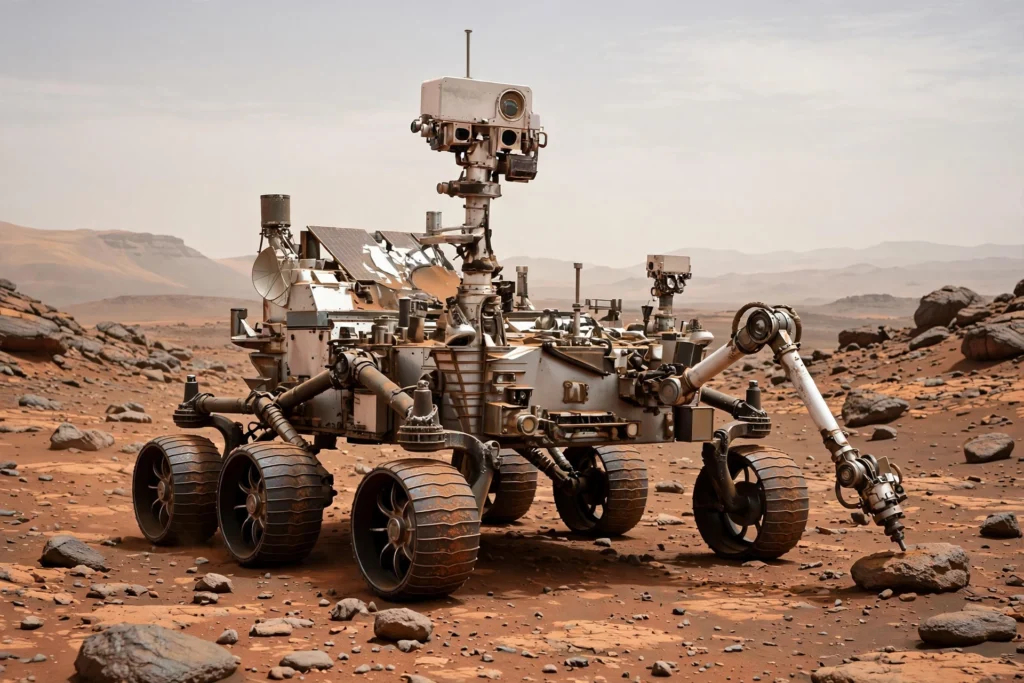
Space robots work in places no person can reach — or at least, not yet. A rover crawls across Mars drilling rock samples, a giant arm on a space station catches a cargo ship, and a small servicer satellite nudges a broken one back into place.
Key Takeaways
- Space robots come in three main kinds: rovers that drive on other worlds, arms that work on stations, and servicers that repair satellites.
- They are driven from Earth in short, careful steps, because a radio signal can take many minutes to reach Mars.
- Solar panels or nuclear power keep them running, and heaters protect their electronics from extreme cold.
- Cameras, lasers, and drills turn a rover into a mobile science lab, not just a vehicle.
- They are built to fail gracefully, keeping work going even when parts wear out.
What is a space robot?
A space robot is any machine that does useful work beyond Earth’s atmosphere without a person on board. The most famous are the Mars rovers — six-wheeled vehicles the size of a small car that have explored the red planet since the late 1990s. But the family is bigger: robotic arms mounted on space stations, free-flying robots that inspect the outside of spacecraft, and satellites designed to grab, refuel, or repair other satellites.
What they share is the environment. Space is cold, airless, and full of radiation, and the nearest repair shop is millions of kilometres away. A space robot has to be tough and able to look after itself, because a small mistake can end a mission that took years to build — so it does the jobs too far, too dangerous, or too dull for astronauts.
How do Mars rovers move and explore?
A Mars rover moves slowly — very slowly. On a good day it might cover a few dozen metres, and it often stops to take photos, analyse a rock, or wait for the next instructions from Earth. Speed is not the point. The point is to reach interesting places without getting stuck, tipping over, or damaging a wheel.
Most rovers use six wheels with a suspension that lets each wheel rise and fall over rocks independently. That design keeps the body level while the wheels climb over obstacles, and it has no steering rack to break — the rover turns by spinning its wheels at different speeds, a bit like a tank.
On top sits the rover’s “head”: a mast with cameras that take panoramic photos and zoom in on distant features. On an arm are the science tools — drills that grind into rock, lasers that zap a surface to read its chemistry, and scoops that collect soil. A rover is really a rolling laboratory with wheels attached.
Power comes from solar panels or a nuclear generator. Solar panels are lighter and simpler, but dust can coat them and winter sunlight is weak. A nuclear power source, used by the larger rovers, produces steady heat and electricity for years.
What do robotic arms do in space?
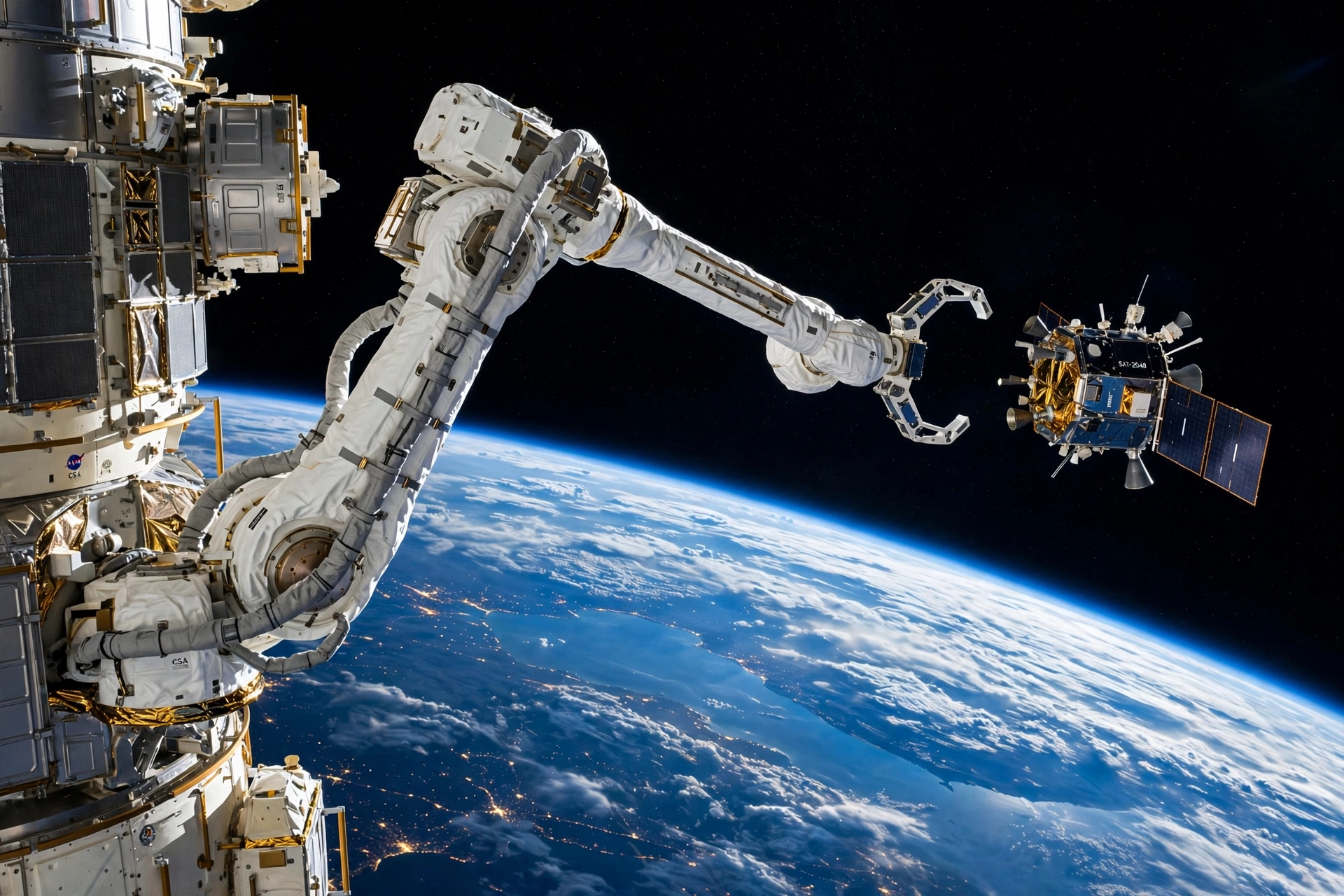
Robotic arms are the workhorses of space stations. The best known is Canadarm2 on the International Space Station, a long arm with joints at both ends that can crawl along the station’s structure, grab visiting cargo ships, and hold astronauts or equipment steady during spacewalks. It works a bit like a crane that can also walk.
Arms like this are built very differently from factory robot arms. They move slowly and gently, because in weightlessness even a small push can send a heavy object drifting, and their joints have brakes that lock in place, so the arm holds its position even if the power cuts out. Every movement is planned and checked on the ground first, then sent up as a set of commands.
Smaller arms do finer work. Rovers carry a short arm with tools on the end — a drill, a camera, a brush — that they press against rocks to study them up close. Future missions plan to use arms to assemble large structures in orbit, piece by piece, instead of launching them whole.
How are space robots driven from Earth?
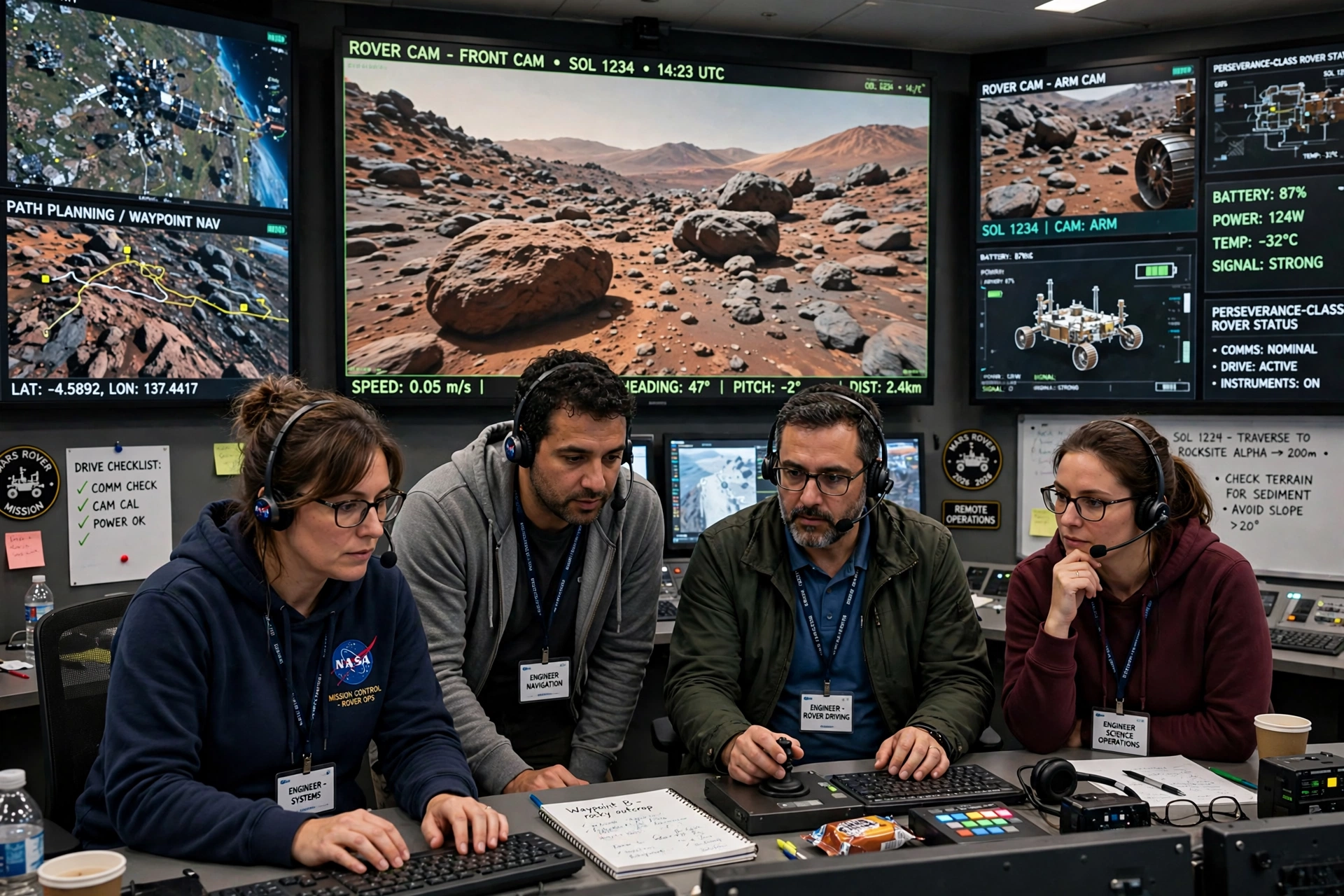
Driving a robot on Mars is nothing like driving a car. A radio signal takes between about 4 and 24 minutes to travel each way, depending on where the planets are in their orbits. An operator on Earth cannot steer a rover live — by the time they saw a rock, the rover would already have hit it.
So the driving happens in daily steps. The rover sends back photos of the ground ahead. Engineers on Earth study the images, pick a safe route, and send a short set of commands: drive forward this far, turn this much, then stop and take photos. The rover follows the plan on its own, using its own cameras to spot hazards and stop if something looks wrong. The next day, the team reviews where it ended up and plans the next move.
This stop-and-go rhythm shapes everything about how space robots work. They are semi-autonomous by necessity: they handle moment-to-moment decisions themselves, while people on Earth set the goals and check the results.
How do space robots survive such a hostile environment?
Space is hard on machines. Temperatures swing wildly between sunlight and shadow, radiation can scramble electronics, and fine dust gets into everything. Mars dust is especially troublesome: it is sharp, clingy, and coats solar panels and camera lenses.
Engineers fight back with simple, sturdy design. Electronics are shielded and often duplicated, so a single failure does not kill the mission, heaters keep batteries warm at night, and software is written to expect trouble — if a sensor reading looks wrong, the robot pauses and waits for instructions instead of pushing on blindly.
Testing on Earth matters as much as the design. Space robots are shaken, frozen, baked, and bombarded with radiation in test chambers before they ever launch, because the first real test cannot be allowed to fail. Even so, wheels wear down, dust storms block the sun, and instruments degrade — so the best missions are planned with spare capacity and backup plans built in from the start.
What about robots that fix satellites?
A newer kind of space robot works much closer to home, in orbit around Earth. Satellite servicers are small spacecraft that approach another satellite, dock with it, and carry out repairs — refuelling it, replacing a part, or pushing it back into its correct orbit. Without them, a satellite that runs out of fuel or drifts off course is usually written off, even if the rest of it works fine.
FAQs
How long does it take to drive a rover on Mars?
A signal takes roughly 4 to 24 minutes each way, so rovers are driven in daily plans rather than live. Engineers send a set of commands, the rover follows them on its own, and the team reviews the results the next day.
What powers a Mars rover?
Smaller rovers use solar panels, while larger ones use a nuclear generator that produces steady electricity and heat. Both have to cope with dust, cold, and long dark winters.
Can space robots repair themselves?
Not really, but they are built to keep going when parts fail. Electronics are often duplicated, software can work around a broken sensor, and rovers have driven on with worn wheels or a stuck joint.
What is the most famous space robot?
The Mars rovers are the best known — Sojourner, Spirit, Opportunity, Curiosity, and Perseverance — along with Canadarm2, the large robotic arm on the International Space Station.
Will robots build the first Moon base?
Probably, at least in part. Robots are expected to prepare landing sites, move materials, and assemble structures before astronauts arrive, because they can work in harsh conditions without life support.
Conclusion
Space robots work by combining rugged design, careful planning, and a lot of patience. Rovers explore other worlds one slow drive at a time, arms build and maintain stations in orbit, and servicers keep satellites alive — all while engineers on Earth send instructions across millions of kilometres and wait for the reply.
If the idea appeals to you, follow a current rover mission and watch how a day’s drive is planned. You will see the same principles that make robots useful on Earth — sensors, mobility, and human control — stretched to their limits in the most unforgiving workplace there is.