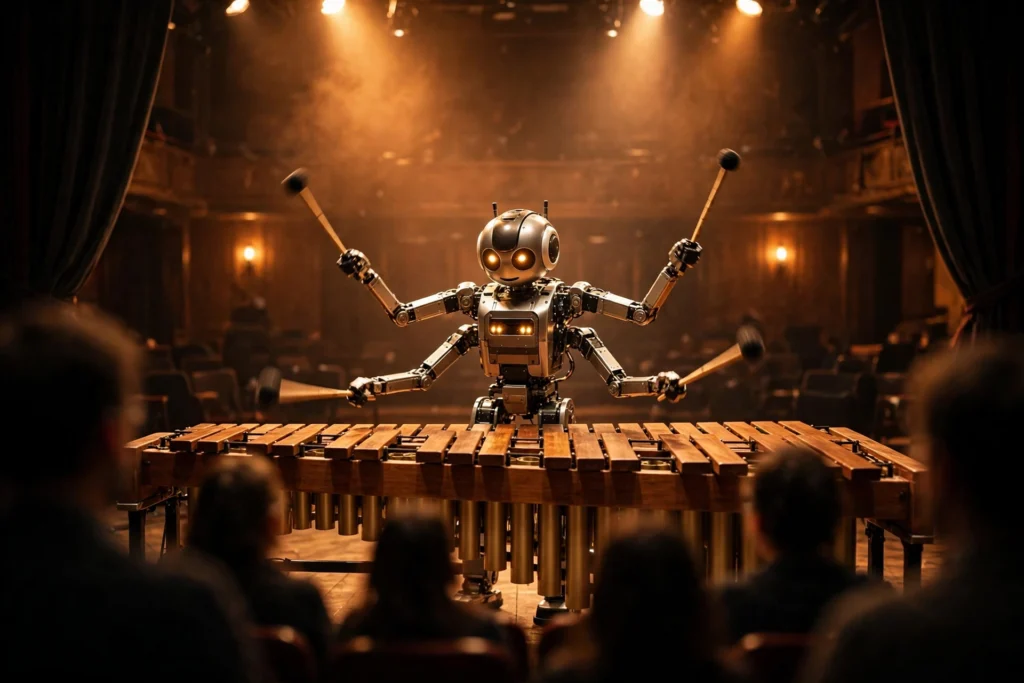
Robot musicians are machines that play real instruments — piano, drums, marimba, and guitar — with motors, sensors, and software instead of hands and ears. They read music as digital instructions, hit each note on time, and listen to the other players to stay in step. They are precise and tireless, yet they miss the feel of a live performance.
Key Takeaways
- Robot musicians play real instruments with motors and software, not through speakers.
- Most read music as MIDI data, or sheet music turned into notes and timings.
- Timing is the hardest part: a robot has to listen and adjust, not just play on a clock.
- Piano, drums, and marimba suit robots best; violin and trumpet are far harder.
- Robots can improvise inside rules, but they do not feel music or read a room.
What exactly is a robot musician?
A robot musician is a machine built to make music on a physical instrument. That is what sets it apart from a music app: the sound comes from wood, strings, skins, and metal, not from a speaker. Under the shell it is mostly familiar robotics — motors to move, sensors to measure, and software to decide what happens next.
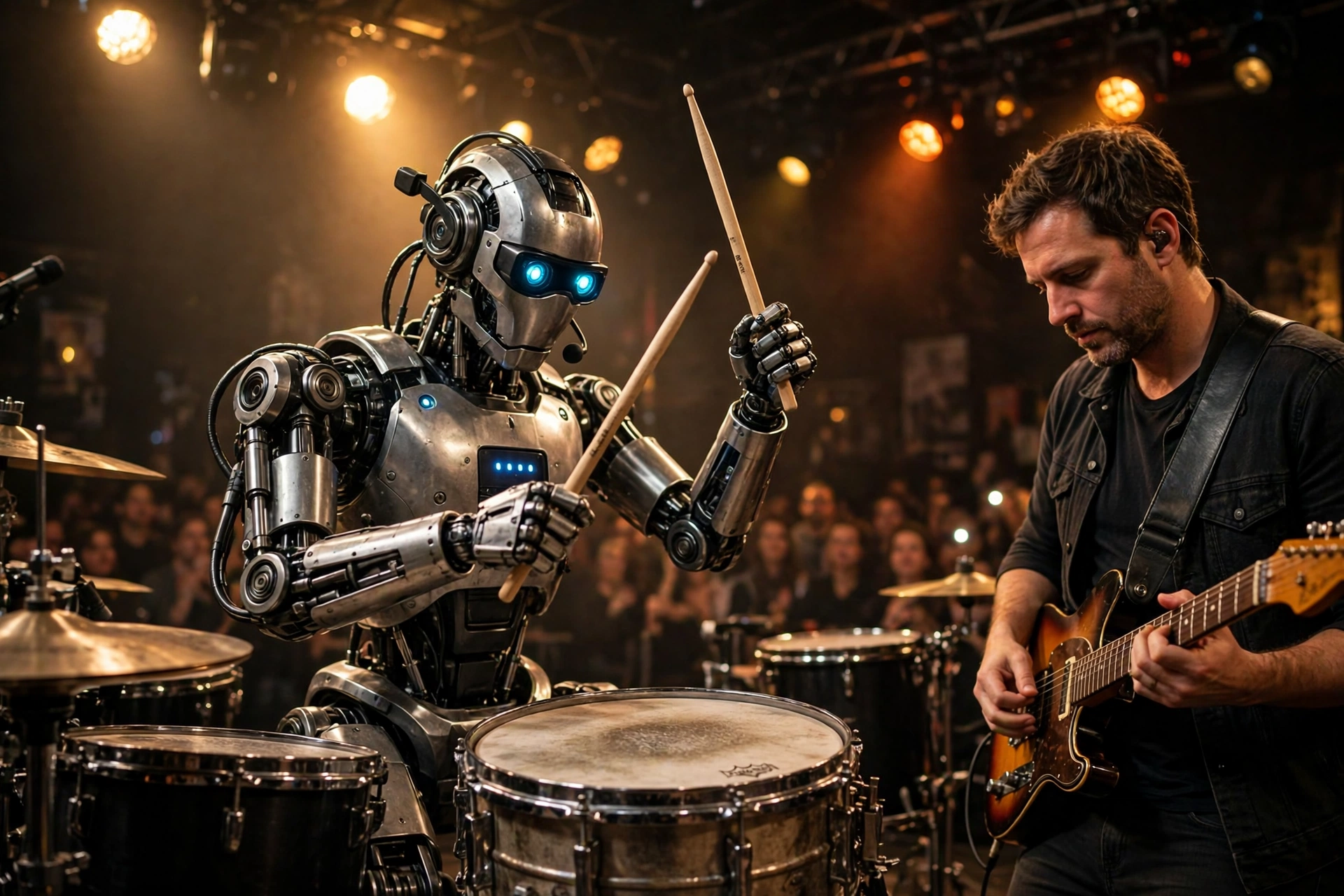
Most take one of three shapes: arms bolted to a stand; humanoid robots with a head, torso, and arms; or whole bands of machines, each on its own instrument. The German group Compressorhead is the best-known example — robots playing real instruments before a live audience.
How does a robot read a piece of music?
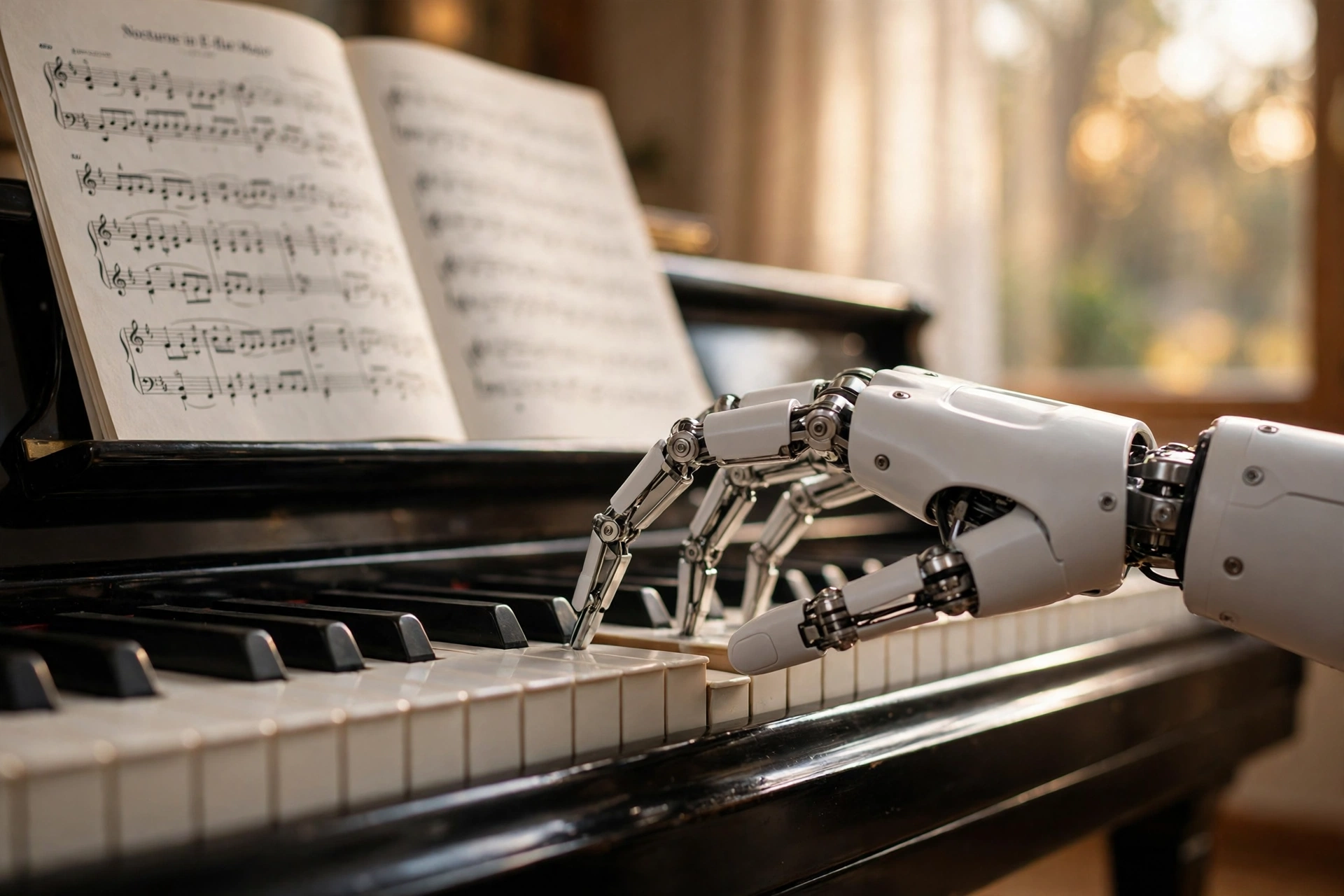
A robot cannot sight-read a score the way a trained pianist can, so the music has to be translated first. The most common format is MIDI, digital sheet music that lists every note, its length, and how hard it should be hit. The robot’s software turns that list into a schedule: this finger presses this key now, that mallet strikes this bar half a beat later.
Some robots read printed sheet music with a camera, or listen to a human playing and pick out the notes. Either way, the score is only a starting point: a robot that just follows a fixed schedule sounds like a metronome with notes, while one that keeps listening can slow down when the singer drags a phrase.
How do robot musicians keep time together?
Timing is where robot bands live or die. A wrong note is easy to forgive; a drummer who drifts off the beat makes the whole band sound broken. Humans solve this by watching and listening to each other. Robots do the same with microphones and cameras.
Most robot bands share a steady clock pulse, and the listening robots track the humans beside them, nudging their timing forward or back. The best-known example is Shimon, a marimba-playing robot built at Georgia Tech, which follows its human bandmates’ tempo changes and invents new phrases over their chords.
Which instruments suit robots best?
Instruments with clear, separate actions — press a key, hit a drum, strike a bar — come first. Ones that need breath or bow pressure come much later, if at all.
| Instrument | How a robot plays it | The hardest part |
|---|---|---|
| Piano | Fingers press the keys | Touch: loud and soft must differ |
| Drums | Sticks strike skins and cymbals | Hitting hard without breaking sticks |
| Marimba | Mallets strike wooden bars | Reaching across the bars quickly |
| Guitar | Fingers fret, a pick strums | Fretting and strumming at once |
| Violin | A bow crosses the strings | Bow pressure changes the sound |
| Trumpet | Valves pressed, air pumped | A robot has no lungs |
That is why robot bands so often look the same: a keyboard or marimba player, a drummer, and maybe a guitarist — the instruments where a machine’s strengths count most.
Can a robot improvise, or does it only follow a script?
Most robot musicians start as followers, playing exactly what they were given, note for note, the same way every time. That is already useful: a robot can play faster than any human, or repeat a difficult passage a hundred times without getting tired or bored.
Improvisation is the next step. Shimon listens to the chords a human pianist is playing and invents melodies that fit them — notes no one wrote down in advance. And the line is worth keeping clear: AI-generated music is software composing on a computer, while a robot musician performs on a physical instrument, in a real room, with real timing.
Where do robot musicians actually perform?
Mostly in research labs, universities, and exhibitions, rather than on tour. Compressorhead plays festivals with a guitarist, bassist, and drummer made from metal and motors. In 2017, musician Nigel Stanford built a project called Automatica, in which three industrial robot arms played drums, bass, piano, synthesiser, and turntables in a warehouse. Georgia Tech’s work with a drummer who lost his arm led to a robotic prosthesis that holds two drumsticks, giving him back the controlled strikes he had lost.
What robot musicians still can’t do
The honest answer is: most of what makes a performance feel alive. A robot can play in time, in tune, and at superhuman speed, but it cannot feel a groove, sense that a crowd is restless, or decide that a slow song needs to be slower still. It does not get nervous before a solo, and it does not get a lift from applause.
Robots also struggle with expressive playing: a violinist changes bow pressure without thinking, and a singer shapes a note with breath. Those subtle, continuous adjustments are the hardest control to program. None of that makes robot musicians a dead end. They are good teachers — a patient machine that repeats a passage exactly, as many times as a student needs — and good collaborators, holding a steady beat while a human experiments on top.
Frequently asked questions
Are robot musicians replacing human musicians?
No, not in any practical sense. They mostly appear in research labs, exhibitions, and one-off shows — very good at precision and repetition, very poor at the feeling and judgement audiences pay for. The realistic future is collaboration: robots holding the beat while humans bring the expression.
Can a robot write its own song?
It can generate melodies inside rules it has learned, much like AI music software does. But writing a song and performing one are different skills, and a robot that composes still needs a human to decide whether the result is worth hearing.
What is the most famous robot musician?
Shimon, the marimba-playing robot from Georgia Tech, is probably the best known. It listens to human players, follows their tempo, and improvises melodies over their chords, and it has performed with jazz musicians in front of live audiences.
How much does a robot musician cost?
There is no shop price. Most are one-off research builds, put together by a university lab or an artist for a specific project. The parts are the same kind of hardware used in factory robots, but the programming and tuning take months of expert work.
Can I see a robot musician perform?
Yes, on video at least. Performances by Shimon, Compressorhead, and the Automatica robot arms are all easy to find online, and some robot bands appear at festivals. A live show is still rare, so check listings for science and music festivals near you.
Conclusion
Robot musicians are at their best when they do what machines do well: play precisely, repeat endlessly, and keep time without drifting. They are at their worst when a performance needs feeling, judgement, or a response to the room. That gap is where the research is heading — not towards robots that replace bands, but towards machines that can listen, adapt, and play alongside people.
To see where the field stands, watch a video of Shimon trading phrases with a jazz pianist, and notice how it listens before it plays. Then try programming a simple beat in any free music app: set the tempo, place the drum hits, and hear how quickly a perfect grid starts to sound mechanical. That gap between correct and musical is exactly the problem robot musicians are trying to solve.
Further reading: Red Bull Music Academy on Georgia Tech’s Shimon robot and a research paper on humanoid robots playing music with human musicians.