AI in water management means using sensors, smart meters, and machine learning to watch every drop of water as it moves from reservoir to tap. The software learns what normal flow and pressure look like, then flags leaks, predicts demand, and helps utilities fix problems before streets flood or bills spike.
Key Takeaways
- AI in water management turns flow, pressure, and sound readings into early warnings for leaks.
- Acoustic sensors listen for the hiss of escaping water, even when nothing shows at the surface.
- Demand forecasts help utilities pump and store the right amount of water at the right time.
- The same models can watch water quality and warn about unusual changes.
- AI supports human crews; it does not replace the inspector who digs up the road.
How does AI find a leak you can’t see?
Most leaks never reach the surface. A cracked pipe under a road can lose water for weeks while the pavement above stays dry, and the first sign is often a higher bill or a soggy patch of grass far from the break. Finding them used to mean walking the network with listening sticks, one stretch at a time.
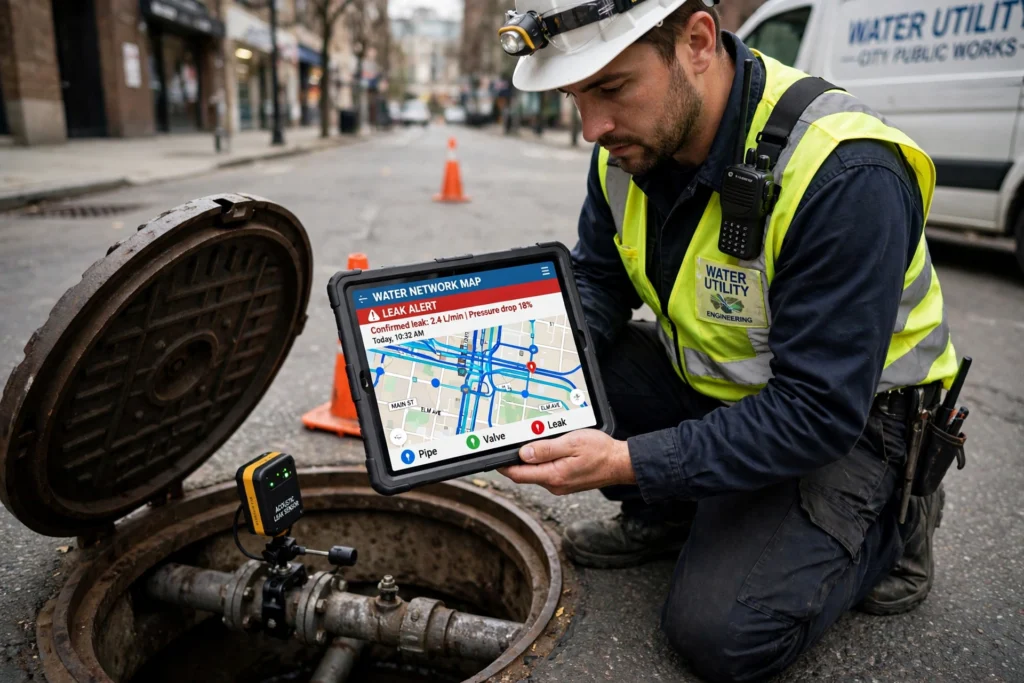
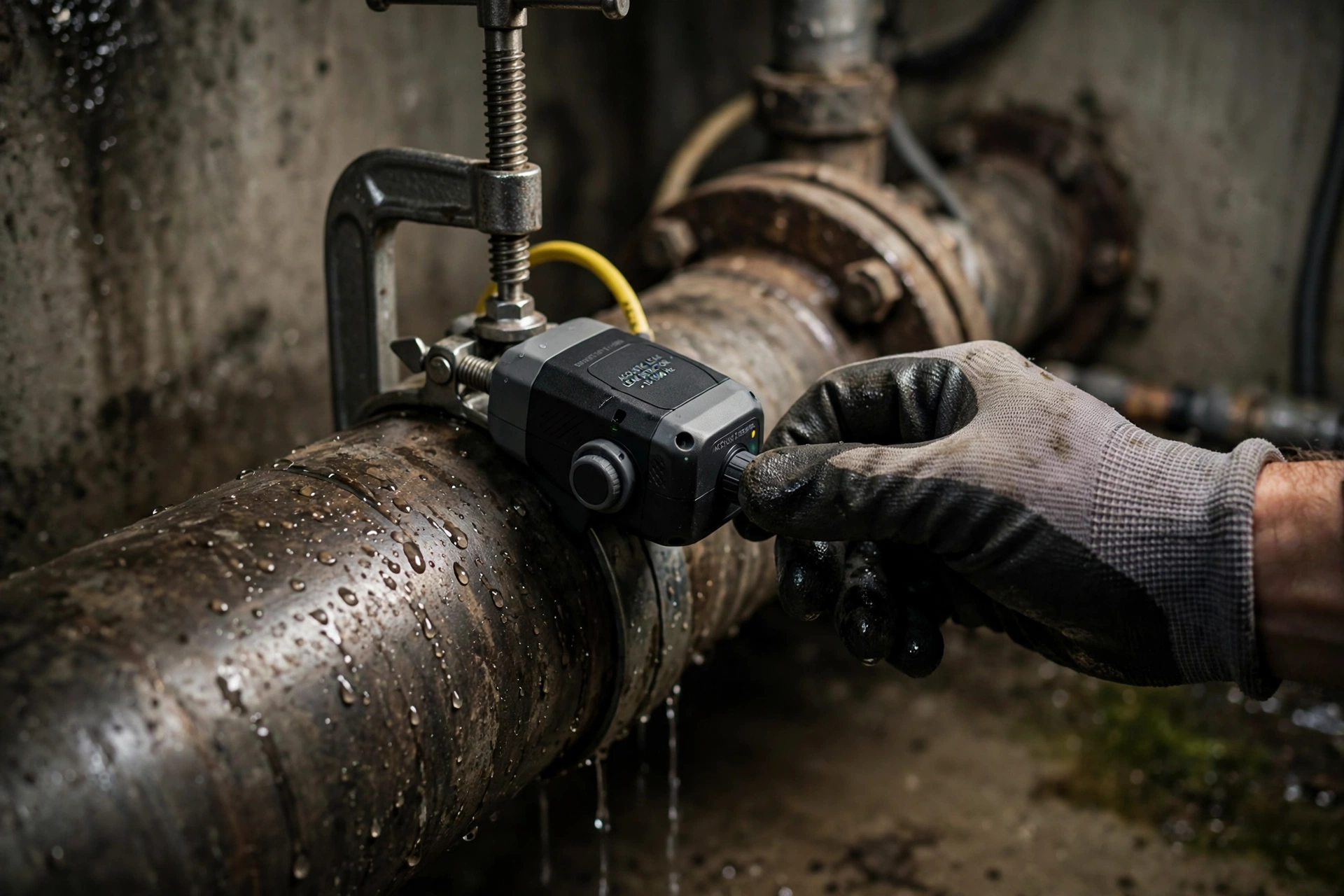
AI changes the order of the work. Small acoustic loggers sit on pipes, valves, and hydrants and listen around the clock. A leak makes a distinct sound — a steady hiss or a high-pitched rush — that differs from traffic, pumps, and normal flow. A model trained on thousands of recordings learns that difference and raises an alert.
Flow and pressure data add a second check. If water enters a district at one rate and leaves at a lower one, something in between is leaking. Models compare live readings with what they expect for that hour and season, and flag the gap. Yorkshire Water runs nearly 40,000 acoustic loggers that listen each morning and send suspected leaks to an analyst for checking.
What data does a smart water network actually use?
A smart water network is a set of ordinary measurements, collected often and read together. Flow meters record how much water passes a point, minute by minute. Pressure sensors watch how hard the water pushes through the pipes — a sudden drop in one zone often points to a break. Smart meters show how much customers actually use, which separates a real leak from a busy morning when everyone showers at once.
Then there are the less obvious feeds. Acoustic loggers add sound. Quality sensors track pH, cloudiness, and chlorine. Weather forecasts and reservoir levels add context, because a hot, dry week changes demand in ways a model needs to expect. Satellite images can even show where the ground above a pipe has grown unusually damp.
The job of the AI is to join these feeds up: a pressure drop plus a strange sound plus a flow gap in the same zone at 2 a.m. is a far stronger signal than any one reading alone.
Can AI predict how much water a city will need?
Yes, and this is where utilities save real money. Pumping water uphill and treating it takes energy, so moving the wrong amount at the wrong time wastes water and power.
Forecasting models look at past usage, the day of the week, holidays, weather forecasts, and big local events. A heatwave weekend or a public holiday leaves a fingerprint in the data, and the model learns to expect it. The utility can then fill reservoirs overnight when electricity is cheaper and keep enough in reserve for the morning rush. AI in energy uses the same kind of forecasting to balance power grids.
Singapore’s water agency, PUB, runs an anomaly leak finder on its Smart Water Grid, a 6,000-kilometre underground network with hundreds of monitoring stations. It has already picked out leaks that field crews confirmed on site. Sensors collect, the model narrows the search, and people do the digging.
What does AI do about water quality?
Water quality is mostly a monitoring job, and AI is good at watching for the odd one out. Sensors at treatment plants and across the network measure pH, cloudiness, chlorine, and temperature, and a model flags readings that drift outside the normal range, even slightly. A slow rise in cloudiness after heavy rain might mean sediment is getting in; a chlorine reading that falls faster than usual could point to a problem at a dosing pump. The model does not diagnose the cause — it says “look here, now”, and an engineer decides what to do.
A night in the life of a smart water network
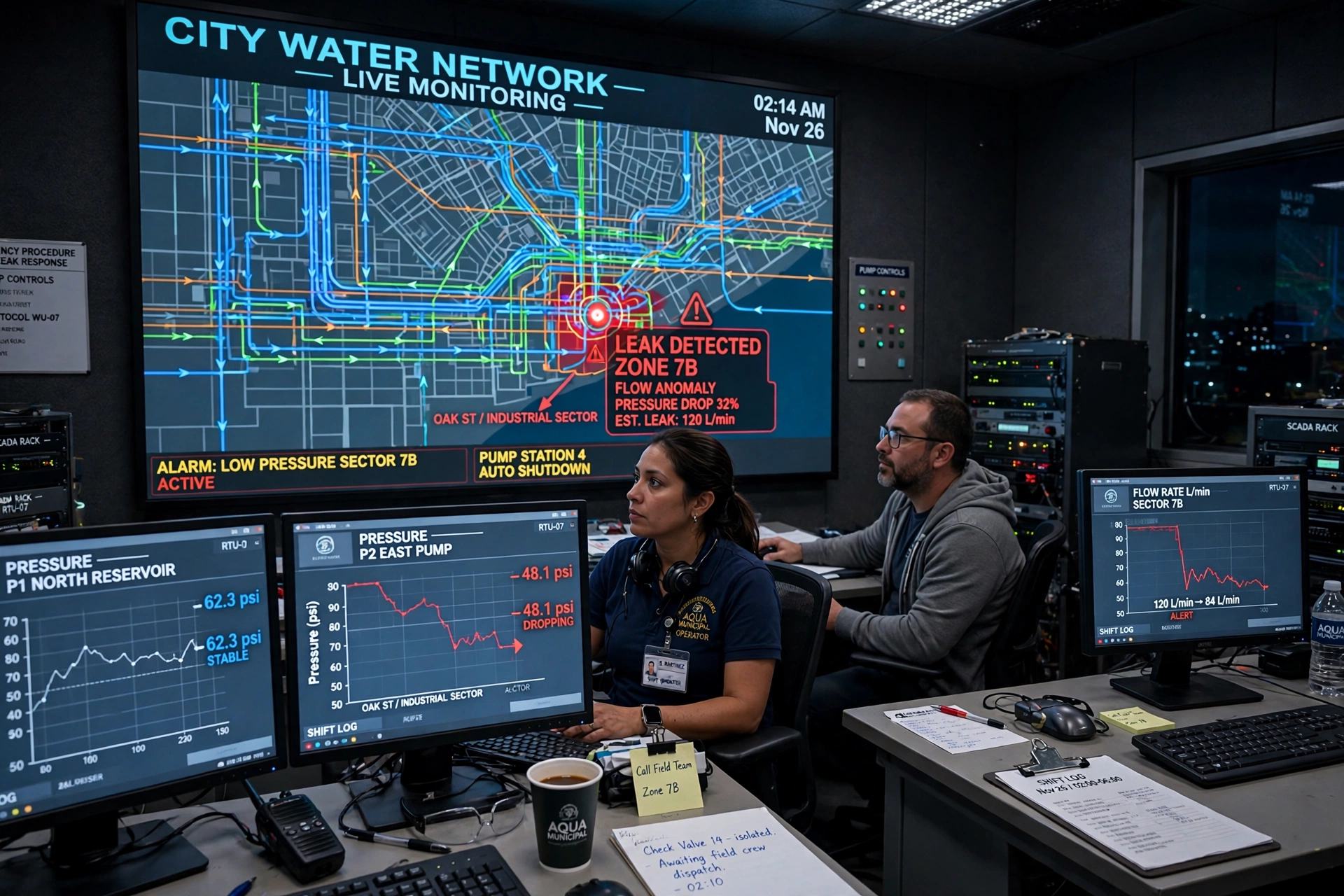
Picture a Tuesday at 2:14 a.m. Most of the city is asleep, so demand should be low and steady. In the control room, the network map shows one zone glowing red: flow in is higher than the model expects for that hour, and pressure at the far end has slipped by nearly a third. An acoustic logger on a main under Oak Street has also flagged a sound it recognises as a leak.
The model combines the three signals and scores the alert as high priority. An operator confirms it is not a scheduled flush or a pump test, and sends the field team a location accurate to within a street or two. By dawn, the crew has found the crack and started the repair — before the morning rush and before the lost water shows up on anyone’s bill.
Old water management vs AI water management
| Task | The old way | With AI in water management |
|---|---|---|
| Finding leaks | Walk the network with listening sticks | Acoustic sensors listen 24/7; models flag likely leaks |
| Spotting a burst | A customer phones in, or water appears on the road | Flow and pressure anomalies raise an alert within minutes |
| Planning supply | Fixed schedules based on last year’s averages | Forecasts adjust daily for weather, events, and habits |
| Checking quality | Samples taken by hand and tested in a lab | Sensors report continuously; models flag drift early |
| Fixing problems | Crews search a wide area for the break | Alerts narrow the search to a street or two |
Where AI in water management still falls short
AI is only as good as its data, and water networks are old. Many pipes were laid decades before anyone thought about sensors, and some districts still have patchy coverage. A model trained on one city’s network can also misread another’s, because pipe materials and soil change the signals.
False alarms are a real cost too. Background noise can sound like a leak, and a sensor knocked loose by roadworks can cry wolf for days. Every false alarm sends a crew out for nothing, so good systems keep a human in the loop: the model suggests, a person confirms. And the biggest limit is simple — AI cannot fix a pipe. It can find the problem faster, but the digging still takes people, time, and money.
Frequently asked questions
Does AI in water management lower my water bill?
Not directly. It helps utilities lose less water and run pumps more efficiently, which can ease pressure on costs over time. Your own bill still depends mostly on how much your household uses.
Can AI find a leak inside my home?
Usually not — utility systems watch the public network up to your meter. Inside the home, a smart meter or a leak sensor under a sink does the same job on a smaller scale, flagging unusual overnight flow.
Is my water usage data private?
Smart meter data shows when and how much water a household uses, which is personal information. Utilities must handle it under data protection rules, using it for billing and network planning. If you are unsure, ask your supplier what it collects and why.
How accurate is AI leak detection?
It is good at narrowing the search, not perfect at pinpointing a break. Systems report a likely area, and a crew confirms the exact spot with listening equipment on site. Accuracy improves as more confirmed leaks feed back into the model.
Will AI replace water engineers?
No. It takes over the watching — the endless scanning of readings no human team could do around the clock — and leaves the judgement and the repairs to people who know the network.
The bottom line
AI in water management is not about a single clever gadget. It is about a network that finally pays attention to itself: sensors that listen, models that notice what does not fit, and crews who arrive with a street name instead of a guess. The water that never leaks is the cheapest water a city will ever have.
If you run a building, a farm, or a small business, the practical next step is the same one utilities took: start measuring. A smart meter or a simple flow monitor will show you your baseline, and once you know what normal looks like, the wasteful is much easier to spot.
Further reading: Blits.ai on AI water leak detection for utility networks and the research paper AI and IoT in smart water management for urban sustainability.