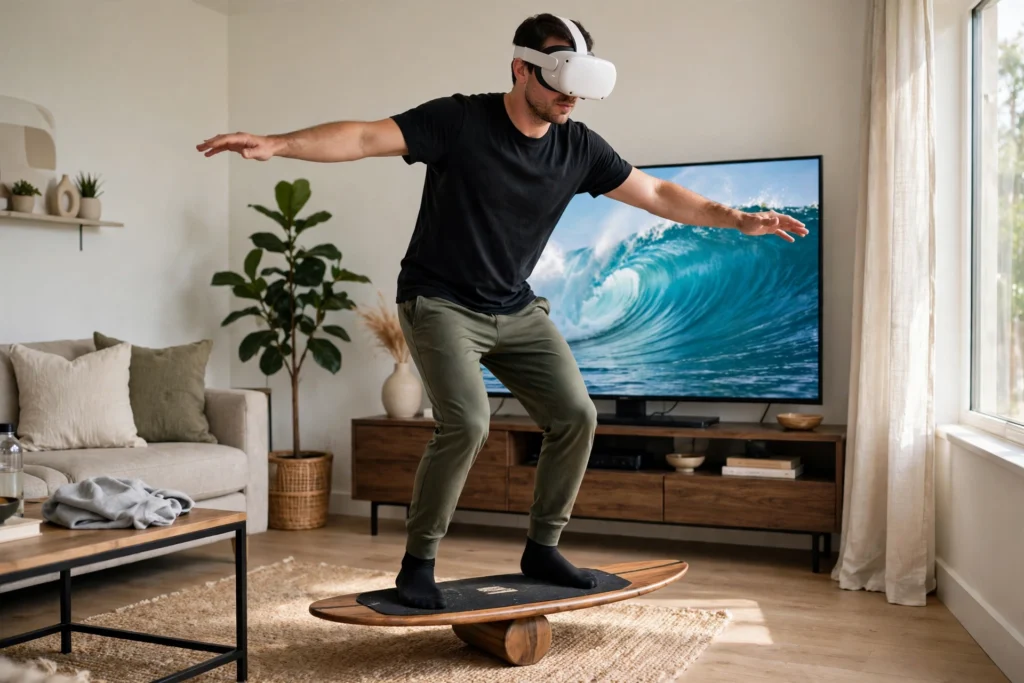
Yes — up to a point. VR surfing can teach you the stance, the balance, the pop-up and how to read a wave, all from your living room. What it cannot teach you is paddling, duck-diving, or how heavy real water feels when it knocks you off. Think of it as a first step, not a replacement for the ocean.
Key Takeaways
- VR surfing puts you on a virtual board in a headset, with real wave physics behind the scenes.
- Stance, balance, pop-up timing and wave reading transfer best to real surfing.
- Paddling, duck-diving and wipeouts can only be learned in real water.
- All you need is a standalone headset and a surfing app; a balance board is optional.
- Begin with short sessions of 15 to 20 minutes, especially if VR makes you queasy.
What Is VR Surfing?
VR surfing is surfing inside a virtual reality headset. You stand in your living room, put the headset on, and find yourself on a board in the sea, with waves rolling in around you. Lean one way and the board turns. Shift your weight and you pick up speed. Fall off, and you are back on dry land with nothing worse than a bruised ego.
The best-known example is True Surf, a game for Meta Quest headsets from the Australian studio True Axis. It builds its waves with a custom physics engine and feeds in real surf data from Surfline, so the waves at each spot behave like the real thing. You start at Waikiki in Hawaii on a long, stable board, and work through missions that unlock harder spots — Bells Beach, Hossegor, J-Bay, Pipeline — and different boards as your skills grow.
What Gear Do You Need to Start?
Less than you might think: a standalone VR headset, such as a Meta Quest, and a surfing app or game. You stand on your living-room floor, hold the controllers or use hand tracking, and the game reads your body position to steer the board.
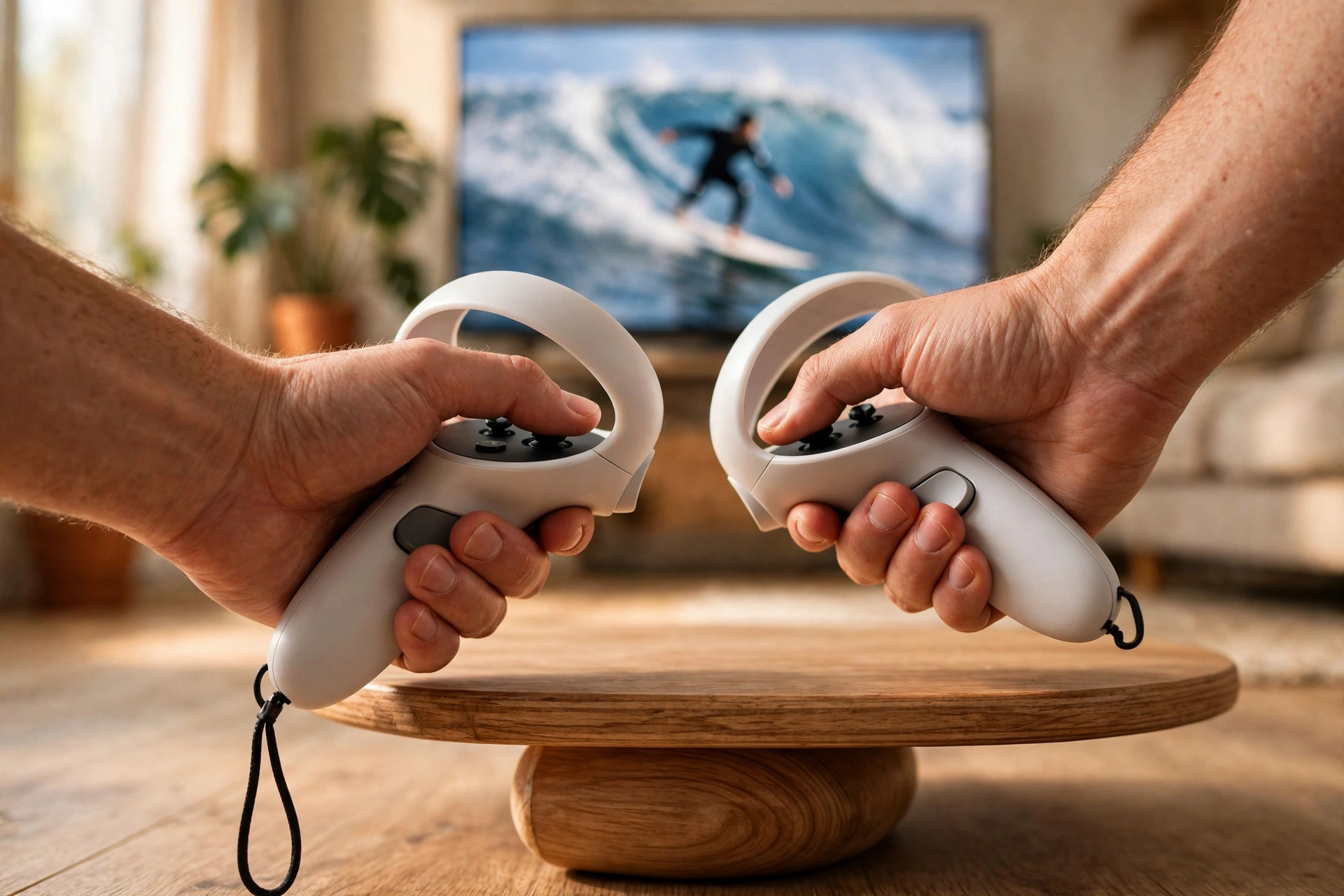
A balance board is the one extra that changes the feel the most: a wooden board on a roller or wobble base that gives your feet something real to react to. It is not required — try the game on a flat floor first. What you do need is space: clear a couple of metres in every direction, move the coffee table, and set the headset’s boundary so the game warns you before you step into a wall. Bare feet or grippy socks beat socks on a hard floor.
Which Surfing Skills Actually Transfer to Real Waves?
Stance and balance transfer best. Standing sideways on a board, knees bent, weight centred, arms out — that is the same in VR as it is on the water, and hours of practice build real muscle memory. The pop-up can be rehearsed too, and wave reading improves as well: after a few sessions you start to see which waves are worth catching and which ones will close out and dump you.
What does not transfer is everything to do with the water itself. VR cannot teach you to paddle hard enough to catch a wave, because there is no water pushing back against your arms. It cannot teach you to duck-dive under a breaking wave, or to read a rip current from the beach. Your legs will be stronger and your balance sharper, but the first time a real wave picks you up, it will still feel new. Coaches who like VR call it a warm-up for the real thing, never a substitute.
VR Surfing Compared with Other Ways to Practise
| Way to practise | Cost | Realism | What it teaches best | Best for |
|---|---|---|---|---|
| VR surfing | Medium | High | Stance, balance, wave reading | Beginners and off-season practice |
| Balance board alone | Low | Low | Core strength and balance | Daily drills at home |
| Wave pool session | High | Very high | Real paddling and pop-ups | Surfers who live near a pool |
| Real surf lesson | Medium | Real | Everything, including wipeouts | Anyone ready for the ocean |
Nothing beats real water, but real water is not always nearby, and a lesson only lasts an hour. VR surfing fills the gap between lessons: cheap per session once you own the headset, available at midnight in January, and forgiving enough that falling off costs you nothing.
Can VR Surfing Make You Feel Seasick?
It can. When your eyes tell your brain you are speeding along a wave but your feet tell it you are standing still, some people feel dizzy or nauseous. It is the same mismatch behind VR motion sickness generally, and it hits beginners hardest in their first few sessions.
Keep your first sessions to around 15 minutes, and stop as soon as you feel off rather than pushing through. A fan blowing on your face helps more than you would expect, and standing on a rug with a clear texture under your feet gives your body a steady reference point. If you feel rough, take the headset off and try again another day — most people find it fades as they get used to VR. If it never fades, VR surfing may simply not be for you, and that is fine; a balance board and a real lesson will still get you there.

How to Try VR Surfing for the First Time
Clear your space and set the headset boundary, with nothing breakable within arm’s reach. Pick the easiest spot and the most stable board — in True Surf that means Waikiki on a longboard — and run the opening missions rather than jumping straight to a big reef break. Keep the session to 15 or 20 minutes, then take a break and see how you feel. Once the basics feel natural, add a balance board to make your feet work harder. Then book a real surf lesson and see what carries over: the stance feels familiar, the pop-up is already in your muscles, and you can spend the lesson learning the water instead of learning to stand up.
If you live far from the coast, VR surfing has a second use that has nothing to do with training. It is simply fun. Like VR sailing, VR scuba diving or VR fishing, it lets you spend an evening somewhere you cannot otherwise go — on a warm wave at sunset, with no flight to book and no wetsuit to dry afterwards.
Frequently Asked Questions
Do I need a balance board for VR surfing? No. Start standing on your living-room floor. A balance board adds realism and works your legs harder, so it is a good second purchase once you know you enjoy it.
Can children try VR surfing? Most headset makers set a minimum age, usually around 10, and sessions should be short and supervised. Check the age guidance for your own headset first, and keep the play space clear.
Will VR surfing help me catch real waves? It helps with the parts that happen once you are standing: balance, stance, turning and reading the wave. It will not help with paddling, which is the part most beginners struggle with, so expect your first real sessions to still be hard work.
Is True Surf the only VR surfing game? No, but it is the most complete surfing simulation on a standalone headset right now, with real wave data and a structured progression through famous surf spots.
How long until I notice a difference? Most people feel steadier after a handful of short sessions spread over a couple of weeks. The change is subtle — better balance, quicker reactions — and it shows up most clearly when you next stand on a real board.
The Bottom Line
VR surfing will not make you a surfer on its own. It will make your first real lessons easier, your off-season less rusty, and your living room more interesting on a rainy evening. If you already own a headset, the cost of finding out is one game and twenty minutes. Try a gentle session at Waikiki, and if you enjoy it, book a real lesson at the coast and let the ocean do the rest of the teaching.
Further reading: True Surf launch on the Meta Quest blog and Virtual reality on Wikipedia.