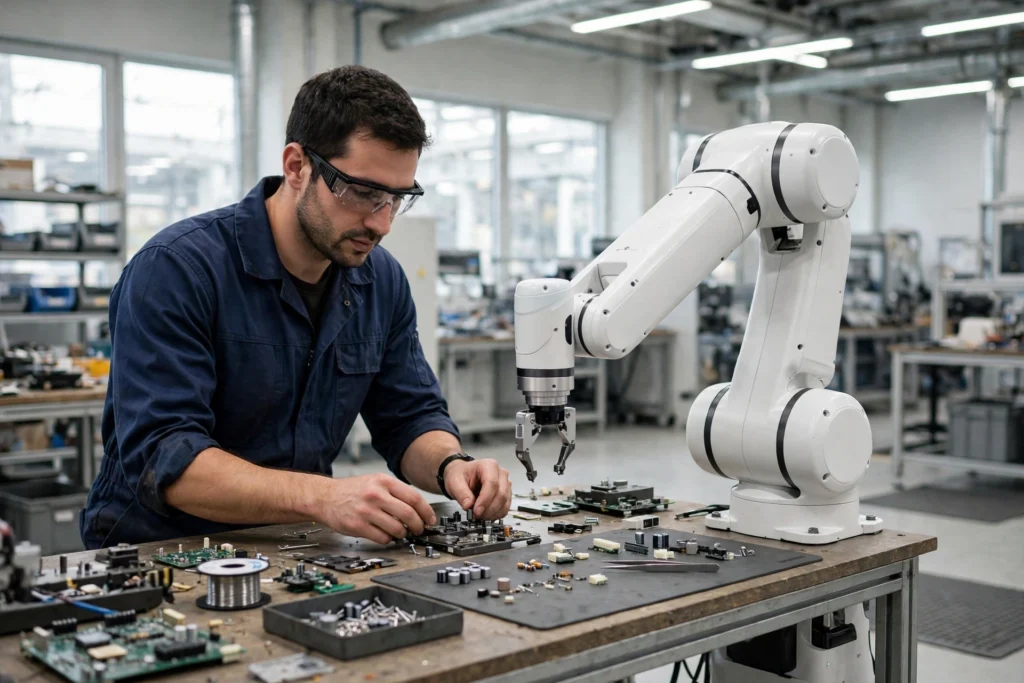
A collaborative robot, often called a cobot, is a robot designed to work in the same space as people, rather than behind a safety fence. It uses force sensing, speed limits, and programming to slow down or stop when a person gets close, and it handles repetitive, heavy, or precise jobs while the person handles judgement, inspection, and changes.
Key Takeaways
- Cobots are built to share a workspace with people, not to replace every human job on a line.
- Force and proximity sensing help a cobot slow down, pause, or stop before contact becomes harmful.
- Most cobots are slower and lighter than large industrial robots, which is part of the safety trade-off.
- The same cobot can often be reprogrammed for a new task, which suits small batches and changing work.
- A risk assessment still matters: “collaborative” describes the application, not a guarantee that every setup is safe.
What makes a robot collaborative?
The short answer is not just the robot itself. It is the whole setup: the robot, its gripper or tool, the parts it handles, the speed it runs at, and the way people move around it. A small arm that moves slowly and lifts light parts is a very different risk from the same arm fitted with a sharp tool and running at full speed.
That is why factories do not simply buy a cobot, put it on a table, and call the job done. Engineers check what could go wrong if a hand is in the way, if a part slips, or if someone walks into the work area unexpectedly. They may add a slower speed mode, a lighter gripper, rounded edges, or a clear stopping distance. Only when those checks pass does the shared workspace make sense.
In practice, you will often see a cobot doing one steady step in a longer job. It might pick up a part, hold it in place while a person fastens it, apply glue in a neat line, or sort finished pieces into a tray. The person stays close because their eyes and hands are still needed for the parts that vary, break, or need a quick decision.
How do cobots sense people and contact?
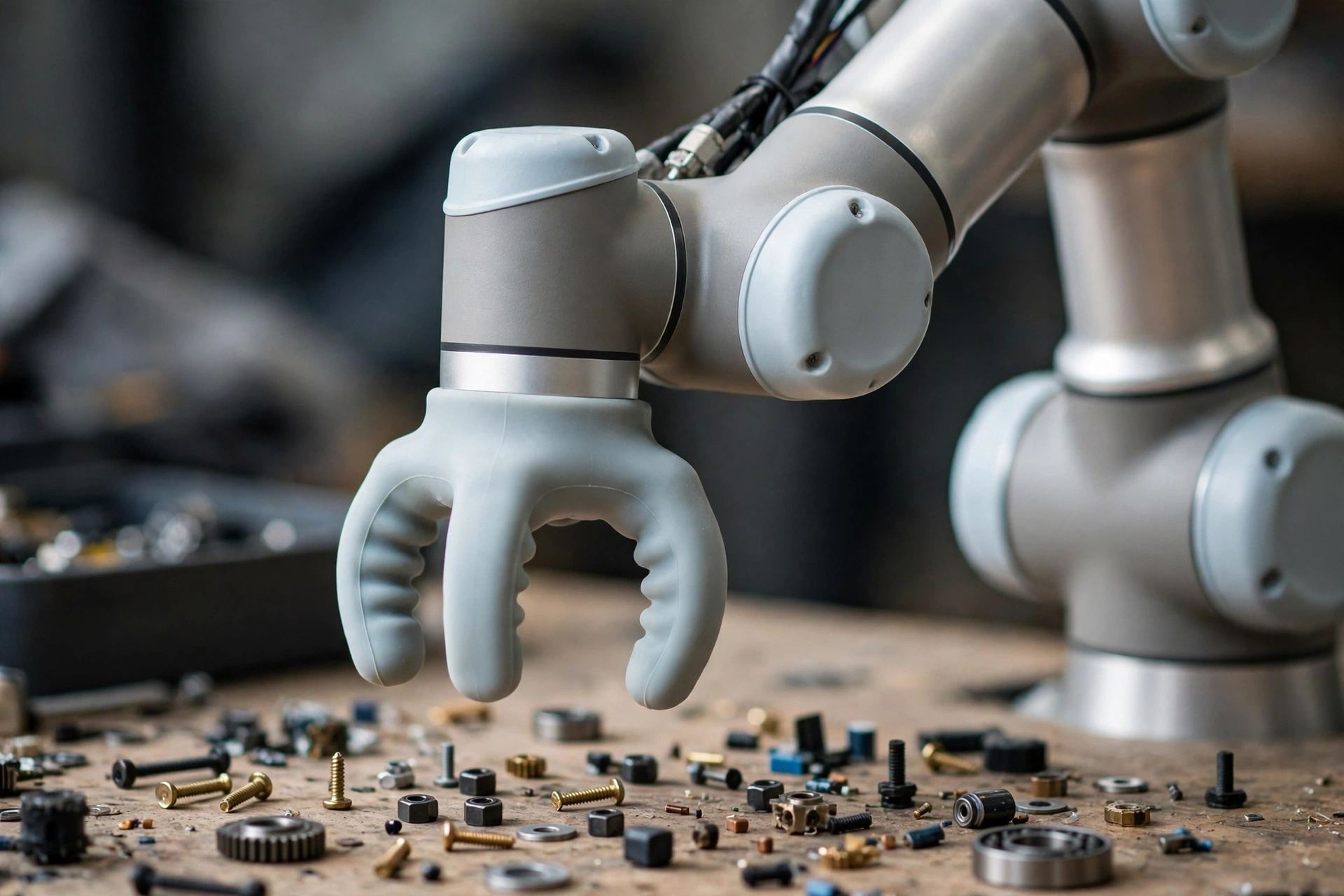
Cobots rely on several layers of sensing, and no single layer does all the work. Many cobots have torque sensors in their joints. In simple terms, these sensors notice when the arm meets unexpected resistance. If the arm is moving freely and suddenly feels a push, the controller can treat that as contact and stop or pull back.
Force and power limits matter too. A cobot application is often set so that even if contact happens, the force stays below a level that would cause injury for that part of the body. That does not mean contact is comfortable or welcome. It means the system is designed around a known limit, tested for the task, and kept within that limit by speed, payload, and tool choices.
How do cobots share work with people?
Sharing work is less about the robot being clever and more about dividing the job sensibly. Robots are good at doing the same motion again and again without getting tired or drifting off position. People are good at noticing a bent part, a missing screw, or a label that looks wrong.
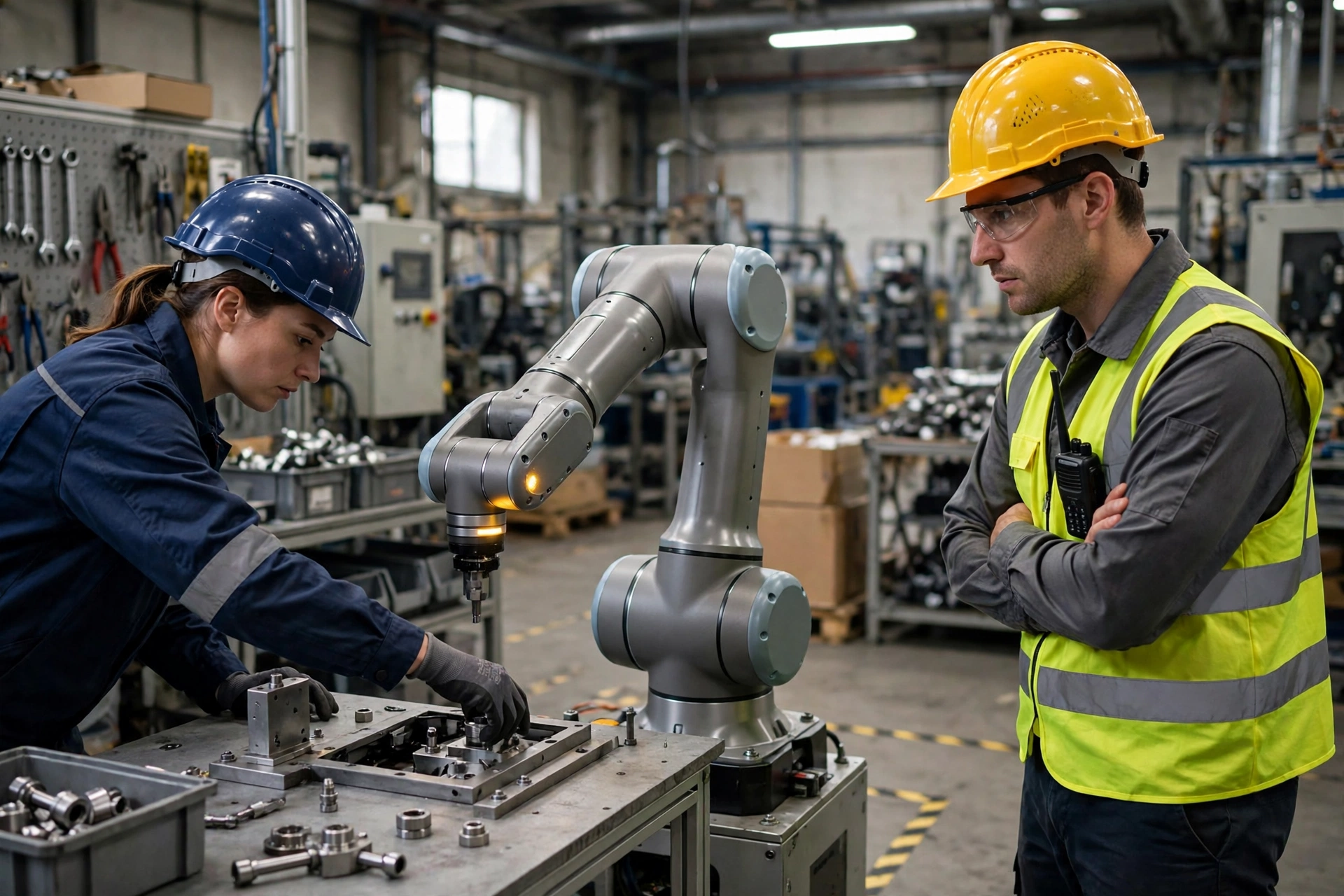
Another pattern is assisted assembly. The cobot holds a heavy panel steady while a person bolts it in place. The person does not have to strain to hold the weight, and the robot does not have to decide where each bolt goes. The work is faster, and the strain on the person’s back and shoulders is lower.
Cobots also suit jobs that change often. A small business might run one product in the morning and a different one in the afternoon. If the cobot can be taught a new path, fitted with a different gripper, and checked again for safety, it can switch jobs without rebuilding a whole fenced cell. That flexibility is often the real reason a small firm chooses a cobot over a larger industrial robot.
Where are collaborative robots used?
You will find cobots in electronics assembly, where small parts need steady handling, and in packaging, where boxes need to be filled, sealed, or stacked in a regular pattern. Machine shops use them to load and unload parts from a machine, so the operator can focus on setup and quality checks instead of standing beside the machine all day. Related robots that also work near people include warehouse robots and robot vacuums.
What are the limits of a cobot?
Cobots are not a simple replacement for every industrial robot. They are usually slower, carry less weight, and reach a shorter distance than a large fenced robot arm. If a job needs high speed, heavy lifting, or long reach, a traditional industrial robot, like the arms explained in our guide to how robot arms work, may still be the better choice.
Safety also depends on the tool. A cobot arm itself may be gentle, but a sharp cutter, a hot tool, or a heavy part can change the risk completely. That is why the risk assessment must cover the tool and the part, not just the robot’s brochure figures.
How to choose a cobot for a small workshop
Start with the job, not the robot. Write down the weight of the heaviest part, how far the robot must reach, how fast the job must run, and what the tool will be. If any of those numbers are close to a cobot’s limits, ask the supplier to test the real task, not just a demo with light plastic blocks. Note the contrast with an exoskeleton, which assists a person’s own movement rather than working beside them.
Frequently Asked Questions
Are collaborative robots completely safe? No robot is completely safe in every setup. Cobots are designed to reduce risk in shared workspaces, but safety depends on speed, force, tools, parts, and layout. A proper risk assessment for the full application is essential before people work beside one.
Can a cobot work without any safety fence? Sometimes, yes, but only when the risk assessment supports it. Many cobot jobs run without a full fence, yet still use speed limits, force limits, sensors, or marked zones. Other jobs still need a barrier, especially with sharp or hot tools.
Do cobots replace human workers? In most cases, they change the job rather than remove the person. A cobot often takes the repetitive or heavy step, while the person handles inspection, variation, and decisions. That can reduce strain and free time for higher-value work, but it still needs people nearby.
How hard is it to program a cobot? Simple tasks can be taught by hand-guiding the arm or using a tablet interface, which is easier than traditional robot coding. More complex jobs, safety settings, and integration with other machines still need skilled setup and testing.
Are cobots only for large factories? No. Small workshops often benefit most, because cobots can be moved, reprogrammed, and used for short runs. The key is choosing a task that fits the cobot’s speed, reach, and payload, and budgeting for grippers, safety checks, and training.
Conclusion
A collaborative robot works because safety is built into the whole job, not just the arm. Sensing, force limits, sensible task design, and a clear risk assessment let people and robots share space without a fence in many cases, while keeping the person in charge of judgement and quality.
If you are thinking about a cobot, start small. Pick one repetitive, well-defined task, test it with real parts and real tools, and watch how people actually move around it. That practical test will tell you more than any brochure about whether a cobot fits your workshop.