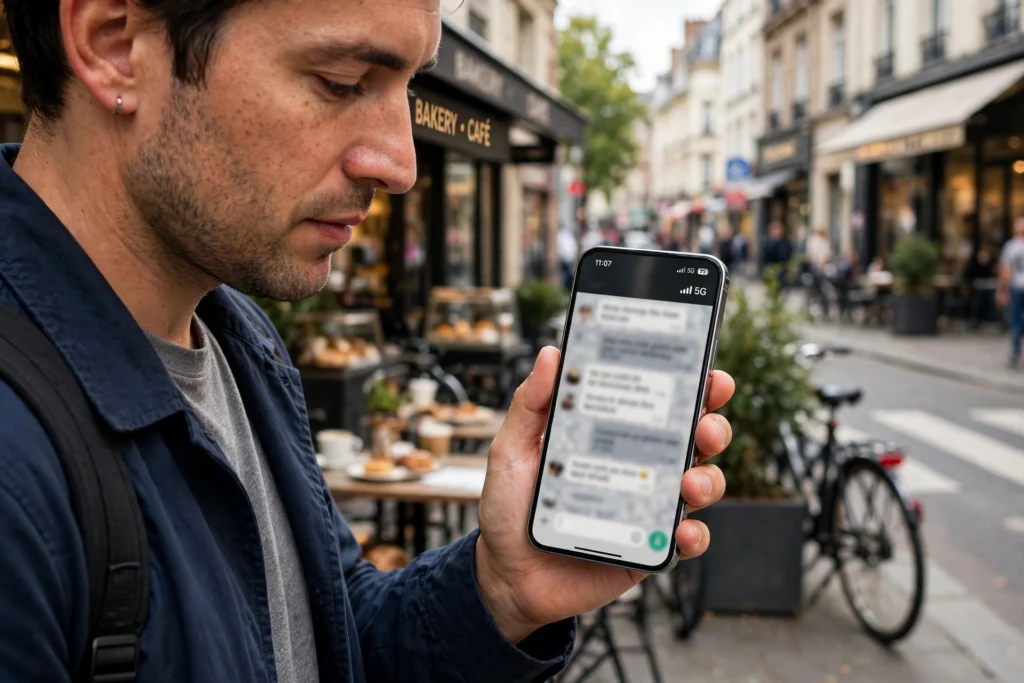
5G is the fifth generation of mobile networks. Your phone talks to a nearby tower by radio waves, the tower passes that data on through a wired link, and the wider internet does the rest. What is new is how it uses spectrum, antennas, and software to carry more data and serve more devices at once.
Key Takeaways
- 5G is still a radio network: phone to tower, tower to the core network, then to the internet.
- Low, mid, and mmWave bands trade coverage for speed, so not all “5G” feels the same.
- Beamforming and many antennas help a tower focus its signal instead of spraying it everywhere.
- Network slicing can reserve capacity for a specific job, such as a factory floor or an emergency service.
- Your actual speed depends on your band, your distance from the tower, congestion, and your phone.
What exactly is 5G?
The “G” simply means generation. Each generation has been a new set of standards for how phones and towers talk to each other, agreed through industry bodies so that a phone bought in one country can usually work on a network in another. 5G’s radio part is called 5G NR, short for New Radio, and it sits alongside a newer core network that is more software-based than the older, hardware-heavy cores it replaces.
That core matters more than it sounds. Older networks were built largely for one job: carrying phone calls, then later, general internet traffic. The 5G core can divide the network into virtual slices, each tuned for a different job. A slice for video streaming might prioritise steady throughput, while a slice for industrial sensors might prioritise lots of small, reliable connections. Qualcomm’s overview of 5G wireless technology describes it as a unified platform for many kinds of connected devices, not just phones, and that is a fair summary of the ambition.
How does a phone connect to a 5G tower?
It starts before you open an app. Your phone listens for signals from nearby cells, picks the strongest suitable one, and registers with the network. The network checks your SIM or eSIM, confirms your plan allows 5G, and assigns your phone a connection. From then on, your phone and the tower exchange short control messages even when you are not actively downloading anything, so the network knows roughly where you are and which cell should serve you next.
When you tap a link, the request travels in small packets. Your phone’s modem turns those packets into radio signals, the tower’s antennas receive them, and the tower forwards them into the operator’s core network and out to the internet. The reply comes back the same way in reverse. The whole round trip is measured as latency, and lower latency is why a video call feels more natural and a cloud game feels less laggy on a good 5G connection than on a congested older one.
Why are there different kinds of 5G?
Radio spectrum is the raw material of wireless, and different frequencies behave very differently. Low-band 5G uses frequencies below about 1 GHz. These waves travel far and pass through walls reasonably well, so they are good for covering towns and countryside, but they carry less data at once and often feel only a little faster than good 4G.
Mid-band 5G, roughly in the 1 to 6 GHz range, is the middle ground most people actually want. It travels a useful distance, still works indoors in many places, and carries much more data than low-band. If your 5G feels genuinely quicker than your old 4G, mid-band is often the reason.
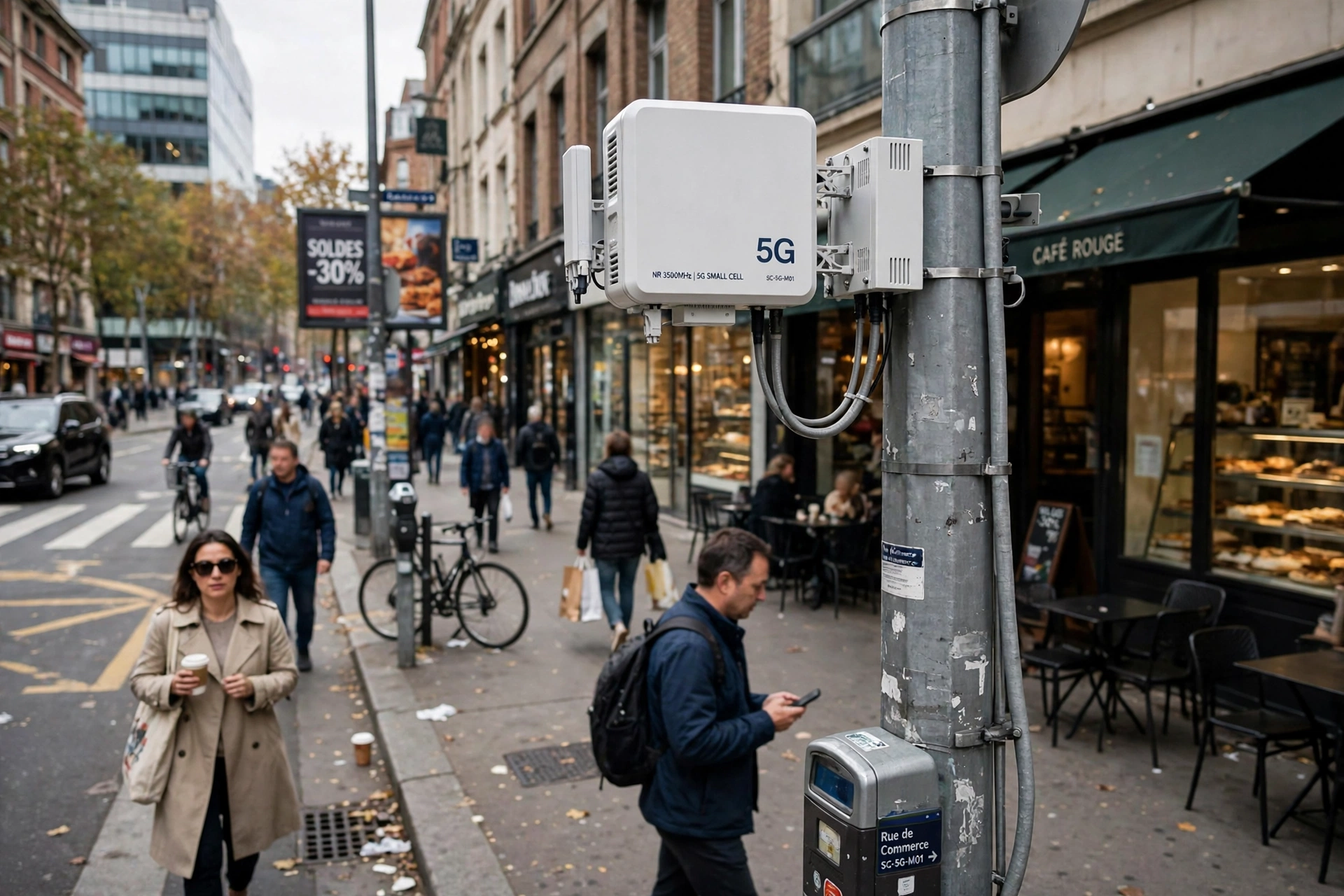
Then there is mmWave, short for millimetre wave, above about 24 GHz. These waves can carry huge amounts of data, but they are easily blocked by walls, windows, trees, and even heavy rain, and they fade over a short distance. That is why mmWave tends to appear in dense spots such as stadiums, airports, and busy city squares, where extra antennas are placed close together to fill a small area with capacity. It is not a replacement for the other bands; it is a booster for places where lots of people gather.
Operators mix these bands according to local needs, which is why two friends on different networks, or even on the same network in different towns, can have very different 5G experiences. Checking which band your area uses matters more than the headline speed on an advert.
What do beamforming and massive MIMO actually do?
Older towers often broadcast broadly, like a light bulb lighting a whole room. Beamforming is more like a torch: the tower uses many small antennas, working together, to steer a focused beam of radio energy towards your phone. As you move, the beam follows, within limits. That focus wastes less energy, reaches further with the same power, and causes less interference for other users nearby.
Massive MIMO, short for massive multiple-input, multiple-output, takes that idea further. A tower with dozens or even hundreds of antenna elements can talk to many devices at the same time on the same frequencies, separating their signals by their different positions in space. Your phone also has several antennas, so it can send and receive multiple streams at once. Together, these tricks let a single tower serve a crowded street far better than a simple, single-antenna tower ever could.
Where do you actually notice 5G?
For most people, the first noticeable difference is everyday responsiveness. Web pages and apps open a beat faster, high-quality video starts without the spinning wait, and large app updates finish sooner when you are on a good mid-band or mmWave cell. On a train, where the phone is constantly handing over between towers, a well-built 5G connection can also hold a video call together more smoothly than a congested 4G cell, though tunnels and cuttings will still interrupt any mobile signal.

Beyond phones, 5G is quietly useful where lots of small devices need to stay connected. Think of delivery scanners in a warehouse, sensors on a farm, cameras at a busy junction, or a pop-up clinic that needs a reliable connection without waiting for a fixed line to be installed. These jobs do not always need headline speeds; they need a connection that stays up, handles many devices, and responds quickly. That is also why 5G often works alongside other wireless tools rather than replacing them: Wi-Fi still makes sense at home, Bluetooth still suits headphones and wearables, and NFC still handles a quick tap, because each one is built for a different distance and job.
FAQs
Do I need a new phone for 5G?
Yes, in most cases. A phone needs a 5G modem and antennas tuned for 5G bands, and older 4G-only phones do not have them. Check that the phone supports the bands your operator uses in your area, not just that it says “5G” on the box.
Is 5G faster than Wi-Fi?
Sometimes, but not always. A good mid-band or mmWave 5G connection can beat a slow home Wi-Fi link, while a fast home fibre connection with good Wi-Fi will usually beat a weak or congested 5G signal. They are different tools: Wi-Fi is local, 5G is wide-area, and the faster one depends on where you are standing.
Why does my phone show 5G but feel slow?
You may be on low-band 5G, far from the tower, indoors behind thick walls, or sharing a busy cell with many other users. Your plan may also have a speed cap or a fair-use limit. Moving near a window, stepping outside, or trying again at a quieter time often reveals whether congestion or coverage is the cause.
Does 5G use more battery than 4G?
It can, especially when the phone is hunting for a weak mmWave signal or switching between bands, but modern phones manage this by dropping back to 4G when 5G is not needed. If battery life matters to you, most phones let you prefer 4G in settings, and that is a reasonable trade-off when you are not using data heavily.
Is 5G safe?
Regulators set exposure limits for radio signals, and 5G networks are designed to operate within those limits, much like earlier generations. If you want the technical background, Wikipedia’s overview of 5G links to the standards and deployment history behind the technology, and your national regulator publishes its own guidance on exposure limits.
Conclusion
5G works by combining a familiar idea — phone to tower by radio — with smarter use of spectrum, focused beams from many antennas, and a more flexible core network. The result is not one single speed, but a range of experiences: wide low-band coverage, capable mid-band service for most places, and very fast mmWave capacity in busy hotspots.
Before you upgrade, do one practical check. Look up your operator’s coverage for your home, your workplace, and your commute, ask which band serves those places, and make sure any new phone supports those bands. That five-minute check will tell you more about what 5G will feel like for you than any headline speed figure. Then, if you do switch, test it in your real daily routine for a week — that lived experience, not the icon in the corner of the screen, is the honest measure of whether 5G has made a difference for you.