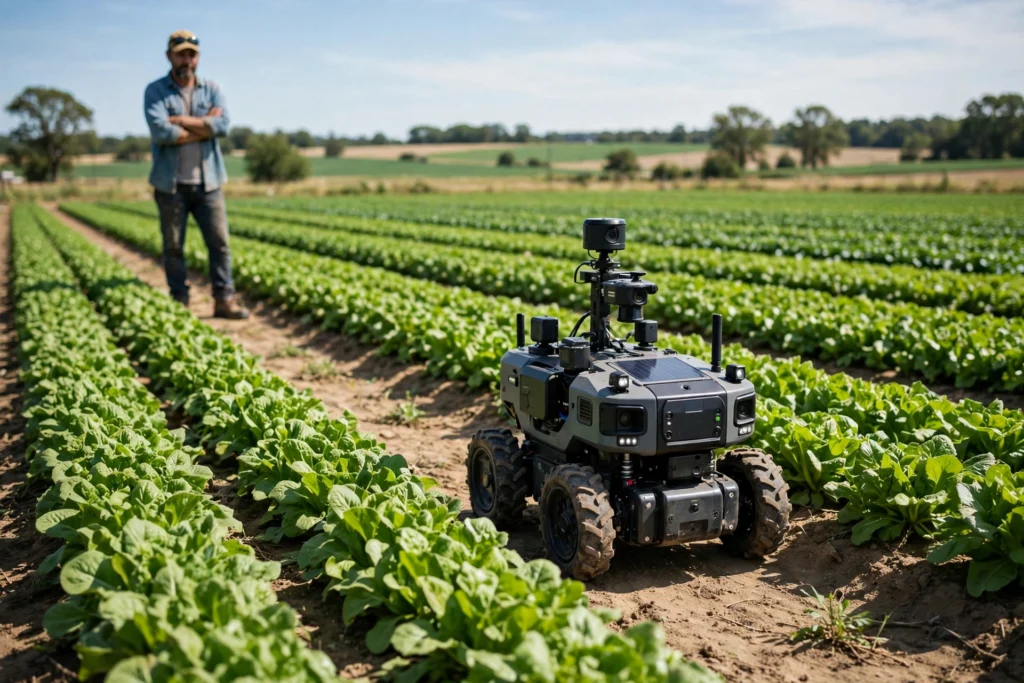
Agricultural robots are machines that carry out farm jobs with little supervision: they plant seeds, pull weeds, spray crops, and pick fruit, using cameras, sensors, and maps to find their way around a field. Think of them less as one clever machine and more as a careful pair of hands, a set of eyes, and a steering system working together.
Key Takeaways
- Farm robots combine navigation, sensing, and one working tool — a seeder, sprayer, or gripper — to do a single job well.
- Cameras and precise GPS help a robot tell crops from weeds, stay in its row, and remember where it has been.
- Picking soft fruit is still the hardest job, because every berry differs slightly in size, shape, and ripeness.
- These machines usually assist farm workers rather than replacing a whole team, and they work best on flat, well-mapped fields.
- Cost, mud, dust, and uneven ground remain real limits for many farms.
What kinds of jobs do agricultural robots do?
Farm robots are usually specialists. A weeding robot drives slowly down a row, spots weeds with a camera, and removes them without touching the crop beside them. A planting robot drops seeds at set depths and spacings, then records exactly where each seed went, so a later weeding or spraying run already knows where the rows are.
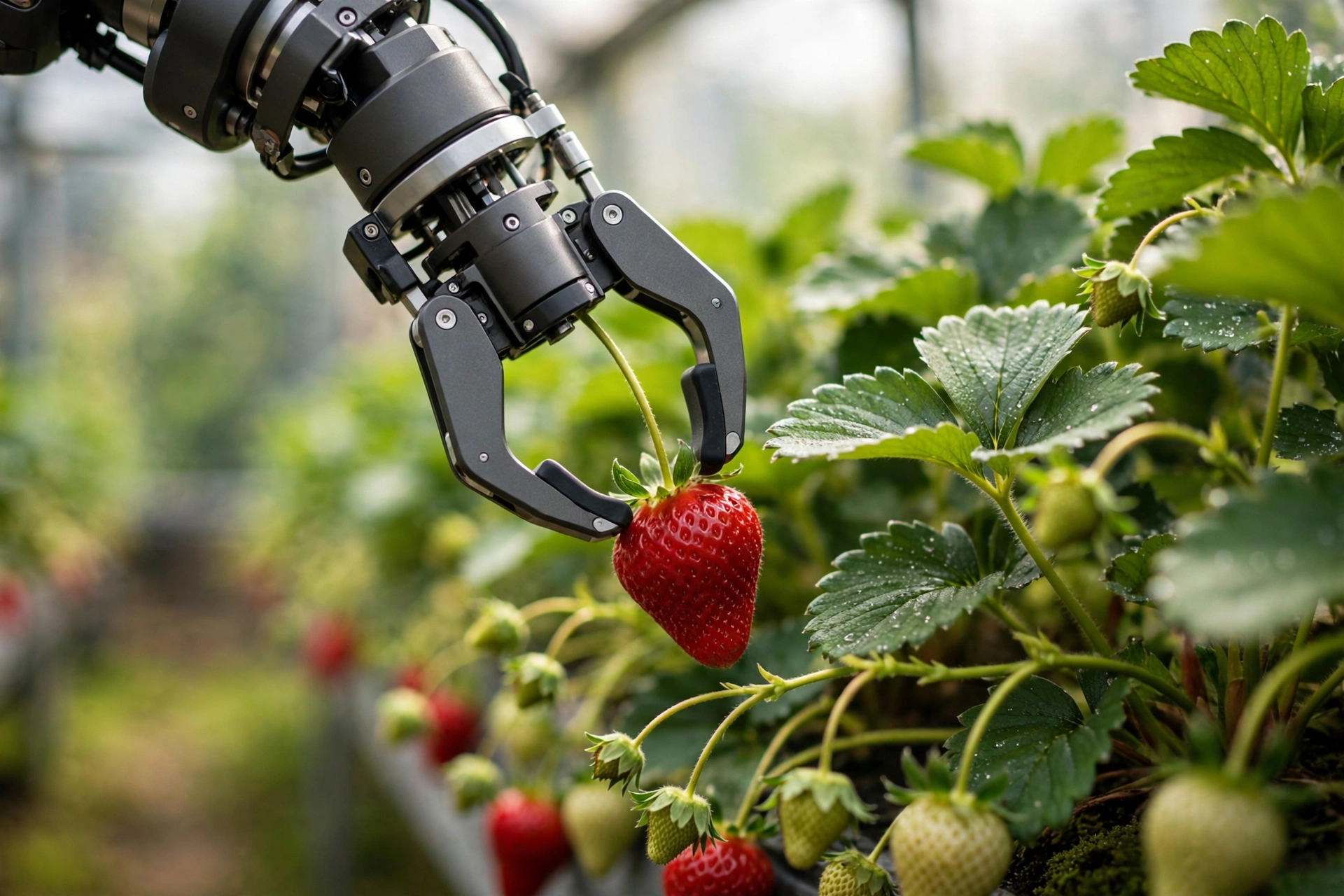
Harvesting robots are the most eye-catching, and the most demanding. A strawberry picker must find a ripe berry among leaves, judge readiness, grip it gently enough not to bruise it, and place it in a tray without squashing the rest. That is why many pickers still work in greenhouses or orchards trained into flat, predictable rows — the environment is tidied up to suit the machine.
Other robots never touch a plant. Some carry crates behind picking crews, following a worker so nobody hauls a heavy load back to the road. At home, robot vacuums do a similar specialist job on floors, following a map room by room. Others patrol fields with sensors, measuring soil moisture or signs of disease, and building a map the farmer can act on. The common thread is repetition: robots excel at the same careful job, hour after hour, in heat or dust that would tire a person out.
How does a farm robot know where it is?
Navigation starts before the robot enters the field. Many farms keep a digital map of boundaries, row positions, and obstacles such as trees, ditches, and gates. The robot loads that map, then uses precise satellite positioning to place itself on it within a few centimetres — close enough to stay between crop rows, though tree cover and hills can weaken the signal.
Once moving, it leans on its own senses. Cameras watch the rows ahead and steer it back to the centre line if it drifts. Laser scanners measure distances to plants, posts, and people, while wheel sensors estimate distance travelled. Together these readings build a live picture of the surroundings, so the robot can update its position as it goes rather than blindly following a drawn line. If something unexpected appears — a person, a dog, a fallen branch — a well-designed machine stops or steers around it.
A field is messier than the places other mobile robots work. Delivery robots travel pavements with maps and cameras, and warehouse robots run on flat floors where shelves never move. In a field, rows curve, plants grow, rain changes the ground, and light shifts through the day, so farm navigation trades a little speed for the ability to cope when the map and the real world disagree.
How does a robot tell a crop from a weed?
At first glance this sounds simple, until you look at a real field where seedlings and weeds can look remarkably alike. Early systems relied on field geometry: if the crop was planted in straight rows, anything growing between the rows was probably a weed. That trick still works and is cheap and reliable on tidy farms.
Modern machines add machine vision. A camera photographs plants passing underneath, and software trained on thousands of labelled images compares shapes, leaf patterns, and colours. A lettuce seedling has a different outline from the weeds around it, and a ripe strawberry is redder than an unripe one. The robot does not need to be perfect on every plant — it needs to be right often enough, and cautious enough, that mistakes stay rare. When confidence is low, the safest choice is to leave the plant alone and flag it for a person to check.
Spraying robots use the same judgement differently: instead of drenching a whole field, they spray only the plants that need it, which can cut chemical use considerably. Weeding robots may use a small blade, heat, or a laser pulse rather than chemicals at all. But a robot matches patterns it has seen before, and unusual lighting, a new weed species, or an unfamiliar crop variety can still fool it — which is why most systems keep a person reviewing maps and results after each run.
Why is picking fruit so hard for robots?
Picking tests every part of a robot at once. First comes vision: fruit may be partly hidden, shaded, or clustered with others. Then the grip: too firm and the fruit bruises, too gentle and it slips. Then the arm: it must reach through leaves without snapping stems or knocking neighbouring fruit off. Finally speed: a person can pick roughly a piece of fruit a second, while many experimental pickers take several seconds per piece, which makes them hard to justify commercially even when they work well.
Engineers answer with softer grippers, suction cups, and arms that move like a human wrist. Some systems pick by the stem, cutting it cleanly so the berry stays intact; others use two cameras to judge depth, the way our two eyes do. Strawberry and apple pickers that once only worked in a laboratory now run in commercial trials, but soft, delicate crops remain the frontier. A robot that handles oranges may still fail on raspberries, and the gap between “works sometimes” and “works every day, all season” is where most projects stall.
The robot arms themselves borrow ideas from factory robots, which use similar motors, joints, and controls — except the factory brings identical parts to the robot, while the farm asks the robot to cope with parts nature never made identical.
What are the limits of agricultural robots?
Cost comes first for most farmers. A capable field robot is a serious purchase, and it also needs charging, maintenance, software updates, and someone who can fix it mid-season. Some machines are therefore sold as a service — the company owns the robot and charges per acre — rather than as a one-off purchase.
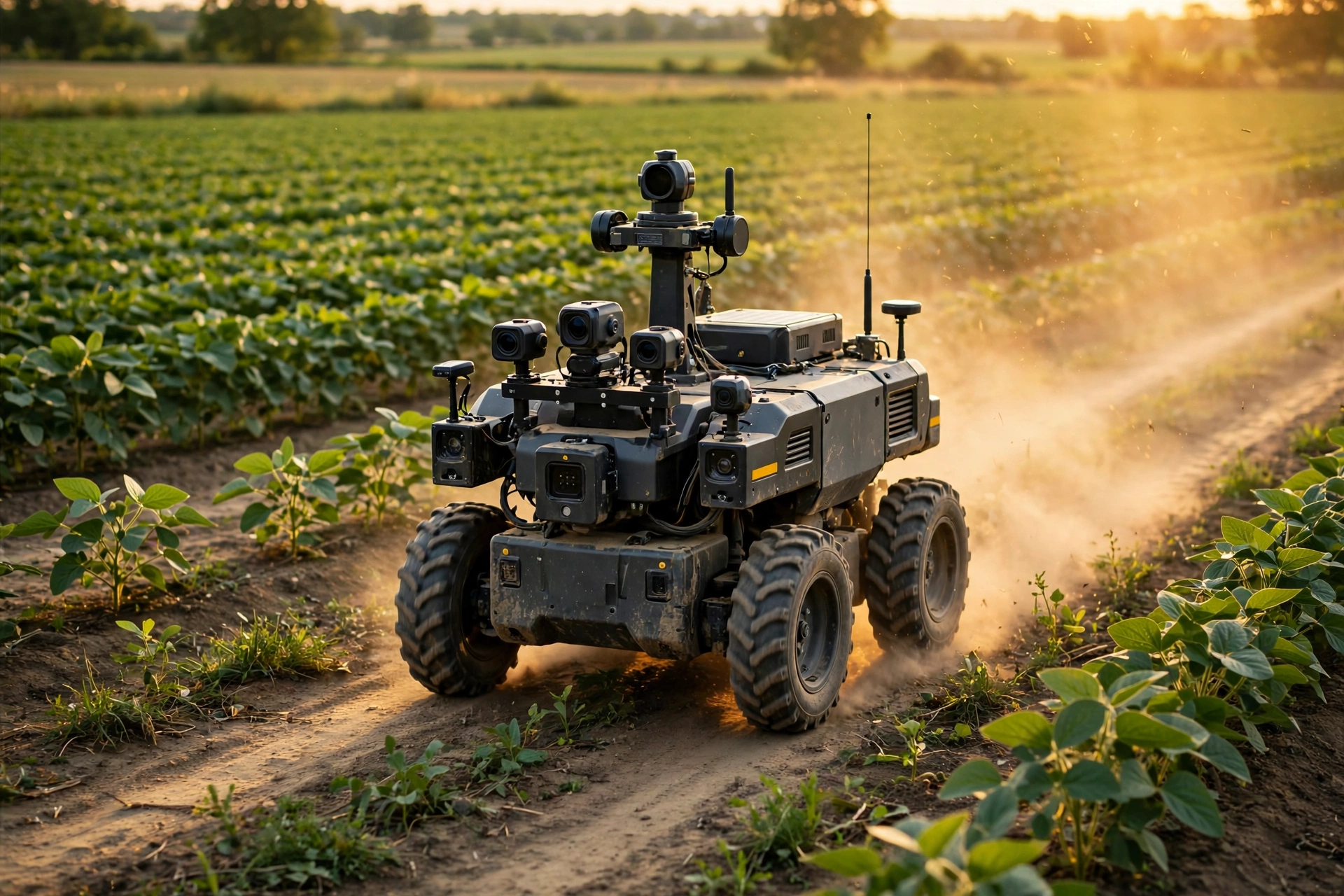
The field itself is the second limit. Mud clogs wheels, dust coats camera lenses, rain changes traction, and batteries run down faster in cold weather. Connectivity is another snag: many farms have patchy mobile coverage, so a robot that depends on a constant cloud connection may stall just when it is needed.
There are people questions too. Farm work is seasonal and skilled in ways that are easy to underestimate — an experienced picker reads ripeness at a glance. Robots can ease labour shortages, especially at harvest, but they also change farm jobs, shifting work toward supervising, maintaining, and checking machines. Farmers who adopt them usually keep people central: the robot takes the repetitive strain, and people handle judgement calls, repairs, and the unexpected.
Frequently Asked Questions
Are agricultural robots already used on real farms? Yes, though unevenly. Weeding, spraying, milking, and crop-monitoring robots are in commercial use in several countries, while fruit-picking robots are mostly in trials or limited commercial runs. Adoption is fastest where labour is scarce, fields are large and regular, and the crop suits machine handling.
Do agricultural robots replace farm workers? They mostly change farm work rather than erase it. Robots take on repetitive, heavy, or hard-to-staff tasks, while people still supervise, maintain machines, make judgement calls, and handle crops the robot cannot.
How do agricultural robots navigate without a driver? They combine a field map with precise satellite positioning, cameras that follow crop rows, laser scanners, and wheel and motion sensors. Together these let the robot stay in its lane, avoid obstacles, and stop safely when something unexpected appears.
Can a robot pick soft fruit without damaging it? It can, but slowly and with care. Soft grippers, suction, and stem-cutting tools reduce bruising, and vision systems check ripeness before picking. Strawberries and similar soft fruit remain harder than firm crops, and speed is still a key challenge.
Are agricultural robots only for large farms? Not necessarily. Some are small machines built for market gardens, and some companies offer robots as a service charged per acre, lowering the upfront cost. Still, cost, maintenance, and connectivity mean they are not yet a fit for every farm or crop.
Conclusion
Agricultural robots work by combining three things that are each straightforward alone: a way to move through a field, sensors and cameras to understand what is around them, and a tool that does one job well, whether planting, weeding, spraying, or picking. The hard part is making all three cope with a real field — uneven ground, changing light, plants that never grow alike, and weather that does not cooperate.
If you are curious about farm automation, a practical next step is to watch one machine do one job on a farm like yours, and ask the awkward questions about mud, charging, repairs, and what happens when it gets something wrong. The robots that earn their keep are rarely the flashiest; they are the ones that show up, do the same job carefully every day, and leave the farmer more time for the decisions only a person can make.
For further reading, see the Britannica overview of robotics and the Wikipedia article on agricultural robots.