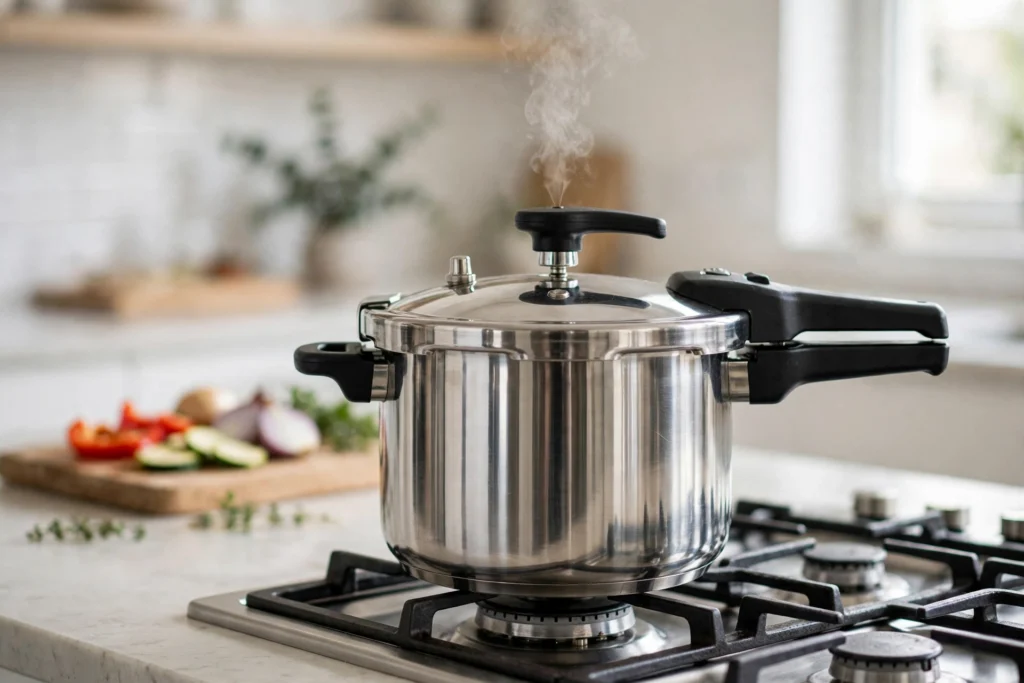
A pressure cooker works by trapping steam inside a sealed pot, which raises the pressure and lets water boil hotter than 100°C. That hotter steam cooks food much faster than an open pan, while the lid’s valves and safety lock keep the pressure under control. Once cooking ends, the pressure is released before the lid can be opened.
Key Takeaways
- Trapped steam raises the pressure, so water boils near 120°C instead of 100°C.
- Hotter steam cooks tough foods in a fraction of the usual time.
- A regulator valve, a safety valve, and a lid lock keep pressure in check.
- Stovetop and electric models use the same idea, with different controls.
- Always release the pressure fully before opening the lid.
Why does trapped steam cook food faster?
In an open pan, water boils at 100°C and stays there — turn the heat up and the water just boils away faster. A pressure cooker changes that deal. Its lid seals tight, so the steam has nowhere to go. As steam builds up, the pressure inside climbs, and with it the boiling point. At full pressure the water inside is closer to 120°C, and that extra heat cuts cooking times sharply — dried beans that take two hours on the hob can be ready in about 40 minutes. Steam also gives up its heat the moment it touches cooler food.
What happens inside a pressure cooker, step by step?
Add food and liquid — usually at least a cup of water or stock — lock the lid, and turn on the heat. The liquid boils, steam fills the pot, and at first some air escapes through the valve. Once the air is gone, the valve closes and pressure builds: a stovetop valve rocks or hisses, and an electric display counts down. Then turn the heat down and hold it steady.
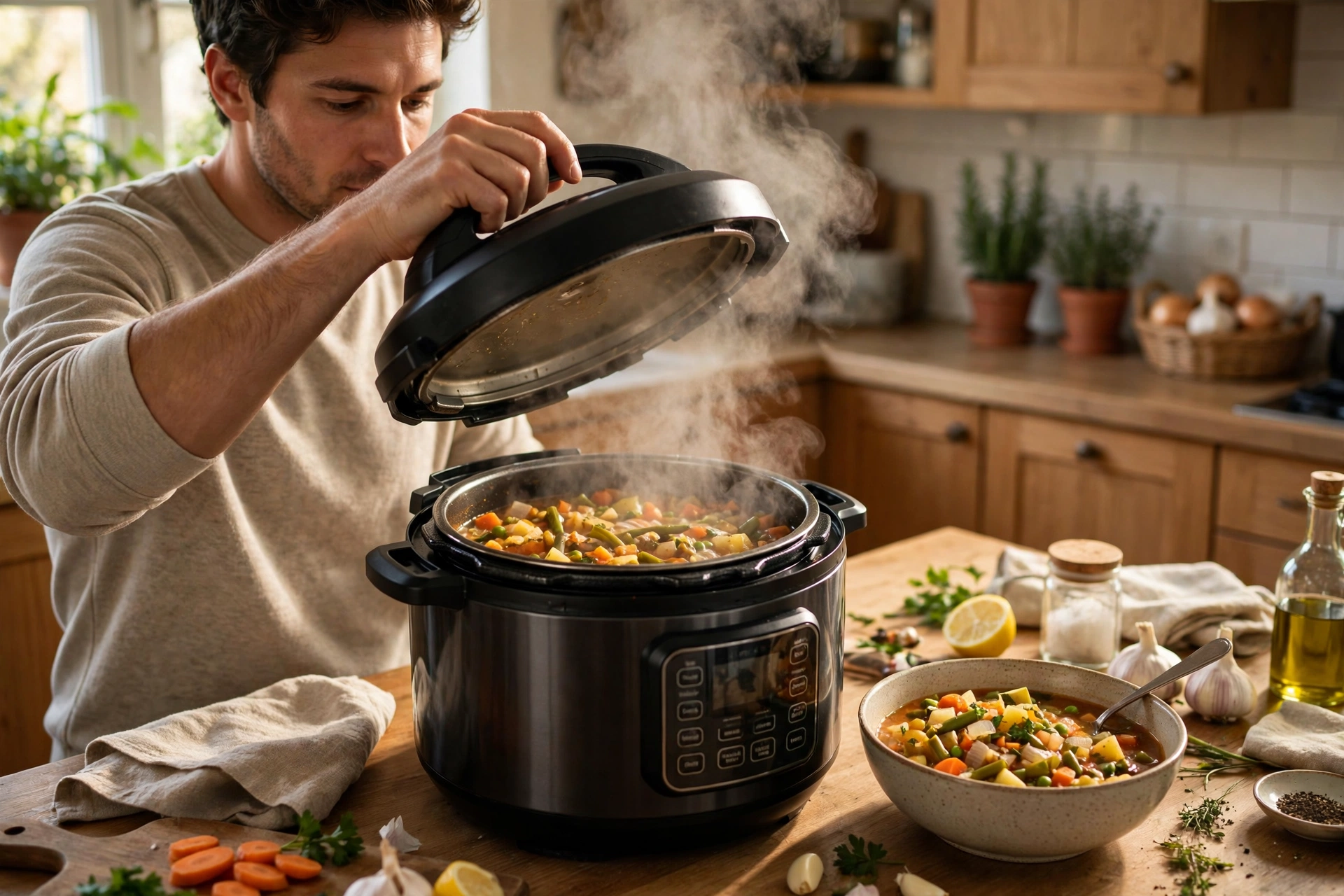
When the time is up, release the pressure — let the cooker cool on its own, or open the release valve for a quick burst of steam. Only then can the lid be turned and lifted.
What do the valve, regulator, and safety lock actually do?
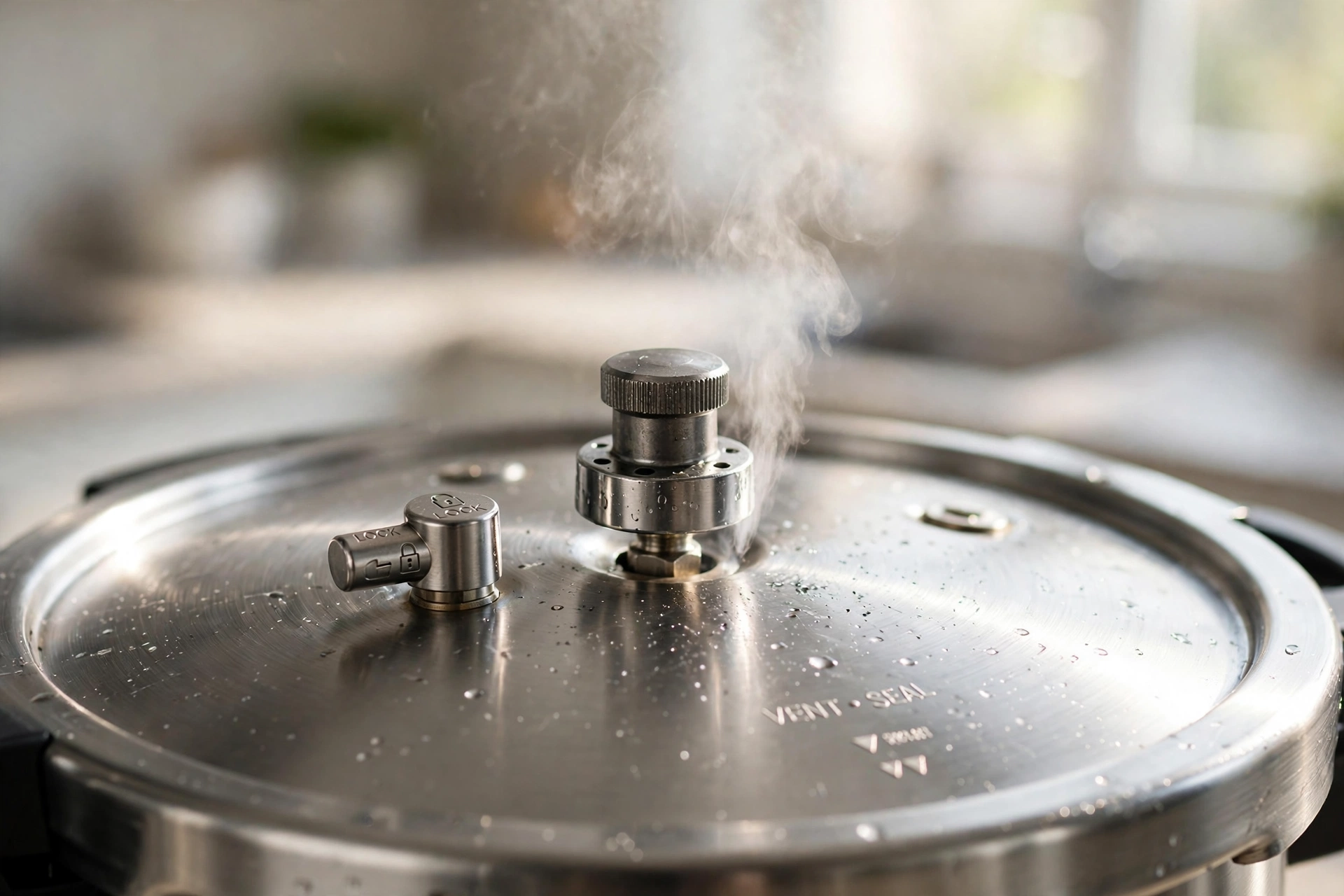
The valve is the cooker’s pressure manager. On older stovetop models it’s a small weight on a vent pipe: when pressure passes the set level, steam lifts the weight just enough to escape, then it settles back down. That rocking holds the pressure steady. Newer models use a spring-loaded valve, and electric models use a sensor that switches the heater on and off.
The safety lock is a small pin that pops up once pressure builds. While it’s up, the lid can’t be turned — you physically cannot open a pressurised pot by accident. A backup safety valve blows off steam if the main valve ever gets blocked by food.
Stovetop or electric: what’s the difference?
The physics is identical; the control is not. A stovetop cooker is a pot with a locking lid heated on a hob, with the burner adjusted by hand. It’s fast to heat up, lasts for years, and costs less — but you must watch it and turn the heat down at the right moment.
An electric cooker — a multicooker — has its own heating element, a timer, and preset programmes. Choose a setting, press start, and it brings itself up to pressure, holds it, and switches to keep-warm when the timer ends. Many models can also slow-cook and steam. If you like to set things going and walk away, electric wins; if you want speed and simplicity, stovetop wins.
What foods work best — and what doesn’t?
Pressure cookers shine with slow foods: dried beans and lentils, chickpeas, tough cuts like beef shin or lamb shoulder, whole chickens, and root vegetables all come out tender in well under half the usual time.
They’re less suited to foods that need to stay crisp or brown — no crackling skin or roasted crust, as the moist heat never gets hot enough. Delicate fish, pasta, and quick vegetables can overcook in minutes. And foods that foam a lot, like split peas or oatmeal, can bubble up and block the valve if the pot is too full. Never fill a pressure cooker more than two-thirds full — and only half full with foods that expand or foam.
How do you use one safely?
Check the sealing ring and valves before each use — a cracked ring won’t seal, and a clogged valve can’t release steam. Always add enough liquid, since the cooker needs water or stock to make steam. Keep hands and face away from the valve when releasing pressure: the steam is far hotter than a kettle’s, so point it away from yourself.
Don’t force the lid — if it won’t turn, pressure is still inside. Wait, or run cold water over a stovetop cooker’s lid. Forcing it is the one mistake that can actually cause a burn. If a valve or seal looks damaged, replace it before cooking again. Wash the ring after use, let it dry fully, and replace it about yearly.
Frequently Asked Questions
Is a pressure cooker safe?
Yes, when used as the manual describes. It has a regulator valve, a backup safety valve, and a lid lock that stops the lid opening while pressure remains. Most accidents involve very old cookers, or a blocked valve that was never cleaned.
Can a pressure cooker explode?
It’s extremely unlikely with a modern cooker in good condition. The lid lock, regulator, and safety valve give pressure three separate ways to stay controlled — problems only arise when a valve is blocked or a seal has failed.
How much water should you put in a pressure cooker?
Most recipes need at least a cup (about 250 ml) of liquid to build steam. Never fill the cooker more than two-thirds full — only halfway for foods that foam or expand, like beans or split peas.
Can you cook frozen food in a pressure cooker?
Yes. Frozen meat or vegetables can go straight in, though they need roughly half as long again as fresh food. Skip quick release with frozen meat — the sudden drop can leave the outside overcooked and the middle underdone, so use natural release.
Does pressure cooking destroy nutrients?
No more than other methods, and often less. Food cooks quickly and spends little time in the water, so water-soluble vitamins survive better than in a long boil — less time, less water, less loss.
Conclusion
A pressure cooker is a simple idea with a big payoff: seal the steam in, let the pressure raise the boiling point, and dinner lands on the table in a fraction of the usual time. The valves and lid lock handle the safety; your job is checking the seal, adding enough liquid, and releasing the pressure first.
If you’ve never tried one, start with something forgiving, like a lentil stew. For more kitchen explainers, see how a toaster browns bread, how an induction cooktop heats a pan, how a blender cuts and mixes, and how a hair dryer moves hot air — and for the deeper science, Wikipedia’s pressure cooking guide and Britannica’s pressure cooker overview are worth a read.