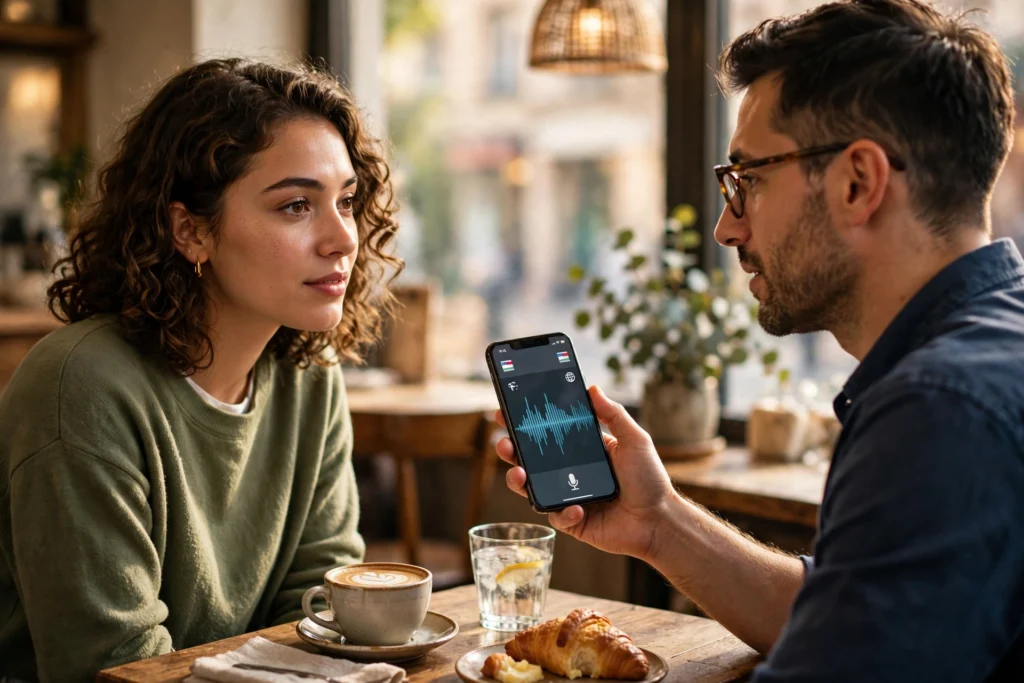
AI translates languages in real time by listening or reading, working out what the words mean in context, and then rebuilding that meaning in another language — all in a couple of seconds, rather than swapping words one by one.
Key Takeaways
- Live translation usually chains speech recognition, translation, and speech output together.
- Context matters more than single words: the same word can mean different things in different sentences.
- Camera translation adds image recognition, so signs and menus can be translated on screen.
- Accents, background noise, slang, and rare languages still cause the most mistakes.
- For anything important, check the result in the original language or ask a fluent speaker.
How does live speech translation actually work?
It starts with speech recognition, which turns sound into text. That part is not magic either: the system has learned patterns from many recorded voices, so it can guess which words you most likely said, even when you mumble a little or pause mid-sentence. Next, a translation model reads that text — not just one word at a time, but the whole sentence, and often the sentences around it — and predicts a natural version in the target language. Finally, if you are listening rather than reading, a speech synthesis voice reads that translation aloud.
That chain explains why delays happen. Each step takes a moment, and a good system will sometimes wait for a little more of the sentence before it starts translating, because the meaning can change right at the end. In English, for example, “I didn’t say she stole the money” can mean several different things depending on which word you stress. A rushed, word-by-word version would miss that completely.
Why doesn’t it just translate word by word?
Because languages don’t line up neatly. Word order changes, some words have no exact match, and idioms rarely survive a literal translation. “It’s raining cats and dogs” is not about animals falling from the sky, and a word-for-word version in another language would sound baffling. Modern translation models try to capture the idea instead, which is why they usually sound far more natural than older dictionary-style tools did.
What about translating signs, menus, and documents with a camera?
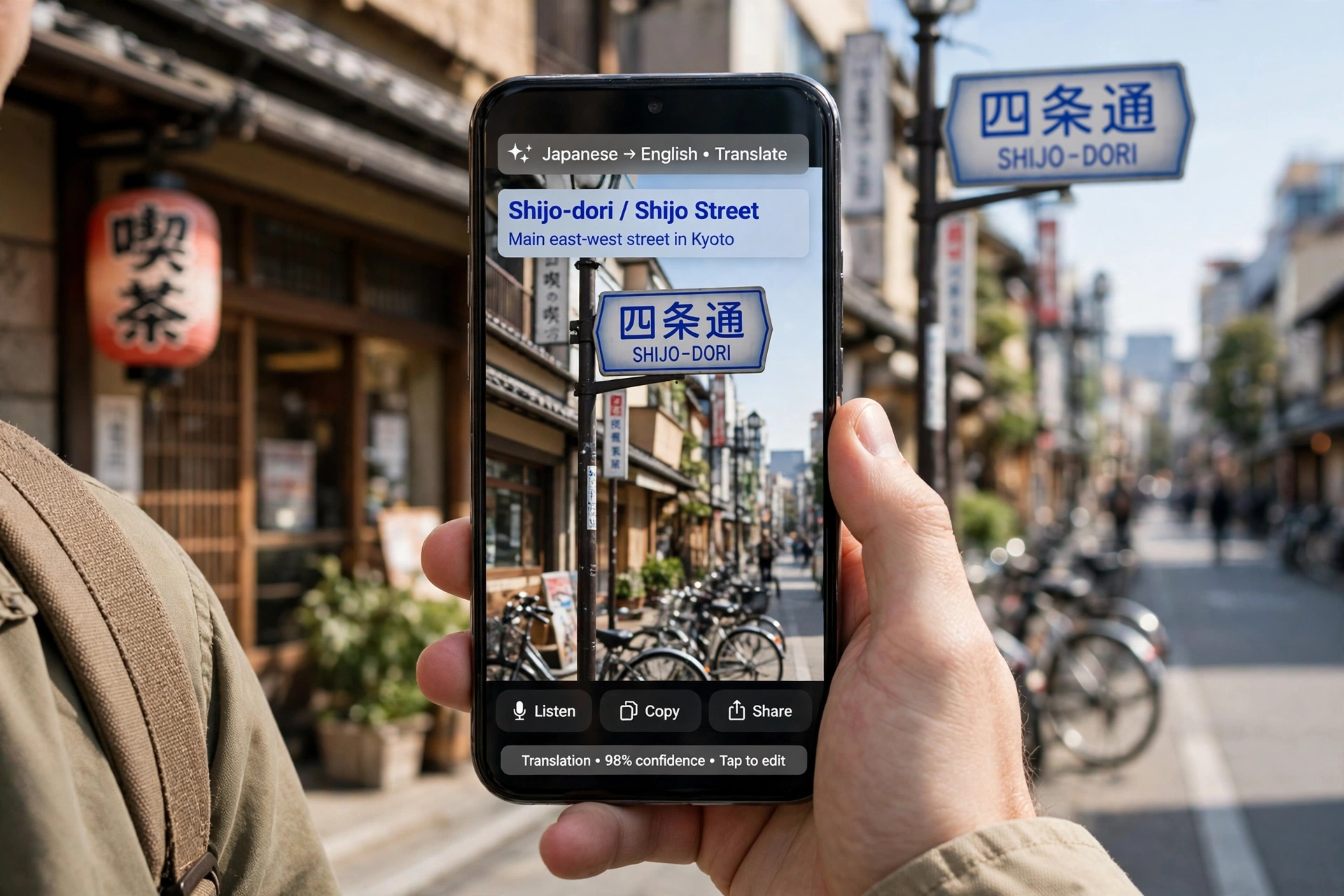
Here the first step is different: the phone has to find and read the text in the photo. That is called optical character recognition, and it works best on clear, well-lit print. Once the words are recognised, the same translation step kicks in, and the result is drawn back over the image so you can read it in place.
Why do live translations still go wrong?
Noise is one big culprit. A busy market, a car window down, or two people talking at once can confuse speech recognition before translation even begins. Accents and dialects are another: a system trained mostly on one regional accent may mishear another, and slang or local expressions often have no tidy equivalent.
Then there is ambiguity. Some sentences are genuinely unclear without more context, and the system has to guess. It will usually pick the most common meaning, which may not be yours. That is also why short phrases are riskier than full sentences — “bank” could be a river bank or a place to keep money, and without context the tool cannot know.
How can you get better results from a live translator?
Speak in short, complete sentences, and pause briefly between them. Avoid mumbling, shouting, or talking over someone else, and hold the phone close enough that it picks up your voice rather than the room. If a translation looks odd, try rephrasing rather than repeating the same words louder — a simpler sentence often translates more cleanly.
It also helps to check both directions. If you are chatting with someone, let them see the original as well as the translation, or read the back-translation if your app offers one. That way a mistake is easier to spot before it causes confusion. And if the conversation really matters — a medical appointment, a contract, a job interview — bring a human interpreter or a fluent friend, and use AI only as a backup.
Where does live translation work best, and where should you be careful?
It shines for everyday situations: asking for directions, ordering food, checking into a hotel, or following a simple meeting. In those cases, even a slightly clumsy translation usually gets the point across, and you can clear up confusion with gestures, a map, or a photo.
Be more careful with instructions that affect safety, health, money, or legal rights. A mistranslated dosage, a wrong turning at a road sign, or a misunderstood clause in an agreement can have real consequences. In those situations, treat AI translation as general information only, and confirm the details with a qualified person or an official source.
What is changing next for real-time translation?
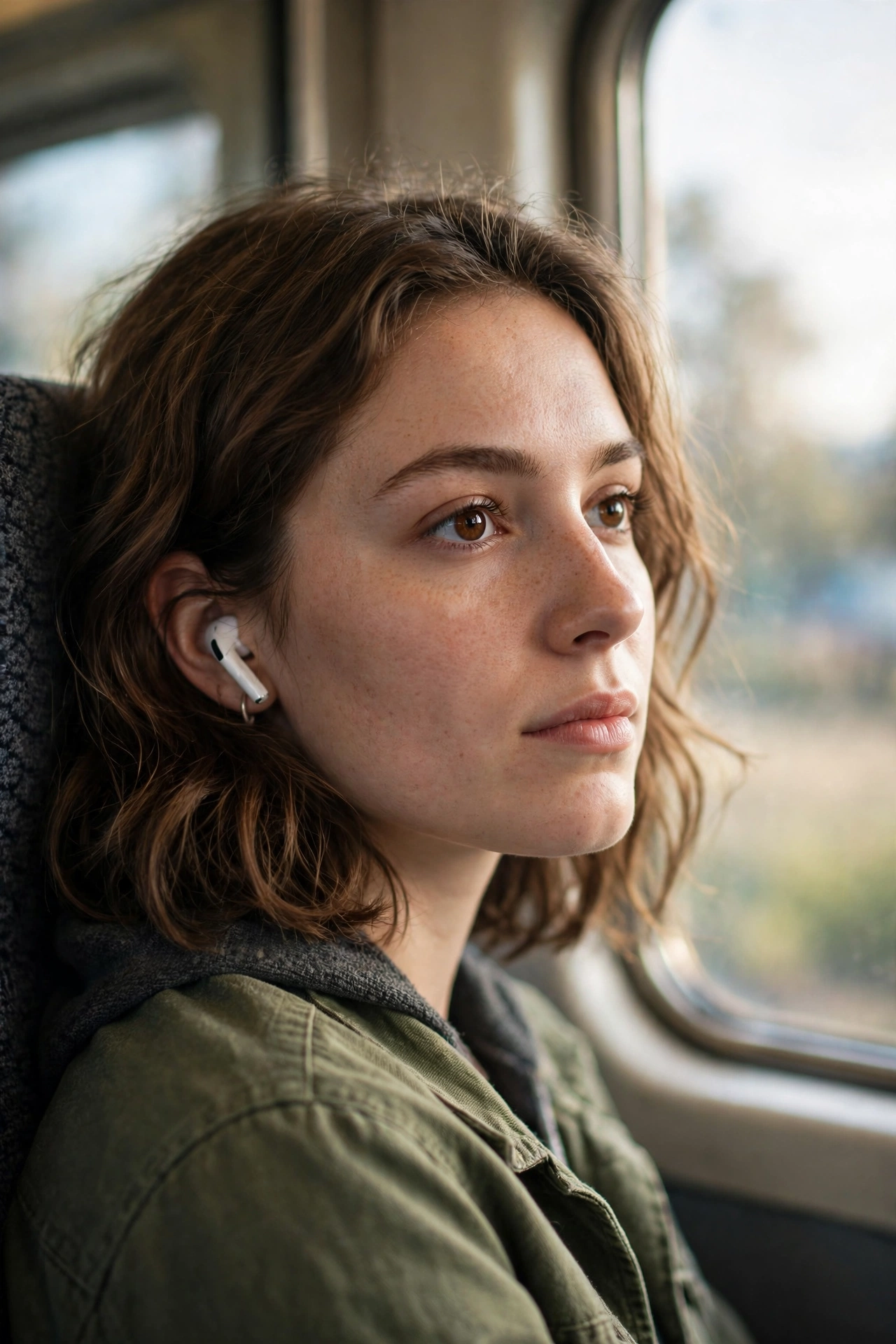
Systems are getting better at handling longer conversations, remembering what was said a few minutes earlier, and keeping a speaker’s tone more consistent. Some earbuds and headsets now aim to translate a conversation almost as it happens, so you can listen in your own language while someone else speaks theirs. That feels impressive, and for casual chat it often is — but the same limits still apply underneath: noise, ambiguity, and low-resource languages remain hard problems, and no tool should be presented as perfect.
The practical shift is not that translation has become flawless. It is that it has become fast and accessible enough to lower the barrier to talking with people you could not talk with before. Used with a bit of patience and a habit of checking, that is genuinely useful.
FAQs
How fast is real-time AI translation?
Usually a few seconds behind the speaker, because the system waits for enough of the sentence to understand its meaning before it starts. Very short phrases can appear almost instantly, while longer, more complex sentences take a little longer.
Does live translation need an internet connection?
Often, yes, especially for less common languages or for voice output. Some apps offer downloaded language packs for offline use, but those versions are usually smaller and may be less accurate than the online version.
Can AI translate slang and jokes well?
Sometimes, for very common expressions, but slang, wordplay, and cultural jokes are still among the hardest things to translate. If a joke or a casual phrase sounds strange in translation, it may be a literal rendering rather than the intended meaning.
Is camera translation reliable for road signs?
It is useful for orientation, but not foolproof. Clear, well-lit signs translate best. For safety-critical signs, follow the official sign, local guidance, or ask someone nearby rather than relying on the phone alone.
Should I trust AI translation for an important document?
No, not on its own. Use it to get the gist, then have a qualified translator or a fluent speaker check anything that affects health, money, legal rights, or safety before you act on it.
Conclusion
Real-time AI translation works by chaining listening, understanding, and speaking — or reading, in the case of camera translation — and rebuilding meaning rather than swapping words. It is at its best in everyday conversation and travel, and at its weakest with noise, slang, ambiguity, and rare languages. Try it for your next trip or video call, speak in clear, complete sentences, and check anything important before you rely on it. That simple habit turns a clever tool into a genuinely helpful one.
Further reading: Britannica’s guide to machine translation and Wikipedia’s overview of machine translation.