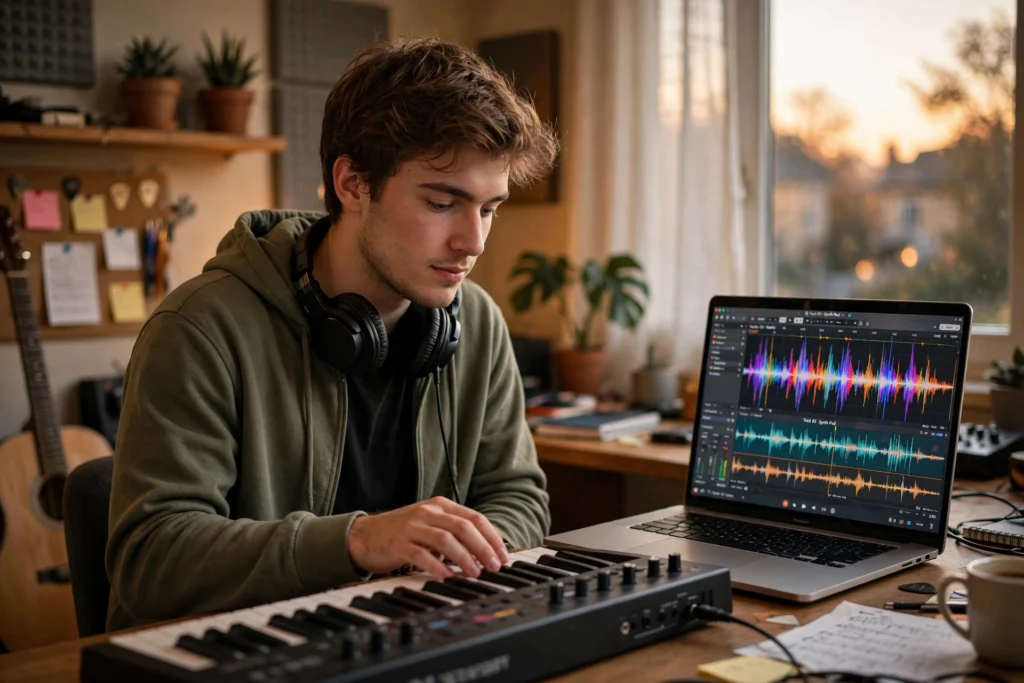
AI generate music by learning patterns from thousands of existing songs, then composing new melodies, harmonies, and rhythms that fit the style it was asked for. You type a short description, pick a mood or genre, and the model produces a finished-sounding track in seconds. It is pattern recognition turned into sound.
Key Takeaways
- AI music tools learn from large collections of songs, not from rules written by hand.
- A text prompt sets the style, mood, tempo, and instruments.
- Some tools produce sheet music or MIDI notes, while others produce finished audio.
- AI music works well for background tracks and demos, but it can sound generic.
- Copyright rules for AI songs are still unsettled, so check before you sell a track.
How does AI learn a musical style?
A music model starts with a huge training set of recordings, MIDI files, and sheet music spanning many genres. During training it studies how notes follow one another, which chords tend to appear together, and how a chorus differs from a verse. It does not memorise whole songs. Instead, it builds a statistical sense of what “sounds like jazz” or “sounds like a calm piano piece”.
This is the same kind of learning behind deep learning: layered networks pick up patterns at different levels, from single notes up to the shape of a whole song. A lower layer might learn that one chord often resolves to another, while a higher layer learns that a pop song usually builds toward a louder chorus. The training data matters a lot: a model trained mostly on classical piano will struggle with hip-hop drums, and one trained on chart pop will lean toward familiar progressions.
What happens when you ask AI for a song?
Most tools work in three steps. First, your prompt is turned into instructions the model understands: genre, tempo, mood, and instruments. A prompt like “a gentle acoustic song for a morning video” tells the model far more than “make a song”, so the more specific you are, the closer the result tends to land.
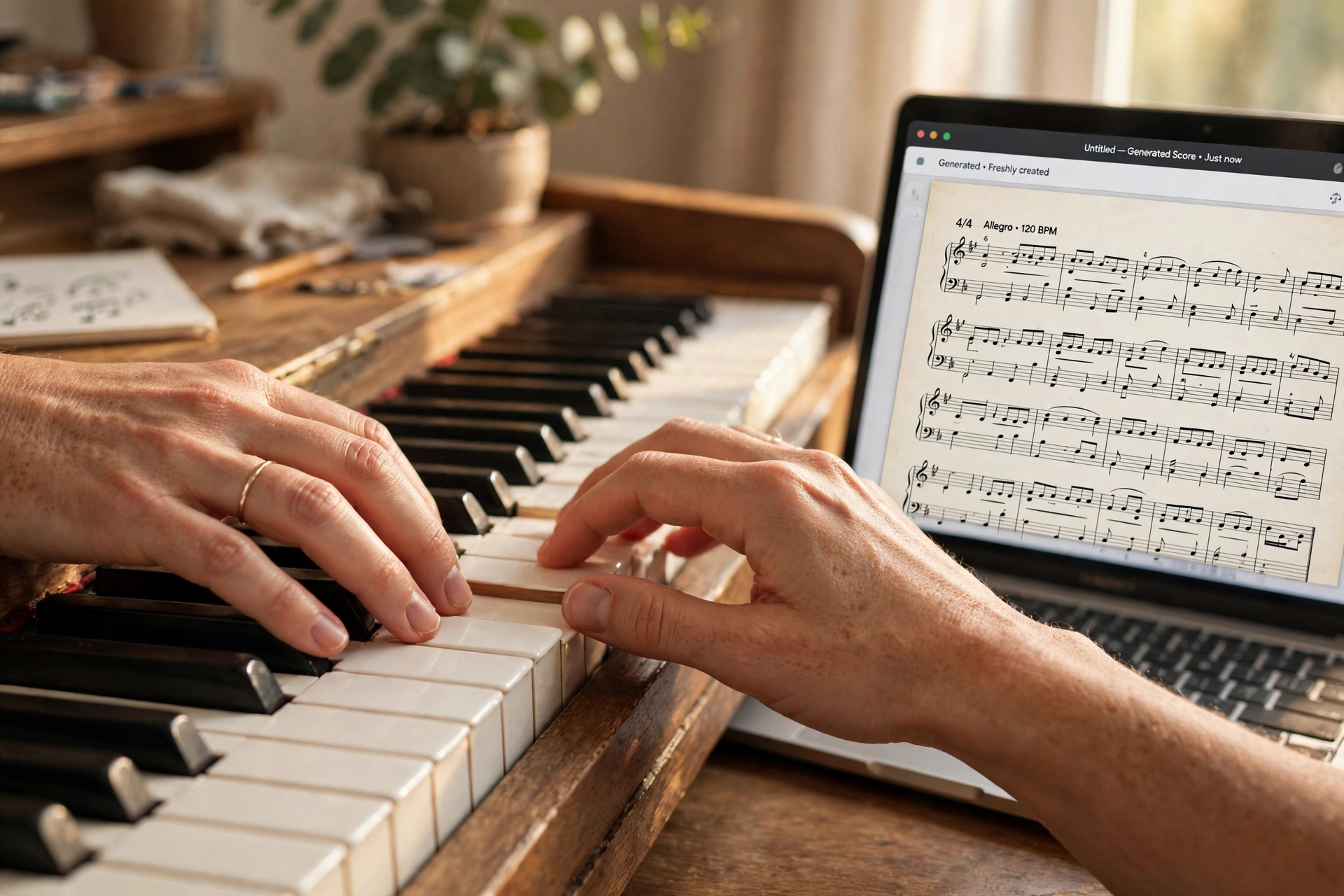
Second, the model generates the music note by note, or frame by frame if it works directly with audio. Some systems produce MIDI, a list of notes and timings a musician can edit afterwards. Others produce raw audio, which sounds finished straight away but is harder to change.
Third, the result is rendered into something you can hear. A few tools let you keep generating variations until one feels right, a bit like asking a band to play the same idea five different ways.
Can AI write lyrics too?
Yes, and this is where music generation meets language. Many song tools pair a music model with a language model, so the same prompt that shapes the melody also shapes the words. The lyrics are generated the way other AI text is: by predicting likely next words, guided by the theme, rhyme scheme, and mood you asked for.
The results are often decent on the surface — rhymes land and the syllables mostly fit — but the words can feel hollow on a second listen. That is a fair trade-off for a demo or a backing track, but it is also why human songwriters still do the heavy lifting on songs meant to say something specific. Always read the words before you use them: AI lyrics can include odd phrases or lines that do not scan when sung aloud.
Where is AI-generated music actually used?
The most common use is background music. Video makers, podcasters, and small businesses need a track that fits a mood without paying for a licence or waiting for a composer. AI tools can produce a 30-second intro or a looping bed for a tutorial in less time than searching a stock library.
Musicians use it differently, as a sketchpad: generate ten chord progressions, keep one, and build a real song around it. Film and game composers use it to test a mood quickly before recording with live players, and teachers use it to show students how a melody changes when the key or tempo shifts.
What are the limits of AI music?
The first limit is originality. Because models learn from existing music, their output leans toward the average of what they were trained on. A prompt for “something completely new” usually produces something familiar. It can combine styles in fresh ways, but it cannot decide that a rule is worth breaking for emotional effect.
The second limit is structure over longer pieces. Short clips often sound convincing, but a five-minute song can drift: the verse and chorus blur together, or the ending feels tacked on. Human composers plan an arc — tension, release, surprise — and models still find that hard to sustain.
The third limit is legal, not technical. Who owns a song the AI wrote? The answer depends on where you live, what the tool’s terms say, and whether the training data included copyrighted work. Some services say you own the output; others keep a licence to it. Read the terms and, for commercial use, check the rules in your country first.
Frequently Asked Questions
Is AI-generated music real music?
It is real sound, made by software, and people enjoy listening to it. Whether it counts as music in the artistic sense is a matter of taste.
Do I need musical training to use an AI music tool?
No. Most tools are built for people who cannot read sheet music. You describe what you want in plain words, and the tool handles the notes.
Can AI copy a famous artist’s style?
It can imitate a general style, such as “1980s synth-pop”, but cloning a specific living artist’s voice or sound raises serious legal and ethical problems. Many services block prompts that name a real artist.
How much does AI music generation cost?
Many tools offer a free tier with a limited number of songs per month, and paid plans start at a few dollars a month. Read the terms before you pay: cheaper plans sometimes limit commercial use.
Will AI replace musicians?
It is unlikely to replace musicians outright. It is already changing parts of the job, especially routine background music and quick demos. But live performance and songwriting with a personal point of view are still human strengths.
Conclusion
AI generate music by turning patterns learned from thousands of songs into new melodies, harmonies, and rhythms on demand. It is fast, cheap, and surprisingly good at short, mood-fitting tracks, yet it leans toward the familiar and still struggles with long-form structure and genuine originality. Treat it as a collaborator: a way to sketch ideas, fill a gap in a video, or explore a style you have never tried.
A practical next step is to try one free tool this week with a prompt you care about — a 30-second theme for a project, or a calm piano piece for your morning routine. Listen twice, keep the parts you like, and change the rest yourself.