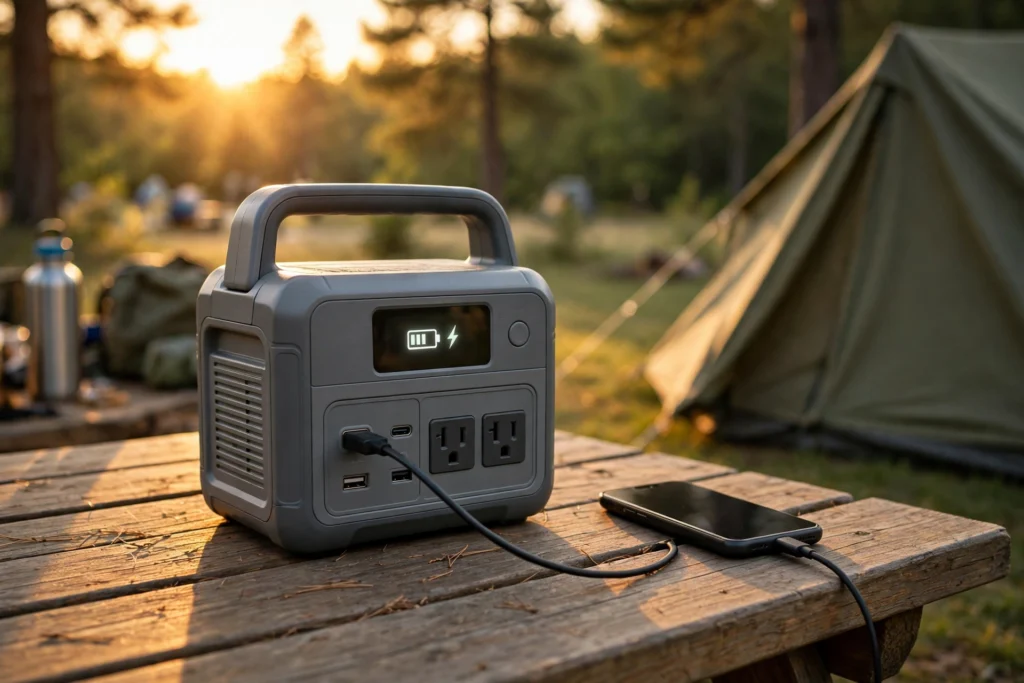
A portable power station works by storing electricity in a rechargeable battery, then converting it into the kind of power your devices expect. Plug in a phone, laptop, or small appliance, and the station’s inverter turns the battery’s direct current into mains-style alternating current, while its USB ports supply direct current straight to smaller gadgets.
Key Takeaways
- A portable power station is a big rechargeable battery with an inverter, a battery management system, and a set of output ports built into one carryable box.
- Capacity is measured in watt-hours (Wh) and tells you how much energy it holds; output is measured in watts (W) and tells you how powerful a device it can run.
- The inverter converts the battery’s direct current (DC) into alternating current (AC), so ordinary mains-powered devices can plug in.
- Most stations recharge from a wall socket, a car socket, or solar panels, and many can charge and discharge at the same time.
What is a portable power station, exactly?
Think of it as a power bank that grew up. A power bank charges phones over USB; a portable power station does that too, but it also has proper mains sockets, so it can run a laptop, a lamp, a small fridge, or a CPAP machine when there is no wall socket nearby. Campers use them for weekends off grid, and households keep one ready for power cuts.
Unlike a petrol generator, a power station has no engine, no exhaust, and almost no noise. You can use one indoors, and you can recharge it from the sun. The trade-off is that it holds a fixed amount of energy: once the battery is flat, you need to recharge it before it can do anything else.
What’s inside the box?
Inside are four main parts working together. First is the battery pack itself, usually made of lithium-ion cells. Second is the inverter, which turns the battery’s DC into AC for the mains sockets. Third is the battery management system, a small circuit board that watches each cell’s voltage and temperature and steps in if anything looks wrong. Fourth is the charge controller, which manages power coming in from a wall socket, a car socket, or solar panels.
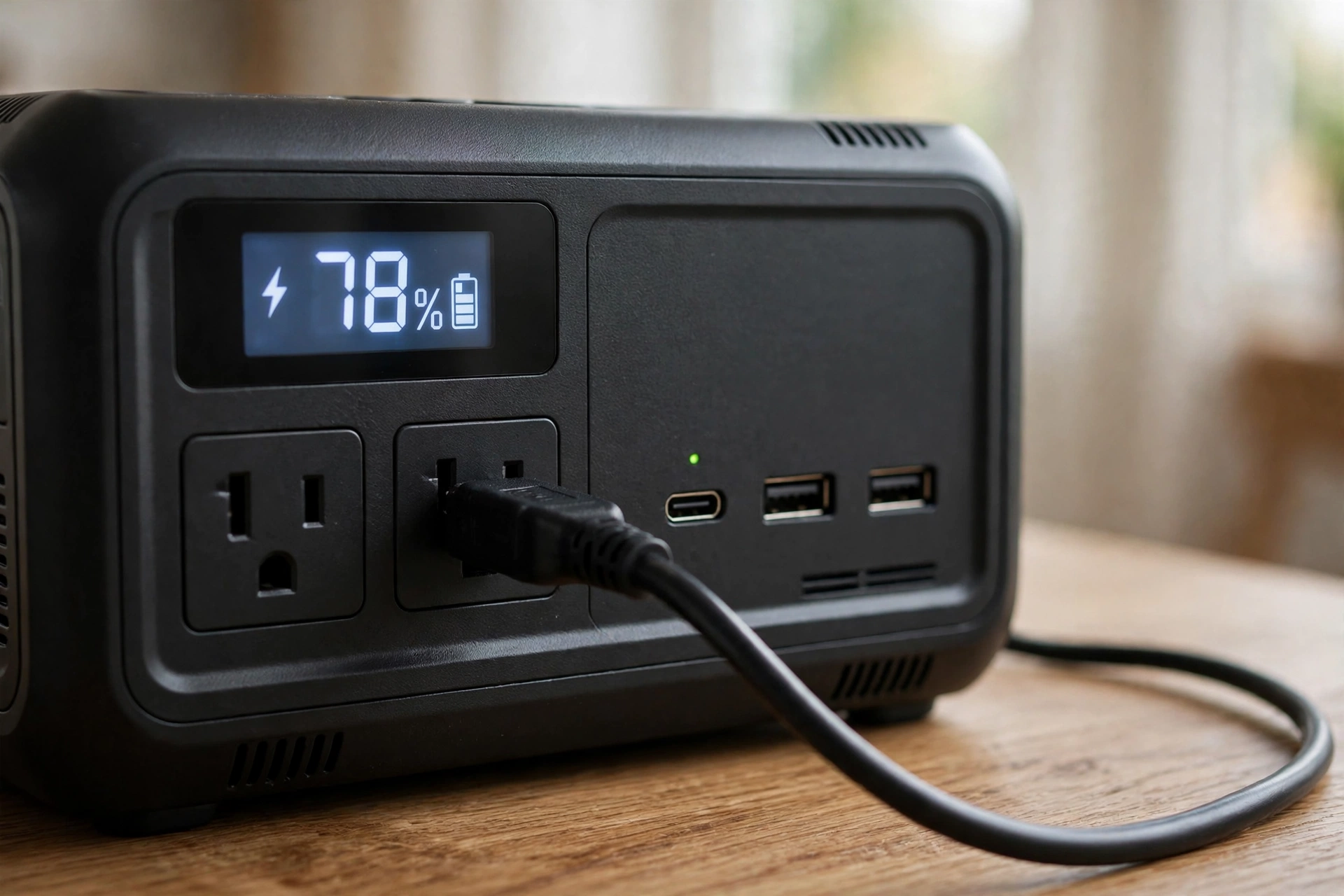
Around those parts sit the outputs you actually touch: AC sockets, USB-A and USB-C ports, and a 12V car socket. A small display shows the charge level and how much power is going in and out, and a fan cools the inverter when it works hard.
How does the battery store energy?
The battery stores energy chemically and releases it as direct current. Two numbers on the box matter most. Capacity, in watt-hours (Wh), is the size of the tank: a 500Wh station holds roughly twice the energy of a 250Wh one. Output, in watts (W), is how fast it can pour that energy out: a 500W station can run a 500-watt device, but not a 1,000-watt kettle.
Most modern stations use one of two lithium chemistries. Lithium iron phosphate (LFP) cells are known for long life and good thermal stability, and they often last for thousands of charge cycles. Nickel manganese cobalt (NMC) cells pack more energy into the same weight, which is why smaller, lighter stations often use them. Either way, the battery behaves much like a laptop battery — just on a much bigger scale.
One practical point: a battery’s stated capacity is not quite what you get out. Converting DC to AC loses some energy as heat, so a 500Wh station might deliver roughly 400–450Wh of usable AC power.
How does the inverter make mains power?
Your wall sockets supply alternating current, but batteries only store direct current, so something has to translate. That something is the power inverter. It switches the DC on and off very quickly and shapes the result into a smooth wave that mimics mains electricity.
Better stations use a pure sine wave inverter, which produces a clean wave close to what the grid supplies. Sensitive electronics — laptops, medical devices, audio gear — generally prefer it. Cheaper stations may use a modified sine wave, a rougher, stepped approximation. Many simple devices cope with it fine, but motors can run hotter and noisier, and some chargers may buzz or refuse to work.
How do you recharge a portable power station?
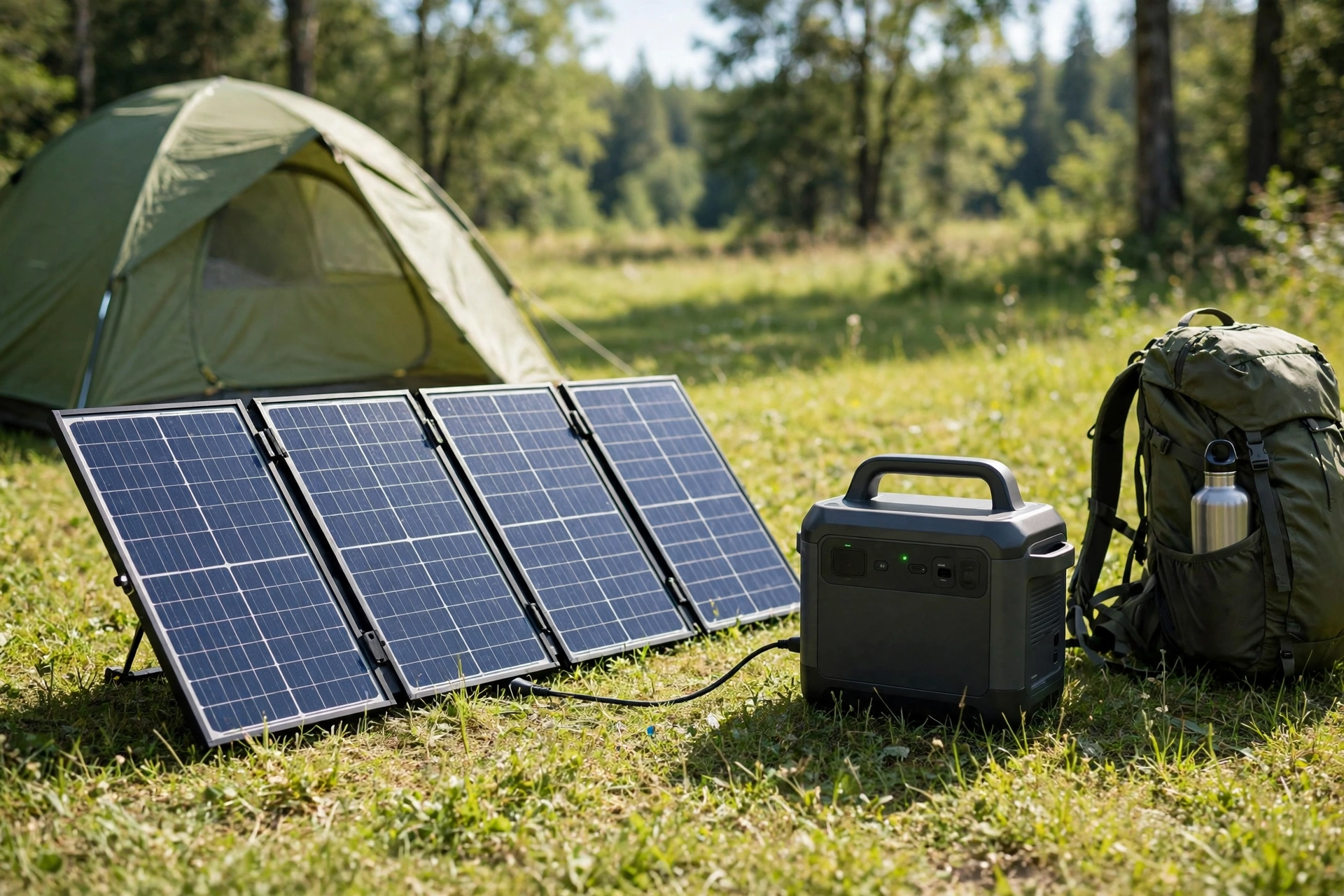
There are usually three ways in. The fastest is a wall socket: plug the station in like any appliance, and most mid-size models refill in a couple of hours. The second is a car’s 12V socket, which is slower but handy on a road trip. The third is solar: unfold a portable panel, plug it into the station’s solar input, and let daylight do the work.
Solar charging is the slowest of the three and depends heavily on weather, panel size, and how the panel is angled. A small panel on a cloudy day might add only a trickle, while a larger panel in full sun can make a real dent. Many models also support pass-through charging, meaning you can charge the station and run devices from it at the same time. That same solar setup can top up a drone‘s batteries between flights, which is why field photographers often carry a station.
How long will it run your devices?
The rough maths is simple: divide the station’s usable watt-hours by the device’s watts. A 500Wh station running a 50W laptop should last around eight hours once you allow for conversion losses. A 10W phone charger would stretch the same station for days, while a 1,000W hair dryer would flatten it in under half an hour — if the station’s output is even high enough to run it.
Check the label on your device for its wattage, and remember that some appliances draw a short surge when they start up. A fridge, for example, may need two or three times its running watts for a second when its compressor kicks in, so make sure the station’s surge rating covers that.
What should you check before buying one?
Start with your devices, not the marketing. List what you want to run, note each device’s watts, and add up how many watt-hours a typical session needs. Then check capacity (Wh) with some spare, output (W) above your hungriest device, the right mix of AC sockets, USB-C, and 12V outputs, and battery type — LFP for long life, NMC if weight matters more. Also check recharge speed, whether it takes solar input, and weight: a 500Wh station may weigh 6–7 kg, while a 2,000Wh one can top 20 kg.
Some newer models also include a wireless charging pad on top, though a cable is still the faster, more reliable option for most devices.
Frequently asked questions
Can a portable power station run a fridge?
A small camping fridge, yes, usually for many hours. A full-size household fridge is harder: it draws more power and surges when the compressor starts, so you need a station with a high continuous and surge rating. Check the fridge’s wattage label first.
Can I use a portable power station indoors?
Yes. Unlike a petrol generator, it produces no exhaust, so it is safe to use inside. Keep it in a ventilated spot, away from direct heat, and give the fan room to breathe — blocking the vents can make it overheat under a heavy load.
How long does a portable power station last?
That depends on the battery chemistry and how you treat it. LFP models are often rated for thousands of full charge cycles before their capacity drops noticeably, while NMC models are usually rated for fewer. Storing the station partly charged in a cool place helps it last longer.
Can I charge it with solar panels while using it?
Usually, yes — this is pass-through charging, and most modern stations support it. The solar input may not keep up with a heavy load, though, so the battery can still drain slowly on a cloudy day even while the panel is plugged in.
Is a portable power station the same as a UPS?
Not quite. A UPS switches over to battery power in milliseconds when the mains fails, which matters for desktop computers and servers. A power station is designed to be carried and used anywhere; it is not built for instant switchover, though some models offer a UPS mode.
What to do next
If you are thinking about buying one, start by listing the devices you actually need to keep running and their wattages. That short list tells you the capacity and output to shop for, and it stops you paying for a giant station when a mid-size one would do. Then check the weight, the ports, and whether it takes solar input — and keep it charged and ready, because a power station is only useful when it has energy in it.
General information only: always follow the manufacturer’s instructions for your specific model, and if you are unsure about running medical equipment or high-power appliances, ask the manufacturer or a qualified electrician first.