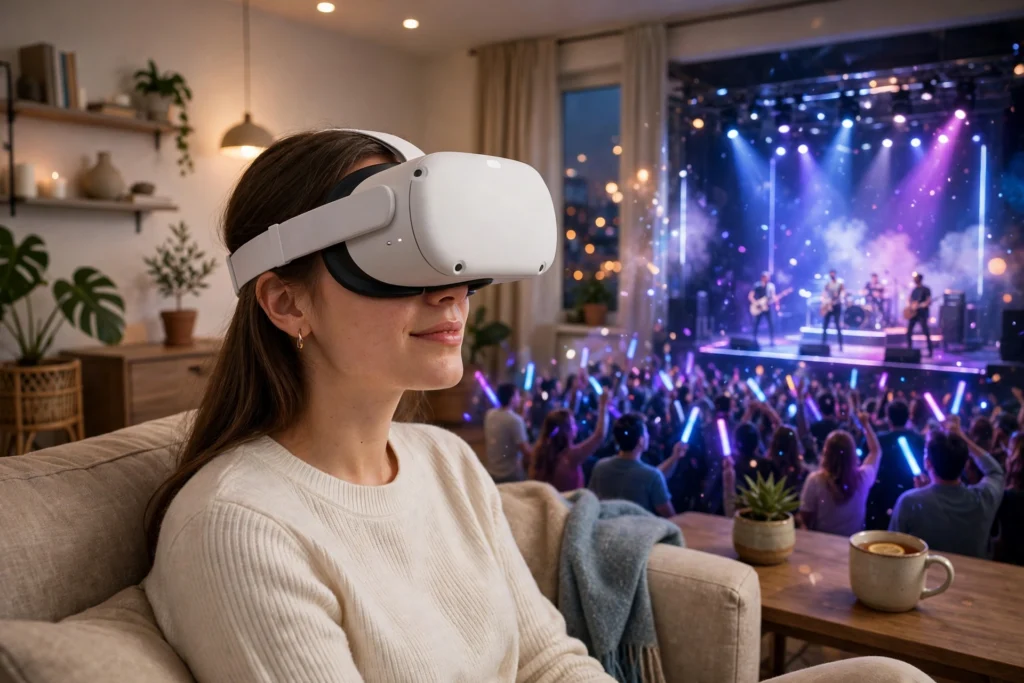
A VR concert puts you in front of a stage without leaving home. Put on a headset, join the show, and you can watch the singer up close, look around at the crowd, and hear the music in stereo sound that follows your head movements. It is not the same as standing in a venue, but for many fans it is the next best seat.
Key Takeaways
- VR concerts use filmed or computer-made stage views, spatial sound, and a headset that tracks your head.
- You can usually choose a viewpoint, such as front row, side stage, or a wider crowd view.
- Some shows are live, some are recorded, and some mix live music with virtual sets that could not exist on a real stage.
- Good sound, a charged headset, and a stable internet connection matter more than fancy extras.
- Check ticket terms before you buy: start time, replay access, headset support, and refund rules.
How does a VR concert actually work?
A VR concert starts with a view of the stage. Some shows are filmed with special cameras that capture the stage in 360 degrees, so you can turn your head and look around the venue. Others are built as virtual worlds, where the stage, lights, and crowd are computer-made and you move through them as an avatar. Both approaches use the same basic kit: a headset that shows a separate image to each eye, which your brain reads as depth.
That head tracking is what makes it feel like a concert rather than a video. Turn left and you see the crowd on that side. Look up and you see the lights above the stage. If you want the basics first, our guide to How Do VR Headsets Work? explains screens, lenses, and tracking in plain language.
Sound matters just as much. In a good VR concert, the music does not stay fixed in one ear when you turn your head. Instead, it shifts as you move, so the stage stays in front of you in sound as well as in sight. Our guide to How Does VR Audio Work? explains spatial sound and why it helps a virtual room feel real. Headphones built into the headset work well for most shows, and many viewers prefer over-ear headphones for longer sets.

What kinds of VR concerts are there?
Live VR concerts stream a real performance as it happens. You join at a set time, watch with other viewers, and share reactions in chat or with simple gestures. Recorded VR concerts work more like a film: you can start when you like, pause, and rewatch a favourite song. Both can be enjoyable, but they feel different. A live show has a shared buzz and a fixed start time, while a recorded show suits a quiet evening at your own pace.
Then there are virtual-only shows. These are not filmed in a venue at all. The artist performs as an avatar, or appears in a fantasy setting with effects that would be hard or impossible on a real stage, such as floating platforms, changing skies, or a stage that reshapes between songs. These shows can be playful and creative, though they feel less like a traditional gig and more like a music event inside a game.
Some events mix these ideas. A real singer may perform in a studio while the audience sees a virtual stage around them, or a filmed concert may add virtual effects between songs. The label on the ticket page usually tells you which kind it is, so read it before you buy rather than assuming every VR concert is live.
Can you watch with friends?
Yes, and for many people this is the best part. Some VR concerts let you join with friends as avatars, so you can stand in the same virtual crowd, wave, dance, and chat between songs. Others let you watch side by side at home, each in your own headset, while talking on a call or in the app. Our guide to What Is Social VR? explains how people meet and hang out in virtual worlds, and the same ideas apply here.
Avatars add another layer. You may pick a simple figure, customise clothes and colours, or use a basic likeness of yourself. Our guide to How Do VR Avatars Work? covers bodies, faces, and movement. Keep expectations modest: avatars are fun for waving and dancing, but they do not replace seeing a friend’s real face. If you want a shared night in, a video call alongside the concert can fill that gap nicely.
If you watch alone, you are not missing the whole show. Many viewers prefer a solo front-row view, without chat distracting them from the music. Try a short recorded show first to learn which style suits you, then join a live event when you feel comfortable with the controls.
What do you need to watch a VR concert?
You need a VR headset, a stable internet connection, and the app or ticket link for the show. Most standalone headsets work without a PC, which keeps setup simple. Check that your headset model is listed as supported before you buy, because some shows work only on certain devices. Charge the headset fully, and keep the charger nearby for longer shows.
A comfortable seat helps more than people expect. You can stand for a short set, but sitting is easier for a full concert, and it reduces the chance of bumping into furniture while you look around. Keep water nearby, adjust the headset strap so the picture stays sharp, and test the sound level before the show starts. If the app offers a lobby or waiting room, join a few minutes early so you can fix any sound or picture problem before the first song.
Internet speed matters too. A VR stream needs more data than a normal video, so a weak connection can cause blurry pictures or pauses. A wired connection or a strong Wi-Fi signal near your seat usually works best. If the picture drops in quality, try closing other apps and devices that are using the same connection.

What are the limits of a VR concert?
A VR concert cannot copy everything about a live venue. You will not feel the bass in your chest the same way, smell the venue, or bump shoulders with strangers in a crowd. The picture can also feel less sharp than a large TV, especially in wide crowd views where the stage is far away. Front-row views usually look best, because the action fills more of your view.
Motion discomfort affects some viewers, especially in shows with fast camera moves. If you feel dizzy or uneasy, take the headset off, rest, and try a slower, seated show next time. Long shows can also tire your eyes and neck, so take breaks between sets when the app allows it, and do not feel you must watch every minute without pausing.
Ticket terms are another limit to check. Some tickets allow one viewing only, some allow replays for a day or a week, and some limit the number of devices. Prices vary widely, from free short shows to paid full concerts. Read the terms, check the time zone for the start time, and note whether the show is live or recorded, so the experience matches what you expected.
How do you pick a good VR concert?
Start with music you already love. A favourite artist in VR will usually beat an unfamiliar act with better effects, because you will care more about the songs. Then check the format: live or recorded, filmed or virtual-only, solo or social. Pick the one that fits your evening, not the one with the longest feature list.
Next, check practical details. Does it support your headset? How long is the show? Can you replay it? Is there a chat or friends option, and can you turn it off if you want a quiet listen? A short, well-reviewed show is a better first try than a long, expensive event. If you enjoy it, you can try a bigger live show next time with more confidence.
Finally, set up for comfort. Sit somewhere quiet, dim the room lights if that helps the picture, and tell others at home you will be wearing a headset for a while. Small steps like these make the show feel like an event, rather than just another video on a screen.
FAQs
Do I need an expensive headset for a VR concert?
Not necessarily. Most VR concerts run on a standalone headset, with no PC needed. Picture quality varies by device, but a mid-range standalone headset is usually enough for a first show. Check the show’s supported devices list before you buy a ticket.
Are VR concerts live or recorded?
Both exist. Live shows stream at a set time with other viewers, while recorded shows can be started and paused when you like. The ticket page should say which kind it is, along with replay rules, so check before you buy.
Can I watch a VR concert with friends?
Yes, in many apps. You can join as avatars in the same virtual crowd, or watch at the same time from different homes and chat during the show. Some viewers prefer a solo front-row view, so pick the social setting that suits you.
Does a VR concert sound as good as a real concert?
It can sound very good with headphones and spatial audio, but it will not feel exactly like a venue. Bass, crowd noise, and room sound are different at home. Good headphones and a quiet room help a lot, and front-row views usually sound clearest.
Is a VR concert worth the ticket price?
It depends on the artist, the format, and what you value. A VR ticket is often cheaper than travel and a venue ticket, and it gives you a front-row view from home. Try a free or short show first, then decide whether a paid live event feels worth it for you.
Conclusion
A VR concert works by combining a headset view, spatial sound, and a stage, whether filmed or virtual, into a shared musical event you can join from home. It will not replace a live venue for everyone, but it offers a front-row view, flexible timing, and a fun way to watch with friends. For background on the technology itself, see Britannica’s overview of virtual reality and Wikipedia’s guide to virtual reality.
Your next step is simple. Pick one short recorded VR concert by an artist you like, check that your headset is supported, and try it from a comfortable seat. If you enjoy the front-row view and the sound, a live show with friends is a natural next step.