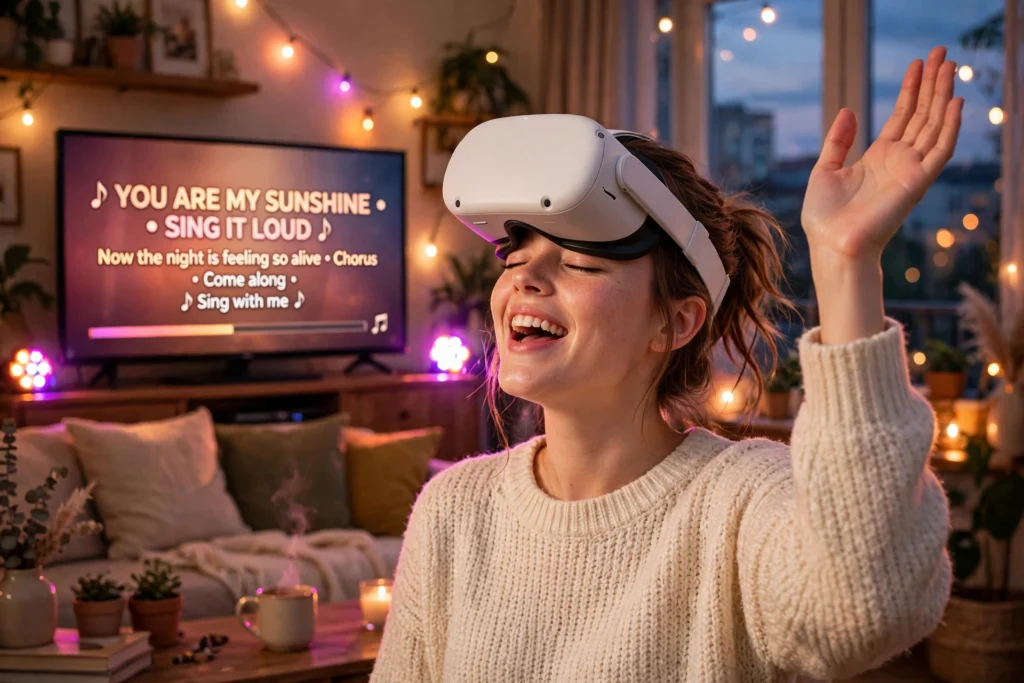
VR karaoke puts you on a stage that only exists inside your headset. You pick a song, the lyrics float in front of you, and you sing into your headset’s built-in microphone while a virtual crowd cheers you on — no karaoke bar, no separate microphone, and nobody in the room has to hear you warm up.
Key Takeaways
- VR karaoke uses the headset’s built-in microphone, so no extra equipment is needed.
- Games like Songbird score your pitch and timing, but most never let you fail a song.
- Casting to a TV lets friends watch, sing along, and cheer from the sofa.
- Clear the floor, charge the headset, and keep the first session short.
What Is VR Karaoke?
VR karaoke is karaoke inside virtual reality. Instead of a bar screen, you stand — or sit — inside a virtual venue: a cosy club, a mountain stage, a neon-lit bar. The lyrics appear on a board in front of you, the backing track plays through the headset speakers, and your voice is picked up by the microphone already built into the headset.
The idea goes back years, but modern hardware changed the deal. A headset such as the Meta Quest has a good microphone built in, so there is no USB mic to buy and no cable to trip over. Put the headset on and sing.
How Does VR Karaoke Actually Work?
Three pieces do the work: the microphone, the pitch tracking, and the stage.
The microphone captures your voice. Most games do not record you for anyone else unless you choose to share — the mic judges your singing, it does not broadcast it.
Then comes pitch tracking. As the song plays, the game listens to the notes you hit and compares them with the melody. A pitch line scrolls across the lyrics, showing whether you are on key or a little flat — the same idea as the coloured bars in Guitar Hero, except the instrument is your voice. Some games also reward timing, scoring you for starting each phrase on the beat.
Finally, the stage. The game wraps the song in a place: a stage that changes as you sing, an audience that reacts, lights that pulse with the music. In Songbird, the best-known VR karaoke game on Quest, you perform across a fantasy world called Nestopia, and the scenery fills in as you sing.
What Do You Need to Start?
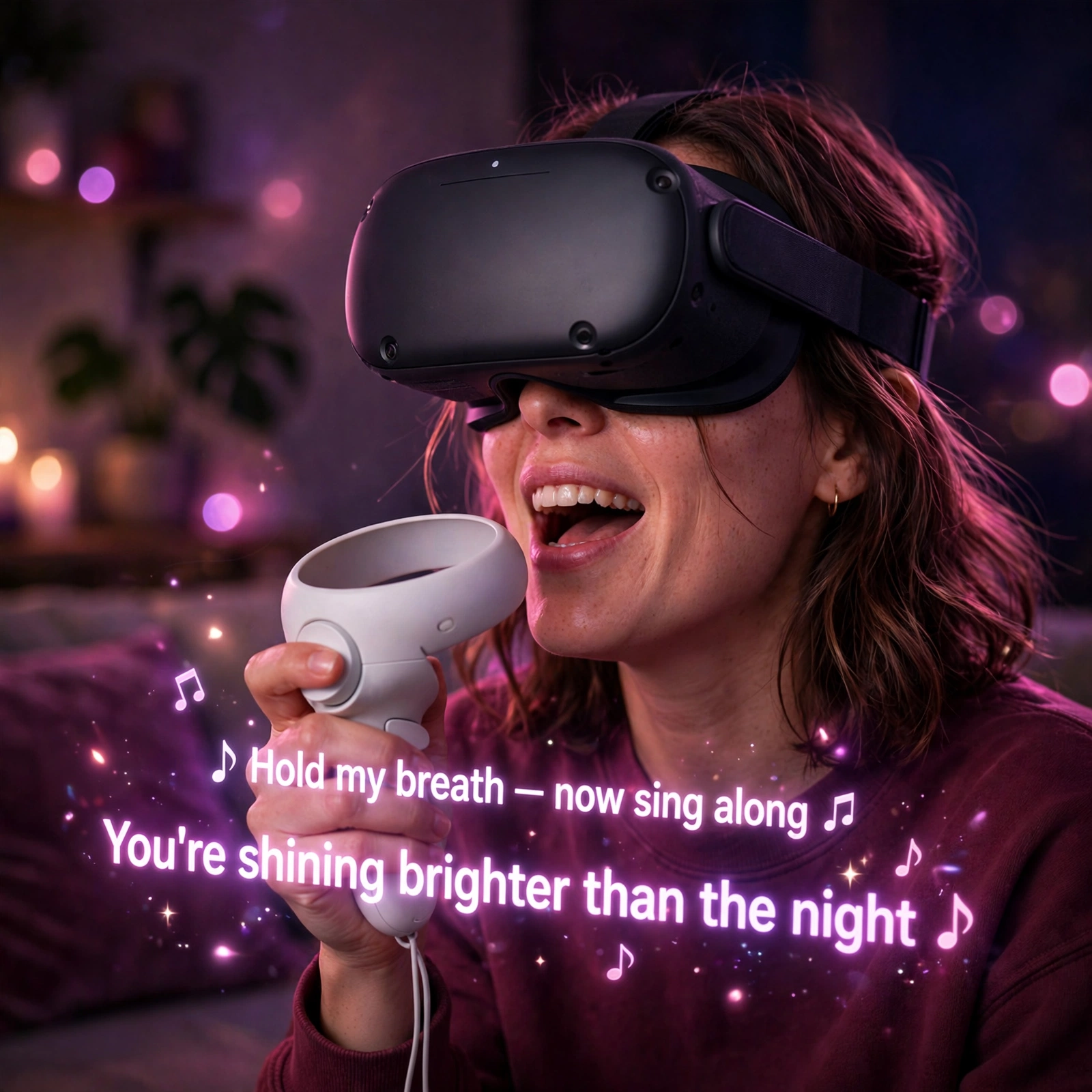
A VR headset, a karaoke app, and enough clear floor to stand in without knocking over a lamp.
A standalone headset such as a Meta Quest 2, 3, or Pro runs karaoke games on its own, with no PC and no cables. If you already own one for the games in our guide to how VR headsets work, you already have everything the app needs — display, speakers, microphone, and tracking, all in one box.
Songbird is the flagship app: it launched on Quest with 33 licensed tracks, three difficulty levels per song, and monthly song packs after that. It costs $24.99, every song is unlocked from the start, and you cannot fail a song — which takes the pressure off completely.
Then there is the room. Karaoke in VR is more physical than it looks: people sway, gesture, and step toward the crowd. Clear a couple of metres around yourself and set up the guardian boundary first. Our guide to how VR controllers work explains the boundary system — if it flashes, stop and step back.
VR Karaoke vs. a Real Karaoke Bar
A virtual stage is not a replacement for a real bar, but it is a surprisingly close cousin.
| VR karaoke | Karaoke bar | |
|---|---|---|
| Cost per night | One app purchase, then free | Drinks, cover charge, per-song fees |
| Audience | Virtual crowd, or friends on the sofa | A real room full of strangers |
| Song choice | Fixed track list, packs added monthly | Huge catalogue, request slips |
| Stage fright | Low — nobody real is watching | High — the whole bar is watching |
| Social side | Casting to TV, passing the headset | Everyone sings together in the room |
| Best for | Practice, shy singers, game nights | Big groups, birthdays, strangers |
The row that surprises most people is stage fright. Plenty of people who would never sing in a bar will happily sing in VR, because the audience is not real. If you have always wanted to try karaoke but never wanted the room to watch, VR is the gentlest first step.
A 20-Minute First Session
Start with the headset fully charged and the room cleared. Open the app, pick an easy song you already know by heart — something slow, with long notes — and set the difficulty to easy.
Afterwards, check the score screen. It shows your pitch accuracy phrase by phrase, so you can see exactly which lines drifted flat. Pick one of those lines and sing it again — that is the whole practice loop, and it is why VR karaoke works as a singing trainer as well as a party game.
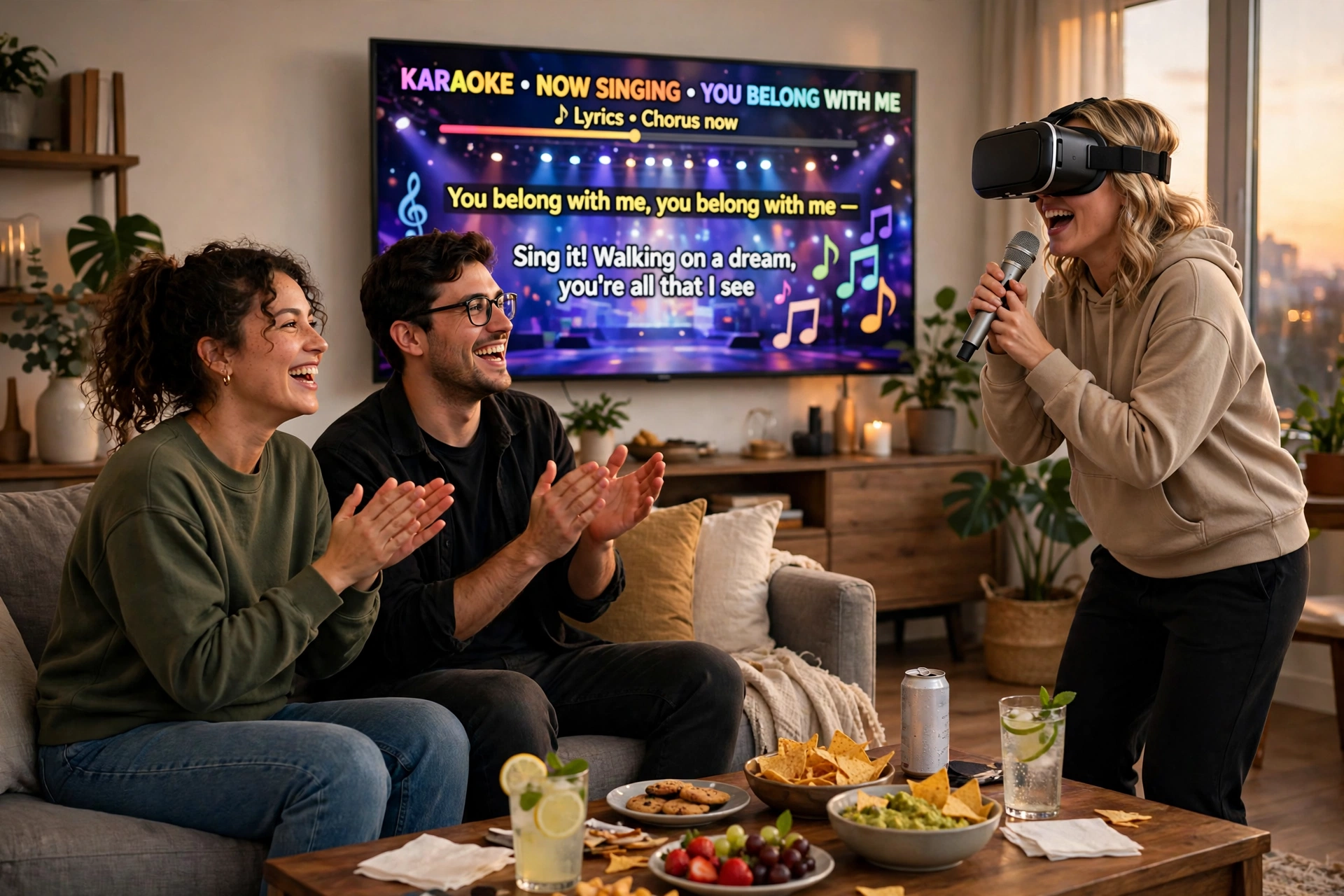
Then cast the game to your TV — a couple of taps in the Quest quick settings — and hand the headset over after every song so everyone gets a turn. One headset, four singers, twenty minutes: that is the rhythm that works.
Can You Sing with Friends?
Yes, but it works differently from a bar. Most VR karaoke games today are single-player: one singer, one headset. Songbird, for example, has no online multiplayer — the shared part is physical, passing the headset around the room while everyone else watches on the TV.
That sounds like a limitation, and in a way it is. But in practice it creates its own kind of evening: the singer is fully inside the performance, and everyone else is the audience and the backing singers. If your group wants everyone singing at once, the TV cast is your friend — the lyrics are on the big screen, the music is in the room, and the headset wearer is just the lead vocalist.
Two Honest Warnings
Motion sickness is less of a problem here than in most VR games, because you are mostly standing still — but if a stage spins, look at the lyrics board instead of the scenery and the feeling usually passes. Sitting down helps too.
Your voice will also tire faster than you expect. Singing into a headset mic tempts people to push harder than they would in a shower, and an hour of belting choruses is a workout for your vocal cords. Keep water nearby and take a break every two or three songs.
Frequently Asked Questions
Do I need a separate microphone for VR karaoke?
No. Modern headsets have a built-in microphone that is good enough for pitch tracking, and games like Songbird are designed around it. Some players hold a controller up like a mic, but nothing extra is required.
How much does VR karaoke cost?
The app is the main cost: Songbird is $24.99 on Quest and includes 33 tracks, with extra song packs sold separately. If you already own a headset, that is the whole price.
Can I sing my own songs, or only the ones in the app?
Only the ones in the app. VR karaoke games ship with a licensed track list, and you cannot import your own music files — check the track list before you buy.
Is VR karaoke good for learning to sing?
It helps with the basics: the pitch display shows you, note by note, where you drift off key, and the forgiving scoring means you can practise without failing. It will not replace a teacher, but as a daily practice tool it beats singing alone in the car.
Your Next Step
VR karaoke is at its best as a low-pressure first stage. If you already own a headset, the cheapest experiment is a single evening: charge it, clear the floor, cast to the TV, and sing one song you love. If the pitch display shows you drifting flat on the chorus, sing it again — that is the whole game, and it is oddly addictive.
If you do not own a headset yet, try one at a friend’s place first. And if you enjoy moving while you play, our guides to VR rock climbing and VR rowing are good next stops.
Further reading: Meta’s launch post for Songbird (https://www.meta.com/blog/songbird-launch/) and a closer look at how Songbird was designed for approachable VR karaoke (https://www.spursfancave.com/how-songbird-aims-for-approachable-vr-karaoke-on-quest/).