An action camera is a small, tough, waterproof camera built to be mounted rather than held. You strap it to a helmet, a handlebar or a chest harness, press one button, and it records steady wide-angle video while you ride, swim or ski. Clever stabilisation and a wide lens do the hard work, so the footage looks smooth even when the ride doesn’t.
Key Takeaways
- An action camera is made to be mounted on your body or your gear, not held in your hand.
- Electronic stabilisation uses motion sensors to cancel shake, at the cost of a slightly narrower view.
- Most current models are waterproof to around 10 to 20 metres with no extra case.
- A wide-angle lens, a modest sensor and a fast processor are the core of the design.
What makes an action camera different from a phone camera?
A phone camera is built for everyday photos. An action camera is built for the moments when holding a camera is impossible. It is roughly the size of a matchbox, weighs around 150 grams, and has one or two big buttons you can find with gloves on. There is no zoom lens sticking out and no fragile screen to crack. A phone needs your hand; an action camera needs a mount.
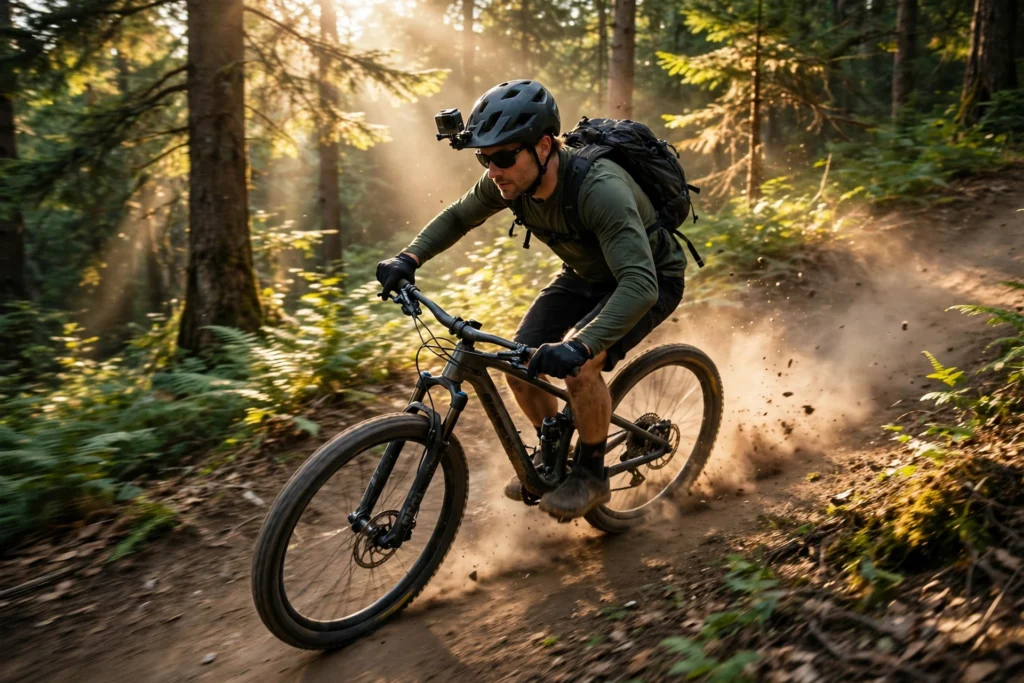
Once it is clipped to your helmet, you forget it is there, and it records your point of view instead of someone else’s. That first-person angle is what makes the footage feel like you are there, whether it is a rocky trail descent or a dive over a reef. Phones have caught up in video quality, and for a calm walk a phone is often the better camera — but take one mountain biking and you will spend the ride worrying about it.
How does stabilisation keep the footage smooth?
Stabilisation is what separates watchable action footage from a shaky mess. Most action cameras solve it electronically: a gyroscope and accelerometer measure how the camera moves hundreds of times a second, and the processor shifts the image in the opposite direction to cancel the shake. GoPro calls its version HyperSmooth; DJI calls its system RockSteady, with a HorizonSteady mode that keeps the horizon level even when the camera tilts.
The trade-off is a small crop. To shift the image around, the camera needs spare pixels at the edges, so it records a slightly narrower view than the lens actually sees — often around 10 per cent. That is why action cameras start with such a wide lens: even after the crop, the picture still feels wide and immersive.
How do action cameras survive water and knocks?
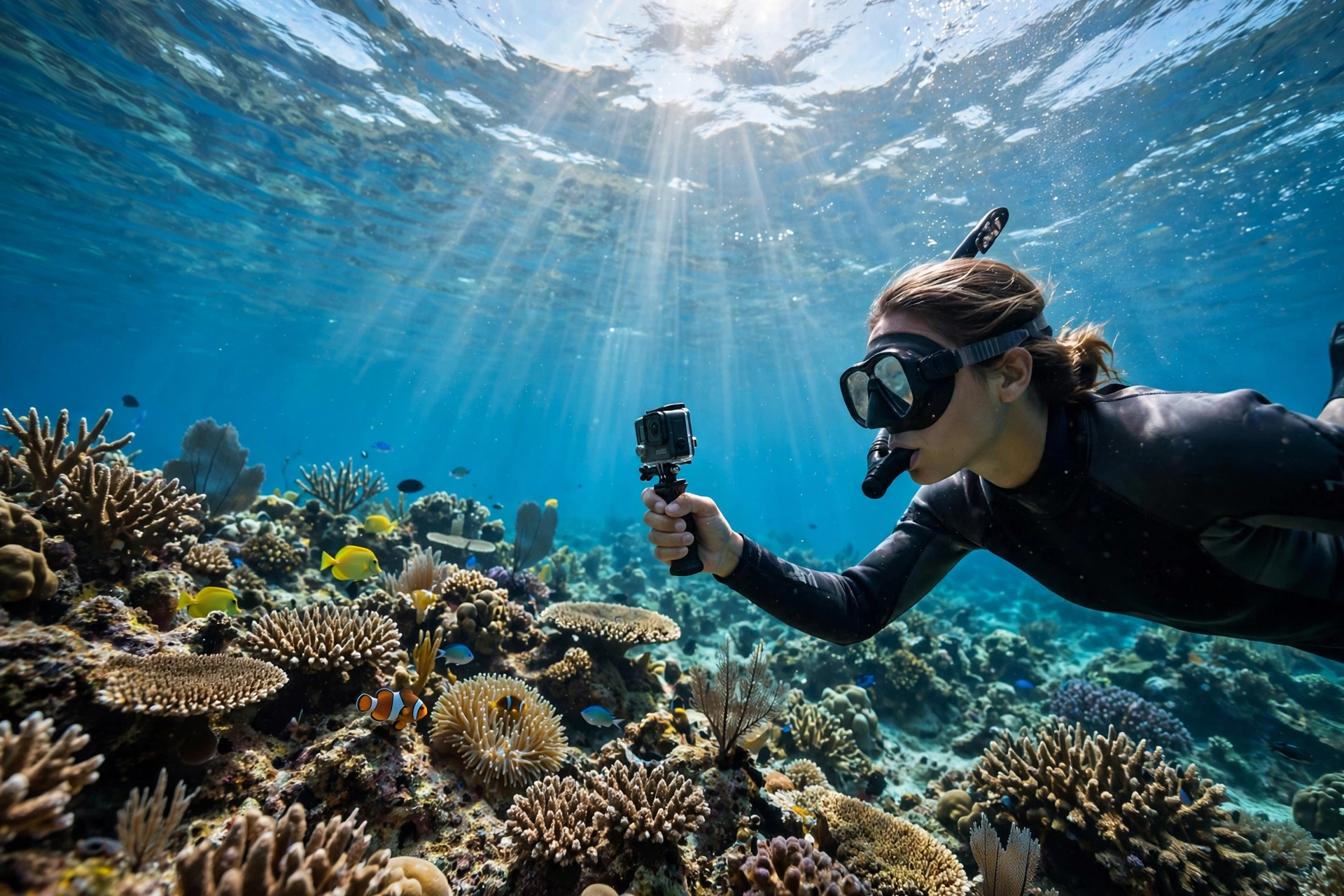
Waterproofing is built into the body, not added afterwards. Rubber gaskets seal the battery door, the charging port and the lens cover, so most current models can be used underwater without a case. GoPro’s HERO13 Black is rated to 10 metres, while DJI’s Osmo Action 5 Pro is rated to 20 metres, and a separate housing extends both to around 60 metres for deeper dives.
The ratings assume the seals are clean and undamaged. Sand in a gasket, a cracked lens cover or a battery door that wasn’t fully closed are the usual reasons water gets in, so a quick rinse in fresh water after a sea swim and a check of the seals before the next outing goes a long way.
What do the sensor and lens actually do?
The sensor is the chip that turns light into an image, and in action cameras it is deliberately modest. DJI’s Osmo Action 5 Pro, for example, uses a 1/1.3-inch sensor — much bigger than a phone’s front camera, but smaller than the sensor in a mirrorless camera. A bigger sensor gathers more light, which helps at dusk or underwater, but it also needs a bigger lens and body.
The lens is where action cameras really differ. It is a fixed, ultra-wide lens — the Osmo Action 5 Pro has a 155-degree field of view at f/2.8 — which captures far more of the scene than a phone’s main camera. That width makes the viewer feel inside the action, and it gives the stabilisation system the spare pixels it needs. There is no optical zoom, and that is deliberate: a zoom lens would be fragile, slow and bulky.
Which mount should you use, and where?
Mounts are the other half of the system, and the right one changes the feel of the footage completely. A helmet mount gives a true first-person view that follows your gaze. A chest mount sits lower and steadier, and shows your arms and handlebars, which many riders prefer. A handlebar mount shows the bike and the trail ahead, while a small tripod or hand grip suits walking, vlogging or filming underwater.
Two mounting styles dominate. GoPro’s finger-and-screw mount has been around for years, so almost every accessory ever made fits it. DJI’s magnetic quick-release mount is newer and faster: the camera snaps on and off with one hand, which is handy when you swap between a helmet and a grip mid-ride. Adapters exist between the two systems, so you are rarely locked in. Many cameras also pair with your phone over Bluetooth, so you can frame the shot and start recording without touching the camera.
Action camera vs phone vs mirrorless: which fits where?
| Action camera | Phone | Mirrorless camera | |
|---|---|---|---|
| Best for | Sport, water, first-person video | Everyday photos and video | Portraits, landscapes, low light |
| Waterproof without a case | Yes, 10–20 m | No | No |
| Stabilisation | Built-in, tuned for motion | Good, tuned for walking | Depends on lens |
| Mounting | Helmets, bars, chests, grips | Needs an accessory | Needs a rig |
| Zoom | None (crop in editing) | Digital and optical | Interchangeable lenses |
A worked example: a 30-minute trail ride
Picture a 30-minute ride on a forest trail. The camera goes on the helmet mount, recording in 4K at 30 frames per second with stabilisation on high — a sensible middle ground: smooth enough to watch, detailed enough to crop, and not so demanding that the battery gives up halfway. In half an hour you will record roughly 15 to 20 gigabytes, so a 128 GB memory card leaves plenty of room, and the battery will be around half spent. A smartwatch on your wrist can track the same ride’s heart rate and distance while the camera records the video. Battery life is the honest weak point: expect around an hour to an hour and a half per charge in 4K, less in the cold, and carry a spare. Most cameras charge over USB-C, and for storage look for a microSD card rated V30 or above.
Frequently Asked Questions
Can I use an action camera as a webcam?
Yes. Most current models offer a webcam mode over USB, and the wide lens works well for video calls. Check whether your model needs an app or a firmware update first.
How do I keep the lens from fogging underwater?
Keep the camera dry before the dive, avoid opening it in humid air, and use anti-fog inserts if your model supports them.
Are action cameras worth it if I don’t do extreme sports?
Often, yes. They are popular for holidays, cycling commutes, snorkelling and road trips — anywhere a phone feels too fragile or too fiddly.
What should I check before buying one?
Check the waterproof depth, the battery life at the resolution you will actually use, and whether the mounts you need are included or cost extra.
Conclusion
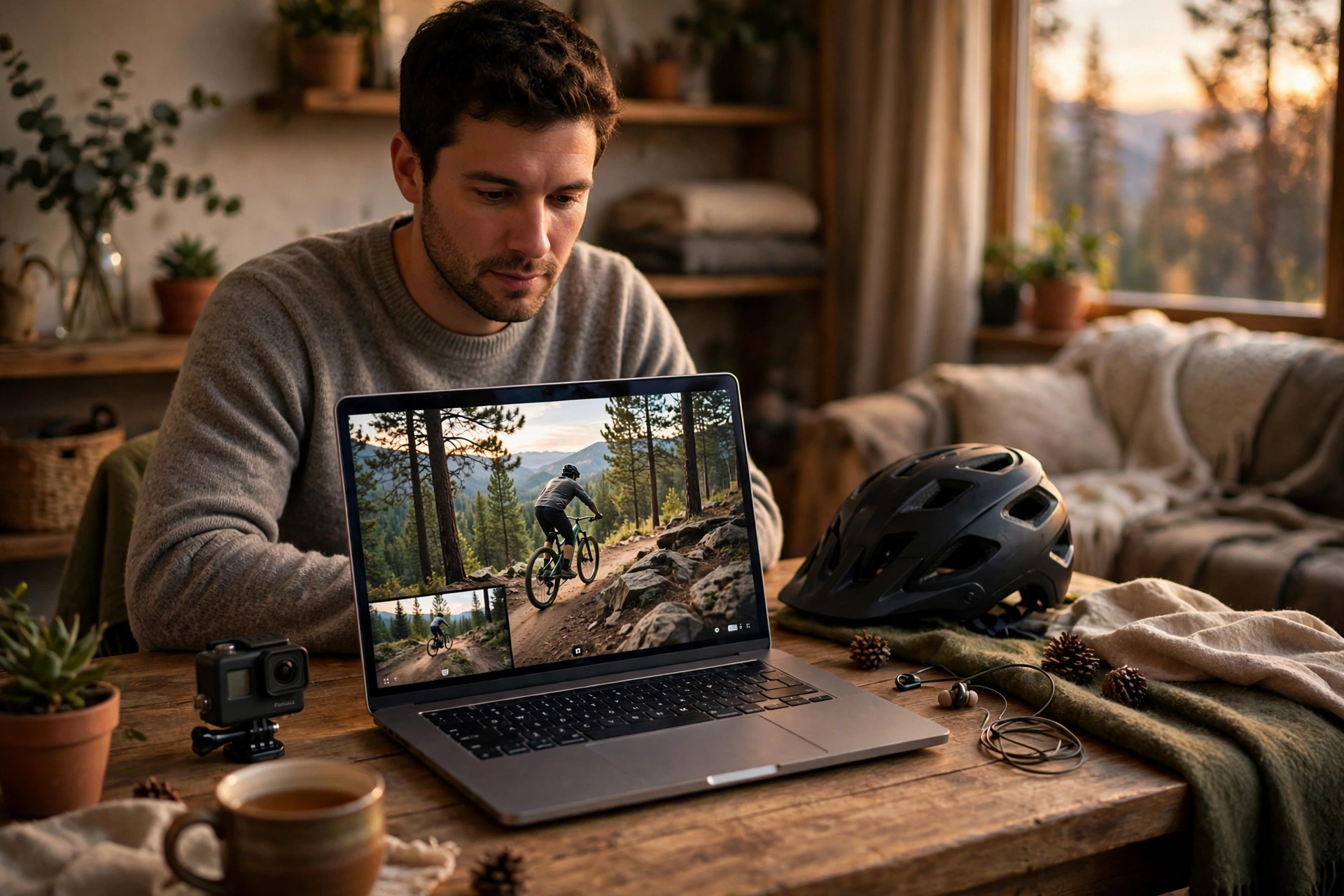
An action camera earns its place by being the camera you can take where no other camera wants to go: a wide lens, stabilisation that hides the bumps, and a body sealed against water and drops. Together, they let you press one button and forget about the camera entirely. Before a big trip, try a ten-minute test ride or swim and watch the footage back on a monitor — it will tell you more than any list of specifications.
Further reading: DJI Osmo Action 5 Pro and GoPro cameras.