
Semi-supervised learning is a way of training AI with a small set of labeled examples plus a much larger set of unlabeled examples. Instead of needing every photo, message, or record tagged by a person first, the model learns from the few answers it is given and uses patterns in the rest of the data to fill in the gaps. That makes it useful when labeling is slow, expensive, or needs a specialist, but raw data is easy to collect.
Think of it like teaching someone to sort mail. You show them a handful of envelopes already marked “bill,” “letter,” or “parcel,” then hand them a big unsorted pile. They don’t guess at random. They compare each new envelope with the ones you’ve labeled — its size, shape, and handwriting — and sort it with the closest match. Semi-supervised learning works in a similar spirit, only the comparing is done with numbers, distances, and probabilities.
Key Takeaways
- Semi-supervised learning combines a little labeled data with a lot of unlabeled data.
- It sits between supervised learning, which needs labels for everything, and unsupervised learning, which uses none.
- It helps most when labels are costly but unlabeled data is plentiful.
- The unlabeled data must be related to the task, or it can mislead the model.
- Common methods include self-training, label propagation, and consistency training.
How is it different from supervised and unsupervised learning?
In supervised learning, every training example comes with the right answer. That’s powerful, but labeling thousands of examples takes time and money. In unsupervised learning, there are no answers at all, so the model looks for groups and patterns on its own. That can reveal structure, but it can’t by itself tell you which group means “spam” and which means “not spam.” Semi-supervised learning takes the middle path. The labeled examples anchor the task: they define what the categories are and what they look like. The unlabeled examples then show how those categories are spread out in the real data. If two unlabeled items sit close together, the model leans toward giving them the same label. If there’s a wide empty gap between groups, that gap is a natural place to draw the boundary between them. This only works if the unlabeled data actually reflects the problem you’re solving. A pile of dog and cat photos won’t help a model learn to tell cars from motorcycles. Garbage in still applies — here the problem can be irrelevant data, not only wrong labels.
Why does labeling cost so much?
Labeling sounds simple until you try it at scale. Sorting photos into “cat” or “dog” is quick, but drawing boxes around every object in a street scene, or marking the exact boundary of something in a medical scan, is slow and fiddly. Some labels need a trained expert, not just anyone with a spare afternoon, and that expert time is expensive. There’s also a quality problem: two people can disagree on borderline cases, like a sarcastic comment or a blurry photo, and cleaning up those disagreements adds another round of work. So teams often end up with a small, carefully labeled set they trust and a huge unlabeled set they haven’t touched. Semi-supervised learning was built for exactly that situation. It doesn’t remove the need for good labels — it stretches them further. If one category has almost no labeled examples, the model may barely learn it at all.
How does semi-supervised learning actually work?
There isn’t one single method. Instead, there’s a family of approaches that share the same idea: let the labeled data guide, and let the unlabeled data shape. Self-training is the most straightforward. You train a first model on the labeled examples only, then ask it to predict labels for the unlabeled ones. The predictions it’s most confident about get added to the training set as if they were real labels, and the model is trained again. The risk is clear: if an early confident prediction is wrong, that mistake gets baked in. Good self-training systems are picky, accepting only high-confidence predictions and checking results on a held-out labeled set.
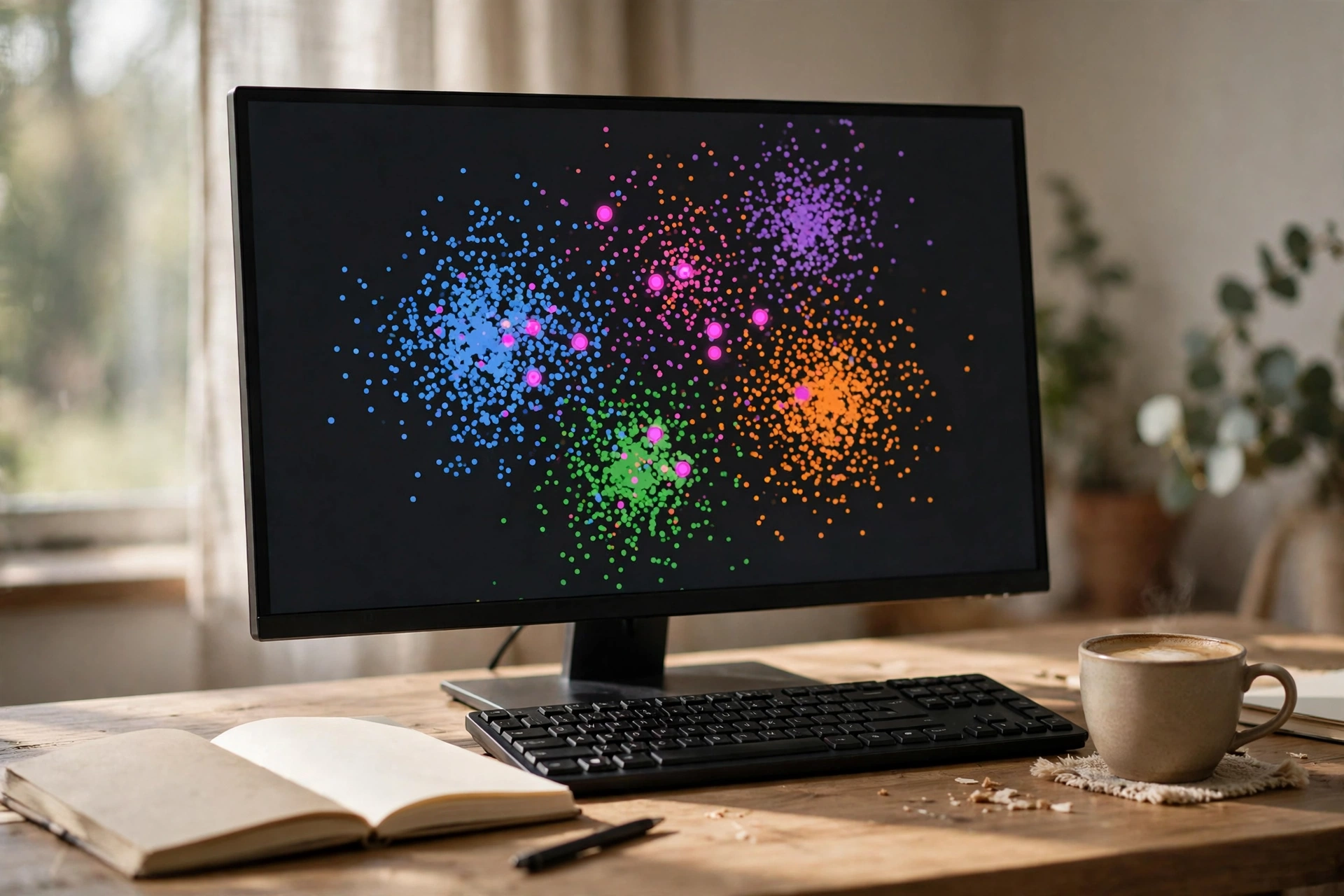
Label propagation works more like gossip in a neighborhood. Imagine every data point as a dot, connected to its nearest neighbors. Labeled dots pass their labels along those connections, step by step, to nearby unlabeled dots. Dots in the same cluster tend to end up with the same label. This works well when similar items really do belong together, but it can struggle with very large datasets, because building all those connections takes computing power. Consistency training shows the model the same unlabeled example twice, with small changes each time — a photo slightly cropped, for instance — and asks it to give the same answer both times. A model that flips its answer after a tiny change probably hasn’t learned anything solid. In practice, teams often mix these ideas, and they keep a separate labeled test set aside to check whether the unlabeled data is helping or hurting. If accuracy drops when unlabeled data is added, that’s a signal to stop and rethink the data, not to add more of it.
Where is semi-supervised learning used?
You’ll find it wherever data is abundant but labels are scarce. In medical imaging, a hospital may hold thousands of scans but only a few hundred reviewed by a specialist. Semi-supervised methods can help a model learn from the reviewed scans while still making use of the rest, though any medical use still needs careful human oversight and validation before it touches real decisions. Text is another natural fit. The web is full of unlabeled text, while labeled examples — say, reviews marked positive or negative — are far fewer. A model can learn the shape of language from the unlabeled text, then use the labeled reviews to pin down what “positive” means in that context. The same pattern shows up in speech, where transcribed audio is costly but raw recordings are plentiful.
What are the limits?
The biggest limit is the assumption underneath it all: that similar unlabeled examples probably share a label, and that clusters in the data line up with real categories. When that holds, unlabeled data is gold. When it doesn’t — when the unlabeled pile contains different categories, noisy measurements, or data from another source — it can pull the model off course. There’s also a confidence trap: models can be confidently wrong early in self-training, so humans should spot-check predictions and measure performance on fresh labeled data. Finally, semi-supervised learning isn’t magic for tiny datasets. If you have almost no labeled data and the unlabeled data is messy, you may be better off labeling a bit more or simplifying the task. It helps you get more from limited labels; it doesn’t replace labels entirely. For a broader view of how machine learning fits together, see our guide to artificial intelligence.

FAQs
Is semi-supervised learning the same as self-supervised learning?
No. Semi-supervised learning uses some real, human-made labels plus unlabeled data. Self-supervised learning creates its own training signals from the unlabeled data itself — for example, hiding a word in a sentence and asking the model to guess it.
How much labeled data do you need?
No universal number exists. You need enough labeled examples to cover each category and its main variations — a handful per category may work for a simple problem, while a messy real-world problem needs considerably more.
Can it beat fully supervised learning?
Sometimes, when labeled data is scarce, adding unlabeled data improves accuracy over using the labeled data alone. But if you already have plenty of high-quality labeled data, adding unlabeled data may add little, and it can occasionally hurt. The honest test is always a labeled test set the model hasn’t seen.
Does it work for images, text, and audio?
Yes. The details change — what counts as “similar” for an image isn’t the same as for a sentence — but the principle stays the same.
Should a beginner try it first?
Probably not as a first project. Start with supervised learning on a clean, labeled dataset. Once labeling cost becomes your bottleneck, semi-supervised methods are a natural next step.
Conclusion
Semi-supervised learning is a practical answer to a very ordinary problem: good labels are expensive, and raw data is cheap. By combining a small, trusted labeled set with a large, relevant unlabeled set, it can stretch your labeling effort further — as long as you keep checking results against real labels and stay honest about when the unlabeled data is helping. If you’re exploring this for your own project, a sensible next step is a small experiment: train a simple model on your labeled data alone, then try a self-training or label-propagation approach on the same task, and compare both on a test set neither has seen. For background, IBM’s overview of semi-supervised learning and scikit-learn’s documentation on semi-supervised estimators are good places to start. That comparison, more than any claim about the method, will tell you whether it’s worth using for your data.