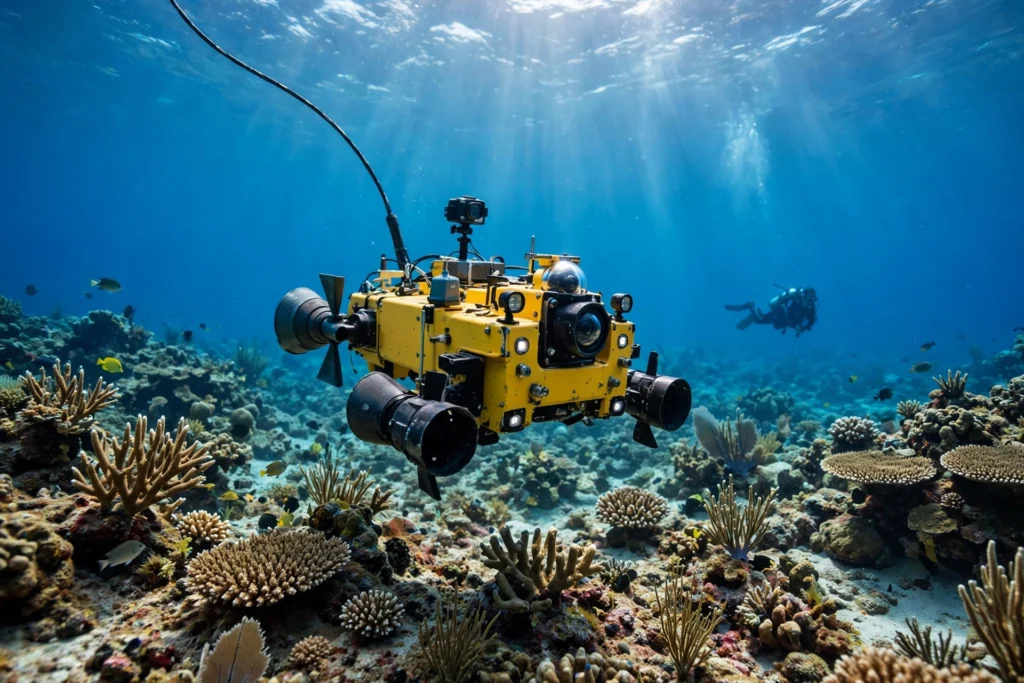
Underwater robots explore places people can’t easily reach. They glide over reefs, inspect pipelines, and film the seabed in darkness, all while an operator on a ship — or a program inside the robot itself — stays in charge. They do this with a simple combination: thrusters for movement, sealed electronics for survival, sensors for seeing and measuring, and a link back to the surface for control and data.
In short, an underwater robot is a tough, watertight machine that moves with small propellers, senses its surroundings with cameras and sound, and either follows live commands through a tether or runs a planned mission on its own. The rest of this guide explains how each part works, and where these robots are actually used.
Key Takeaways
- There are two main types: tethered ROVs, controlled live from a ship, and untethered AUVs, which follow a pre-planned route on their own.
- Thrusters push water in different directions so the robot can move forward, sideways, up, and down, and hold steady in a current.
- Cameras, lights, sonar, and depth sensors replace human eyes and hands in dark, murky, or very deep water.
- A tether carries power and live video for an ROV, while an AUV runs on batteries and stores its data until it surfaces.
- Underwater robots are used for science, inspection, search work, and filming — not just deep-sea exploration.
What Is an Underwater Robot?
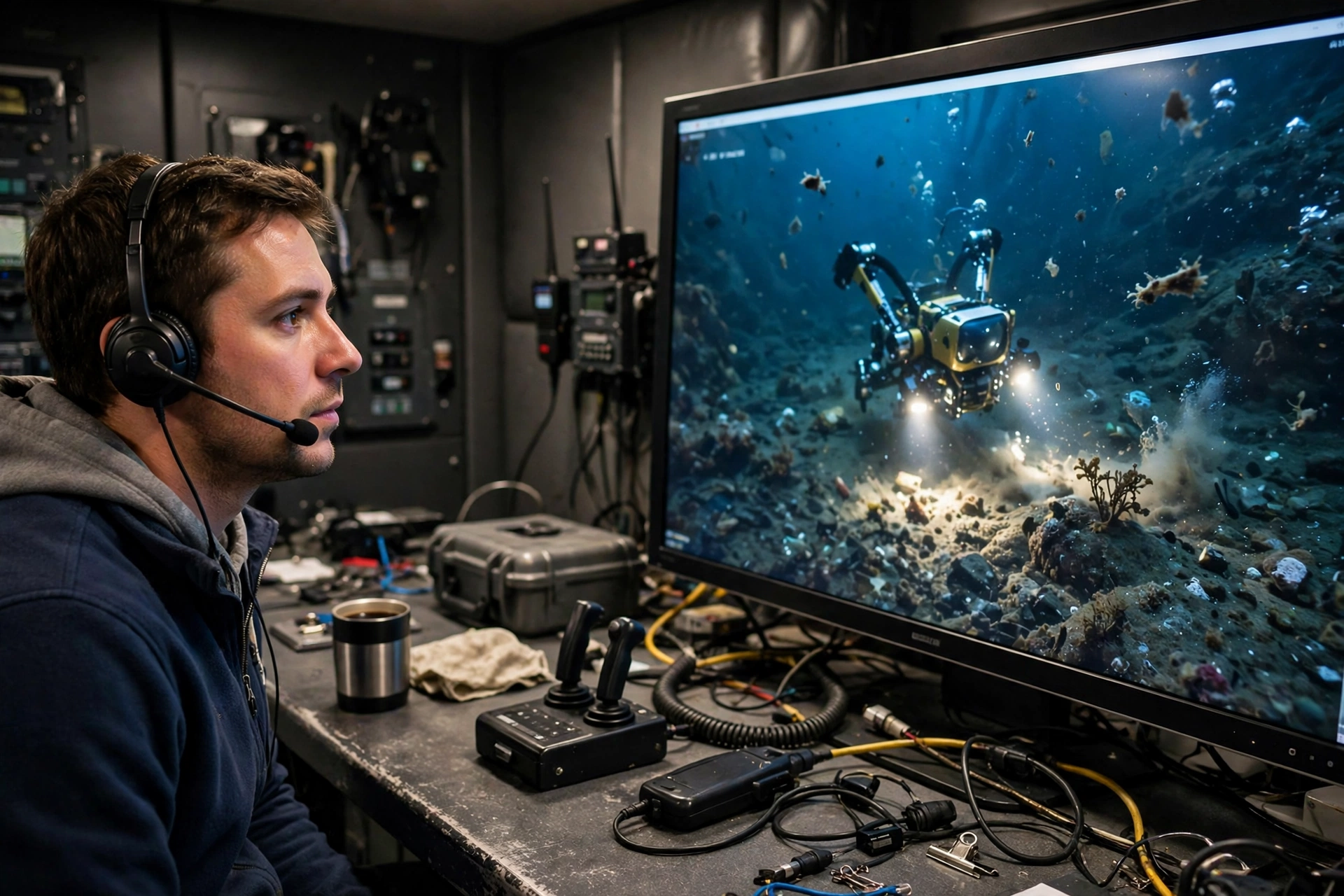
An underwater robot is a machine built to work below the surface without a diver on board. The two main kinds solve different problems. A remotely operated vehicle, or ROV, stays connected to a ship by a long cable called a tether. The operator steers it in real time and watches its camera feed. An autonomous underwater vehicle, or AUV, has no tether. It is programmed before launch, swims its route, collects data, and returns to a planned pickup point.
In short, an ROV suits jobs needing a live human decision, such as inspecting damage, while an AUV suits long, repeated surveys, such as mapping a stretch of seabed, where a tether would get in the way.
How Do Underwater Robots Move?
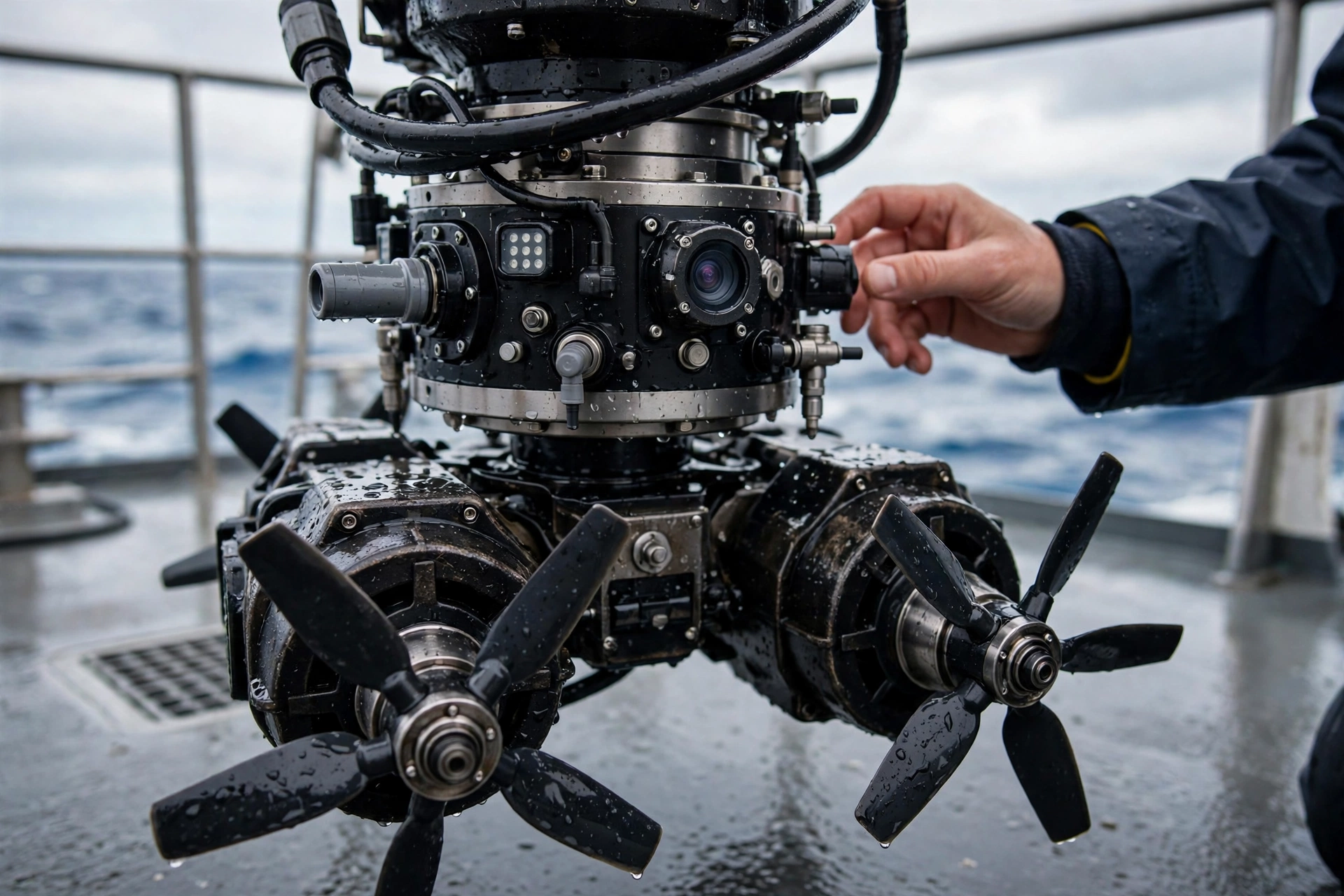
Underwater robots move with thrusters, which are small electric motors with propellers. Most designs use several thrusters pointed in different directions: some push the robot forward and back, others move it sideways, and others lift it up or push it down. By speeding up or slowing down individual thrusters, the robot can turn, tilt, and hover in one spot, even when a current is trying to push it off course.
Staying level matters. A robot filming a reef or inspecting a pipe needs a steady picture, so its control system constantly adjusts the thrusters to correct for drift. Buoyancy helps too: foam or ballast makes the robot close to neutrally buoyant, so the thrusters only handle fine movement.
Depth adds another challenge. Water pressure grows quickly as a robot descends, so its electronics sit inside sealed metal or plastic housings, and cables pass through special watertight fittings. A robot built for shallow coastal water would not survive a deep trench dive, which is why depth rating is one of the first specs engineers check.
How Do Underwater Robots See and Sense?
In clear, shallow water, a camera does a lot of the work. Deeper down, sunlight fades fast, so robots carry their own lights. Even then, visibility can drop to a few metres in murky water, which is where sonar comes in. Sonar sends out sound pulses and listens for echoes, building a picture of shapes and distances that a camera cannot capture in the dark.
Other sensors fill in the gaps: a pressure sensor gives depth, a compass and motion sensors track heading and tilt, and some robots carry water-quality sensors for temperature or salinity. Larger ROVs may also carry a manipulator arm for picking up samples, guided slowly via the camera feed.
How Do They Stay in Touch with the Surface?
Radio signals, which work well in air, fade very quickly underwater. That is why ROVs use a tether. The cable carries power down and live video and control signals back up, so the operator sees what the robot sees with only a short delay. The trade-off is range and handling: the tether can snag, drag, or limit how far the robot roams.
AUVs accept a different trade-off. Without a tether, they run on batteries and store their readings on board. They may surface at set points to send a short status message or get a satellite fix on their position, then dive again. Acoustic signals — sound waves sent through water — can carry simple commands or short updates, but they are slow and limited compared with a cable. Mission planning therefore matters a lot: the route, the battery budget, and the return point all have to be right before launch.
What Are Underwater Robots Used For?
Science is a big use. Researchers send robots to survey reefs, track changes on the seabed, and collect water and sediment samples without disturbing a site more than necessary. Because a robot can stay down longer than a diver and work in cold or deep water, it opens up places that would otherwise stay unseen.
Industry uses them too: offshore energy, shipping, and telecoms rely on pipelines, cables, and platforms that need regular inspection, and a robot can film a weld or check for damage without shutting an operation down. Search teams use them for wreckage in water too deep for divers, and filmmakers use small ROVs for reef and wreck footage.
Related machines show the same pattern in other settings. Robot arms use joints and grippers for precise work, warehouse robots follow planned routes to move goods, and delivery robots navigate streets and sidewalks on their own. Underwater robots apply similar ideas — motors, sensors, and planned routes — to a much harsher environment.
What Limits Underwater Robots?
Battery life is one limit, especially for AUVs: more sensors, lights, and thruster use all drain power. Communication is another, since an operator cannot watch a live feed without a tether. Navigation is also harder, because GPS does not work underwater — robots estimate position from motion sensors, sonar, and occasional surfacing.
Frequently Asked Questions
How deep can underwater robots go?
It depends on the design. Small inspection ROVs may be rated for tens or a few hundred metres, while deep-rated research and work-class vehicles are built for several thousand metres. Always check the depth rating before assuming a robot suits a job.
Why can’t underwater robots just use Wi-Fi or GPS?
Both fade quickly underwater. Radio signals, including Wi-Fi and GPS, do not travel far through water, so robots use tethers, acoustic signals, or onboard navigation instead.
Do underwater robots work in the dark?
Yes, up to a point. They carry lights for cameras and use sonar when visibility is poor. In very murky water, sonar and other sensors matter more than video.
Are underwater robots the same as submarines?
No. Submarines carry people and are far larger. Underwater robots are uncrewed, usually much smaller, and built for specific tasks such as inspection, survey, or filming.
Can a hobbyist buy an underwater robot?
Yes, small inspection ROVs are available for hobby and education use, though they are usually limited to shallow water and short tether lengths. Check local rules for the water you plan to use, and practise in calm, shallow conditions first.
Conclusion
Underwater robots work because they combine a few proven ideas: thrusters for movement, sealed housings for pressure, cameras and sonar for sensing, and either a tether for live control or a planned route for autonomy. Together, those parts let them explore reefs, inspect structures, and gather data where divers cannot easily go.
If you want to learn more, start with the basics of how these machines are classified and used. The remotely operated underwater vehicle overview explains ROV design and history, and the robotics overview from Britannica puts underwater robots in the wider context of the field. From there, a good next step is to compare a small inspection ROV with a survey AUV and note how depth, battery, and communication shape what each one can actually do.