
Continual learning is a way of training AI so it can keep learning new tasks over time without losing what it already knows. Instead of being trained once and then frozen, a continual-learning model is updated in stages, and each update is designed to protect earlier skills while adding new ones.
Key Takeaways
- Continual learning, also called lifelong learning, trains a model on a sequence of tasks rather than on one fixed dataset.
- The main obstacle is catastrophic forgetting, where learning a new task weakens or erases an older skill.
- Common fixes include replaying old examples, limiting changes to important parts of the model, and adding new capacity for new tasks.
- It matters most where data keeps changing, such as personal assistants, robots, and systems that meet new kinds of input.
- Continual learning is still an active research area, so results depend on careful testing, not on a single update.
What does continual learning mean?
In ordinary training, a model usually sees all of its training data at once, or at least in a shuffled mix. That works well when the job stays the same. Real life rarely stays the same, though. A photo app meets new styles of images, a voice assistant hears new phrases, and a warehouse robot is asked to handle a new kind of package.
Continual learning treats learning as a sequence. The model learns task one, then task two, then task three, and it is expected to still do a reasonable job on the earlier tasks. That sounds simple, and in some ways it mirrors how people learn: you do not forget how to ride a bike just because you learned to swim. For a neural network, however, that kind of steady accumulation is not automatic.
It helps to connect this idea to the wider picture of artificial intelligence. Our guide to artificial intelligence explains how AI systems learn patterns from data, while machine learning covers the training process itself. Continual learning builds on both: it asks how that training can go on, safely and usefully, after the first round is finished.
Why do AI models forget?
A neural network stores what it has learned in its weights, which are the many small numbers that shape how it responds to input. When it trains on a new task, it adjusts those weights to reduce its errors on the new data. The trouble is that the same weights may also carry older knowledge. Push them too far in one direction, and the older skill fades.
Researchers call this catastrophic forgetting, and the word “catastrophic” is not just drama. The loss can be sharp: a model that once handled an earlier task well may become noticeably worse after a short round of training on something new. It is a bit like rewriting notes in a notebook without leaving room for the old pages. The new notes may be clear, but the old ones are gone.
This does not mean every update causes forgetting. Small, closely related updates are usually easier to absorb than a sharp change in topic. Still, the risk grows when tasks arrive one after another and the model never revisits the earlier ones. That is why continual learning methods do not just add data; they also add protection for what came before.
How does continual learning work?
There is no single method that solves the problem for every model. Most approaches fall into a few broad families, and in practice they are often combined.
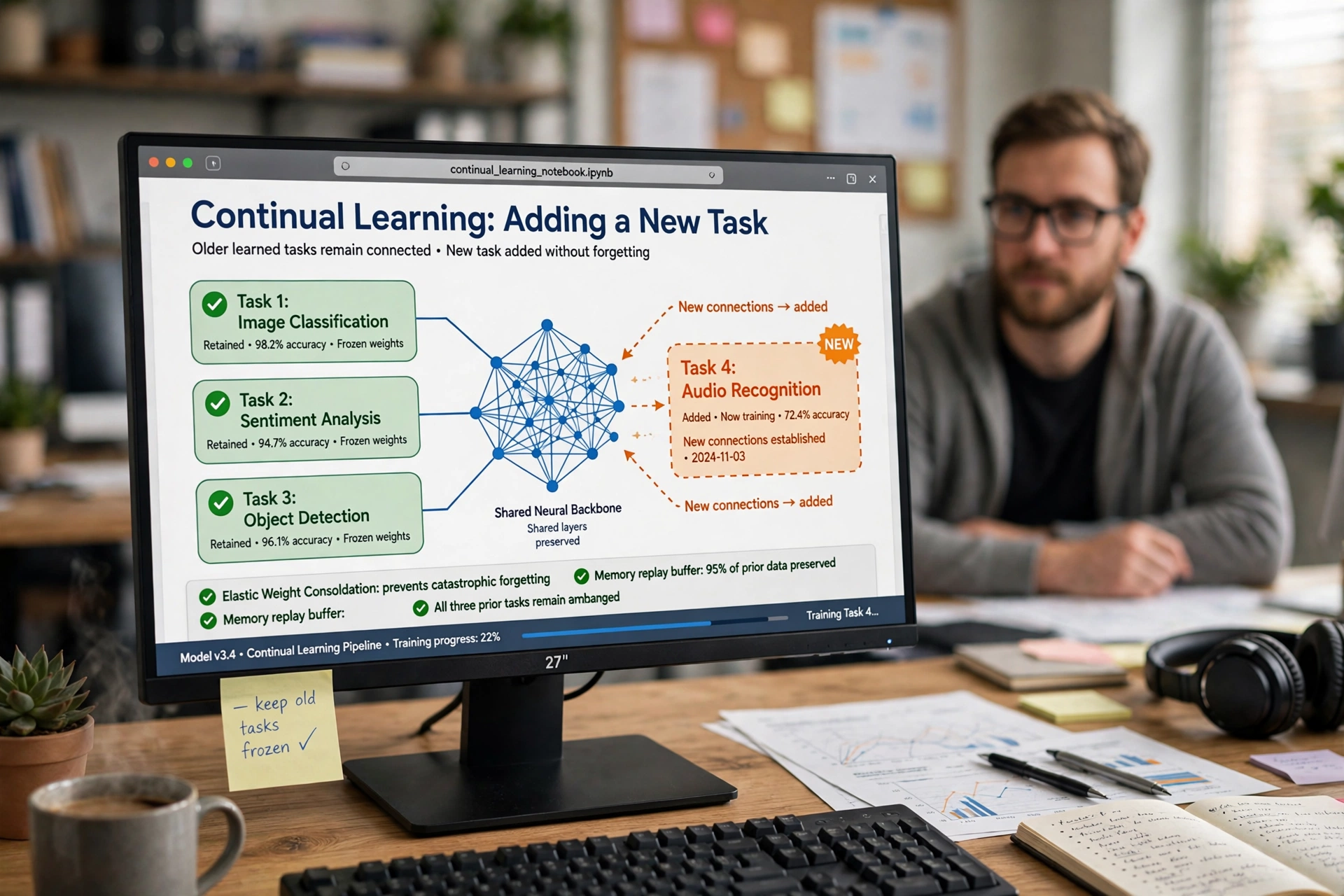
One family is replay. The model keeps a small set of earlier examples, or a compact summary of them, and mixes those examples back in while it learns the new task. Revisiting old material is a familiar study trick, and for models it helps for a similar reason: it reminds the weights what the earlier tasks looked like. The trade-off is storage and privacy. Keeping old examples is not always possible, especially when the data is personal or sensitive.
A second family is regularization. Here, the training process penalizes large changes to the parts of the model that mattered most for earlier tasks. Think of it as protecting the load-bearing walls while you renovate a room. The model can still change, but it changes more cautiously where change would do the most damage. This approach needs a way to judge which parts matter, and that judgment is itself an estimate, so it is not perfect.
A third family changes the architecture. The model may grow new sections for new tasks, or keep separate small modules for different jobs while sharing a common base. That separation reduces interference, because a new task does not have to overwrite the old one. The cost is size and complexity: a model that keeps growing needs careful management, or it becomes slow and hard to maintain.
How is this different from transfer learning and fine-tuning?
It is easy to mix these ideas up, because they all involve building on earlier training. Transfer learning starts with a model trained on one job and adapts it to a related job, usually with less new data than training from scratch. Fine-tuning is a common way to do that adaptation: you take a pre-trained model and train it further on a smaller, more specific dataset.
Continual learning is related, but its goal is broader. Transfer learning and fine-tuning are often judged mainly on the new task. Continual learning is judged on the whole sequence: the new task and every task that came before it. A fine-tuned model may be excellent at its new job and weaker at its old one, and that trade may be fine if the old job no longer matters. In continual learning, that trade is exactly what you are trying to avoid.
That distinction matters when you read claims about a system that “keeps learning.” A system that is retrained from scratch on a larger dataset each time is not necessarily a continual learner. Likewise, a model that is fine-tuned once is not automatically good at learning over a long series of changes. The test is simple to state and hard to pass: does it still handle the earlier tasks after the later ones?
Where is continual learning used?
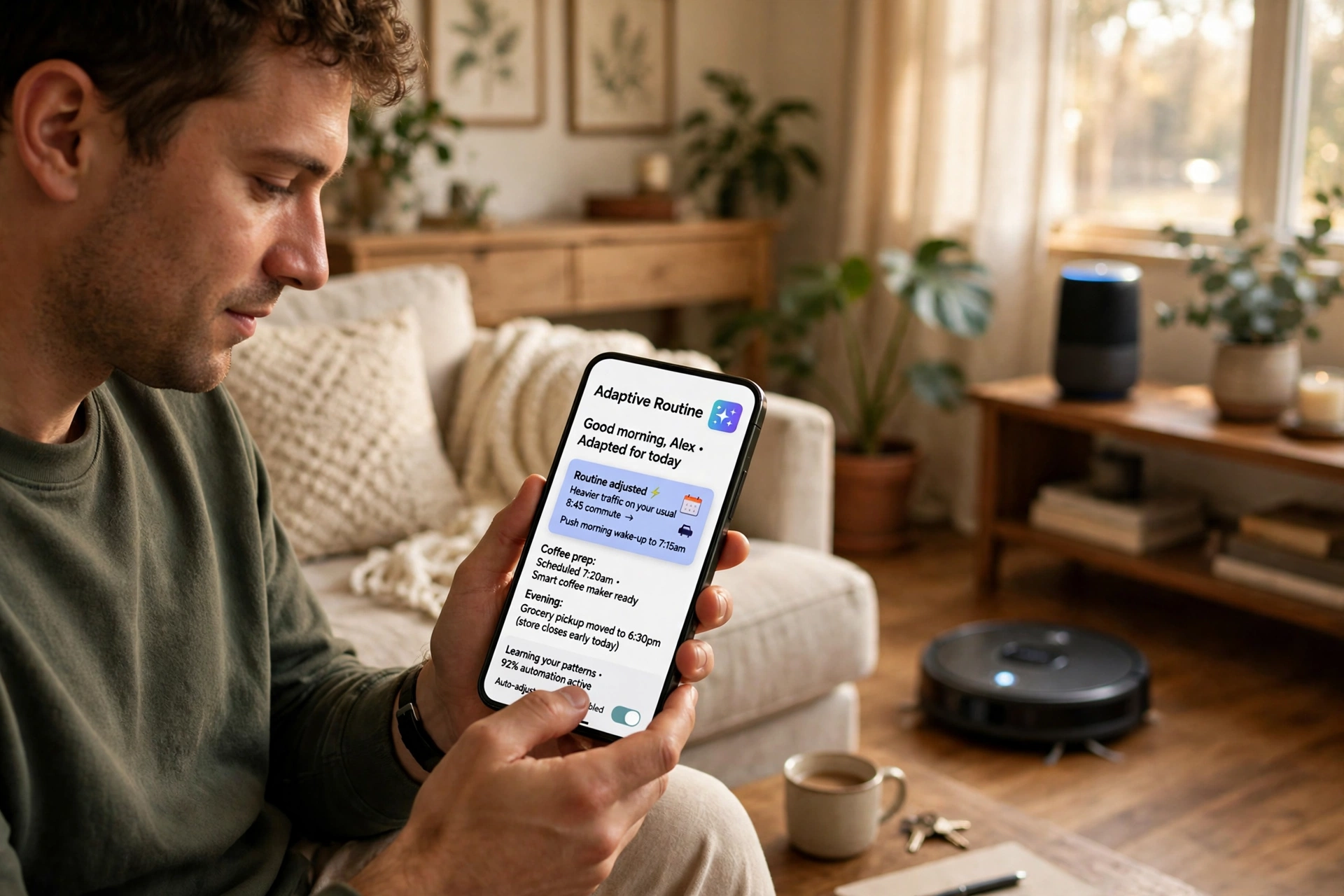
You are most likely to meet the idea behind the scenes rather than as a labelled feature. A personal assistant that adapts to your routine, for example, needs to learn new preferences without suddenly forgetting older ones. A robot working in a changing warehouse needs to handle new items while still recognising the old ones. A medical or industrial system that meets new kinds of input over time faces the same pressure, though in those settings human checks and safety rules matter even more.
Continual learning also matters for systems that cannot easily be retrained from scratch. Retraining a large model on everything it has ever seen can be expensive and slow, and in some cases the original data is no longer available. An update method that builds on what is already there can be far more practical, provided it is tested properly.
That said, everyday products often use simpler approaches. A company may collect new data for a while, then retrain or fine-tune a model in a controlled release, with tests before and after. That is a sensible engineering choice, even if it is not continual learning in the strict research sense. The label matters less than the behaviour: does the updated system still do the old jobs well?
What are the limits and risks?
Continual learning does not make a model immune to mistakes, and it can introduce new ones. If new data contains errors or bias, repeated updates can bake those problems in. If the model keeps adapting to one user or one narrow setting, it may drift away from the general behaviour it was meant to keep. And if old examples are replayed without care, private information could linger longer than intended.
Testing is therefore central. A good evaluation does not just check the newest task; it rechecks the older ones, looks for unexpected drops, and compares the updated model with the version before it. When a team skips that step, a model can look improved on the latest test while quietly getting worse elsewhere.
There is also a practical limit: memory, compute, and complexity all grow as tasks pile up. No current approach offers unlimited learning for free. That is why researchers still describe continual learning as an open problem, not a solved one. Progress is real, but it is uneven, and it depends on the tasks, the data, and the methods used.
How can you tell if a system is learning continually?
If you are reading a product description or a research summary, a few questions help. First, does it report performance on older tasks, not just the new one? Second, does it explain how old knowledge is protected, whether by replay, regularization, or separate modules? Third, is the update tested before release, and can it be rolled back if something goes wrong?
Those questions apply whether you are a developer choosing a method or simply a curious reader trying to see past a buzzword. A careful answer will mention limits and trade-offs. A vague promise that a system “learns forever” without evidence deserves a second look.
Frequently Asked Questions
What is continual learning in simple terms?
It is training that happens in stages, so an AI model can learn new tasks over time while keeping its earlier skills. The aim is steady improvement without forgetting.
What is catastrophic forgetting?
It is the loss of earlier skills when a model is trained on new data. The model’s weights shift to fit the new task, and the older knowledge can be weakened or lost.
Is continual learning the same as online learning?
Not quite. Online learning usually means updating a model as new examples arrive, often one at a time. Continual learning is broader: it focuses on learning a sequence of tasks while retaining earlier ones, and it may use batches of new data.
Can continual learning work without storing old data?
Sometimes, yes. Regularization and architecture-based methods can reduce forgetting without keeping raw old examples, though they may not work as well as replay in every case. The right choice depends on privacy, storage, and the tasks involved.
Will continual learning make AI assistants perfect over time?
No. It can help a system adapt, but it does not remove errors, bias, or the need for testing. A model that keeps learning still needs human oversight, clear limits, and a way to undo a bad update.
Conclusion
Continual learning is a practical answer to a plain problem: the world changes, and AI systems that cannot change with it soon fall behind. The goal is not to learn everything at once, but to learn in steps without throwing away what already works. Replay, careful regularization, and modular design each help in different ways, and none of them is a magic fix.
If you want a useful next step, start with the basics rather than the buzzwords. Read IBM’s overview of continual learning and a recent survey of continual learning research, then compare any “keeps learning” claim against a simple test: does the system still handle its older tasks after the new ones? That question, asked patiently, separates a genuine improvement from a fresh coat of paint.