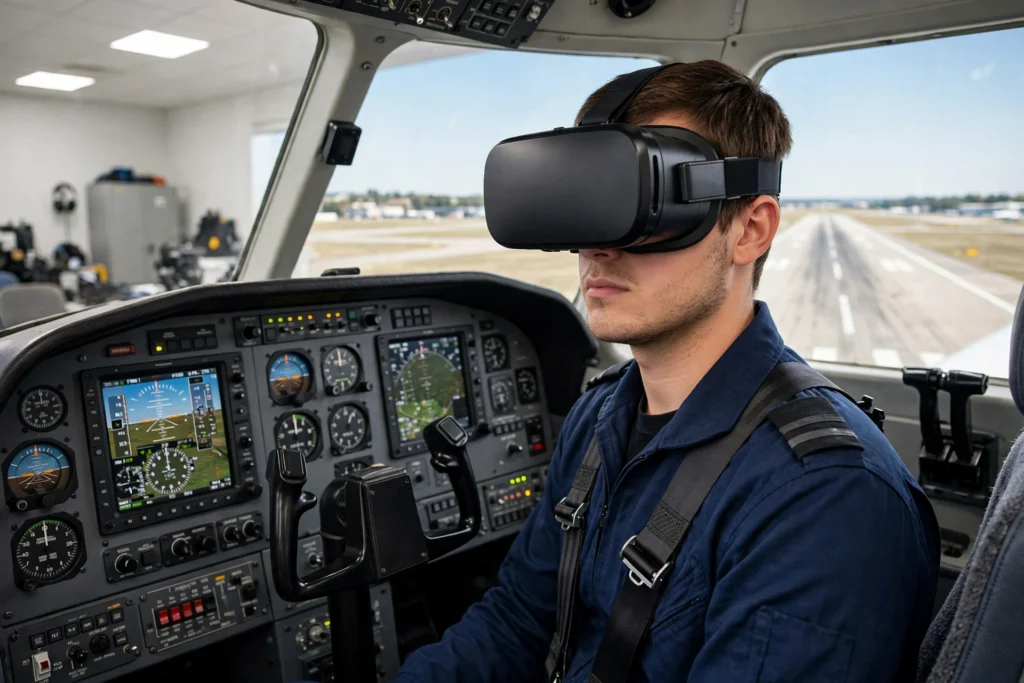
VR flight training puts a trainee inside a virtual cockpit, where they can practise takeoffs, landings, and emergencies without leaving the ground. The headset shows the outside world, the controls respond to their hands, and the software reacts like an aircraft would — so a mistake becomes a lesson, not a risk. It does not replace real flying on its own, but it gives students far more chances to practise before they ever touch a real throttle.
Key Takeaways
- VR recreates the cockpit view, controls, and flight behaviour in a safe, repeatable setting.
- Head tracking, hand tracking, and physical controls work together to make the experience feel natural.
- Emergency and bad-weather practice is where VR is most useful, because those moments are hard to repeat in a real aircraft.
- Real flight time still matters for feel, judgement, and meeting licensing requirements.
- The best training mixes VR practice, instructor feedback, and real aircraft time.
How does a VR flight session actually start?
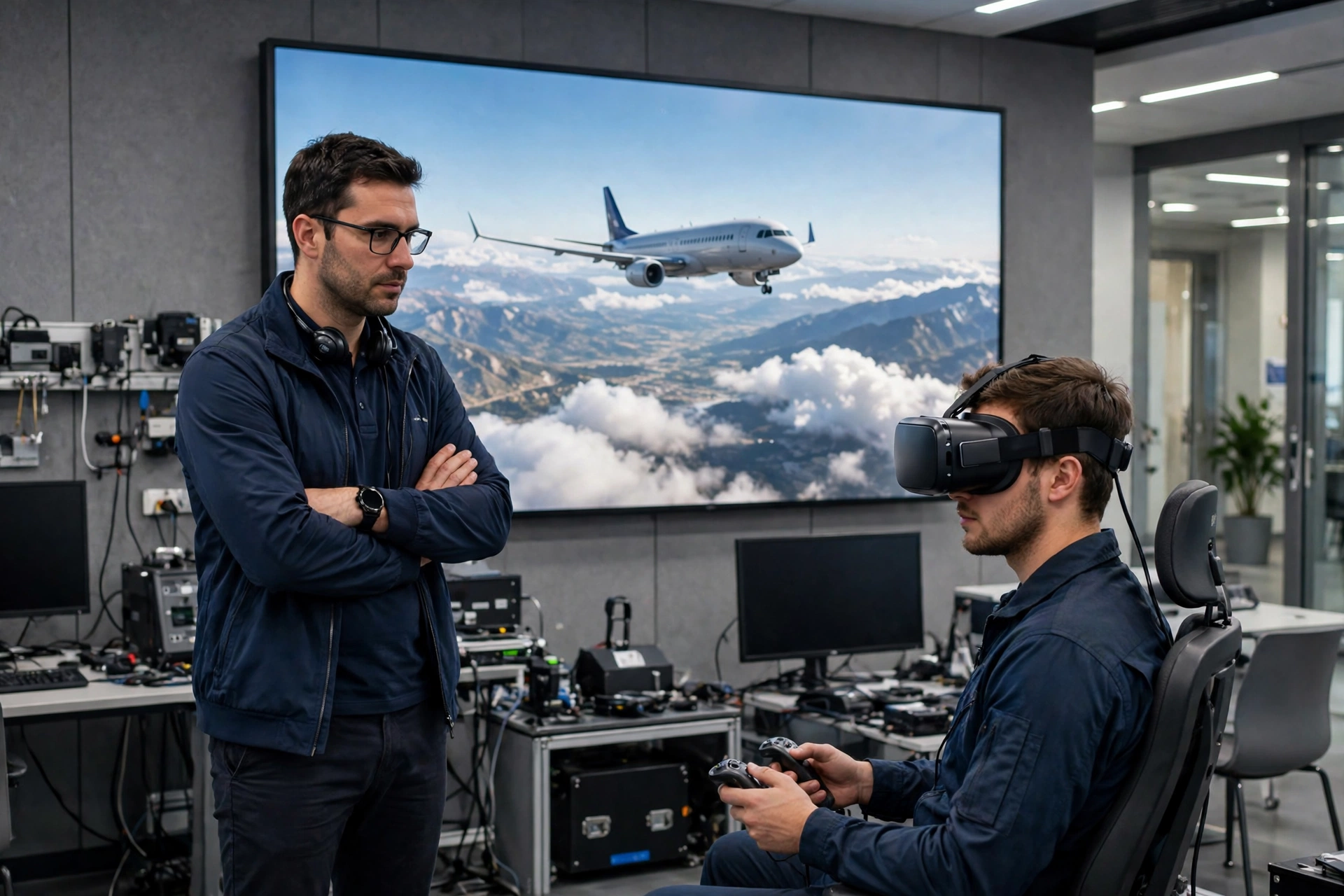
A session usually starts the way a real flight does: with checks. The trainee puts on the headset, sits at the controls, and runs through a familiar routine — power, instruments, radios, and flaps — while the instructor watches from a separate screen. That screen matters more than it first appears, because it lets the instructor see what the trainee sees, pause the session, and point out a missed step before it becomes a habit.
Once the checks are done, the virtual aircraft is placed on a runway or at a gate. The trainee can look around the cockpit just by turning their head, glance at the instruments, and check the view outside. Nothing here is a video playing on rails; the scene changes in response to every input, which is what separates training from simply watching a flight.
What does the headset do in flight training?
The headset is the trainee’s window into the virtual world. It shows a slightly different image to each eye, which gives a sense of depth, and it tracks head movement so the view shifts naturally when the trainee looks left, right, up, or down. If that tracking lags, the illusion breaks quickly — and some people feel unwell — so smooth, low-delay tracking is a practical requirement, not a luxury.
In a good setup, the headset also helps with scale. A runway should look far away, not like a picture on a wall, and a nearby instrument should feel close enough to reach. That sense of space helps trainees learn where to look and when, from scanning the horizon during a visual approach to checking engine instruments during a climb. Our guide to How Do VR Headsets Work? explains the screens, lenses, and tracking behind that view in more detail.
What about the controls — do you just use VR controllers?
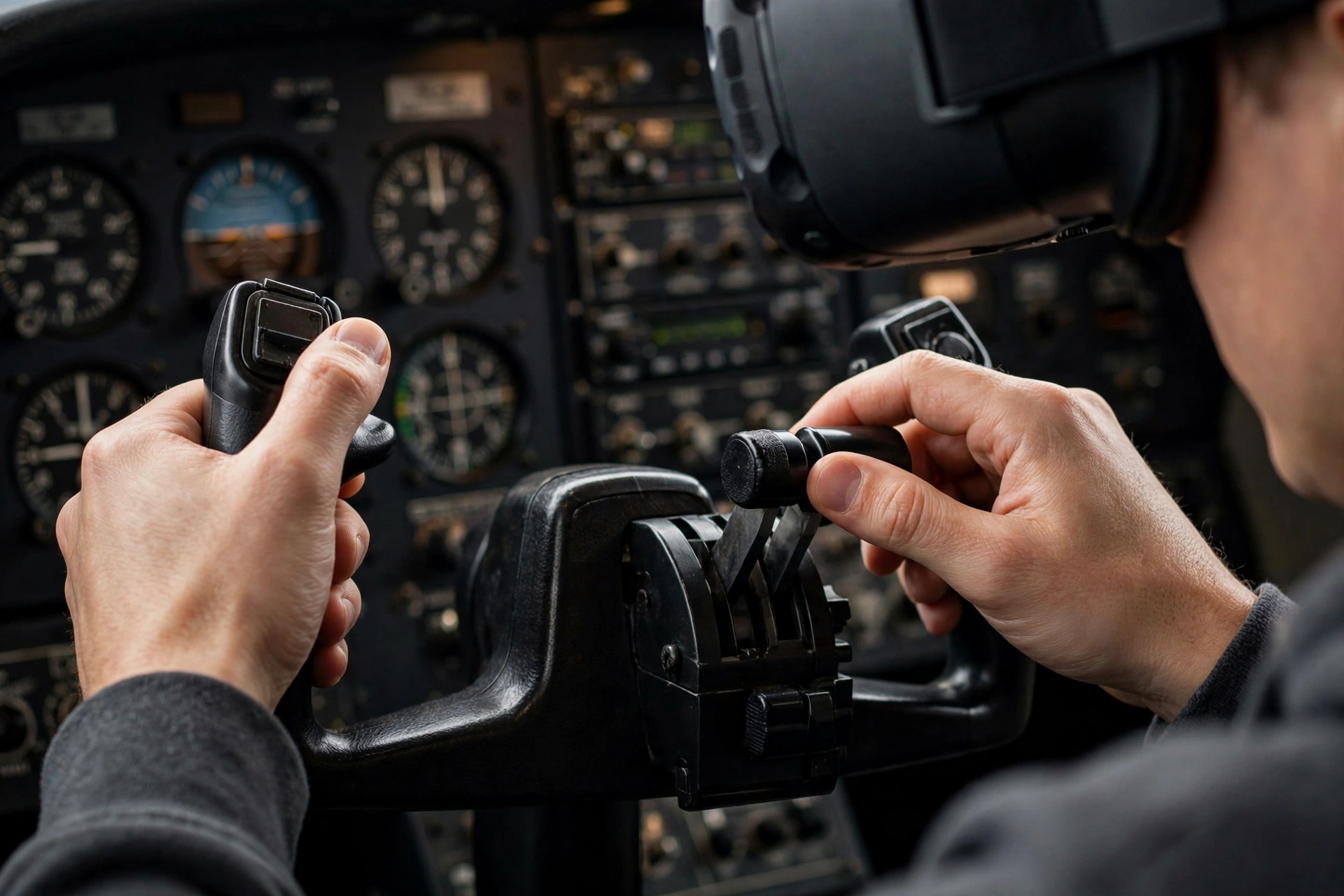
Some entry-level setups do use handheld controllers, and they can work well for learning procedures and cockpit layout. But flight training usually goes further: a physical yoke or stick, throttle levers, and rudder pedals give the trainee something real to hold. The virtual world then has to match those physical controls, so pulling back on the yoke pitches the virtual aircraft up, and pushing the throttle forward adds power.
This mix is deliberate. Handheld controllers are flexible and easy to reset, while physical controls build muscle memory — the kind of automatic response a pilot needs when something goes wrong and there is no time to think through every step. How Do VR Controllers Work? covers how tracking and haptics turn hand movements into actions inside VR.
How does VR simulate motion if you are sitting still?
This is one of the honest limits of VR, and it is worth stating plainly. A headset on its own cannot recreate the push of acceleration or the tilt of a steep turn. Some training rigs add a motion platform that tilts and moves gently, and some add vibration or sound cues, but none of them fully reproduces what a real aircraft feels like.
What VR does well is the visual and procedural side: the sight picture on approach, the order of steps in a checklist, the radio calls, and the decisions in between. Instructors often pair that with a fixed simulator or real flight time for the physical feel, rather than pretending VR alone covers everything. A trainee who understands that split gets more from both kinds of practice.
Why is VR so useful for emergencies?
Emergencies are rare in real flying, which is exactly why they are hard to practise. An engine failure just after takeoff, a sudden loss of visibility, or a system warning at night cannot be safely staged again and again in a real aircraft. In VR, the same scenario can be run, paused, rewound, and run again with a small change — a stronger crosswind, a different runway, a busier radio.
That repetition builds a calmer response. The first time, a trainee may freeze or skip a step. The fifth time, the checklist flows. The tenth time, they can also talk to air traffic control while handling the problem. None of that means the trainee is ready for the real thing on VR alone, but it does mean their first real encounter with a difficult situation is less likely to be their first encounter ever.
Can VR recreate weather and different airports?
Yes, and this is another practical strength. A training program can place the same trainee at a short mountain runway in the morning, a busy international airport at dusk, and a wet runway at night, all in one afternoon. Weather, daylight, traffic, and runway conditions can be adjusted without waiting for the right day or travelling to another airfield.
That variety helps with judgement, not just handling. Trainees learn how a crosswind changes an approach, how low cloud changes what they can see, and how a different airport layout changes taxiing and radio work. It also helps instructors test decisions: do you continue the approach, go around, or divert? In VR, the trainee can try an answer, see the result, and discuss it right away.
Where does VR fit beside a full flight simulator?
A full flight simulator — the large, enclosed device with a moving platform and a replica cockpit — remains the closest thing to a real aircraft on the ground. VR is generally smaller, cheaper, and easier to move, which makes it useful earlier in training and for more frequent practice. Think of it as a spectrum rather than a contest: VR for familiarity, procedures, and repetition; larger simulators for higher-fidelity handling; real aircraft for the feel, environment, and licensing checks that only real flight can provide.
Regulators and training organisations set their own rules about what counts toward a licence, and those rules vary by country and licence type. So a VR session that is excellent practice may still not count as logged flight time. Anyone considering a course should check that detail with the school or authority involved, rather than assuming every virtual hour counts the same way.
What are the limits to watch for?
Motion sickness is the most common one. Some trainees feel fine for an hour; others need short sessions and regular breaks, especially at first. A good program starts gently, keeps sessions short, and does not push through discomfort.
Visual limits matter too. Reading small instrument text in a headset can be harder than in a real cockpit, and fine detail at a distance may look softer than real life. Hand tracking can also struggle if the trainee’s hands leave the headset’s view. None of these flaws makes VR useless, but they are reasons to treat it as one tool among several, and to keep an instructor in the loop.
There is also a habit risk: if a trainee always practises the same airport, the same weather, and the same emergency, they may learn that scenario rather than the skill behind it. Varied scenarios, honest debriefs, and real-flight checks help prevent that narrow kind of confidence.
How does VR training connect to other kinds of VR practice?
Flight training shares its building blocks with other VR training. Headset tracking, hand tracking, and room awareness are the same ideas whether the trainee is in a cockpit, a car, or a virtual room. How Does VR Room Mapping Work? explains how a system maps a physical space so a virtual one can sit safely inside it, and How Does VR Work for Driving Training? shows how the same repeat-and-review approach works on the road, where hazards can also be practised without real danger.
That shared foundation is part of why VR training keeps spreading: once a school has headsets, tracking, and instructor tools, adapting them to a new vehicle or procedure is often easier than building a whole new simulator from scratch.
Frequently Asked Questions
Does VR flight training replace real flying lessons?
No. VR is a strong aid for procedures, practice, and emergency rehearsal, but real flying teaches feel, real weather, radio work with live traffic, and judgement in a way no headset fully reproduces. Most serious programs use VR alongside real aircraft time, not instead of it.
Do VR flight hours count toward a pilot licence?
It depends on the device, the course, and the aviation authority involved. Some approved training devices can credit certain hours, while a consumer headset setup may count as practice only. Check with the training school and the relevant authority before relying on VR hours for a licence.
Is VR flight training only for airline pilots?
Not at all. It is used for student pilots learning basics, for experienced pilots refreshing procedures, for helicopter and military training, and for cabin and ground-crew familiarisation. The scenario changes; the idea of safe, repeatable practice stays the same.
Can VR help someone who is nervous about flying?
It can help with familiarity — seeing a cockpit, hearing the sounds, and walking through a flight step by step in a calm setting. It is not a treatment for a fear of flying on its own, and anyone with strong anxiety should talk to a qualified professional rather than relying on a headset alone.
What equipment do I need to try VR flight training at home?
A VR headset and a compatible flight simulation program are the starting point, plus a joystick or yoke if you want more realistic controls. Home setups are great for learning layouts and procedures, but they are not the same as an approved training device, and they do not replace instruction from a qualified instructor.
Conclusion
VR flight training works because it turns rare, risky, or expensive practice into something repeatable: a cockpit you can sit in, controls you can move, weather you can change, and emergencies you can rehearse until the response feels steady. Its limits — motion feel, visual detail, and licensing rules — are real, so the sensible path is a blend of VR practice, instructor feedback, larger simulators where available, and real flight time.
If you are curious, a practical next step is to try a short introductory VR session at a local flight school or training centre, then ask how its VR practice connects to real lessons. You will learn quickly whether the format suits you — and you will do it safely on the ground. For background on the technology itself, see Britannica’s overview of virtual reality and Wikipedia’s history of the flight simulator.