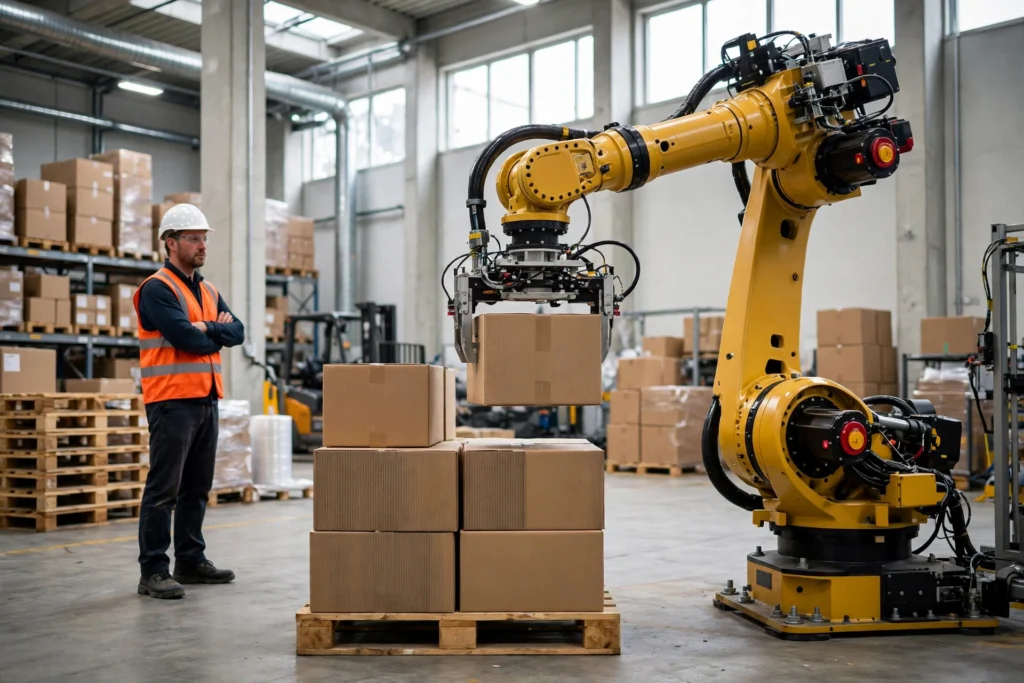
Palletizing robots stack boxes, bags, and other packed goods onto pallets in neat, stable layers, ready for wrapping and transport. They pick each item from a conveyor, move it to a planned spot, and repeat the pattern until the pallet is full.
Key Takeaways
- A palletizing robot repeats a planned stacking pattern, layer by layer, instead of piling items at random.
- Sensors and software check each item’s size, position, and weight before the robot picks it up.
- Different grippers suit different loads: clamps for boxes, vacuum heads for flat cartons, and fork-style tools for bags.
- Safety fencing, sensors, and slow restart routines keep people clear of the robot’s moving arm.
- Palletizing robots work best with steady, similar loads; very mixed or fragile loads still need extra care.
What Does a Palletizing Robot Actually Do?
Think of the last step in packing. Products have already been boxed, sealed, and labelled. Someone still has to stack them on a pallet so a forklift can move the whole load at once. That’s the palletizing robot’s job.
It doesn’t pack the boxes or decide what’s inside them. It takes finished items, one at a time, and builds a load that won’t topple in transit. When the pallet is full, it is usually wrapped in film, then moved away by a forklift or conveyor, and an empty pallet takes its place.
You’ll find these robots in food and drink plants, warehouses, and distribution centres — anywhere the same kind of case keeps arriving hour after hour.
How Does a Palletizing Cycle Work?
A typical cycle has five steps, and it runs in the same order every time.
First, a box arrives on a conveyor and stops at a known pick point. Sensors may confirm it is in place, upright, and facing the right way. If it isn’t, the system can pause or flag it rather than stack it wrong.
Second, the robot moves its arm to that spot. Its controller already knows the box’s position from the conveyor layout and, in some setups, from a camera or barcode scan.
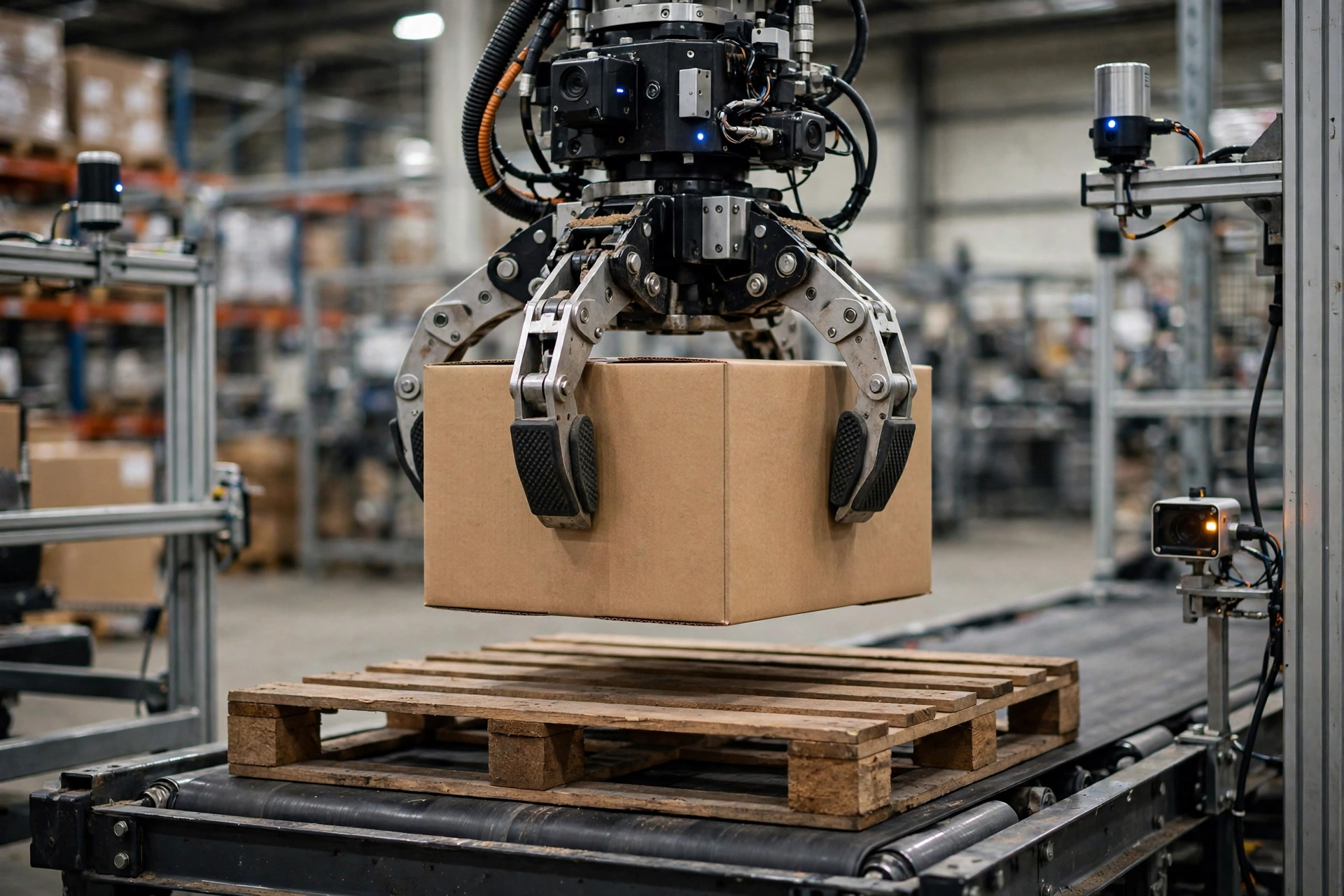
Third, the gripper picks the box up. A clamp squeezes the sides gently, a vacuum head lifts it from the top, or a fork slides underneath it. The choice depends on the box’s weight, shape, and surface.
Fourth, the arm swings to the pallet and sets the box down in its planned position. It doesn’t drop the box; it lowers it, releases it, and pulls back cleanly so the next layer stays level.
Fifth, the controller updates its count. When a layer is complete, it starts the next one, often offsetting the pattern so boxes interlock like bricks. That interlocking is what keeps a tall stack steady.
What Kinds of Grippers Do They Use?
No single gripper fits every load, so palletizing robots are often fitted for the job at hand.
Clamp grippers are common for sturdy cardboard cases. They hold the sides and can handle a range of box sizes, but they need enough grip force without crushing the contents.
Vacuum grippers use suction cups on top of a flat carton. They work well for smooth, sealed boxes and leave the sides untouched, though dusty or uneven surfaces can weaken the seal.
Fork or scoop grippers slide under bags, sacks, and softer packs that a clamp might squeeze out of shape. Some systems also use a bag gripper that supports the load from below while holding it steady.
Changing the gripper, or adjusting it for a new box size, is part of setting the robot up for a different product. It’s not a job to rush: a gripper that doesn’t match the load is a common cause of dropped or damaged cases.
How Does the Robot Know Where Each Box Goes?
The stacking pattern is planned in advance, usually in the robot’s software. An operator or engineer enters the pallet size, the box size, and how many boxes fit in each layer. The software then works out a pattern that fills the layer evenly and keeps the load balanced.
For mixed loads, where boxes differ in size, the software has a harder job. It must place heavier boxes lower, keep the stack’s centre of gravity near the middle, and avoid leaving gaps that let boxes shift. Some systems handle a few known sizes well; a fully mixed stream of random sizes is still trickier and may need human checks.
Sensors help along the way. A camera or light curtain can confirm a box’s position, a scale can catch an unexpectedly heavy case, and a height check can spot a box that landed tilted. When something looks off, the robot can stop and wait for help instead of building on a mistake.
What Keeps People Safe Around a Palletizing Robot?
A palletizing arm is strong and fast, so safety is built around keeping people out of its reach while it moves. Most cells are fenced, with a gate that stops the robot when opened. Light curtains and floor scanners can do a similar job, slowing or stopping the arm if someone steps too close.
Operators still need to enter the cell sometimes — to clear a jam, change a gripper, or swap a pallet. That’s why restart routines matter. The robot should not spring back to full speed the moment a gate closes; a controlled restart, with a clear view of the cell, gives everyone time to step clear.
Good housekeeping helps too. Loose film, stray pallets, and blocked walkways around the cell create trips and distractions, and they can also confuse sensors. A tidy cell is easier to run and easier to fault-find.
Where Are Palletizing Robots Most Useful?
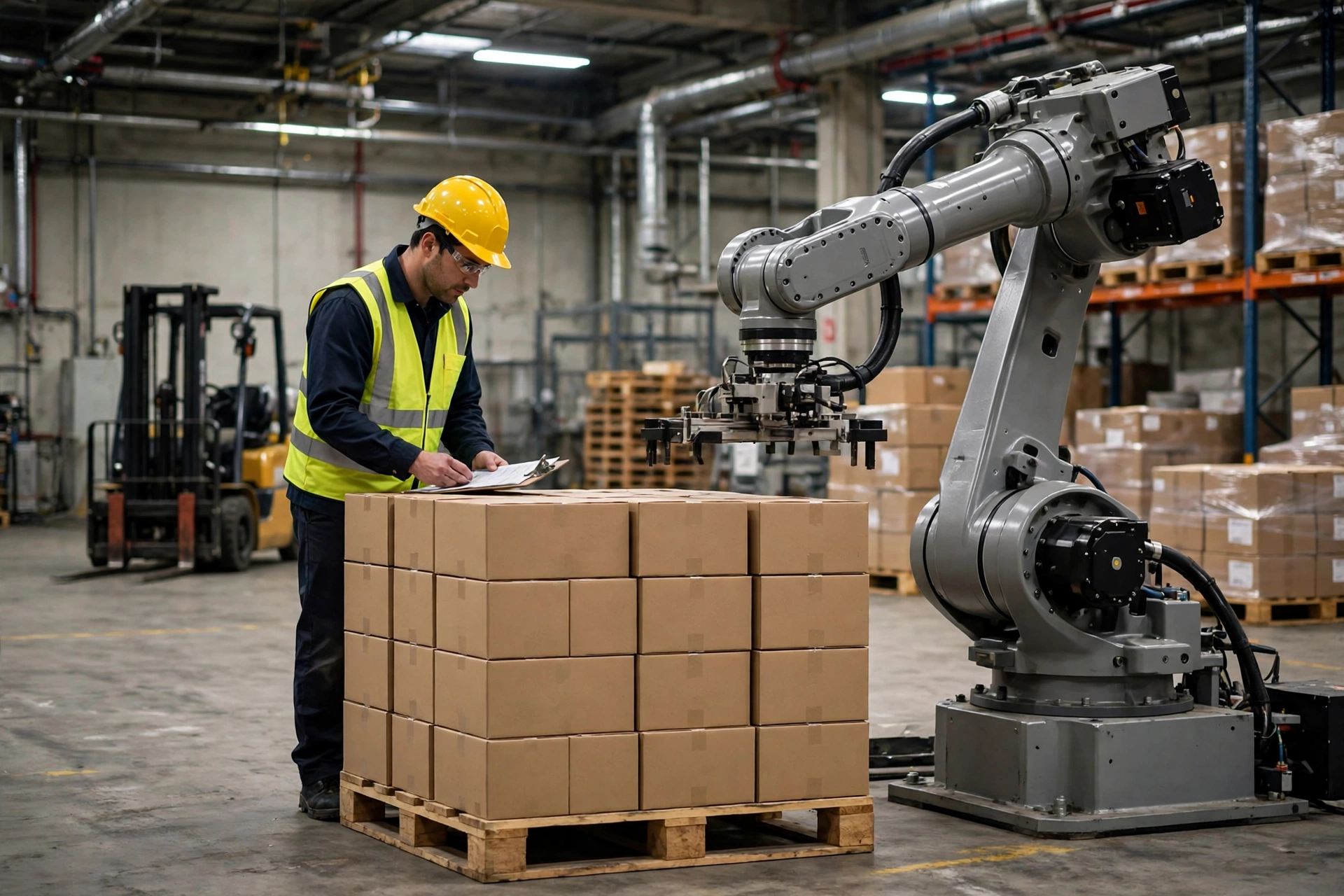
They shine where the work is repetitive, heavy, or awkward for people to do all shift. Stacking full cases hour after hour is tiring, and it puts strain on backs and shoulders. A robot takes on that steady lifting while people handle checks, changeovers, and problem-solving.
They’re also useful when loads must stay consistent. A neat, square pallet wraps better, stacks better in a truck, and is less likely to lean or collapse. For a warehouse sending out hundreds of pallets a day, that consistency matters.
That said, palletizing robots aren’t a fit for every site. A small operation with constantly changing box sizes, tiny volumes, or very fragile, irregular loads may find manual stacking simpler and cheaper. The best candidates are steady flows of similar cases, with enough volume to justify the cell, fencing, and setup time.
What Are the Limits?
Palletizing robots handle the known well and the unexpected less well. A crushed box, a wet carton, a label facing the wrong way, or a pallet with a broken board can all throw off a cycle. Systems with good sensing catch many of these, but not every fault is visible to a camera.
Changeovers take time as well. A new box size may mean a new pattern, a gripper adjustment, and a test run. Sites that switch products several times a day need to weigh that setup time against the robot’s speed once it is running.
Finally, a palletizing robot is only one link in the chain. If boxes arrive damaged, labels are wrong, or the next conveyor is blocked, the robot can’t fix those problems on its own. It works best as part of a tidy packing line, not as a cure for mess upstream.
Frequently Asked Questions
Is a palletizing robot the same as a warehouse robot?
Not quite. Warehouse robots cover many jobs, from moving shelves to sorting parcels. A palletizing robot does one specific job: stacking packed goods onto pallets. It often works alongside warehouse robots, but its arm, gripper, and software are built for stacking.
Can one robot handle different box sizes?
Often yes, within limits. Many systems store several patterns for known box sizes and switch between them. Very different sizes in the same run are harder, because the pattern, gripper setting, and weight balance all change. Check the range a system supports before assuming it covers every case you ship.
Do palletizing robots replace workers?
They usually change the work rather than remove people entirely. Someone still loads pallets, clears jams, checks quality, and manages changeovers. The heavy, repetitive stacking moves to the robot, while people take on supervision and fault-finding — roles that need judgement the robot doesn’t have.
How fast is a palletizing robot?
Speed varies with box weight, travel distance, and pattern complexity. Light, uniform cases on a short move cycle faster than heavy, mixed loads that need careful placement. Suppliers usually quote cycles for a specific load, so compare figures for your own box size rather than a headline number.
What should I check before choosing a palletizing robot?
Start with your boxes: size range, weight, surface, and how mixed they are. Then check your pallets, floor space for a fenced cell, and how often you change products. A short trial with your real cases, including your worst-case box, will tell you more than a brochure about fit and reliability.
Conclusion
A palletizing robot earns its place by doing one job well: turning a stream of finished cases into neat, stable, transport-ready pallets, layer after layer. Its strength is consistency — the same pattern, the same placement, without the fatigue that creeps into manual stacking.
If you’re considering one, start small and practical. Measure your most common box and pallet sizes, watch how often sizes change, and run a trial with real cases. That groundwork will show quickly whether a palletizing robot fits your line — and which gripper and pattern it needs to stack safely.
Related reading: Robot Arms, Warehouse Robots, Collaborative Robots, Fruit Picking Robots
Further reading: Britannica robotics, Wikipedia palletizer