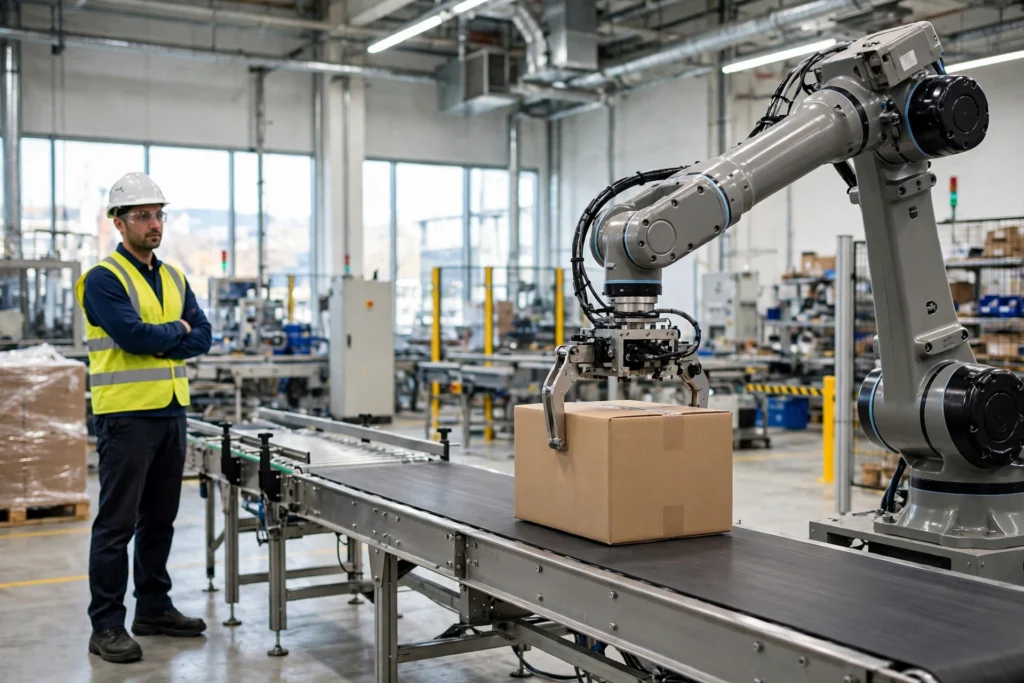
Packaging robots are machines that fill, close, label and check boxes, bags and trays on a production or warehouse line. They don’t make decisions the way a person does. Instead, they follow a set programme, use sensors and cameras to find each item, and repeat the same careful movements thousands of times a day.
Think of the last parcel you opened. Before it reached you, something had to put the item in a box, fold the flaps, tape it shut, stick on a label and send it in the right direction. In many factories and fulfilment centres, a robot now does several of those steps, while people handle the trickier checks, fixes and exceptions.
Key Takeaways
- A packaging robot usually combines an arm or gantry, a gripper, sensors, cameras and control software.
- It works through a repeatable cycle: pick, place, fill or fold, seal, label and check.
- Cameras and weight or barcode checks help it spot missing items, wrong labels and damaged boxes.
- The right gripper matters: soft items, glass jars and heavy cartons need very different handling.
- Safety guards, sensors and slow-speed modes let people work nearby without entering the robot’s path.
What exactly does a packaging robot do?
It depends on the line, but most packaging robots handle one or more end-of-line jobs. Case packers place products into cartons or cases. Cartoners fold and fill smaller boxes. Sealers close flaps with tape, glue or heat. Labellers apply a barcode or shipping label in the same spot every time. Some systems also wrap a finished pallet, which is where they hand over to palletising equipment.
A single robot can do more than one job if its gripper and programme change. For example, the same arm might pick bottles in the morning and cartons in the afternoon, after a tool change and a new recipe is loaded. That flexibility is one reason smaller operations now consider robots that once only made sense in very large plants.
How does a packaging robot know what to pick up?
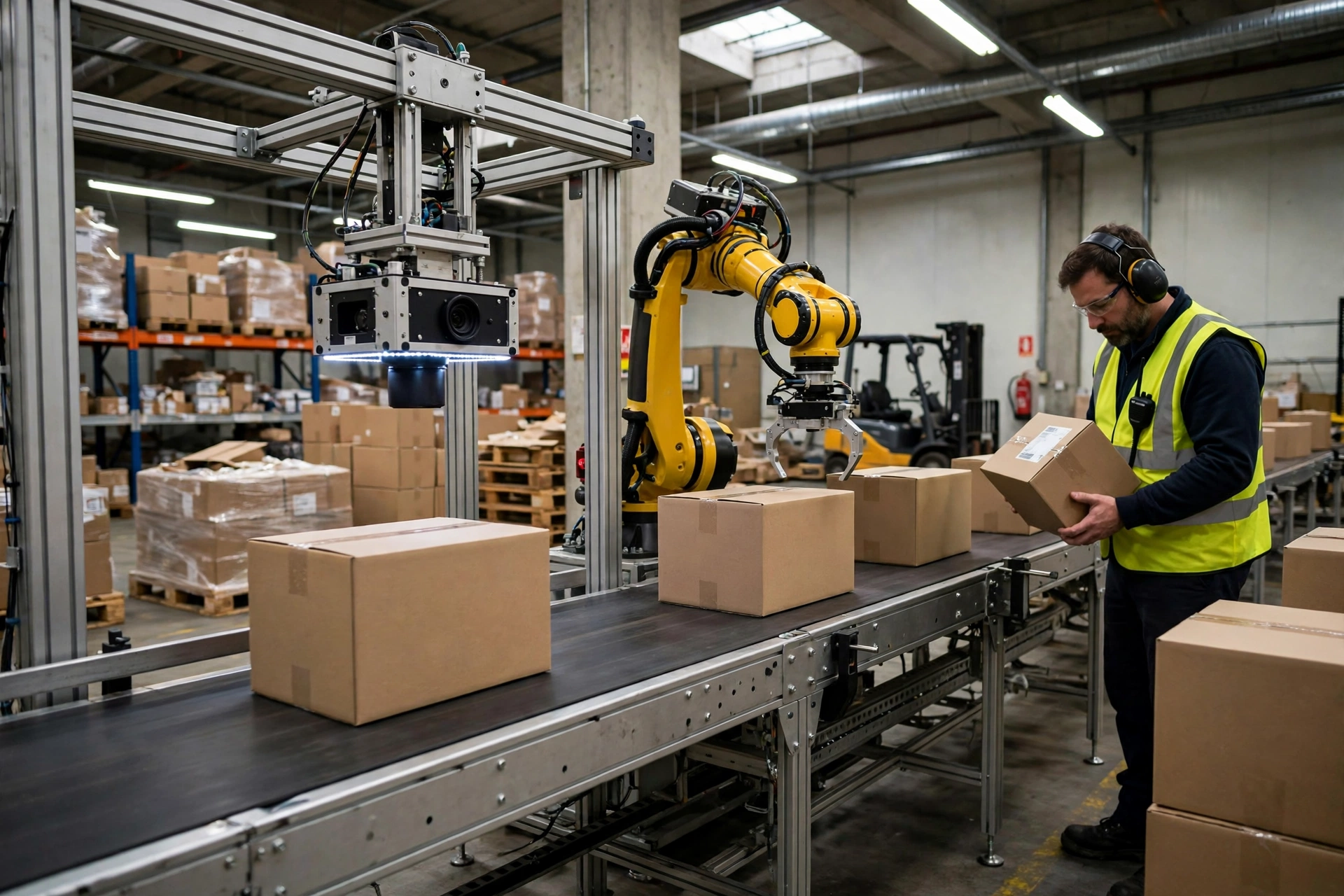
It starts with sensing. A camera above the belt takes a picture of the item and compares its shape, size and position with what the programme expects. A barcode reader confirms the product code. A simple light sensor can tell whether a box is present, while a weight check can flag a box that is too light — a sign something may be missing.
Once the robot knows where the item is, its controller plans a path. Joints move the arm to the pick point, the gripper closes with just enough force, and the arm lifts the item without dragging it. Force sensors help here: too much grip can crush a cereal box or crack a jar, while too little grip lets it slip.
If an item arrives upside down or slightly off-centre, a good vision system adjusts the pick point instead of stopping the line. When it can’t recognise the item at all, it usually pushes it to a reject lane so a person can look at it, rather than guessing.
What are the main parts of a packaging robot?
The arm is the most visible part. Articulated arms bend at several joints, like a human arm, and suit varied shapes and angles. Gantry robots move along overhead rails and suit straight-line pick-and-place over a wide area. Delta robots, with their spider-like arms, are fast for light items such as biscuits or small pouches.
At the end of the arm sits the end effector, or gripper. Vacuum cups lift flat, smooth surfaces. Mechanical fingers grip bottles and cans. Soft grippers handle fruit, bakery items and other delicate goods. Some lines use more than one gripper and swap between them automatically.
Underneath all of this is control software. It stores recipes for each product: box size, pick height, seal position, label location and belt speed. Operators select a recipe on a touchscreen rather than reprogramming the robot from scratch each time. Sensors feed back constantly, so the controller can pause if a box jams or a guard door opens.
How does it fill, seal and label a box?
Filling is often the gentlest step. The robot places items in a set pattern so they don’t rattle around in transit. For liquids or powders, a separate filler may dose the product first, and the robot then handles the closed container. Counting matters here: a case that should hold twelve bottles must not leave with eleven.
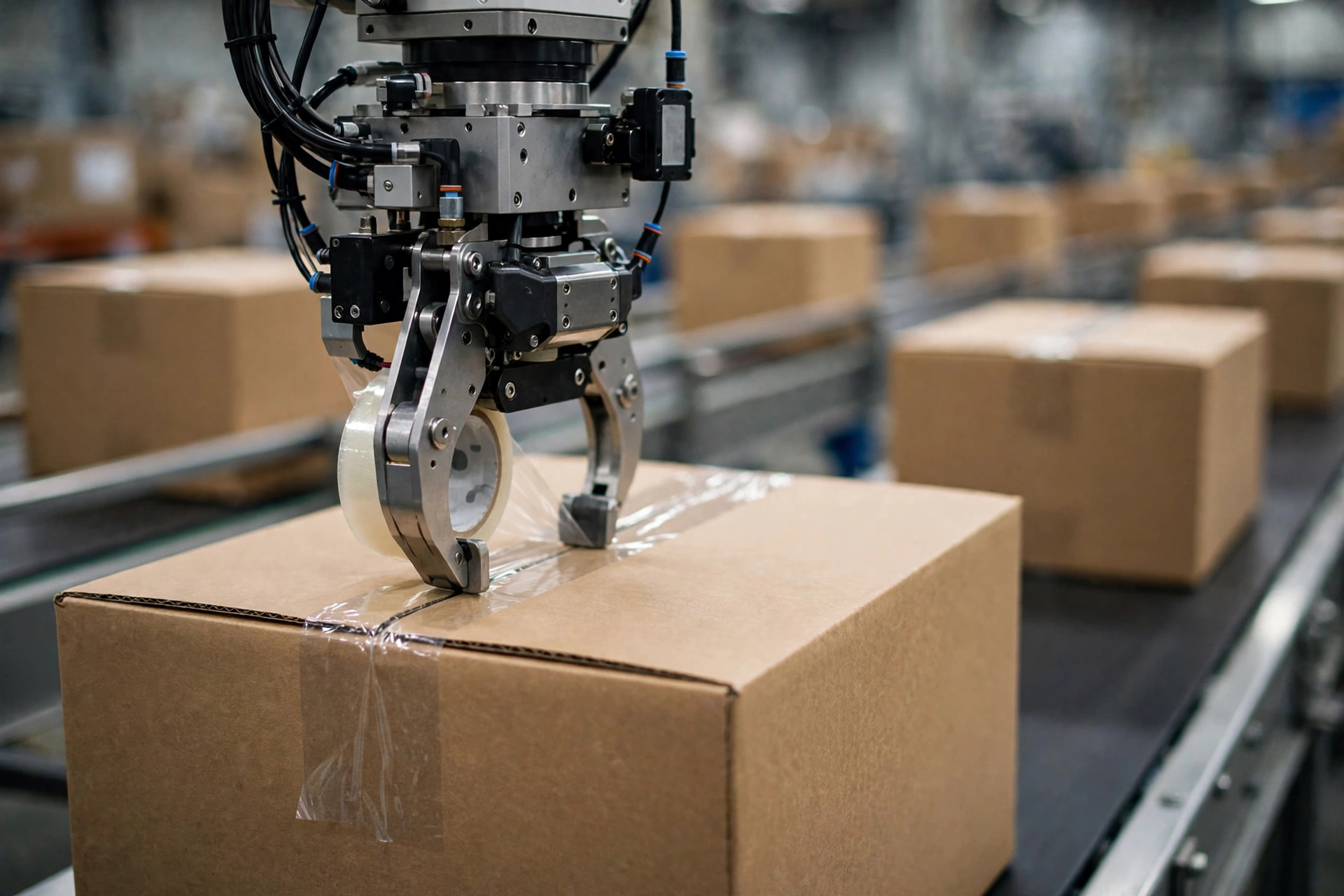
Sealing comes next. For a cardboard box, the robot or a connected sealer folds the top flaps, then applies tape or hot-melt glue along the seam. For pouches and bags, heat sealing melts the edges together. The seal needs to be strong enough to survive handling, but not so aggressive that it damages the product or makes the pack hard to open.
Labelling is a precision job. A label printed just before application carries a barcode, batch code or shipping address. The robot or labeller places it flat, in the same position, so scanners downstream can read it first time. A camera then verifies the barcode. If it can’t be read, the box is diverted instead of being shipped with a faulty label.
How does it check its own work?
Checks are built into the line, not added as an afterthought. Cameras look for open flaps, torn film, missing caps and crooked labels. Checkweighers compare each box with its expected weight. Barcode scanners confirm the right product is in the right case. Metal detectors or X-ray systems are used in food and pharmaceutical lines where contamination checks matter.
When a check fails, the system should not simply carry on. It stops that box, sends it to a reject area and, in many setups, logs the reason. That log helps engineers spot patterns — for instance, a gripper that keeps misplacing one size of jar, or a label printer running low on ribbon.
Where are packaging robots used?
Food and drink lines use them for bottles, cans, cartons and pouches, where hygiene and speed matter. Pharmaceutical lines use them for blister packs, vials and labelled cartons, where traceability is essential. Consumer goods, electronics and cosmetics lines use them for fragile or high-value items that need consistent handling.
Warehouses use packaging robots differently. There, the job is often to pack mixed orders: pick items from totes, place them in a shipping carton, add protective filling and seal the box. That work is less predictable than a factory line, because every order is different, so vision and flexible grippers matter even more.
Related systems work alongside packaging robots. Warehouse robots move goods to and from the packing area, robot arms handle the heavier lifting, and palletising robots stack finished cases for shipping. Collaborative robots, which are designed to share space with people, suit smaller packing cells where a full safety cage would be impractical.
What are the limits and safety risks?
Packaging robots are brilliant at repetition, but they struggle with surprises. A dented box, a wet label or a product that has changed shape can confuse a vision system. Changeovers still take time, especially when a new gripper or recipe must be tested. And a robot cannot judge quality the way an experienced worker can — it can only check what it has been told to check.
Safety is the other limit. A fast industrial arm can injure someone who steps into its path, so lines use fencing, light curtains and emergency stops. Collaborative models slow down or stop when a person comes close, but they still need a proper risk assessment. Anyone working near a packing robot should be trained on lockout procedures, and guards should never be bypassed to keep a line running.
Costs matter too. The robot itself is only part of the spend: conveyors, guarding, integration, training and maintenance all add up. For a small business, a simpler semi-automatic sealer or labeller may be a better first step than a fully robotic cell.
Is a packaging robot worth it for a small operation?
It depends on volume, variety and labour. If you pack the same few products all day, a robot can pay back through fewer errors, steadier output and less strain on staff. If every order is different and volumes are low, the time spent changing recipes may eat into those gains.
A practical way to decide is to start with the bottleneck. Is sealing slow? Are labels often misplaced? Are staff spending hours on heavy, repetitive lifting? Fixing one clear problem with a focused robot cell is usually wiser than automating everything at once. Talk to an integrator, ask for a trial with your actual boxes and products, and check what happens when a box jams or a label fails.
Frequently Asked Questions
How fast is a packaging robot?
Speed varies a lot by task and product. Light pick-and-place robots can handle many small items per minute, while heavy case packing is slower. The useful measure is not top speed alone, but steady output over a full shift, including changeovers and rejects.
Can a packaging robot handle fragile items?
Yes, with the right gripper and settings. Soft grippers, vacuum cups and force limits help protect glass, baked goods and electronics. Fragile items still need testing with the real product, not just a similar-looking dummy.
Does a packaging robot replace all packing staff?
Usually not. People are still needed to load materials, clear jams, check quality, handle exceptions and maintain the system. The work changes — less repetitive lifting, more supervision and problem-solving — rather than disappearing entirely.
What maintenance does a packaging robot need?
Regular cleaning, gripper and belt checks, sensor calibration and software updates. A planned maintenance schedule prevents small wear, such as a tired vacuum cup, from turning into repeated mis-picks and downtime.
What should I check before buying one?
Check your box sizes, product weights, line speed and available floor space. Ask how long changeovers take, what happens on a failed check, and what training and spare parts are included. A trial run with your own products will reveal more than a brochure ever can.
Conclusion
Packaging robots work by combining sensing, careful movement and repeated checks: find the item, pick it gently, place or fill it correctly, seal it, label it and verify the result. They are at their best on steady, repetitive packing jobs, and at their weakest when products keep changing or quality needs human judgement.
If you’re considering one, start small and practical. Measure your current packing errors and bottlenecks, test a robot with your real boxes, and keep people in the loop for checks and exceptions. That way, automation supports the team rather than creating a faster way to make the same mistakes.
For background, see Britannica’s robotics overview and the igus guide to robotic packaging, linked in the further reading below.
Further reading: Britannica robotics and igus robotic packaging guide.