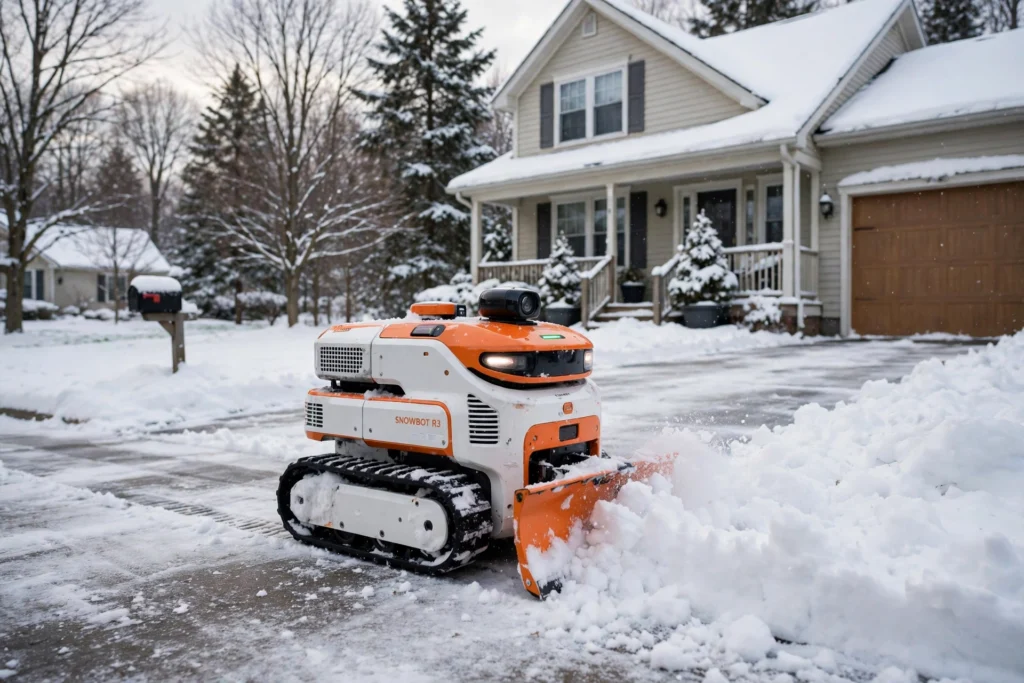
A snow-clearing robot is a small, self-driving machine that clears snow from a driveway, path, or pavement without someone pushing it. It follows a planned route, senses edges and obstacles, pushes or throws snow to one side, and returns to charge when its battery runs low or the job is done. Think of it as a robot vacuum for winter, only heavier, tougher, and built to work in cold, wet conditions.
Key Takeaways
- A snow-clearing robot combines navigation, sensing, and a snow-moving tool such as a blade or auger.
- It usually works within a mapped area, using cameras, satellite positioning, and boundary markers to stay on course.
- Most home models suit light to moderate snow, not deep drifts or thick ice.
- Safety features such as obstacle detection, blade guards, and automatic stopping matter as much as clearing power.
- Cold weather shortens battery life, so charging time and a sheltered dock are worth checking before buying.
How does a snow-clearing robot know where to go?
Before its first run, the robot needs to learn the area. Some models use a boundary wire laid around the edge of a driveway, much like the wire used by a robot lawn mower. Others build a digital map from satellite signals, cameras, and sensors as they are guided around the area once. Once the map is saved, the robot can plan neat, overlapping passes instead of wandering at random.
Satellite positioning helps outdoors, but snow, trees, and tall buildings can weaken the signal. That is why many robots combine several sources of information. Cameras read the edges of a path, wheel sensors measure distance travelled, and a compass or gyroscope tracks direction. If one source becomes unreliable, the others help the robot keep its place. When the signal is lost for too long, a well-designed robot should stop and wait for help rather than guess where it is.
What sensors keep it on the path and away from obstacles?
A snow-clearing robot does not see the world the way we do. It builds a simple picture from its sensors. Cameras spot kerbs, parked cars, bins, and people. LiDAR, which sends out light pulses and measures how long they take to bounce back, builds a rough three-dimensional map of nearby objects. Ultrasonic sensors are useful at close range, especially in falling snow when cameras struggle.
Together, these sensors help the robot slow down near an obstacle, steer around it, or stop completely. A child, a pet, or a neighbour stepping onto a driveway should trigger a pause, not a push-through. Some models also use bump sensors as a last resort: if the robot touches something unexpected, it backs off and tries another route. No sensor system is perfect in a blizzard, so keeping the area reasonably clear of toys, cables, and loose objects still helps a great deal.
How does it actually move the snow?
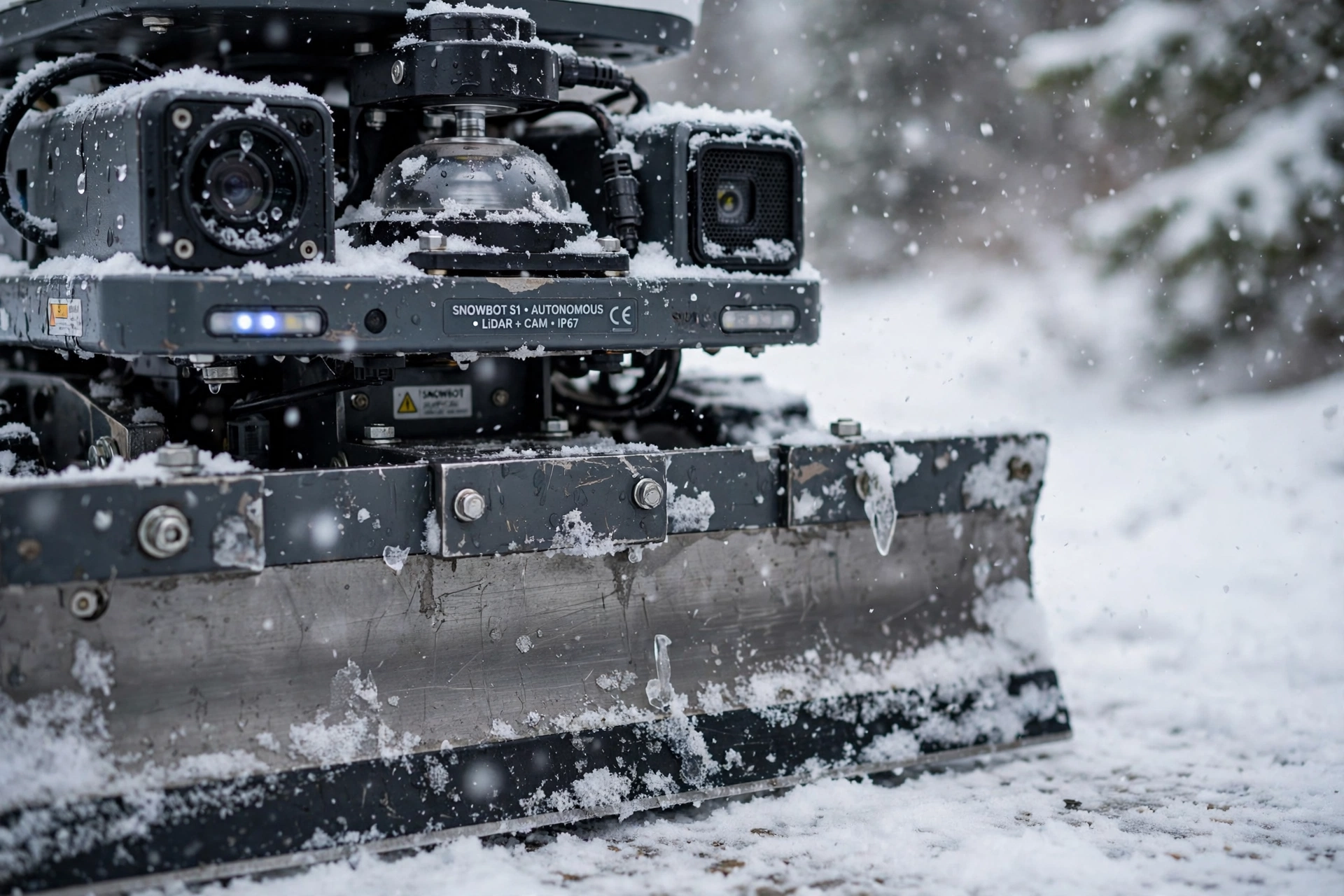
Most home snow-clearing robots use one of two methods. A blade, or plough, pushes snow forward and to the side, leaving a cleared strip behind it. This works well for fresh, light snow on a flat surface. An auger, a rotating screw-like tool, scoops snow up and throws it through a chute to one side. Augers cope better with deeper snow, but they use more power and need more care around gravel, ice, and hidden objects.
The robot’s tracks or wheels matter too. Tracks spread its weight, grip better on slippery ground, and climb small kerbs more easily than small wheels. Wheels are simpler and often quieter, but they can slip on ice. Either way, the robot moves slowly and steadily. Speed is not the point here; a careful, repeated pass clears more reliably than a fast, skidding one, and it is far safer for anyone nearby.
How does it cope with ice, slopes, and deep snow?
Ice is the hardest test. A blade can slide over a frozen layer without shifting it, and wheels or tracks can lose grip on a slope. Many robots are therefore sold for snow removal, not ice removal. Some can spread grit or salt after clearing, but that is a separate job and needs its own tank and controls. If your driveway ices over often, a robot alone may not be enough, and a manual check after a freeze is still sensible.
Slopes need care as well. Manufacturers usually give a maximum gradient, and going beyond it can cause slipping or a stuck machine. Deep snow is another limit. A robot designed for, say, 15 centimetres of fresh snow will struggle in a 30-centimetre drift, and forcing it through can drain the battery or jam the auger. Clearing little and often, during or soon after snowfall, usually works better than waiting until the snow is deep and heavy.
What powers it, and how long does it run?
Most home snow-clearing robots run on rechargeable lithium batteries. A single charge may last from under an hour to a couple of hours, depending on snow depth, temperature, and how hard the motor must work. Cold is the enemy of batteries: capacity drops in freezing weather, so a robot that runs for 90 minutes in mild conditions may manage far less on a bitter morning.
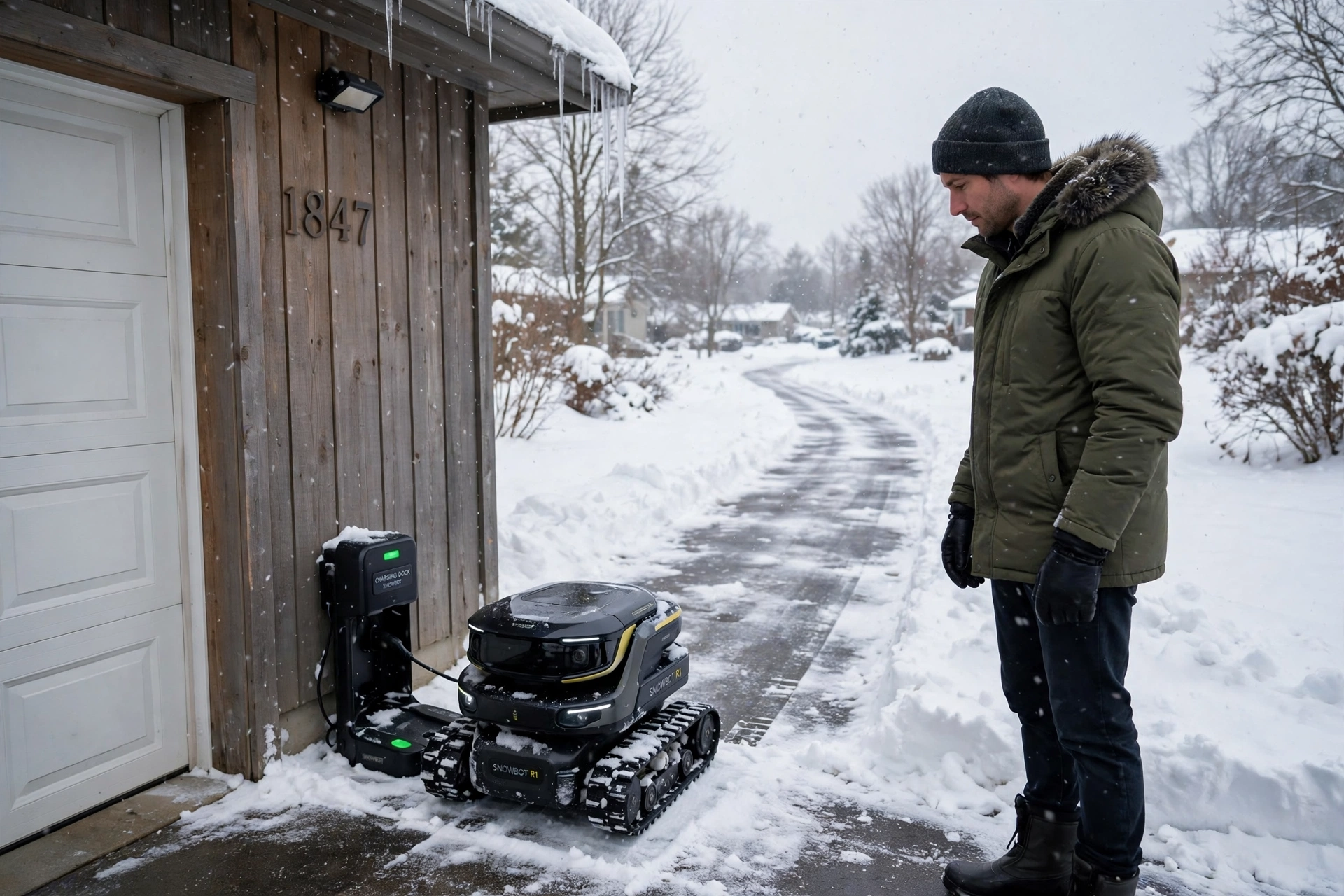
That is why the charging dock matters. Some robots return to the dock on their own when the battery is low, recharge, and then resume where they left off. Others need to be carried back and plugged in by hand. A sheltered dock near a power point, protected from drifting snow, makes the whole system far more practical. It is also worth checking how long a full charge takes, because a robot that needs hours to recharge may miss the morning school run or the commute.
How is a snow-clearing robot controlled?
Control is usually through a phone app, a remote control, or simple buttons on the machine. The app lets you set a schedule, choose the area to clear, and see where the robot has been. Some apps send an alert if the robot gets stuck, loses signal, or needs attention. Remote control is handy for a first run or a tricky corner, but the point of the robot is that it should manage most jobs on its own.
Scheduling is where these robots earn their keep. Set one to clear the driveway before you leave in the morning, and you may only need to check the result rather than do the job yourself. Still, a schedule is not a substitute for a quick look outside. A fallen branch, a parked car in a new spot, or a fresh drift across the path can change the job, and a sensible owner checks the area before the robot starts.
Is a snow-clearing robot safe to use around people and pets?
Safety starts with design, but it also depends on how the robot is used. A good robot slows or stops for people and animals, keeps its blade or auger guarded, and shuts down if it is lifted or tipped. Bright lights, warning sounds, and a clear working area all help neighbours and passers-by notice it. At night, extra care is needed, because a small, quiet robot in falling snow is easy to miss.
Owners can help by keeping children and pets indoors while the robot works, marking the edges of the area clearly, and never reaching into a jammed auger while the machine is powered on. If snow jams the mechanism, switch the robot off first, follow the maker’s instructions, and use a tool rather than your hands. The same caution applies to any snow-clearing machine, robotic or not, and it is worth teaching everyone in the household before the first snowfall.
How do snow-clearing robots compare with robot vacuums and lawn mowers?
Snow-clearing robots share a family resemblance with other home robots, but winter changes the demands. Like robot vacuums, they navigate a mapped area and return to charge, yet they must cope with cold, wet snow, and slippery ground. Like robot lawn mowers, they often work within a boundary and follow planned passes, but they face a moving, melting obstacle rather than grass that grows at a steady pace.
The mechanics are closer to industrial machines than to a vacuum cleaner. The arm and drive ideas behind robot arms show up in how motors, joints, and sensors are coordinated, while the route planning echoes the logistics thinking behind warehouse robots. The difference is the setting: a home driveway is uncontrolled, public, and weather-exposed, so the robot must be more cautious than a machine working behind a factory fence.
What should you check before buying one?
Start with your own driveway, not the sales page. Measure its size, slope, and surface, and note whether it is paved, gravel, or mixed. Check the robot’s rated snow depth, clearing width, battery life in cold weather, and whether it can handle your slope. Look for obstacle detection, automatic stopping, a guarded blade or auger, and a charging dock that suits your garage or outdoor space.
Also check the practical details. How loud is it, especially early in the morning? Does it need a clear satellite signal, or does it work with a boundary wire? Can it be updated over time, and are spare blades, tracks, and batteries available? A robot that fits your driveway and your routine is more useful than a more powerful model that cannot navigate your kerbs or recharge in your garage.
For background on how robots sense and move in general, Britannica’s robotics overview explains the core parts — sensors, actuators, control systems, and power — that sit behind most machines. For how traditional snow machines move snow, Wikipedia’s snow blower page describes augers, impellers, and discharge chutes, which helps explain why robotic versions differ in power and design.
FAQs
Can a snow-clearing robot clear a whole driveway on one charge?
It depends on the driveway, the snow, and the temperature. A small, flat driveway with light snow is far easier than a long, steep drive with deep, wet snow. Many owners find the robot handles a normal home driveway, but larger areas may need a recharge part-way through, or a second pass after the first charge.
Does it work in heavy snowfall or a blizzard?
Most home models are not built for blizzard conditions. Falling snow can blind cameras, deep drifts can overwhelm the blade or auger, and wind can push snow back onto a cleared path. Clearing during lighter snowfall, or in breaks between showers, usually gives a better result than sending the robot out in the worst of a storm.
Can it clear ice as well as snow?
Generally, no. A blade or auger is designed for snow, not a frozen sheet. Some models can help by spreading grit after clearing, but thick ice still needs manual treatment or a dedicated de-icing step. If ice is a regular problem, plan for that separately rather than expecting the robot to solve it.
Is it safe on gravel driveways?
Gravel needs caution. A blade can push stones around, and an auger can pick up loose gravel and throw it. Some robots are rated only for paved surfaces, while others have a height adjustment or a gravel mode. Check the maker’s guidance for your surface before buying, and test on a small area first.
What happens if it gets stuck or loses signal?
A well-designed robot should stop, send an alert, and wait for help rather than keep driving blind. Common causes are deep snow, a lost satellite signal, a jammed blade, or an obstacle it cannot pass. Clearing the blockage, moving the obstacle, or guiding the robot back to its dock usually sorts it out, but repeated sticking may mean the area or settings need adjusting.
Conclusion
A snow-clearing robot will not replace every shovel or snow blower, but for a suitable driveway it can take the sting out of winter mornings. It works by mapping an area, sensing edges and obstacles, and pushing or throwing snow aside in steady passes, then returning to charge when it needs to. Its limits — ice, deep drifts, steep slopes, and cold-shortened battery life — are just as important as its strengths.
If you are considering one, start with a practical next step: measure your driveway, check its slope and surface, and compare those numbers with the robot’s rated snow depth and gradient. That simple check, done before you buy, is the best way to tell whether a snow-clearing robot will genuinely help at your home, or whether a simpler tool remains the wiser choice.