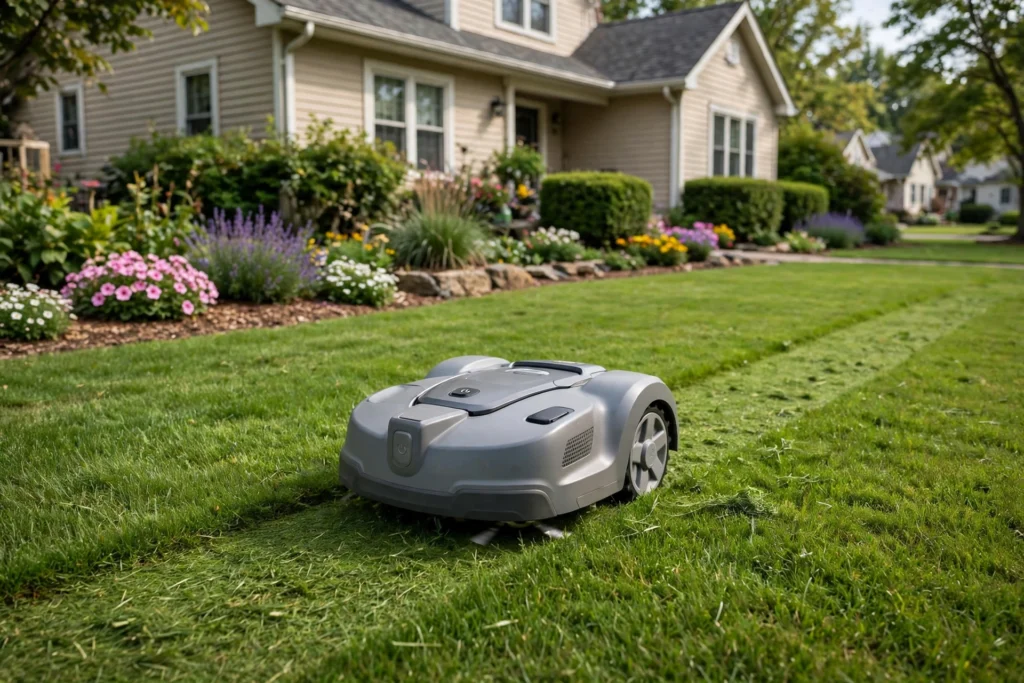
A robot lawn mower is a small, battery-powered machine that trims your lawn a little at a time, on its own, instead of cutting it all in one big weekly session. It follows a boundary around the lawn, uses small blades under its body to snip the tips of the grass, and returns to its charging dock when its battery runs low.
Key Takeaways
- Robot lawn mowers cut little and often, which keeps grass at a fairly even height.
- A boundary wire, a mapped area, or both tell the mower where it may go.
- Small blades, bump sensors, and lift sensors help it cope with obstacles safely.
- Most models return to a charging dock on their own and resume mowing later.
- They suit fairly flat, open lawns best, and still struggle with steep slopes, wet ground, and clutter.
What exactly is a robot lawn mower?
Think of it as a low, flat box on wheels with a cutting disc underneath. It is much smaller than a ride-on mower, and usually quieter than a petrol mower too. Most run on a rechargeable battery and are controlled from buttons on the machine, a remote, or a phone app, depending on the model.
Instead of collecting clippings in a bag, many robot mowers mulch as they go. The tiny clippings fall back onto the lawn, where they break down and feed the soil. That means no bag to empty after every session, but it also means the mower needs to run often. If the grass grows too tall between sessions, the mower will struggle, and the finish will look uneven.
How does a robot lawn mower stay inside the lawn?
Older and simpler models use a boundary wire. You, or an installer, peg a thin wire around the edge of the lawn and around beds, ponds, and trees you want to protect. The wire carries a weak signal, and a sensor on the mower detects it and turns the mower back when it reaches the edge.
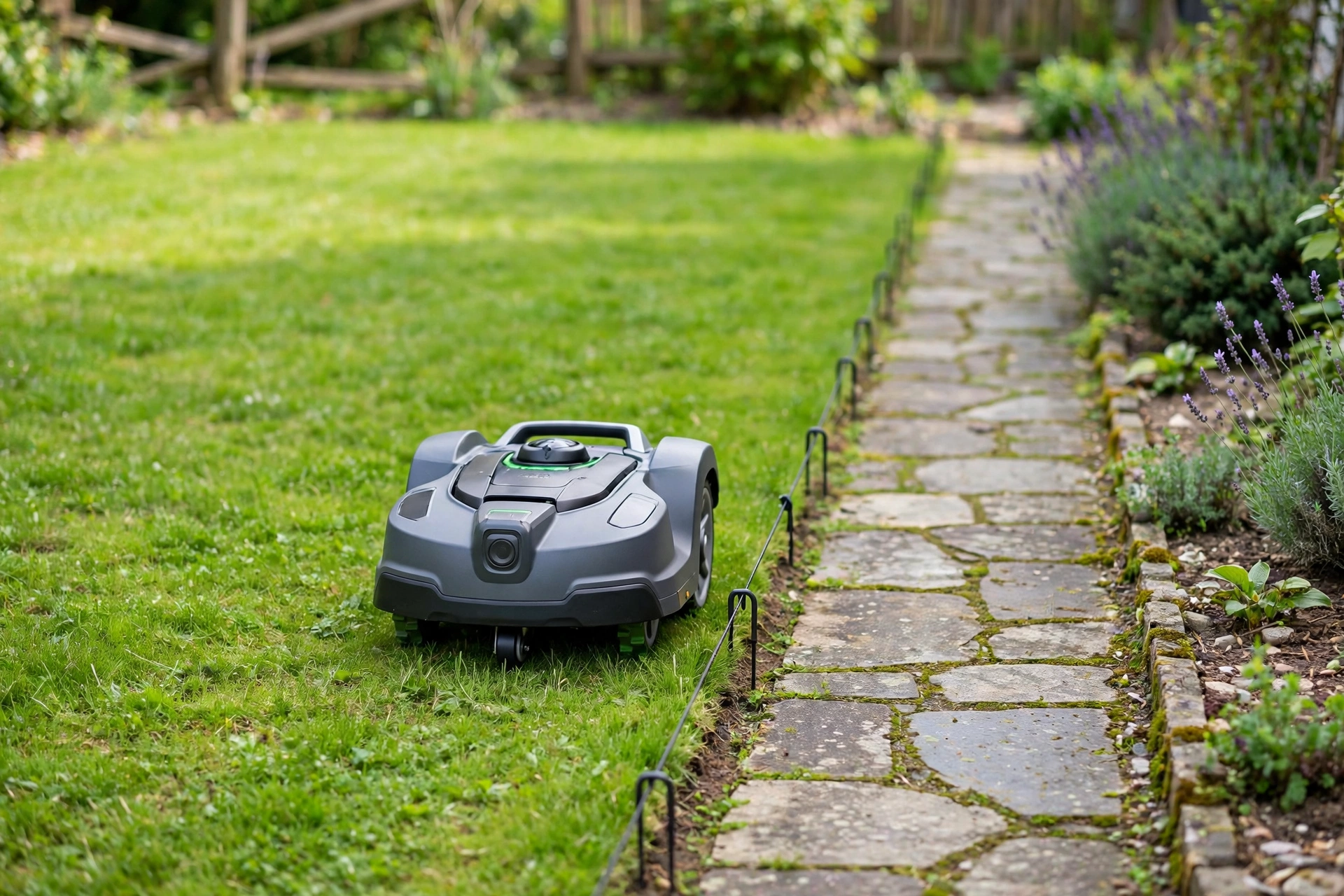
Newer models may use satellite positioning, cameras, or a saved map of the garden instead of, or as well as, a wire. These wire-free models can be easier to set up in a simple garden, but they still need a clear view of the sky or clear landmarks to know where they are. Whichever system a mower uses, the principle is the same: the lawn is a defined area, and the mower is not supposed to wander onto paths, driveways, or flower beds.
How does it actually cut the grass?
Under the mower, a spinning disc holds small, sharp blades, often like short razor blades. As the mower moves, those blades snip the top few millimetres of grass. Because it cuts so little at a time, the motor does not need to be very powerful, and the mower can work quietly.
The mowing pattern is often random rather than neat stripes. The mower drives in straight lines, turns when it hits the boundary or an obstacle, and gradually covers the whole lawn over several sessions. That can look untidy at first, especially if you are used to striped lawns, but after a few days of regular cutting the height tends to even out.
How does it handle obstacles, pets, and children?
A robot mower is not blind to its surroundings, but it is not as aware as a person either. Bump sensors tell it when it has touched something solid, so it can back up and turn away. Tilt and lift sensors stop the blades if the mower is picked up or tips over. Some models also use cameras or ultrasonic sensors to spot larger objects before they hit them.
Even with those safeguards, you should still tidy the lawn before it runs. Pick up toys, hoses, stones, and fallen branches, and keep pets and small children away while it is working. A mower that bumps into a dog’s toy may only stall, but a hidden wire or a small stone can damage the blades or get thrown up. Clearing the lawn first is the simplest safety step, and it also gives a better cut.
Related reading on other home and outdoor robots: How Do Robot Vacuums Work? and How Do Agricultural Robots Work?
How does it charge and keep going?
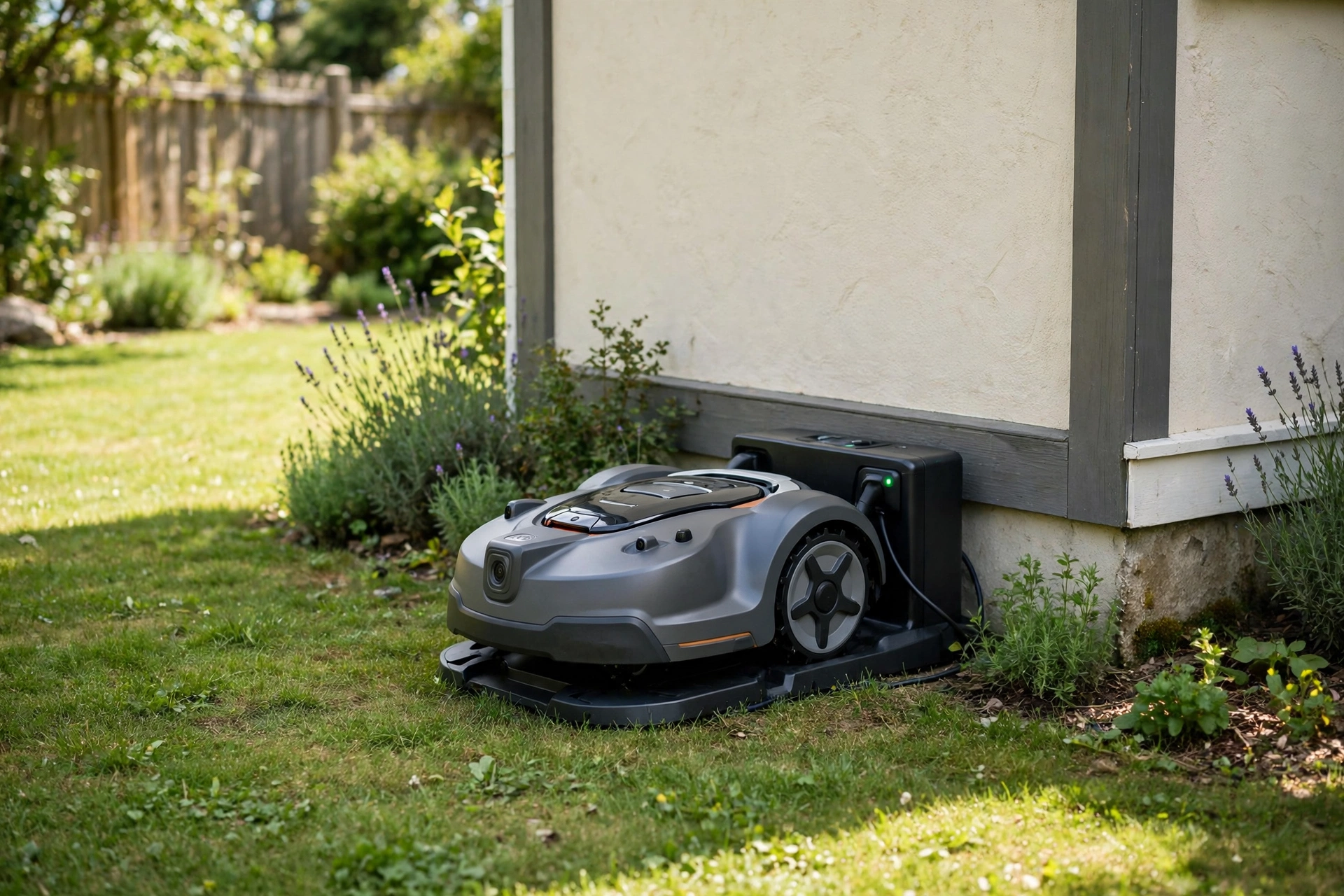
When the battery gets low, most robot mowers head back to their charging dock, usually by following the boundary wire or a guide wire back to the dock. Once charged, they go out again if their schedule says so. Some mowers run for an hour or two at a time, then charge for a similar period, repeating through the day until the lawn is done.
Rain sensors add another layer of common sense. Many mowers pause in heavy rain, because wet grass clumps, sticks to the blades, and can leave a mess. Some return to the dock and wait until the lawn dries a little. That is a useful feature, but it also means a wet week can leave the grass longer than usual, and you may need a manual tidy-up afterwards.
What are the limits of a robot lawn mower?
Robot mowers work best on fairly flat, open lawns with clear edges. Steep slopes can be a problem, because the mower may slip or struggle to climb, and wet slopes are worse. Very small or very complex gardens, with lots of narrow strips and tight corners, may also be hard for a mower to cover well, leaving patches you need to trim by hand.
Tall, thick, or weedy grass is another limit. A robot mower is a maintenance tool, not a clearing tool. If you have let the lawn grow wild, cut it down with a regular mower first, then let the robot keep it at that height. The same goes for leaves in autumn: a thick layer of leaves can block the blades, so clear the worst of them before running the mower.
You can compare its careful, slow approach with other working robots: How Do Warehouse Robots Work? and How Do Robot Arms Work?
For broader background, see Britannica’s robotics overview and Wikipedia’s robotic lawn mower article.
FAQs
How often should a robot lawn mower run?
Most owners run one several times a week during the growing season, rather than once a week. Frequent, light cuts keep the grass even and avoid stressing the lawn, but the exact schedule depends on grass type, weather, and lawn size.
Can a robot lawn mower work at night?
Some can, and they are quiet enough not to disturb most neighbours. Night mowing is still best avoided if hedgehogs or other wildlife use your garden, because the mower may not spot a small animal in the dark. Check the model’s guidance and local rules before setting a night schedule.
Do robot lawn mowers need much maintenance?
They need regular, simple upkeep: cleaning grass from underneath, checking and replacing the small blades when they dull, and keeping the charging contacts clean. The battery will also wear out over a few years and need replacing, which is worth factoring into the total cost.
Can a robot lawn mower handle a large lawn?
Larger models can, up to a point, by working in shifts with charging breaks. Very large lawns may need a bigger model or more than one mower, and complex layouts with many separate areas can still leave edges and corners for a hand trimmer.
Is a robot lawn mower safe around pets?
It is safer than a large petrol mower, thanks to small blades, bump sensors, and blade-stop features. Still, keep pets indoors or supervised while it runs, clear toys and bowls from the lawn, and never let a child ride on or pick up a running mower.
Conclusion: try the simple version first
A robot lawn mower works by staying inside a set boundary, snipping a little grass at a time, dodging what it can, and returning to charge when it needs to. It will not replace every garden tool, but for a fairly flat, open lawn it can take the weekly mowing chore off your list.
If you are thinking of buying one, a practical next step is to walk your lawn and note its slopes, narrow strips, low branches, and any areas where a wire or a clear sky view would be hard to arrange. That quick check will tell you whether a robot mower is a good fit, or whether a smaller lawn, a simpler layout, or a traditional mower is still the better choice.