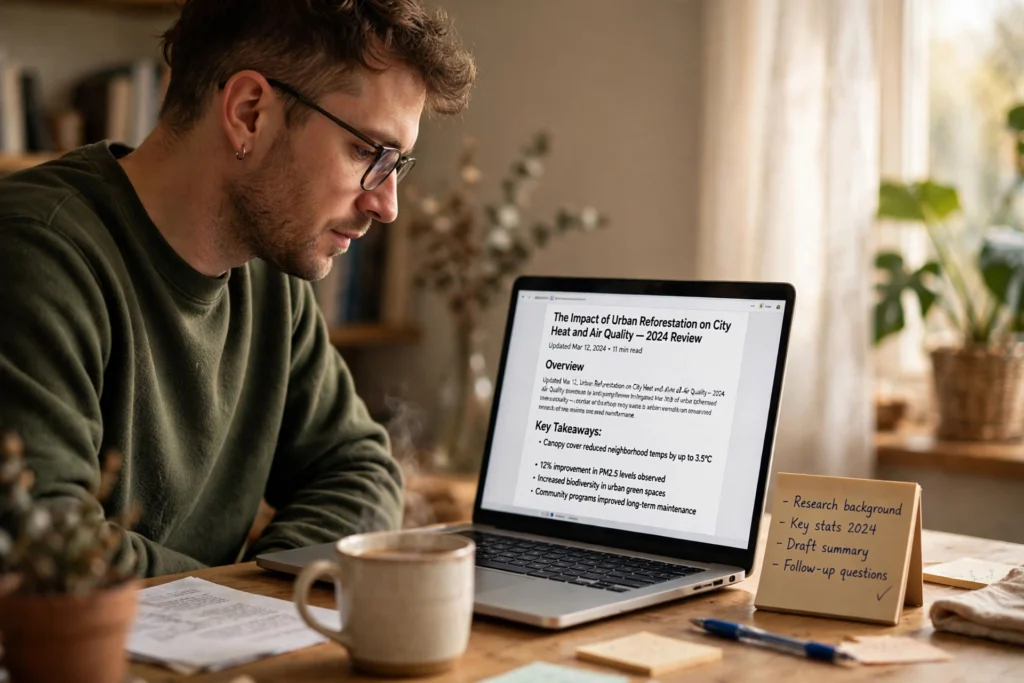
AI summarise text tools work by reading a whole document, deciding which ideas matter most, and rewriting them in far fewer words. They use language models trained on huge amounts of text, which learn how sentences connect and what a good summary sounds like. It is not magic — it is pattern recognition, applied at speed.
Key Takeaways
- AI summarise text tools either pick out the original sentences that matter most or write a fresh, shorter version in their own words.
- The best results come from models that understand context, not just count keywords.
- Summaries save time on articles, reports, and meeting transcripts, but they can drop nuance or invent details.
- A quick human check of numbers, names, and decisions catches most mistakes.
- Short, specific instructions (“three bullet points, focus on the decision”) beat vague ones.
What does “AI summarise text” actually mean?
When you ask an AI tool to summarise a piece of writing, you are asking it to compress meaning. A 5,000-word report becomes five bullet points; an hour-long meeting transcript becomes a list of decisions and next steps. The tool does not read the way you do — it has no curiosity and no real understanding — but it has seen so many examples of long texts paired with short versions that it can usually spot what a human reader would keep.
This sits inside natural language processing, the part of AI that deals with human language. Our guide to natural language processing explains how machines break sentences apart and work out what they mean. Summarisation is one of its most practical uses, and it leans heavily on large language models, the same engines behind chatbots and writing assistants.
What are the two main ways AI shortens text?
There are two broad approaches, and most modern tools mix them.
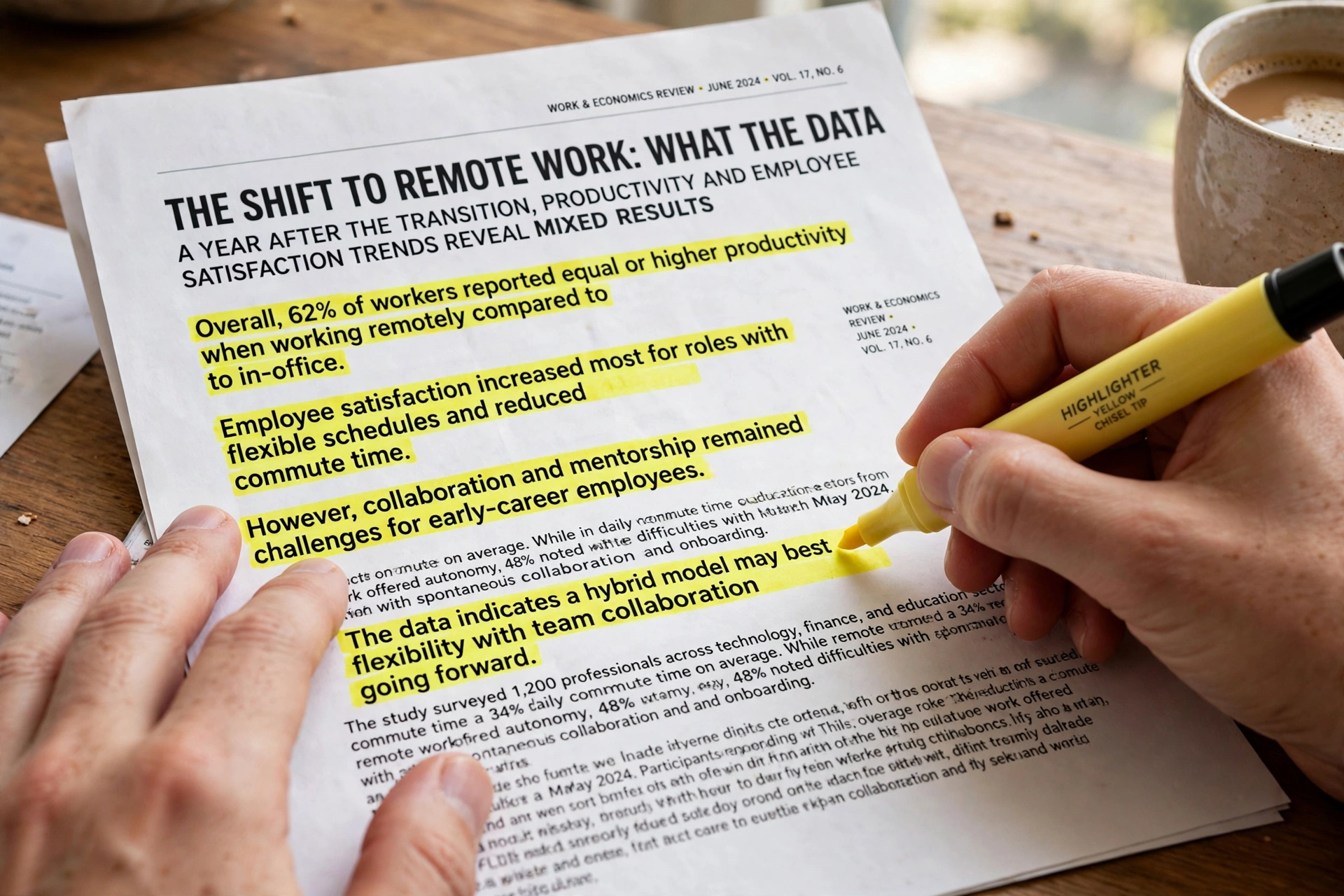
Extractive summarisation lifts sentences straight out of the original. The model scores every sentence for importance — key terms, position in a section, ideas that reappear through the document — then keeps the highest-scoring ones. Every word came from the source, so it is accurate by construction. The downside is that it can read like a patchwork: sentences pulled from different pages do not always flow together.
Abstractive summarisation writes something new. The model builds an internal picture of what the document says, then generates fresh sentences that capture it. This reads far more naturally and can merge ideas from several places into one sentence. The risk is that it can also add things: a model paraphrasing freely may invent a figure, swap a name, or state a conclusion the original never reached — the same hallucination problem that affects other AI writing, so summaries of important documents deserve a second look.
How does AI summarise a meeting?
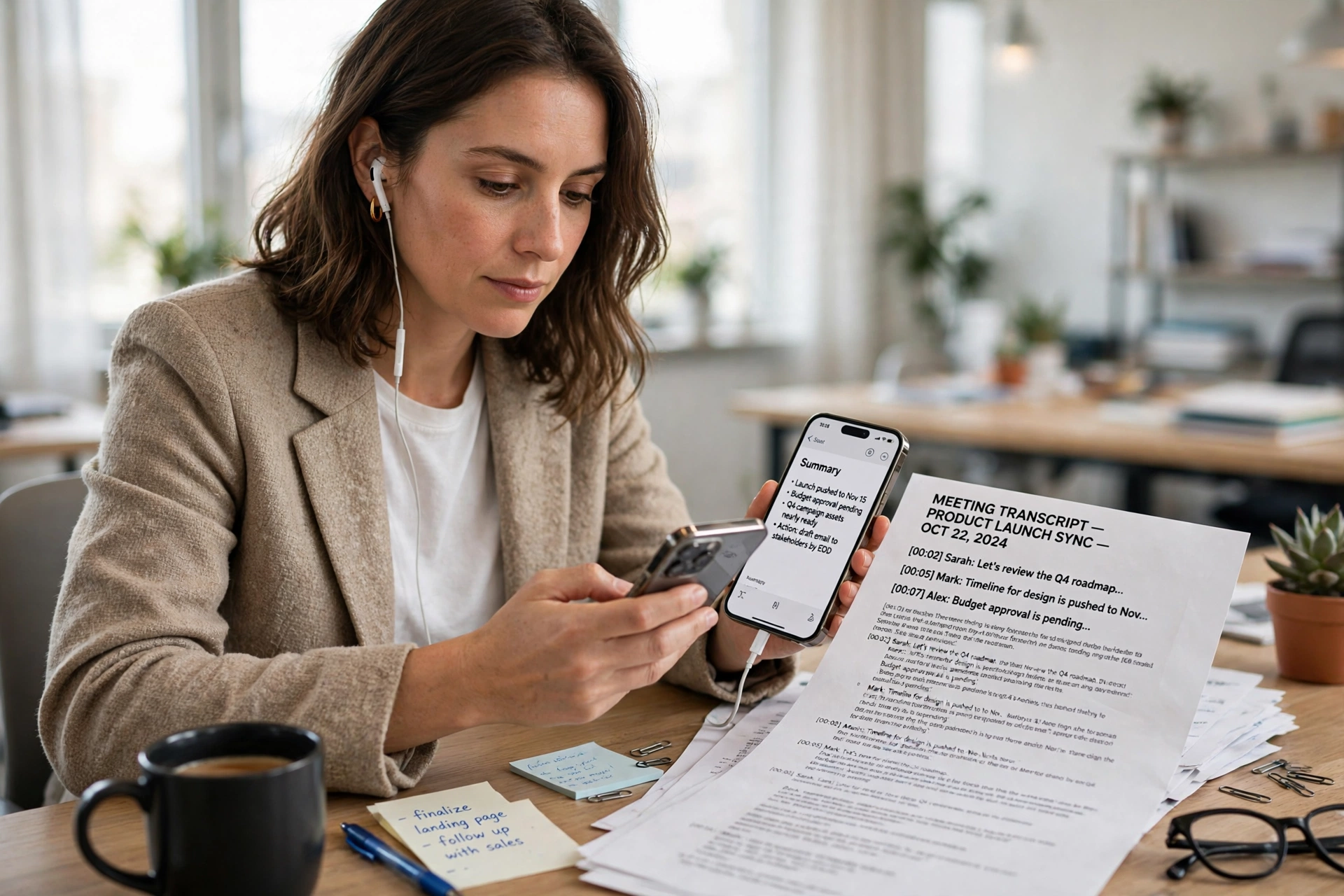
Meetings show off both the strengths and the limits of the technology. The process usually runs in two stages: first the audio is transcribed into text, then the transcript is summarised. Errors in the transcription — a misheard name, one speaker mixed up with another — flow straight into the summary.
A good meeting summary does three things: it records what was decided, it lists the actions and who owns them, and it notes anything explicitly left open. Where tools struggle is with the things people do not say outright: a decision that was implied rather than announced, or a disagreement that was smoothed over. A summary will often flatten those moments into something tidier than reality.
So treat the summary as a first draft. Skim it against the transcript or your own notes, check the action items and the numbers, and fix anything that looks off before you share it. For anything contractual or sensitive, read the original.
Where do AI summaries go wrong?
First, they can drop the caveat. A report that says “sales rose, but only in one region, and only because of a one-off contract” may come back as “sales rose” — true, but misleading.
Second, they can invent details. Abstractive models sometimes fill gaps with plausible-sounding facts: a date that looks right, a percentage that fits the tone. These errors are hard to spot precisely because they sound right, so numbers, dates, and names are the things to verify first.
Third, they can inherit bias from the source. If a document presents one side of an argument, the summary will usually present that same side — more confidently, because the counterarguments were cut for length. A summary is not a fact-check; it is a shorter version of whatever it was given. And very long documents can confuse even good models: information buried in the middle is more likely to be missed, so for long reports it often helps to summarise section by section.
How can you get a better summary from an AI tool?
Start with a clear instruction: what you want, how long it should be, and what to focus on. “Summarise this 20-page report in five bullet points, focusing on decisions and deadlines” will beat “summarise this” every time.
Next, check the output against the source for the facts that matter — figures, names, dates, and decisions. If the summary feels wrong, try again with a narrower instruction, or summarise the document in sections rather than all at once.
For a wider view, our complete guide to artificial intelligence covers the field from the ground up, and our explainer on retrieval-augmented generation shows how AI tools pull facts from documents before they answer. For the technical background, IBM’s overview of text summarization and the Wikipedia entry on automatic summarization explain the two approaches in more depth.
Frequently Asked Questions
Is an AI summary as reliable as a human one?
Usually close, but not identical. AI summaries are fast and consistent, and for straightforward material they are often very good. Humans are still better at judgement calls — what the author really meant, which caveat matters. For anything important, use the AI version as a draft and check it.
Can AI summarise a PDF or a scanned document?
A proper PDF with selectable text works well. A scanned image of a page needs character recognition first, and any errors in that step carry into the summary. If the scan is blurry or handwritten, expect mistakes.
How long should a summary be?
Roughly a tenth of the original for long documents, and a short paragraph for anything under a few pages. Shorter than that and you lose the reasoning; longer and you might as well read the original.
Do AI summarisers store or learn from my documents?
It depends on the tool. Some process your text and discard it; others may keep it to improve their service. Check the privacy policy before uploading anything confidential.
Can AI summarise videos or audio, not just text?
Yes — by transcribing the audio first and then summarising the transcript, which is exactly how meeting summarisation works. The same limits apply, so check the key facts before relying on the result.
Conclusion: A Practical Next Step
AI summarise text tools are genuinely useful: they turn long reading into a quick scan, and they let you decide in seconds whether a document deserves your full attention. They work best when you treat them as a first pass — a way to find the important parts — rather than as a replacement for reading.
Try it this week on something real. Take a long article or a meeting transcript, ask for a five-bullet summary focused on decisions, then check each bullet against the original. You will quickly learn where your tool is strong and where it needs watching.