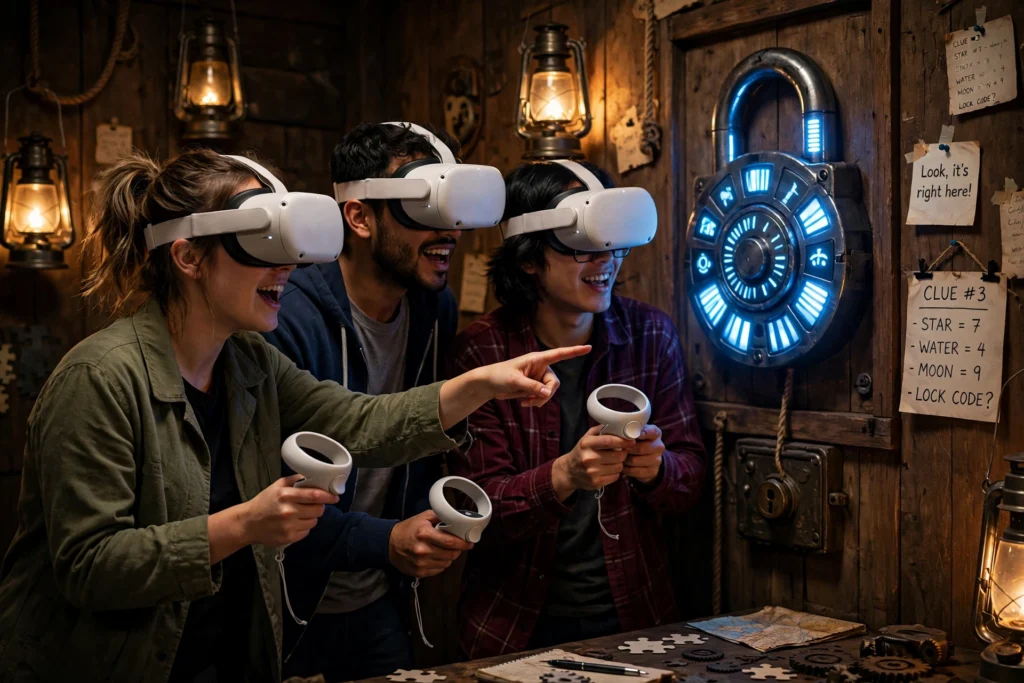
VR escape rooms put you and your friends inside a locked virtual space, where you search for clues, solve puzzles, and work together to get out before the clock runs out. Instead of a real room with physical props, the whole setting is built in software and shown through a headset.
Key Takeaways
- VR escape rooms replace physical props with a virtual world you explore through a headset and controllers.
- Tracking follows your head and hands, so you can look around, pick up objects, and press buttons.
- Most games last 45 to 60 minutes and suit two to six players working as a team.
- Puzzles mix searching, logic, codes, and teamwork, and hints are usually built in.
- Play at a VR arcade or at home on a standalone headset, with a clear, safe play space.
What is a VR escape room?
A VR escape room is a team puzzle game played inside virtual reality. You wear a headset, hold a pair of controllers, and find yourself in a place that only exists in software — a haunted house, a spaceship, or a detective’s office. Your job is the same as in a real escape room: find clues, solve puzzles, unlock doors, and reach the goal before time runs out.
The difference is scale. A physical escape room is limited by its building, while a virtual one can be any size, anywhere. Designers can change gravity, move walls, or hide a clue inside a painting, which is why escape rooms were one of the first kinds of game to feel natural in VR. Most games are cooperative: everyone sees the same world and shares what they find.
How does the headset turn a game into a room?
The trick is tracking. A VR headset follows your head many times a second, and the game redraws the scene to match. Turn your head, and the virtual room turns with you; crouch, and you can peer under a virtual table. That is what makes the room feel like a place rather than a screen.
Your hands are tracked too. Controllers act as your virtual hands, so you can grab a key, turn a dial, or pull a lever. Before you start, the headset asks you to draw a safe boundary on the floor, warning you if you step too close to the edge. For the fuller picture, our guide to how VR headsets work explains the screens, lenses, and tracking behind the illusion.
What kinds of puzzles will you find?

Most games mix a few familiar types. Searching puzzles ask you to look carefully: a code on the back of a painting, a key inside a drawer, a symbol under a rug. Searching feels physical — you actually bend down and look behind things.
Logic puzzles ask you to connect what you found. Maybe three symbols match three numbers on a safe, or a riddle tells you which lever to pull first. Code puzzles are the classic finish line: collect digits from around the room, then enter them into a lock. Team puzzles need two people at once, like pressing buttons on opposite sides of the room together. Most games also include a hint system — a nudge on screen or from a game master — so getting stuck is part of the fun, not a dead end.
Do you play alone or with friends?
You can do either, but the games are designed for groups of two to six players. Smaller groups get more to do each; larger groups need to split up and share what they find.
At a VR arcade, each player gets a headset, and everyone shares the same tracked space or plays from separate booths. Playing from home works too: standalone headsets can connect players over the internet, so friends in different houses can meet in the same virtual room. Voice chat is built into most games, so you can talk through puzzles just as you would in person.
Can you play a VR escape room at home?
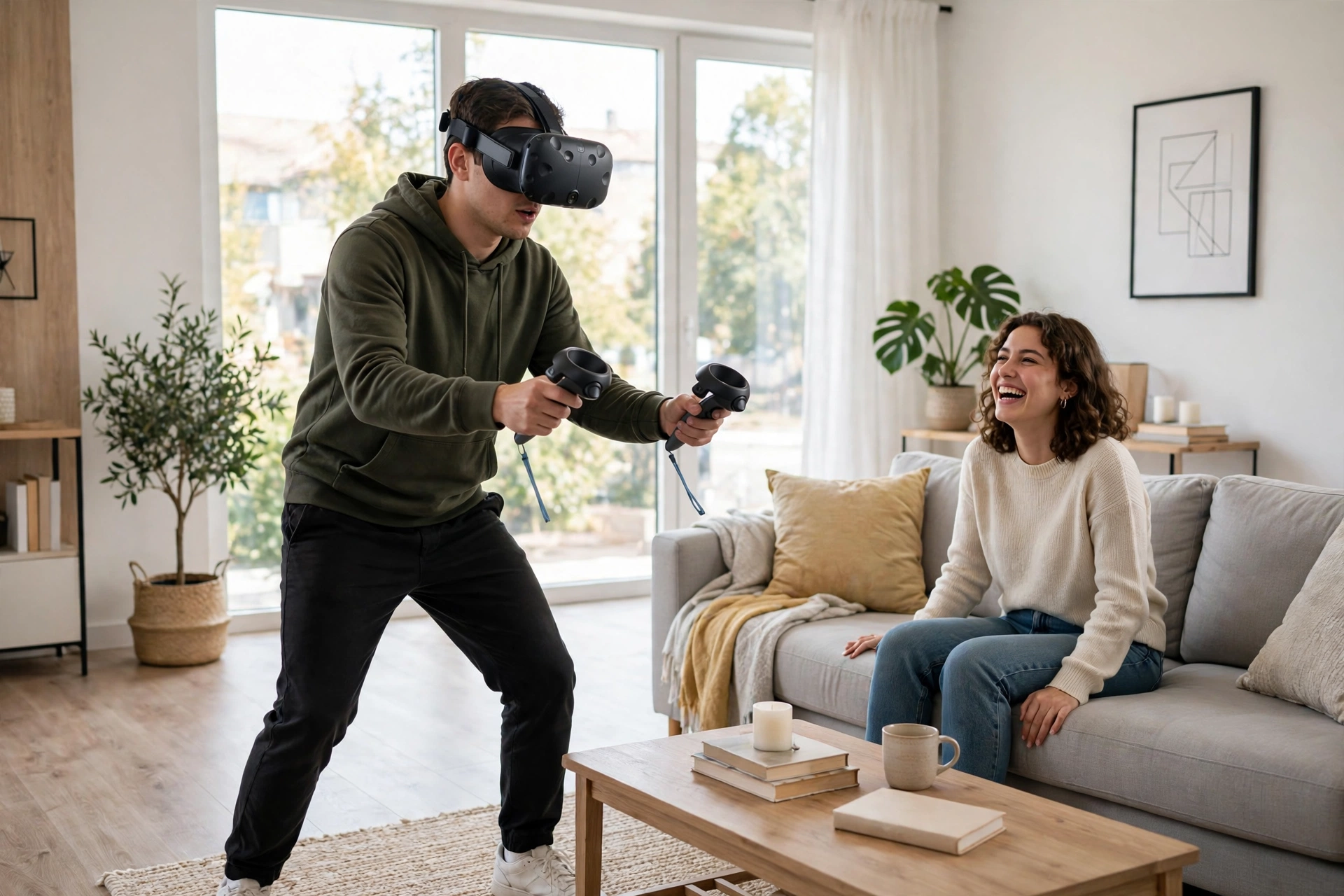
Yes, and it is one of the easiest ways to try one. Many standalone headsets have escape room games you can download and play in your living room. You need enough clear floor space to walk a few steps in any direction — most games ask for at least two metres by two metres — and you should move coffee tables and cables first.
Home games are usually shorter and cheaper than arcade sessions, and you can replay them with different friends. An arcade visit has its own appeal, though: larger tracked spaces, better headsets, and staff who set everything up for you. Our guide to how VR room mapping works explains how headsets keep track of your space, whether you are at home or in a venue.
Is a VR escape room safe?
For most people, yes, with a few simple precautions. The biggest risk is the room around you: you cannot see your real surroundings while the headset is on, so a clear play space and a set boundary matter most.
Motion sickness is the other common issue. Some people feel queasy when the virtual world moves but their body does not. If that sounds like you, choose a game with teleport movement instead of smooth walking, take breaks between rounds, and stop if you start to feel unwell — the feeling usually fades quickly once the headset comes off. Children should play with an adult nearby and stick to games rated for their age.
Frequently Asked Questions
Do I need to own a VR headset to play?
No. VR arcades and entertainment venues rent you a headset as part of the session, and staff help you set it up. Owning a headset only matters if you want to play escape room games at home.
How long does a VR escape room take?
Most games run 45 to 60 minutes, matching the format of physical escape rooms. Some home games are shorter, around 20 to 30 minutes, while larger venue games can run up to 90 minutes.
Can children play VR escape rooms?
Many games are family-friendly, but age guidance varies by game and by headset maker. Most makers suggest younger children play only with adult supervision and in short sessions. Check the game’s age rating before booking.
Is a VR escape room as good as a real one?
It is different rather than better or worse. Physical rooms have real props you can touch, while VR rooms can be any place at all and can change around you. Many players enjoy both, and VR is often the easier first step because it is cheaper and available at home.
What if I feel sick while playing?
Take the headset off and sit down. The queasy feeling usually passes within a few minutes. Next time, choose a game with teleport movement, turn down the movement speed, and keep your first session short.
Conclusion
VR escape rooms take a format people already love — a locked room, a ticking clock, a team of friends — and remove the limits of a physical space. The headset tracks your head and hands, and the game world can become anything the designers imagine.
If you have never tried one, start simple. Pick a friendly theme, gather two or three friends, clear a safe space, and choose a game built for your group size with simple grabbing-and-pointing controls and a good hint system. Talk out loud, share everything you find, and do not be afraid to ask for a hint when the group goes quiet. And if the escape-room bug bites, our guides to how VR headsets work, how VR controllers work, and how VR room mapping works will help you get more from every game, while our look at how VR works for theme parks shows where this shared virtual fun is heading next. For background, Britannica’s overview of virtual reality is a solid starting point, and Wikipedia’s escape room article explains how the physical games that inspired all of this first took off.