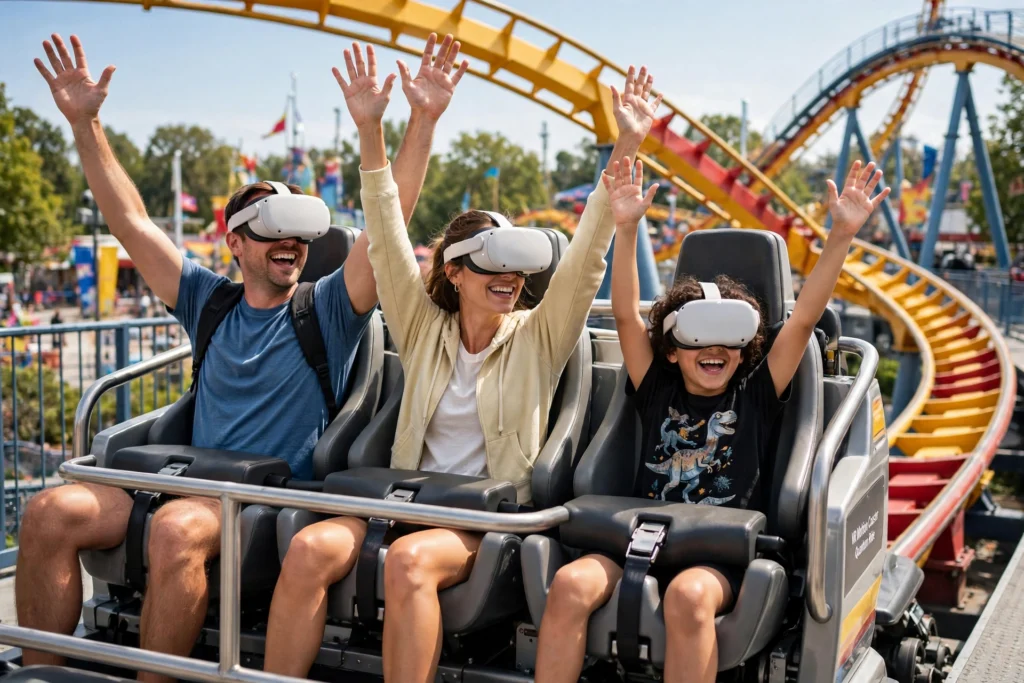
VR theme parks replace, or layer over, the real world on a ride. You wear a VR headset while a coaster, motion platform, or dark ride vehicle moves your body, and the picture is timed to match every drop, turn, and jolt — so one ride can take you through space or under the sea without leaving the park.
Key Takeaways
- A VR theme park ride pairs a headset with a moving vehicle or platform, so what you see and what you feel agree.
- VR coasters sync the virtual world to a real track, while dark rides and free-roam attractions use tracked spaces instead.
- Motion platforms, wind, sound, and vibration sell the illusion more than graphics alone.
- Queues, hygiene, and headset fitting are part of the ride, not an afterthought.
- If you get motion sick easily, shorter rides usually help, and some parks let you ride without the headset.
What makes a VR theme park ride different from a normal ride?
On a normal coaster, the thrill comes from the track itself: the height, the speed, the drops. On a VR coaster, the track is still doing the work, but your eyes are somewhere else entirely. The headset blocks out the park and shows you a filmed or computer-made world instead, so a gentle family coaster can feel like a dive through a canyon or a chase through a city.
That swap is the whole trick: one coaster can run several different virtual rides just by changing the film. A ride that feels tired in its tenth season can feel new again, and a park can re-theme the same track for Halloween or a film launch without rebuilding anything made of steel.
The idea dates back to the 1990s, when parks first tried headsets on motion simulators. What changed is the hardware: modern headsets are lighter, sharper, and cheaper, so parks can hand one to every rider. Britannica’s overview of virtual reality explains how the pieces fit together.
How do VR coasters match what you see with what you feel?
Timing is everything. If the picture shows a drop a half-second before your stomach feels it, the illusion falls apart. Parks solve this by tying the video to the train: sensors on the track or the train tell the ride computer exactly where each car is, and it plays the matching moment of the virtual film, frame by frame. Some systems adjust in real time, so if a train runs slower on a cold morning, the picture slows with it.
The headset’s own tracking helps too: turn your head and the view turns with you, because the headset measures head movement many times a second. That freedom is what makes the world feel like a place rather than a film strapped to your face.
Sound and wind do much of the work: speakers in the headrest, a fan as you “fly” faster, and a small jolt from the seat at the right moment. Parks often spend as much effort on these effects as on the picture itself.
What happens inside a VR dark ride?
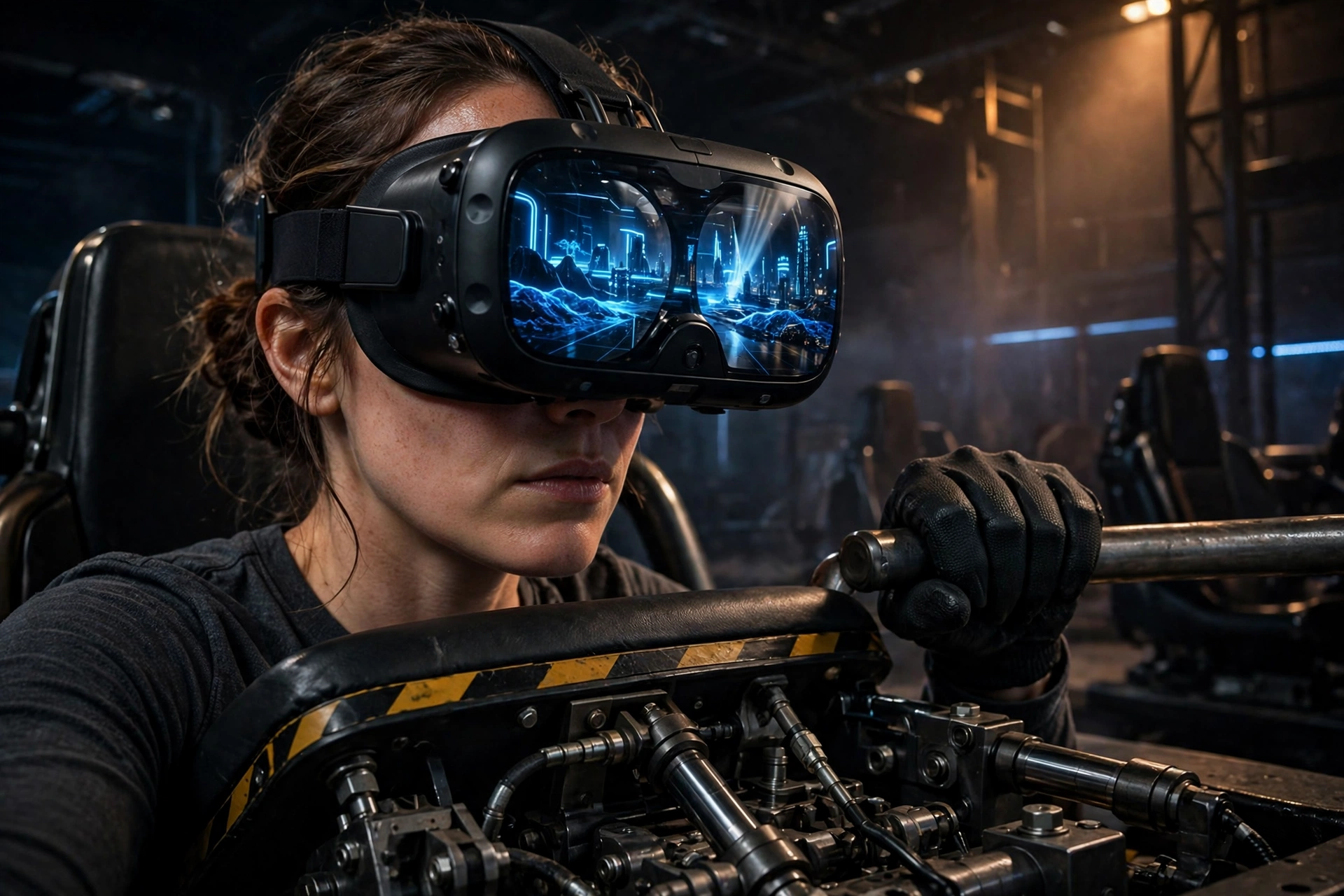
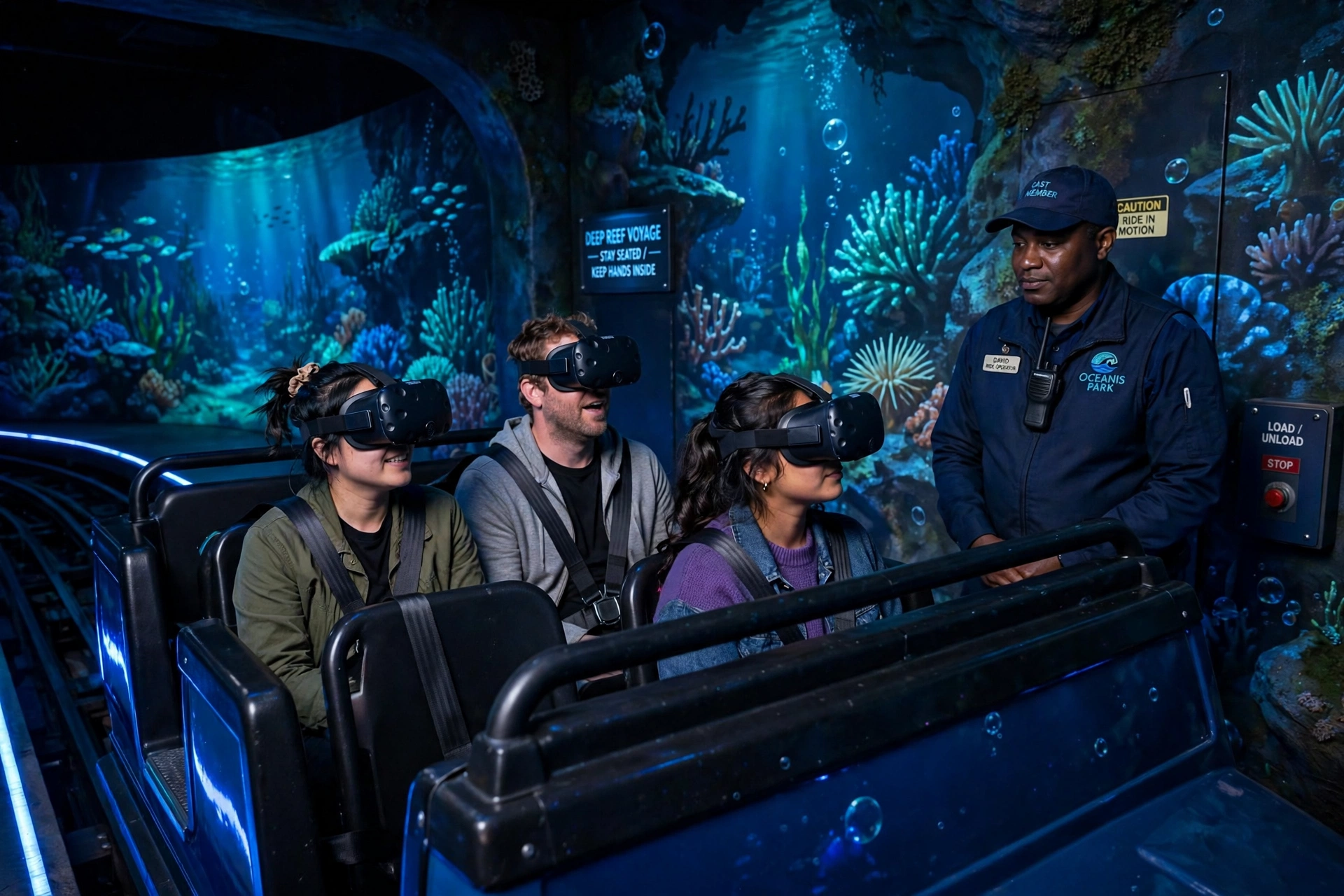
Dark rides suit VR well: the vehicle moves slowly through a dark building while headsets replace the scenery entirely. Because the path is controlled, the park can line up the virtual world with real props — reach out in VR to touch a wall and feel an actual textured panel, or feel a puff of air as a virtual creature flies past.
Loading is part of the design: staff hand out headsets, check the fit, and wipe them down between riders. A short safety film plays first, then the headsets switch on as the vehicle leaves the station. At the end, riders hand them back, and the next group is already waiting.
How do free-roam VR attractions track you?
Free-roam attractions drop the vehicle altogether. You walk through a real room wearing a headset and a tracking pack, and the virtual world is built to match the room’s shape. Walls in VR are walls in real life. Doorways line up. You can walk up to a table and lean on it.
This uses the same kind of room mapping as home VR, scaled up. Cameras or sensors around the room follow each headset and pair of controllers, working out where everyone is within a few millimetres. Some attractions add VR treadmills or low-friction floors so you can walk further than the room allows.
Groups make free-roam special: the system tracks everyone at once, so you can see your friends as avatars and work together on a task. It feels closer to a team game than a ride, which is why parks often place these attractions near arcades.
Why do some people feel sick on VR rides?
Motion sickness is the weak spot of every VR ride. It usually happens when your eyes and your inner ear disagree: your eyes say you are diving, but your body says you are sitting still. VR coasters suffer less than home VR, because the real motion matches the picture; problems start when the timing slips, the headset is loose, or the picture lags — which is why parks calibrate rides daily.
If you are prone to sickness, pick a shorter ride first, keep your head fairly still, and take the headset off between rides. A light meal beforehand helps some people, and if you start to feel unwell, close your eyes for a few seconds: without the picture, the mismatch usually settles.
FAQs
Do VR theme park rides make you dizzy?
Some people do, especially on longer rides or with a loose headset, but most riders are fine. VR coasters match real motion to the picture, which helps, and shorter rides with a snug fit usually reduce the risk.
Can you wear glasses on a VR ride?
Usually yes. Most park headsets fit over ordinary glasses, and staff can add a spacer for extra room. Very wide frames may not fit, so ask at the ride entrance before queuing.
Are VR rides safe for children?
Parks set their own age and height limits, and they vary a lot. Younger children may find the headset heavy, so check the signs at the entrance and start with the gentlest VR ride in the park.
What happens if the headset stops working mid-ride?
The ride keeps going, because the vehicle and the headset are separate systems. You will simply see the real world again, or a dark screen, until the ride ends. Tell the operator afterwards so the headset can be checked before the next rider.
Will VR replace normal theme park rides?
Probably not. VR works best as an extra layer on rides that already work, or as its own attraction. Plenty of guests still prefer the real wind, the real view, and no headset at all. Wikipedia’s article on virtual reality covers the technology’s uses across entertainment, training, and education.
Conclusion
VR theme parks work by pairing a headset with something real that moves: a coaster, a platform, or a tracked room. When the picture, the motion, and the effects all line up, your brain accepts the virtual world, and an ordinary ride becomes a trip somewhere impossible.
If you are visiting a park with VR rides, try the shortest one first, get the fit right, and pay attention to how you feel. Check the height limits before you queue, and ask for a fresh face pad if the headset looks worn. If it clicks, a whole set of worlds is waiting on the same tracks you already know.