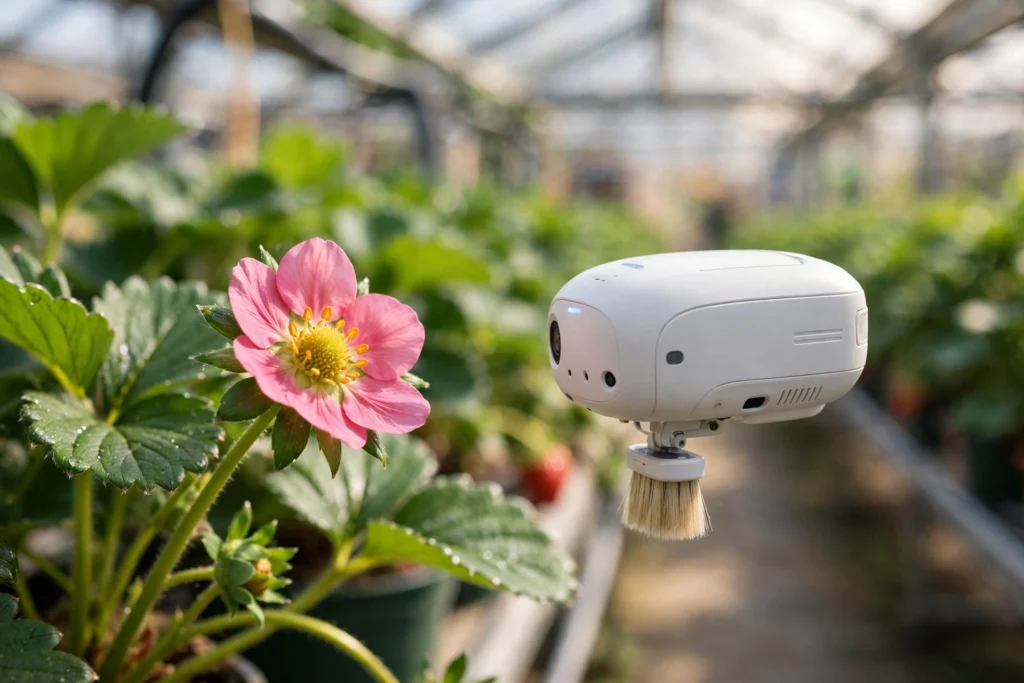
Pollination robots work by finding open flowers with cameras, collecting pollen with a soft brush or a puff of air, and carrying it to the next flower. Sensors and software guide each visit, so the robot touches only blooms that are ready. Most run in greenhouses and orchards, where they support bees and farm workers rather than replacing them.
Key Takeaways
- A pollination robot spots ready flowers with cameras, then brushes or blows pollen from one bloom to another.
- Most work indoors, in greenhouses and orchards, where rows are neat and the weather stays out of the way.
- They help where bees are scarce or hives cannot go, but they do not replace bees across whole farms yet.
- Battery life, speed, and cost still limit them, so they suit high-value crops first.
- For growers, the practical step is a small trial on one crop, not a full switch.
How does a pollination robot find a flower?
It starts with sight. A camera on the robot scans the plants as it moves, and software trained on flower shapes picks out blooms that are open and ready. Colour matters too: a fresh strawberry flower looks different from a closed bud or a fading petal, and the system learns to tell them apart.
Depth sensors add the third dimension. A flower might sit behind a leaf or hang at an awkward angle, so the robot measures distance before it reaches out. That keeps the arm from pushing through foliage or missing the bloom altogether.
Lighting makes the job harder. Greenhouses shift from bright sun to shade as clouds pass, and orchards throw dappled light across every branch. Some machines carry their own lights so the camera sees the same scene whatever the sky is doing.
How does it move pollen from one flower to another?
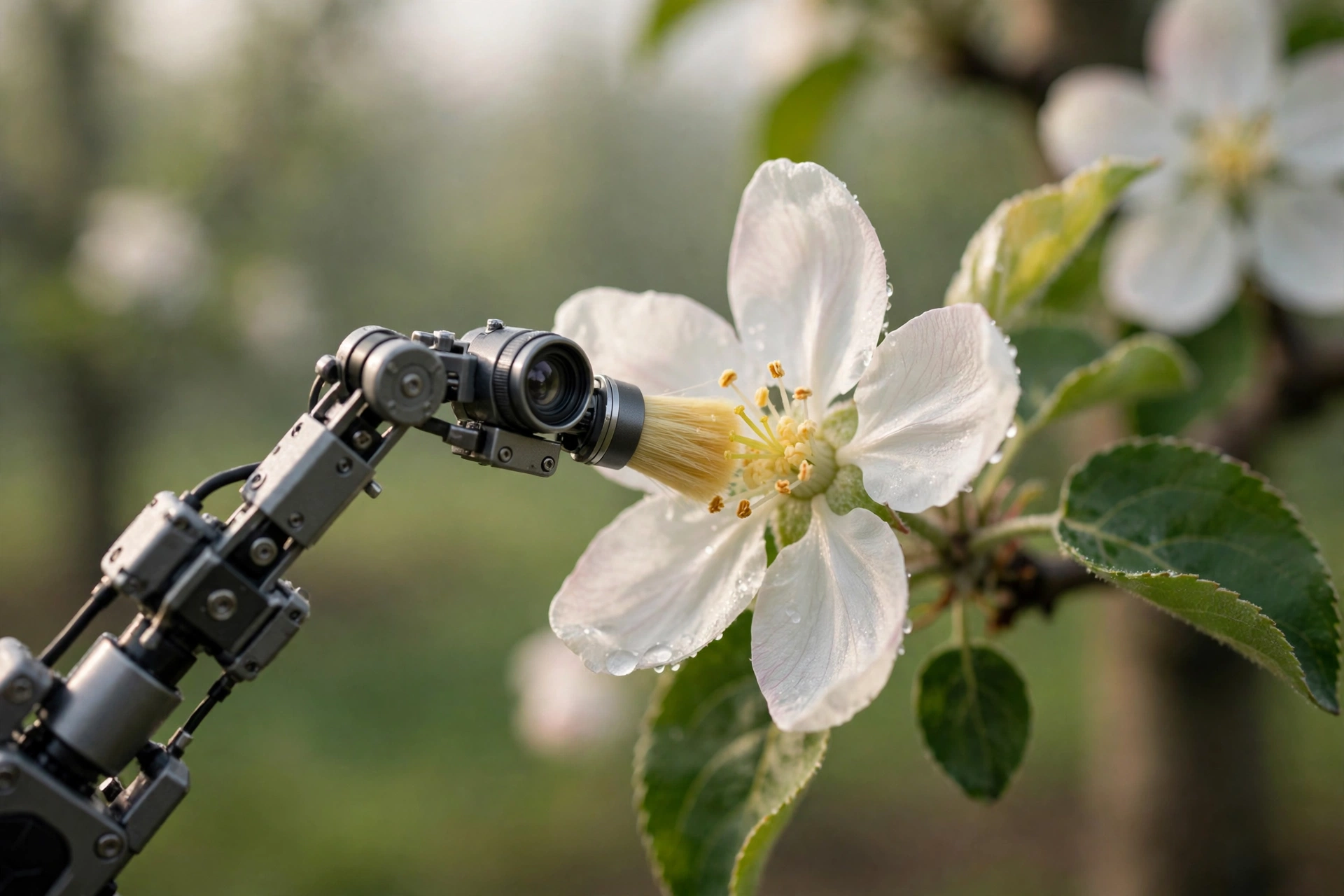
The simplest tool is a soft brush. It dabs the centre of one flower, picks up pollen on its bristles, and dabs the next flower, leaving some behind. The touch is deliberately gentle — a flower bruised by a stiff tool will not set fruit well, so the brush is softer than a paintbrush and the arm moves slowly.
Some designs use air instead. A short puff blows pollen off one bloom and onto another, which suits crops with light, dry pollen. Others shake the flower slightly, the way a bee’s buzz loosens pollen in tomatoes and similar crops. Software keeps a rough map of what has been visited, so each pass covers fresh flowers rather than repeating the same ones.
How does it move around a greenhouse or orchard?
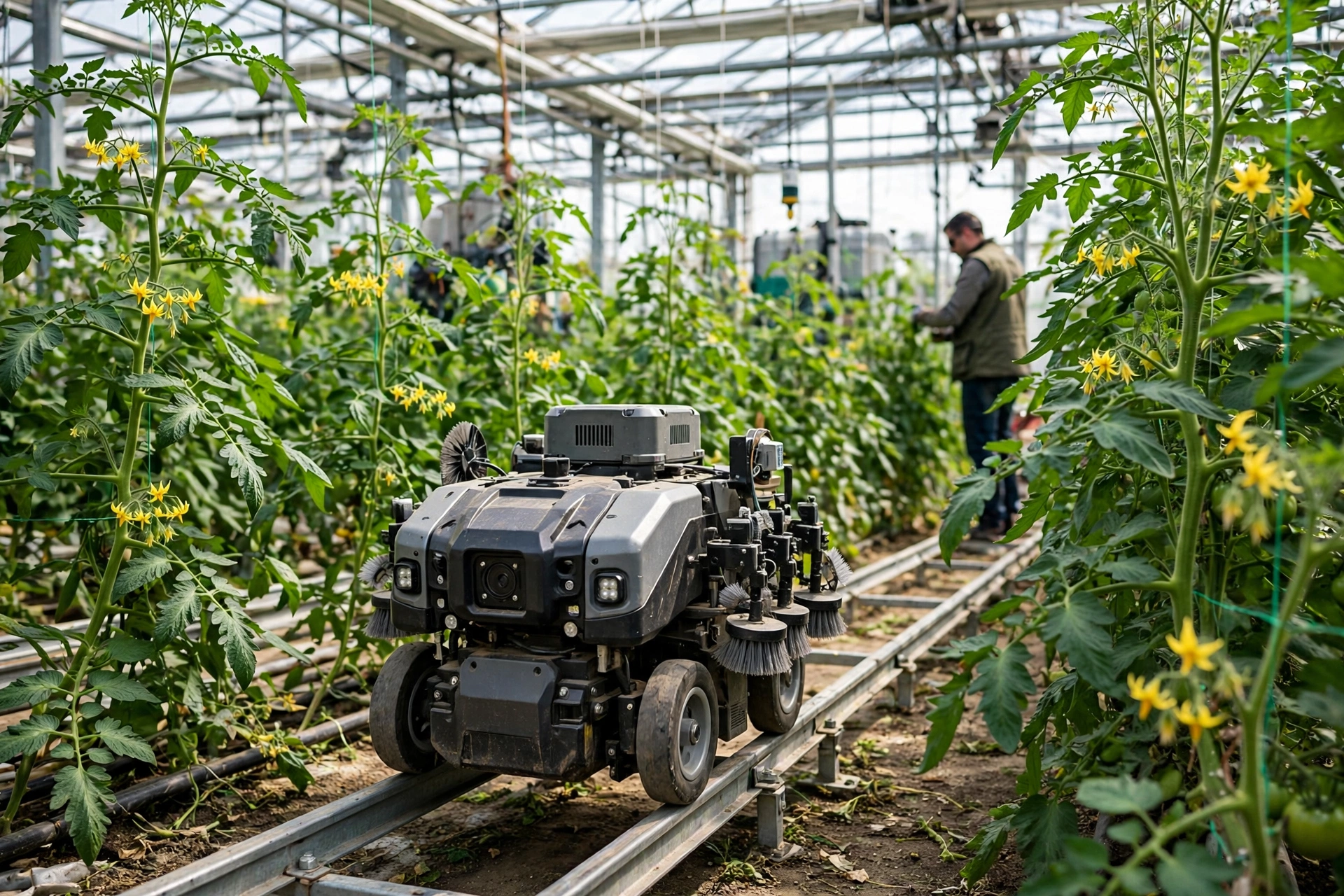
In a greenhouse, the robot often rides on rails. The rows are straight, the floor is flat, and a rail gives the machine a fixed path it can follow again and again. Some larger machines roll on wheels between the rows, steering with cameras and markers on the floor.
Outdoors, the job gets tougher. An orchard robot may drive between tree rows using GPS and wheel sensors, stopping beside each tree to work through the branches. Uneven ground, low branches, and mud after rain all slow it down, which is one reason most pollination robots still work indoors.
What powers a pollination robot, and how long can it work?
Most run on rechargeable batteries, like other farm robots. A greenhouse unit may work for a few hours before it returns to a charging dock. Rail-mounted units sometimes draw power from the rail itself, so they can keep going longer. Energy use stays modest because the work is slow and careful: the arm moves gently and the wheels turn at walking pace or less.
Why are farms trying pollination robots?
The honest answer is that pollination has become harder to guarantee. Bee numbers are under pressure in many regions, and hiring hives costs money and depends on beekeepers being available at exactly the right week. A greenhouse also shuts bees out by design, so growers inside already rely on bought-in bumblebee boxes or hand pollination.
Robots offer something bees cannot: a record. A grower can see which rows were visited and when, and plan around that. They also work at night and in weather that keeps bees inside, which matters when a crop’s flowering window is short.
What are the limits of pollination robots?
Speed is the first limit. A bee visits many flowers in a minute; a robot visits far fewer. That is fine in a greenhouse with a few thousand plants, but it struggles against the sheer scale of an open orchard in full bloom.
Weather is the second. Rain, wind, and dust all confuse cameras and slow wheels, so outdoor work stays limited to calm, dry days. Bees, for all their troubles, handle a breeze without needing a software update.
Then there is variety. A robot tuned for strawberry flowers may do poorly on apple blossom, because the shape, height, and spacing are all different. Each crop needs its own settings, and sometimes its own tool. That is why most machines still focus on one or two crops, and why they are best seen as a helper for specific jobs, not a stand-in for bees.
Frequently Asked Questions
Can pollination robots replace bees?
No, not yet. They work well in greenhouses and on specific crops, but they are slower than bees and cannot cover large open fields during a short flowering season. Most growers use them alongside bees, not instead of them.
Which crops use pollination robots today?
Greenhouse strawberries and tomatoes are the most common, with trials running on apples, kiwis, and other fruit. These crops have high value per plant, which helps justify the cost of the machine.
How accurate are pollination robots?
They are careful rather than fast. Cameras and depth sensors help them find open flowers and avoid damaging them, but they can miss blooms hidden behind leaves. Growers usually check fruit set afterwards to judge whether the robot did enough.
How much does a pollination robot cost?
Prices vary widely by size and crop, and many suppliers sell pollination as a seasonal service rather than a machine to own. A grower considering one should ask for a trial on their own crop before committing.
Conclusion
Pollination robots show how farm machines are getting gentler and more precise: cameras find the flower, a soft brush or puff of air moves the pollen, and sensors keep track of what has been done. They already help in greenhouses, and orchard trials are catching up. Their limits — speed, weather, and one-crop focus — mean bees still do most of the work, and that is likely to stay true for a while.
If you grow fruit under cover, the practical next step is a small trial: pick one crop, one greenhouse row, and one flowering season, and compare fruit set with your usual method.
Related reading: see how agricultural robots work across the field, how fruit picking robots handle delicate produce, how seeding robots place each seed, and how weeding robots tell crops from weeds.
Further reading: Wikipedia’s RoboBee article covers Harvard’s tiny flying-robot research, and Wikipedia explains how pollination works in nature.