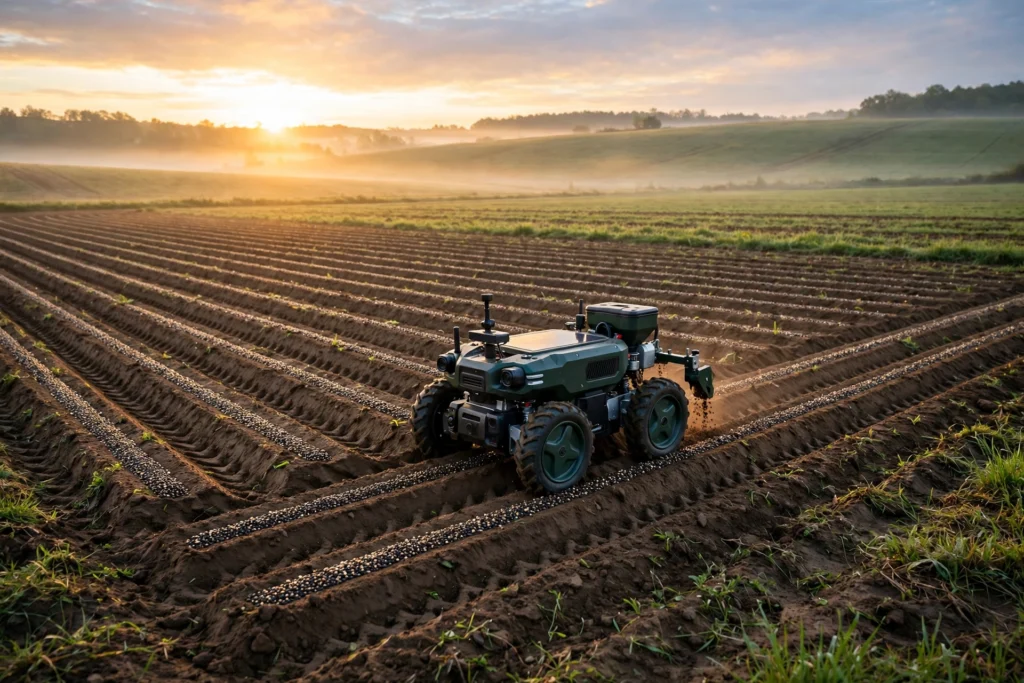
Seeding robots are self-driving machines that plant seeds in straight, evenly spaced rows without a driver in the cab. They use satellite navigation to steer, sensors to read the soil, and a metering unit to drop one seed at a time at the right depth — so a field gets sown more evenly, with less seed wasted.
Key Takeaways
- A seeding robot drives itself along planned rows, placing seeds at a set depth and spacing.
- GPS and ground sensors keep the rows straight, even on uneven ground.
- A metering unit releases seeds one at a time, so fewer seeds are wasted.
- Soil sensors check moisture and firmness before each seed goes in.
- The robots suit flat, open fields best and still need a person to plan and check them.
What does a seeding robot actually do?
A seeding robot does the job a farmer once did with a seed drill pulled behind a tractor — but on its own, and with far more precision. It crosses a field in straight lines, opens a narrow furrow, drops a seed in, covers it, and moves on.
Most seeding robots are smaller and lighter than a tractor, and that is deliberate. A heavy machine squashes the soil, making it harder for young roots to grow. A light robot leaves the ground looser, and with no cab or steering wheel, more of its power goes into planting. The farmer still sets the plan — which crop, which field, how deep, and how far apart.
How does a seeding robot know where to plant?
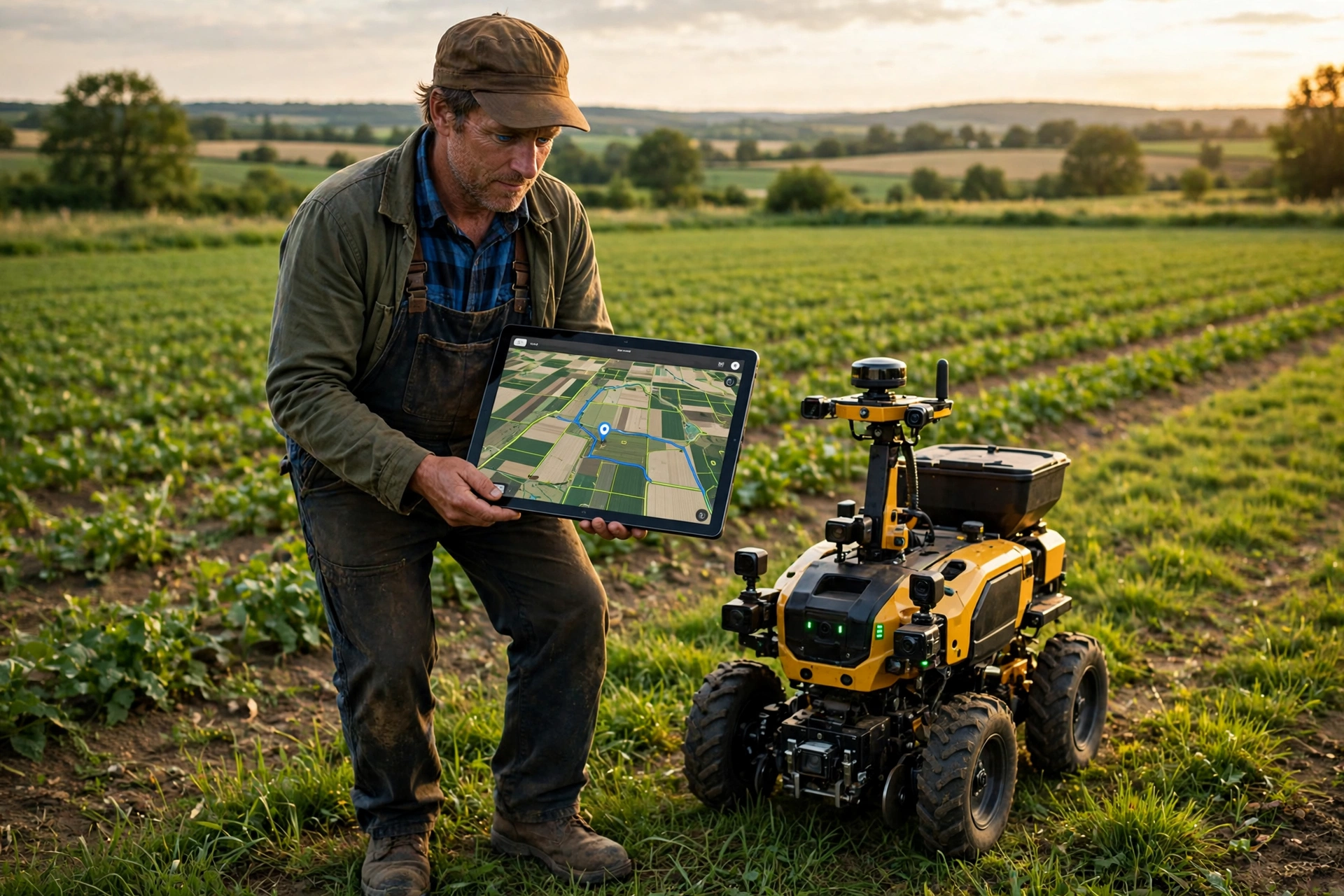
The short answer is GPS, but not the kind in a phone. Seeding robots use a corrected satellite signal that is accurate to a few centimetres, sharpened by a base station at the field’s edge or a correction service sent over the mobile network.
GPS alone is not enough, since signals can drop out under trees or near tall buildings. So most robots carry back-ups: wheel sensors that count how far they have rolled, a compass and gyroscope that track direction, and cameras that spot the previous row and follow it. When the pieces agree, the robot trusts its position; when they don’t, it slows down or stops and waits for help.
How does it place each seed at the right depth?
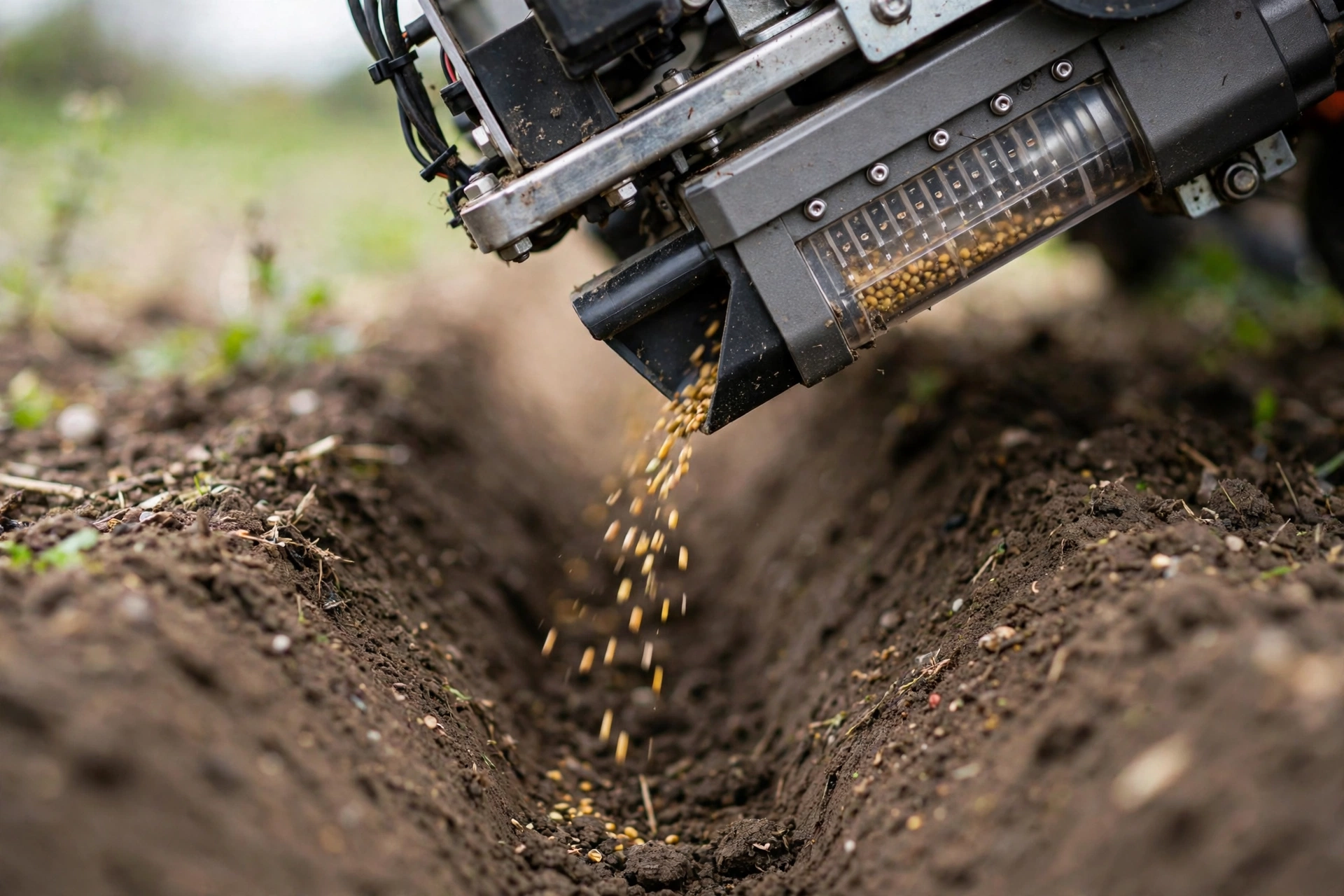
Inside the robot, seeds sit in a hopper. A metering unit — often a rotating disc with small holes, or a set of air-powered tubes — picks up seeds one at a time and releases them into the furrow at set intervals.
Depth matters just as much. A seed buried too deep may never reach the surface; one left too shallow can dry out before it sprouts. The robot opens the furrow with a small disc, and a depth wheel rides along the ground to hold the opener at the right height.
What sensors does a seeding robot use?
Each sensor answers a different question. The GPS receiver fixes its position. Wheel sensors measure distance rolled and whether the wheels are slipping. Soil moisture sensors check if a patch of ground is wet enough for a seed. Cameras watch for the last row, a stone, or an obstacle ahead. Bump and tilt sensors warn if it has hit something or is leaning too far on a slope.
What happens when the ground is wet, rough, or uneven?
Real fields are rarely as tidy as brochure photos. After rain, soil turns sticky and wheels can slip. On rough ground the robot bounces, and a bouncing opener plants seeds at uneven depths.
Good seeding robots are built for this. Their wheels are wide or tracked to spread the weight, and the planting unit floats on springs so it can follow the bumps instead of fighting them. If the wheels slip, the robot notices the mismatch between what the wheels report and what the GPS says, and slows down rather than spinning in place and tearing up the ground.
How is a seeding robot different from a tractor with GPS?
Modern tractors can already steer themselves along GPS lines, so it is fair to ask what a seeding robot adds. The answer is size, weight, and the ability to work without a person on board. A tractor with GPS still needs a driver sitting in it, even if the driver is not steering. A seeding robot needs nobody in the field at all, which frees the farmer for other jobs while planting happens.
The robot’s small size helps too. It can work in wet conditions that would bog down a heavy tractor, and it can plant in narrow strips or awkward corners a big machine cannot reach.
What are the limits of seeding robots today?
Seeding robots are real and working, but they are not yet the default on most farms. First, cost: a capable machine is a serious purchase for a small farm, and the savings in labour and seed take time to add up. Second, reliability: dust, mud, and vibration are hard on electronics, and a breakdown in planting season is stressful. Third, they handle standard row crops well but struggle with unusual seed shapes, very small plots, or fields full of stones and stumps.
FAQs
Do seeding robots work at night?
Some can. They carry lights and rely on GPS and sensors rather than daylight, so darkness alone does not stop them.
Can a small farm use a seeding robot?
It depends on the farm. The machines suit regular, open fields with standard row crops.
What crops can seeding robots sow?
Most handle common row crops such as wheat, maize, lettuce, carrots, and beans.
Do seeding robots replace the farmer?
No. They take over the repetitive driving and dropping, but the farmer still plans the field, chooses the crop and spacing, checks the early rows, and fixes problems.
How much seed do seeding robots waste?
Less than older methods, because the metering unit drops one seed at a time at set spacing instead of scattering seed by the handful.
Conclusion
Seeding robots work by combining accurate satellite navigation, soil sensors, and a precise metering unit to place each seed at the right depth and spacing, row after straight row. They are lighter and more careful than a tractor, they can work without a driver on board, and they build a useful map of the field as they go. They are not cheap, and they are not suited to every field, but for flat, open farmland they already do a solid, dependable job.
Seeding robots are one part of a wider family of agricultural robots. Weeding robots keep the same rows clean after planting, fruit picking robots handle the harvest, milking robots look after cows in the dairy, and robot arms do the lifting and packing — each one built on similar robotics, guidance, sensors, and gentle handling for a different job on the farm.