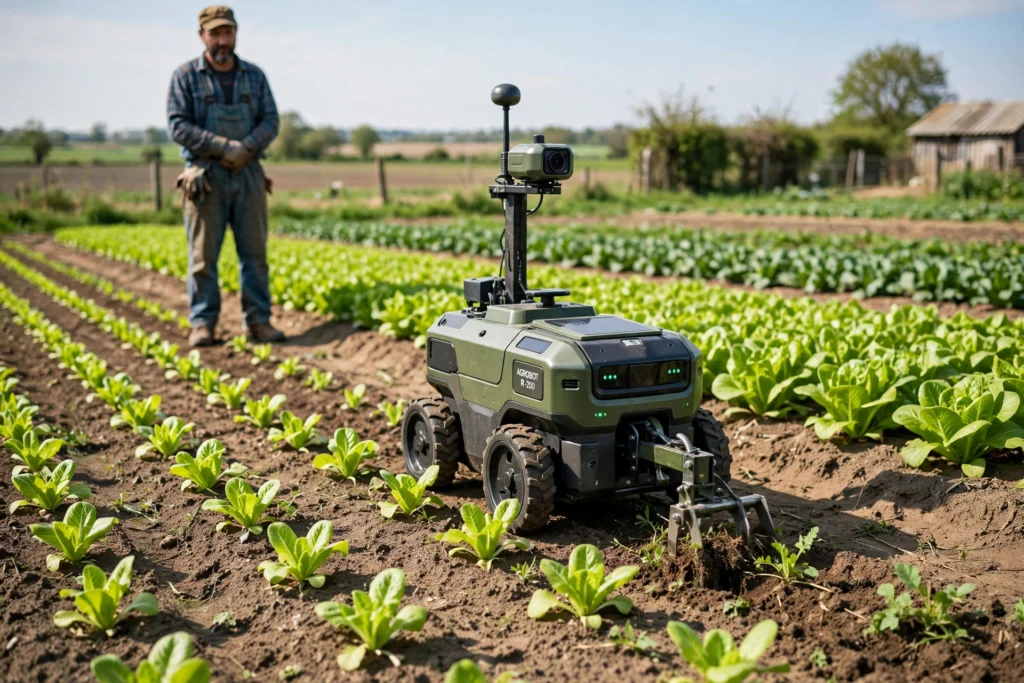
A weeding robot drives slowly along crop rows, photographs the plants ahead of it, and works out which ones are crops and which are weeds. It then removes only the weeds — by pulling, cutting, or zapping them with heat or light — while leaving the crop untouched, cutting hand weeding and chemical sprays.
Key Takeaways
- A weeding robot uses cameras and software to tell crops apart from weeds as it moves along a row.
- Weeds are removed mechanically or with targeted heat or light, so far less chemical spray is needed.
- GPS, wheel sensors, and row-following cameras keep the robot on track between the plants.
- These robots work best in neat, evenly spaced rows and on fairly flat ground.
What Is a Weeding Robot?
A weeding robot is a small self-driving machine built for one job: keeping weeds out of a crop without a person walking the rows with a hoe. Most are about the size of a suitcase, with four wheels, a battery, cameras, and a weeding tool underneath or at the front. Some are towed behind a tractor, but the ones most people mean today drive themselves.
Weeds steal light, water, and nutrients from the crop, and a thick patch can drag a harvest down. The usual answers are hand weeding, which is slow and tiring, or spraying the whole field, which many growers would rather use less of. A weeding robot sits in the middle: it deals with weeds one plant at a time, only where they actually are. It belongs to the same family of farm machines as agricultural robots, and it shares the gentle handling ideas behind fruit picking robots. Britannica’s robotics overview explains the sensors and control systems these machines share, and Wikipedia’s agricultural robot guide lists weed control among the main farm uses.
How Do Weeding Robots Spot the Difference Between a Crop and a Weed?
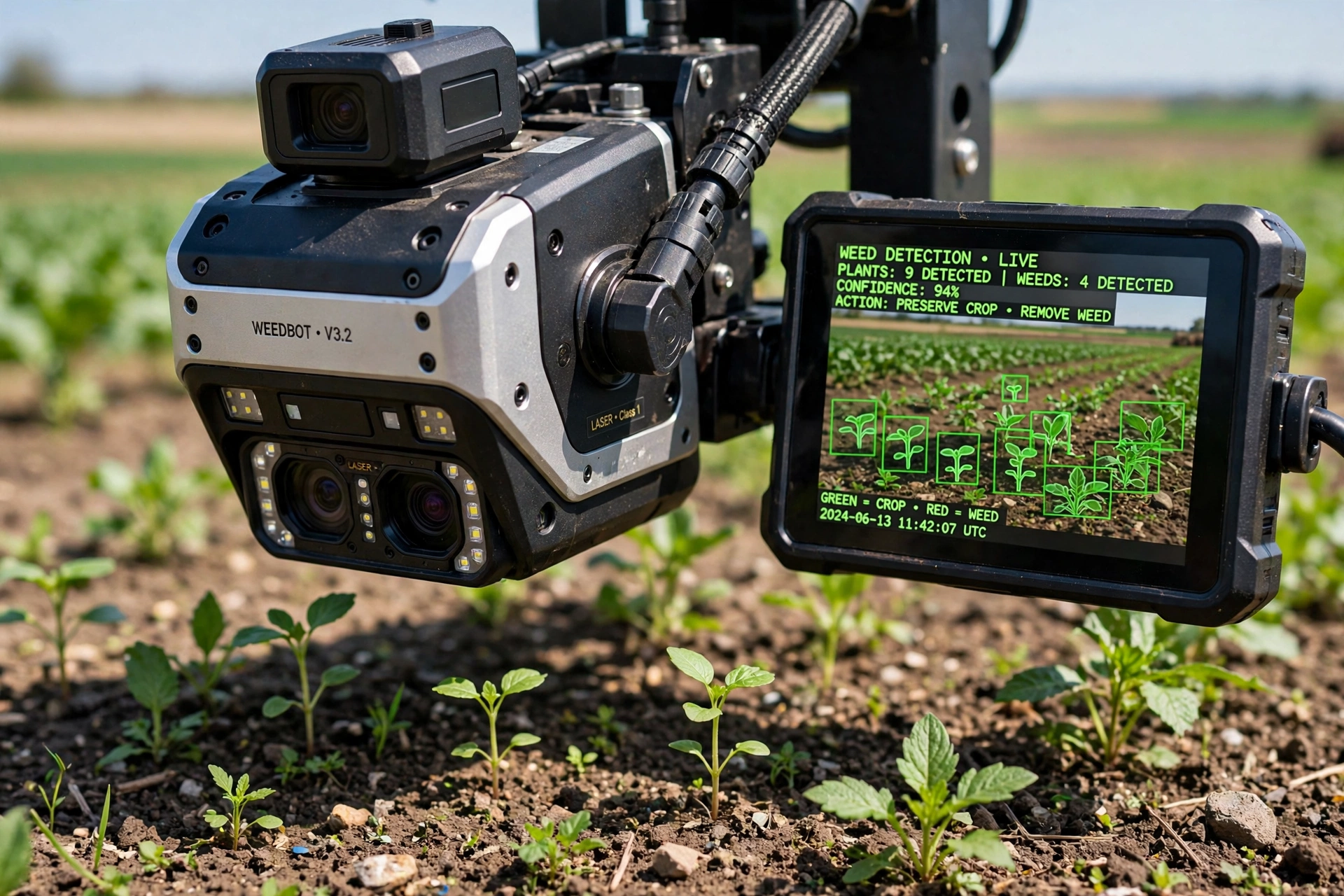
This is the clever part, and it is what decides whether a weeding robot is any good. Its cameras photograph the ground several times a second. Software then looks at each plant’s shape, size, leaf pattern, and position in the row, and compares it with what it has learned a crop seedling looks like.
Row crops make this much easier. When lettuce or carrots are planted in straight, evenly spaced rows, anything growing between the rows is almost certainly a weed, and anything sitting in the row at the expected spacing is probably the crop. The robot also learns the look of common weeds, so it can spot one growing right next to a crop plant.
It is not perfect. A weed that looks a lot like the crop can confuse it, so most robots are cautious: if they are not sure, they leave the plant alone rather than risk pulling out a crop. Farmers can also train the system with pictures of their own crops and weeds, which sharpens its judgement over a season.
How Do Weeding Robots Remove Weeds Without Chemicals?
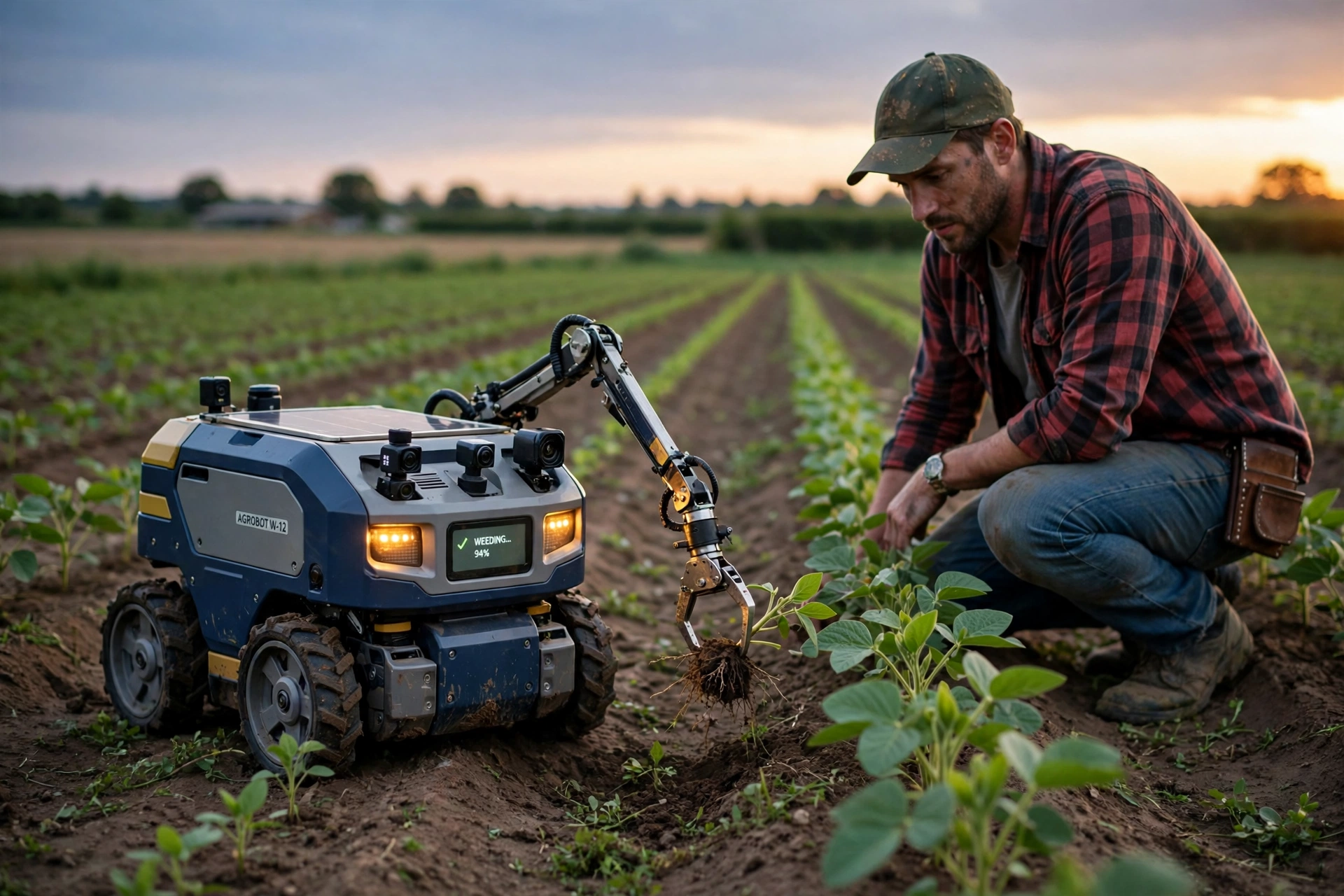
Once the robot has marked a weed, it has to get rid of it. Mechanical weeders use small blades, hoes, or fingers that stir the top layer of soil and uproot the weed, or a gripper that pulls it out by the roots. This is the oldest approach and it works well on soft, young weeds in loose soil.
Other robots use heat. A short, focused burst from a laser or a hot plate wilts the weed in a fraction of a second, without disturbing the soil around it. Laser weeders are precise enough to work close to a crop seedling, which is why they have become popular for lettuce and other leafy crops. A third method uses a tiny, targeted drop of spray, applied only to the weed leaf rather than across the whole field. It still uses a chemical, but far less than blanket spraying.
Each method has trade-offs. Blades are cheap and simple but struggle in wet or stony soil, while lasers are precise but need a lot of power and a clear sight of the weed. The right choice depends on the crop, the soil, and how bad the weed pressure is.
How Do Weeding Robots Move Around a Field?
A weeding robot needs to know exactly where it is, down to a few centimetres, or it would wander into the crop. Most use satellite positioning, the same kind of GPS that guides tractors, often with a correction signal that makes it accurate enough to stay between rows. Wheel sensors measure how far the robot has travelled, and cameras watch the crop rows to keep the machine centred.
The farmer enters the field layout — row spacing, row length, and where to turn around — and the robot follows that plan, stopping at the end of each row to turn and start the next one. The same navigation ideas guide warehouse robots between shelves indoors, just as they guide this machine between rows outdoors. If it meets an obstacle, such as a rock or a person, its sensors tell it to stop and wait. Many models also send updates to the farmer’s phone, so the operator can see how much of the field is done.
That slow pace is deliberate. A weeding robot covers far less ground per hour than a tractor with a sprayer, so it suits farms that value precision over speed, or that run the robot often so weeds never get big.
What Are the Limits of Weeding Robots?
Weeding robots are useful, but they are not a magic fix. Uneven ground, deep ruts, and steep slopes can throw off their steering or block their cameras. Tall crops block the view of the ground, so most robots are designed for low crops such as lettuce, carrots, onions, and sugar beet rather than maize or tall cereals.
Weather matters too: heavy rain turns soil to mud, which clogs wheels and tools, and low light makes the cameras work harder. Some robots carry their own lights so they can keep going after dark, but fog and dust still reduce what they can see. Cost is another real limit — these are specialised machines, and for a small grower the price can be hard to justify. That is why many farms start by hiring a weeding robot service for a season, or sharing one between neighbouring farms, rather than buying one outright.
Are Weeding Robots Worth It for a Small Farm?
For a small farm, the answer depends on what weeding costs you now. If you pay a crew to hand-weed beds of salad leaves several times a season, a robot that handles the routine passes can free that crew for harvesting and other skilled work. The strongest case is for organic growers and farms trying to cut chemical use; the weakest is a farm with rough, sloping ground, tall crops, or very mixed planting. Like robot arms in a factory, a weeding robot earns its keep by doing one repetitive job reliably, not by doing everything.
FAQs
Do weeding robots use any chemicals at all?
Most do not. Mechanical and laser weeders remove weeds without chemicals. A few models use micro-dosing, which applies a tiny drop of spray to a single weed, but that is still far less chemical than spraying a whole field.
Can a weeding robot damage the crop?
It can, but it is designed not to. The robot leaves any plant it is unsure about, and its tools are sized to work in the gaps between crop plants. Damage usually happens when rows are uneven or seedlings are planted at irregular spacing.
How fast does a weeding robot work?
Slowly, compared with a tractor. It moves at walking pace or less, because its cameras need time to identify each plant. That suits regular passes on a market garden, but not clearing a large field in one afternoon.
Do weeding robots work at night?
Some do. Models with their own lights can work after dark, which helps where daytime hours are full, and night work avoids the harsh shadows that can confuse cameras at midday.
Can one robot handle different crops?
Only if it has been trained on them. A robot set up for lettuce will not automatically know what a carrot seedling looks like. Most makers supply crop profiles, and the farmer can add new ones by showing the system labelled pictures of the crop and its weeds.
Conclusion
Weeding robots work by combining simple ideas — cameras, careful steering, and a small weeding tool — into a machine that treats weeds one plant at a time. They are not the fastest way to clear a field, and they do not suit every crop or every piece of ground, but for neat rows of low crops they can cut weeding labour and chemical use in a real way. If you are thinking about one, trial it on a single bed first and let that season’s results decide whether it earns a permanent place on your farm.